The Digital Hook: How Social Media Feeds Teen Drinking Culture
By Adebowale Bello. B.Tech Microbiology. DLHA Fellow. Medically reviewed by the DLHA Team.
June 22, 2026.
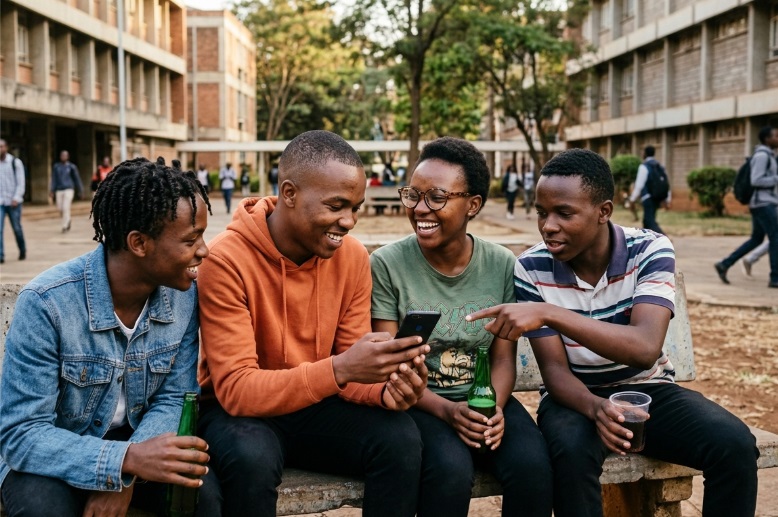
An image of four young Africans seated and having happy moments together against a busy college campus background. They are focused excitedly on a smartphone held by one of them, while the others hold bottles and a glass of alcohol. Image Credit: Gemini AI. Click on image to enlarge.
For many teenagers, the phone is where they learn trends, follow celebrities, watch entertainment and form opinions about what is happening around them. This makes their phones more than just a device. However, as they surf the Internet, scrolling through engaging content, they do come across clearly obvious or subtly disguised content about alcohol.
From lifestyle posts to influencer videos and commercial adverts, alcohol is increasingly present in teen digital feeds. A new study has shown just how deep this exposure goes and how it may quietly shape teens attitudes towards drinking.
The study focused on high school students with an average age of 16 years and examined how often they encounter alcohol-related content on their smartphones. Instead of asking students to recall what they had seen weeks or months later, the researchers used a real-time method known as Ecological Momentary Assessment. This approach captured what teenagers were exposed to as it happened in their daily lives.
A total of 302 students participated and they completed 21-day monitoring periods every four months for an entire year, responding to scheduled prompts and also recording alcohol-related content whenever they came across it. In total, more than 55,000 reports were collected, including nearly 9,000 instances of alcohol-related content exposure. This makes the study one of the most detailed real-world examinations of teen media exposure to alcohol content.
Nearly all participants, about 99.3 percent, encountered alcohol-related content at least once during the monitoring periods. This shows that such exposure is not occasional but part of normal social media use for teenagers.
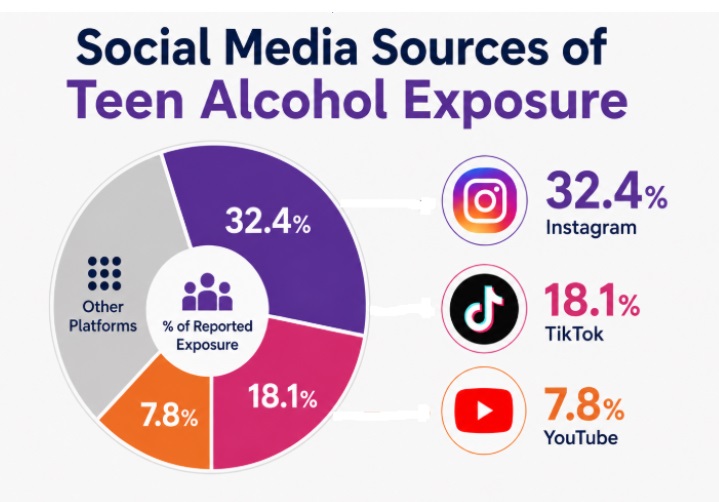
Infographics showing social media sources of teen alcohol exposure. Click on image to enlarge.
The exposure was not evenly spread across platforms. It appeared mostly on Instagram, TikTok and YouTube. Instagram alone accounted for about one-third of all reported exposures with 32.4%, TikTok following at 18.1%, while YouTube also contributed at a lower level of 7.8%.
The study found that alcohol content came from different sources ranging from social media influencers to friends and even commercial advertising for alcohol brands. A large share of exposure on Instagram and YouTube came directly from commercial sources which means that teenagers are not only seeing casual posts but also structured marketing campaigns designed to attract their attention.
Most of the time, teenagers simply scroll past alcohol content without interacting. However, about one in four exposures involved liking a post. This detail is important because it shows that even small actions can signal interest and potentially strengthen positive feelings towards alcohol.
A single exposure did not strongly change what teenagers believed about alcohol or what they thought their peers approved of. However, engagement mattered and when teenagers interacted with alcohol content, even in small ways, it was linked to more positive attitudes towards drinking. This suggests that influence is not just about seeing content but about how the brain responds when it is actively engaged.
For years, researchers have known that exposure to alcohol advertising, movies and television programmes can influence young people's attitudes towards drinking. However, much of this evidence was based on what teenagers recalled from the past. This study fills an important knowledge gap by capturing alcohol exposure as it happens in teenagers' everyday digital lives, which means that instead of relying only on memory, the researchers were able to see how often young people encounter alcohol-related content, which platforms expose them to it most and how they respond to it in real time.
This shift is important because the way young people consume media has changed significantly and today, social media feeds are personalised, fast-moving and constantly updated. As a result of the algorithms programmed into most social media platforms, a teenager may encounter alcohol content through an influencer's lifestyle video, a friend's post or a branded campaign without actively searching for it. Understanding this digital environment gives public health experts a clearer picture of the challenges facing young people today as the findings also provide useful information for several groups involved in protecting adolescent health.
Parents and caregivers can better understand that alcohol exposure is no longer limited to physical environments or traditional advertising. Schools can use the findings to strengthen digital media literacy programmes that help teenagers recognise persuasive content online. Furthermore, public health organisations and policymakers can also use this evidence to design better interventions, including strategies that address influencer marketing and alcohol promotion on digital platforms.
The consequences of how society responds to these findings are significant because if ignored, continuous exposure to alcohol content online may contribute to the normalisation of drinking among young people, especially as smartphones and social media become more central to daily life. However, using this evidence to improve education and promote healthier digital habits could help reduce the influence of alcohol marketing on adolescents.
Given the significant limitation that the study was conducted on young people in the United States, whose culture, attitudes and behaviours do not bear perfect parallels with those of African youths, there are still lessons that stakeholders in Africa and around the world can learn from the study.
1. Similar patterns of social media exposures may be happening across Africa already
Across many African countries, teenagers are skipping traditional media and moving directly into smartphone-based platforms. Instagram, TikTok and YouTube are now central to youth culture. This means exposure patterns found in the study are likely happening locally as well, especially in urban areas where smartphone access is high. Country and regional level research is needed in Africa to identify this.
In many African settings, alcohol regulation still focuses mainly on physical advertising such as billboards, radio and television but social media works differently. Alcohol promotion is often embedded in influencer content, lifestyle videos and subtle brand placements which makes it harder to detect and regulate. As a result, young people may be exposed to alcohol marketing without clear warnings or age restrictions.
The study shows a substantial portion of social media alcohol content comes from influencers who often play a powerful cultural role because they can shape fashion, language, aspirations and even lifestyle choices. When alcohol is shown as part of this lifestyle, it can normalise drinking in ways that feel aspirational rather than risky.
Many African schools still focus on general health education but do not fully address how social media content is designed to influence behaviour. Without this understanding, teenagers may not recognise sponsored posts or marketing disguised as entertainment.
In many communities, alcohol use among adolescents is still socially sensitive. However, repeated exposure online can slowly shift perceptions, making drinking appear more normal or socially acceptable. This does not necessarily lead to immediate behavioural change but it can shape attitudes over time.
Teenagers need to understand how algorithms, influencers and advertising work together to shape what they see.
Conversations at home should include social media influence, not just peer pressure or physical access to alcohol.
Regulators may need to expand alcohol advertising rules to cover influencer content and platform-based marketing.
Social media companies play a major role in distributing alcohol-related content and may need clearer age-based regulations through legislative action as was recently proposed in the United Kingdom.
This study shows that alcohol content is deeply embedded in teenage digital life. It is not rare, random or limited to a few platforms. Instead, it is part of the everyday flow of content on Instagram, TikTok and YouTube. More importantly, the study shows that influence is not just about exposure but engagement because even small interactions such as liking a post can shape attitudes towards alcohol.
For African societies, the concern is not only what teenagers are seeing but how quickly digital culture is becoming a major force in shaping behaviour. As smartphone use continues to grow, understanding and responding to this influence will become an important part of protecting adolescent health.
Source: Jackson, KM, Gabrielli J, S. Colby SM, et al. Characterizing In Vivo Exposure to Alcohol Content in the Media: Media Platform, Engagement, and Associations With Attitudes. Alcohol: Clinical and Experimental Research. 2026;50,(6): e70311. Available from here.
Related:
The Myth of Moderate Drinking Busted: No Level of Alcohol is Safe
Alcohol Use Disorder in African Youths: Causes, Effects, and Response
Published: June 22, 2026
© 2026. Datelinehealth Africa Inc. All rights reserved.
Permission is given to copy, use and share content for non-commercial purposes without alteration or modification and subject to to source.attribution.
DATELINEHEALTH AFRICA INC., is a digital publisher for informational and educational purposes and does not offer personal medical care and advice. If you have a medical problem needing routine or emergency attention, call your doctor or local emergency services immediately, or visit the nearest emergency room or the nearest hospital. You should consult your professional healthcare provider before starting any nutrition, diet, exercise, fitness, medical or wellness program mentioned or referenced in the DatelinehealthAfrica website. Click here for more disclaimer notice.