Quitting Smoking Lowers Dementia Risk (But There Is a Catch)
By Oluwasola Samuel, Freelance health writer. Medically reviewed by: A. Odutola, MB.BS, PhD, FRCSEd.
June 16, 2026
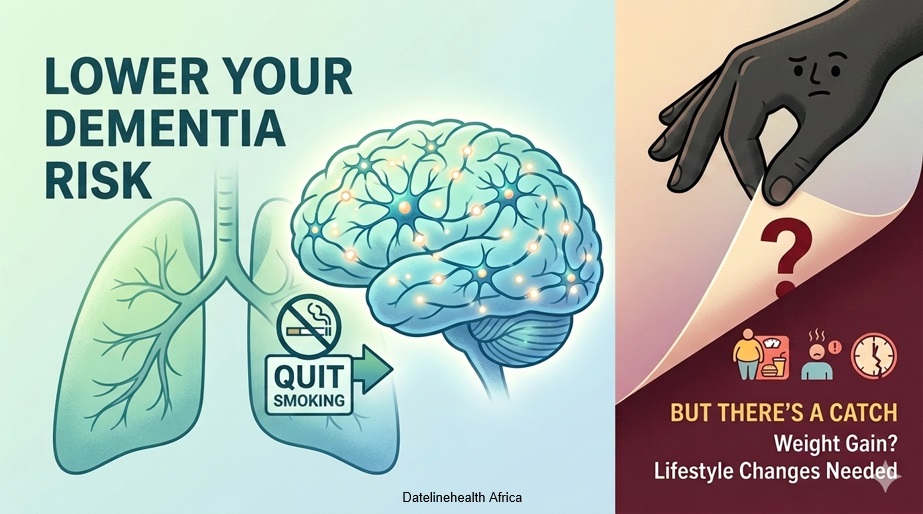
AI generated image shwoing the lungs and brain with captions saying: Quit Smoking, Lower Dementia Risk. To the right of the image is the catch; no weight gain and keeping a healthy lifestyle. Click on image to enlarge.
Smoking is one of the most common habits across Africa, from the busy streets of Lagos to the bustling neighbourhoods of Nairobi and Johannesburg. Many people who smoke know it is bad for the lungs and the heart. But what is less talked about, especially in African communities, is what smoking does to the brain over time.
Research has consistently shown that smoking raises the risk of developing dementia, the condition that slowly steals a person's memory, thinking, and independence.
Now, a new study published in May 2026 in Neurology, the medical journal of the American Academy of Neurology, brings encouraging news. It suggests that quitting smoking may lower your risk of dementia, and the sooner you quit, the better your brain stands to benefit.
Researchers from Zhejiang University School of Medicine in Hangzhou, China, conducted a large prospective cohort study using data from the US Health and Retirement Study, tracking participants from 1995 to 2020. The study looked at 32,802 middle-aged and older adults without dementia at the start. They had an average age of 61 and were followed for an average of 10 years. In total, 20% were current smokers, 36% were past smokers, and 43% had never smoked.
Participants were interviewed every two years about their smoking status, body weight, and overall health. Researchers then tracked who went on to develop dementia over time, using memory and thinking tests to measure how well people were functioning mentally. They also paid close attention to weight changes after quitting, to understand whether putting on weight after stopping smoking affected the brain health benefits of quitting.
Over the study period, 5,868 people developed dementia. After adjusting for factors such as age, physical activity, and cardiovascular health, people who quit smoking had a 16% lower risk of dementia compared with people who continued smoking.
And the longer a person stays smoke-free, the greater the benefit to their brain. The benefit increased with time since quitting, with dementia risk approaching that of never smokers after about seven years.
In other words, quitting smoking does not just slow the damage. Over time, it gives your brain a real chance to recover.
Another important finding from this study is the role that weight plays after quitting. The study found that quitting smoking may be associated with a lowered risk of dementia, especially for people who avoid major weight gain after quitting.
The benefit of quitting was maintained for those who gained up to 11 pounds after stopping, but those who gained 22 pounds or more did not experience a reduced risk of dementia.
As the lead researcher Hui Chen, PhD put it: “Quitting is still associated with better brain outcomes, but maintaining your weight may help preserve those benefits."
Smoking is not a small problem in Africa. Research from Uganda has identified smoking as one of the primary risk factors for dementia in older Africans. This makes the findings of this new study especially relevant for African communities.
Here is what this research means in practice for Africans:
1. Quitting smoking is one of the most powerful things you can do for your brain. According to the Lancet Commission on Dementia Prevention 2024, smoking accounts for a significant proportion of dementia cases that could be prevented worldwide. Stopping is one of the most direct steps you can take to protect your brain as you age.
2. It is never too late to quit. Whether you are in your 30s, 40s, 50s, or older, the evidence is clear. People who quit smoking in middle age may, within a decade, reduce their risk of developing dementia to that of people who never smoked. That is a powerful reason to stop today.
3. Watch your weight after quitting. This study shows that keeping weight gain below 5 kilograms after stopping is important for holding onto the brain health benefits of quitting. Eating well and staying active after quitting is part of the process.
4. Support is available. Quitting is not easy. Speak to a doctor or visit your nearest health facility. They can guide you on safe, effective ways to quit and help you manage your weight during the process.
It is important to understand what this study can and cannot tell us.
The evidence is growing clearer. Quitting smoking is not just good for your lungs and your heart, it is good for your brain too. This study adds to a body of research showing that stopping smoking, at any age, can meaningfully reduce your risk of developing.
For Africans, where dementia awareness is still low and risk factors like smoking remain common, this is an important message. If you or someone you know smokes, now is the time to act. The brain you protect today is the one that will carry you through tomorrow. Speak to a doctor and take that first step.
Source: Chen H, Wang J, Lai S, Peng G, Zong G, Yuan C, et al. Smoking Cessation, Weight Change, and Risk of Dementia: A Prospective Cohort Study. Neurology. 2026 Jun 23;106(12):e218123. doi:10.1212/WNL.0000000000218123. Available here.
Related
Dementia: What Africans should know
15 Modifiable Risk Factors of Dementia Africans Need to Know
10 things Africans should be doing to lower dementia risk
African foods that promote brain health
Published: 16 June 2026.
© 2026. Datelinehealth Africa Inc. All rights reserved.
Permission is given to copy, use and share content for non-commercial purposes without alterations or modifications and subject to source attribution.
DATELINEHEALTH AFRICA INC., is a digital publisher for informational and educational purposes and does not offer personal medical care and advice. If you have a medical problem needing routine or emergency attention, call your doctor or local emergency services immediately, or visit the nearest emergency room or the nearest hospital. You should consult your professional healthcare provider before starting any nutrition, diet, exercise, fitness, medical or wellness program mentioned or referenced in the DatelinehealthAfrica website. Click here for more disclaimer notice.