Pretend Play Boosts Child Development, Study Says
By Victory Onyenekwe. B.Sc. Ed Physical and Health Education. Freelance Health Writer. Medically reviewed by: E. Odekina, MB.BS.
June 8, 2026
.jpg)
African children using wrappers as cape, carton as a castle and water bottles as musical instruments to engage in pretend play. Image generated from Google Gemini. Click on image to enlarge.
One of the most exciting things about childhood is the power of imagination, the power to create magical scenarios and creatures using your mind.
Pretend play is a form of non-structured play that involves acting out scenarios, role-play and make believe.
Children have fun during creative/imaginative play, and a study carried out in Australia has shown that it also plays a role in their mental development.
This report explores the usefulness of the study to understanding child development and how African parents can actively encourage pretend play in their children.
Researchers conducted the study in Australia among more than 1400 children over a period of two years. The mental health and behaviours of the children were observed and assessed at ages 4 to 5, and later at ages 6 to 7, using reports from parents and educators.
The researchers also looked at whether acting out positive or negative scenes during pretend play affected how well children managed their emotions, but they found no difference..
The study found that higher levels of imaginative play at 2 - 3 years of age was associated with better mental health in children, even as they progressed into elementary school.
It also found that toddlers who engaged more in pretend play had fewer emotional and behavioural problems by the time they started grade school. This latter finding, however, had no relationship with children’s abilities to regulate their emotions. A distinction that the researchers consider less understood.
The researchers considered the study finding to be especially relevant today, as many children now have fewer opportunities for free imaginative play due to increased screen time and less structured activities.
They speculated that children performing pretend play may be engaging the cognitive regions of their brain that are thought to play a role in anxiety and attention. By simulating actions with objects - a pillow fort becoming a castle or a wrapper/scarf becoming a cape, kids may be contributing positively to their own brain development.
Pretend play aids child development in the following ways:
Serves as an excellent tool for children to develop executive functions such as working memory and problem solving.
Boosts creativity by encouraging children to create imaginative stories, characters and scenarios.
Promotes social and emotional learning, as children take on different characters either with others or alone. This helps them develop empathy and problem-solving skills as they navigate different situations that arise during play.
Supports the development of speech, language and communication skills.
Encourages independent thinking and builds confidence by allowing children to make decisions and solve problems within their imaginary world.
Despite being conducted in Australia, this study is particularly relevant to the African environment.
Pretend play for most African children is a mimicry of daily adult life. They do not only depend on manufactured toys but repurpose objects found around the house (bottles, cartons, pillows, wrappers). This means African children are already naturally engaging in rich pretend play, which is actually ideal for their mental development.
The study also shows the benefits of having a mixed age group playing pretend outdoors, on positive behavioural outcomes in relating with others. This includes resolving conflict, taking turns and applying general social etiquettes.
Pretend play gives African children the opportunity to connect with their roots, as the stories and scenarios they act out are often deeply tied to their cultural environment and everyday experiences. However, as Africa becomes more urbanised and screen access grows, parents may gradually want to replace imaginative play with screen time.
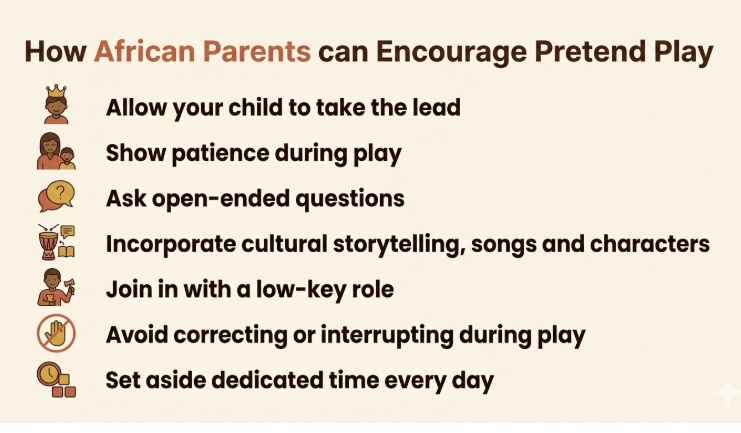
Infographics displaying ways African parents can engage their children in pretend play. Image generated from Google Gemini. Click on image to enlarge.
One of the important things that African parents must understand is that in pretend play, the rules of normal daily activities do not really matter. To encourage their children to engage actively in pretend play, parents must:
There are different types of pretend play that parents can encourage. These include:
Each type offers its own unique experience and benefits for the child’s development.
Pretend play is more than fun and games. It helps children develop problem-solving and conflict-resolution skills, supports their emotional well-being and creates lasting childhood memories.
Parents, especially in busy households, should make time to encourage and participate in pretend play with their children, as these simple moments of imagination can have a lasting impact on their growth and happiness.
Vasilopoulos F, Grummitt L, Bailey S, Birrell L, Dumontheil I, Francis G, et al. Longitudinal evidence of the relationship between pretend play and mental health in the early years. Early Childhood Educ J. 2026. Doi:10.1007/s10643-026-02150-7. Available from here.
Published: June 8, 2026
© 2026. Dateline Health Africa Inc. All rights reserved.
Permission is given to copy, use and share content for non-commercial purpose without alteration or modification and subject to source attribution.
DATELINEHEALTH AFRICA INC., is a digital publisher for informational and educational purposes and does not offer personal medical care and advice. If you have a medical problem needing routine or emergency attention, call your doctor or local emergency services immediately, or visit the nearest emergency room or the nearest hospital. You should consult your professional healthcare provider before starting any nutrition, diet, exercise, fitness, medical or wellness program mentioned or referenced in the DatelinehealthAfrica website. Click here for more disclaimer notice.