Is Melatonin A Safe Sleep Medication? Learn What a New Study Says
By: Elizabeth Obigwe, B.Sc. Anatomy. Freelance Health Writer. Medically reviewed by: A. Odutola, M.B BS, PhD, FRCSEd.
December 15, 2025
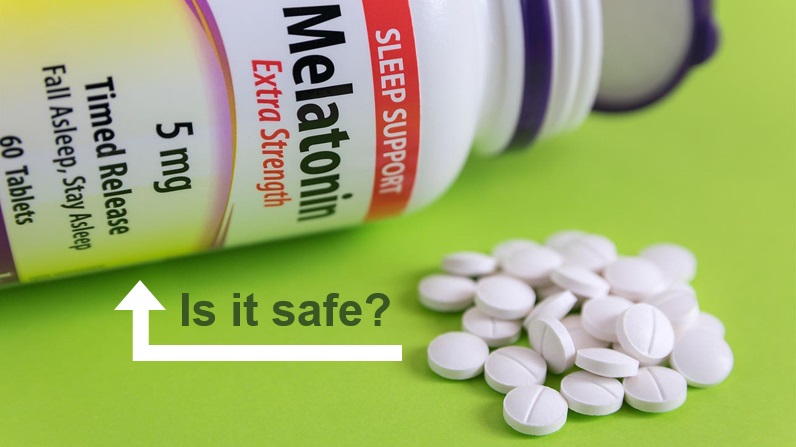
Close up photo of a labeled bottle of melatonin lying sideways on a light green background with free round and white tablets close by. The tablets are linked to the bottle by an angular arrow placed below a text reading: “Is it safe?” Click on image to enlarge.
If you use melatonin supplements regularly, you’ve probably wondered if the drug is safe to use and what the long-term effects may be.
A new study led by Ekenedilichukwu Nnadi, M.D, chief resident in internal medicine at SUNY Downstate/Kings County Primary Care in Brooklyn, New York, sheds light on some of these burning questions, suggesting that melatonin may not be completely safe and that caution may be needed, particularly with long-term use.
Melatonin is a naturally occurring hormone that regulates the sleep-wake cycle. Its levels in the body increase during the dark hours and decrease with exposure to daylight. A synthetic form of this hormone, also called melatonin, is commonly taken by people who have difficulty sleeping (insomnia) or poor sleep quality to help them sleep better.
Melatonin is generally considered relatively safe and is available over the counter in many countries worldwide, including Nigeria and several African countries, where it is sold as a supplement.
Learn more about melatonin and its use for sleep problems.
The researchers reviewed five years of electronic health records of over 130,000 adults diagnosed with insomnia from an international database (the TriNetX Global Research Network).
Of these total participants, 65,414 had been prescribed melatonin at least once and had records suggesting use for at least one year. This group was referred to as the “melatonin group.”
A second group, known as the "non-melatonin group,” consisted of individuals with insomnia who had never been prescribed melatonin.
The outcomes of both groups were then compared.
To reduce bias, the researchers matched the two groups across as many as 40 factors, including age, sex, existing medical conditions, and medication use. This was done to ensure that differences in outcomes were not mainly due to these factors.
Participants who already had a diagnosis of heart failure or who were using other sleep medications, such as benzodiazepines, were excluded from the study.
The health records of both groups were then analysed for diagnostic codes related to a new diagnosis of heart failure, as well as codes indicating hospitalisation for heart failure or death.
Heart failure is a condition that occurs when the heart can't pump enough oxygen-rich blood to the body’s organs for them to function properly. It is common worldwide as it affects 6.7 million adults in the U.S., for example and is associated with 34% risk of death annually in sub-Saharan Africa, a figure that is twice the world average.
The study found:
Although these findings do not prove that melatonin directly causes heart failure, they do show an association between melatonin use and an increased risk of heart failure. This suggests that long-term melatonin use may carry potential cardiovascular risks.
This study has some limitations that may influence its findings, examination and conclusions.
For these reasons, the lead researcher recommended that further research is needed to better understand how melatonin supplements may affect heart health.
Despite these limitations, the findings are still important and justify attention, as they raise concerns that long-term melatonin use may not be entirely harmless to the heart.
What the study means for you
Sleep is essential for overall health, and chronic sleep deprivation has been linked to an increased risk of cardiovascular disease.
Although the study findings have suggested that melatonin supplements used in the long-term for sleep problems may be associated with heart failure, you should not necessarily ignore their use in the short-term for your sleep problem.
If you use melatonin regularly or are concerned about its safety, it is advisable to speak with your healthcare provider about alternative treatment options. Depending on the cause and severity of your insomnia, other medications or non-drug approaches may be more appropriate.
Indeed, certain non-drug measures including exercises have been shown to help improve sleep. You can try them out if you have a mild case of insomnia. For more severe or persistent sleep problems that cannot be managed with home remedies, see a doctor to help determine the safest and most effective treatment plan.
The findings reported in this study and presented as an abstract at an American Heart Association scientific meeting should be considered preliminary until it undergoes peer review, independent verification and publication in a scientific journal.
Source:
American Heart Association. Long-term use of melatonin supplements to support sleep may have negative health effects. Dallas (TX): American Heart Association Scientific Session, Dallas Texas, Abstract MP2306. November 3, 2025. [Cited 2025 Dec 11]. Available from here.
Related
Sleep Medications: Types, Uses and Side Effects
Need To Sleep Better? Study Suggests You Try These Exercises
Melatonin Use for Sleep Problems: An Overview for Africans
Published: December 15, 2025
© 2025. Datelinehealth Africa Inc. All rights reserved.
Permission is given to copy, use and share content freely for non-commercial purposes without alteration or modification and subject to attribution as to source.
DATELINEHEALTH AFRICA INC., is a digital publisher for informational and educational purposes and does not offer personal medical care and advice. If you have a medical problem needing routine or emergency attention, call your doctor or local emergency services immediately, or visit the nearest emergency room or the nearest hospital. You should consult your professional healthcare provider before starting any nutrition, diet, exercise, fitness, medical or wellness program mentioned or referenced in the DatelinehealthAfrica website. Click here for more disclaimer notice.