First Daughter Syndrome: How Birth Order Affects Health and Wellbeing in African Families
By: Kelechi Nwaowu, Freelance Health and Wellness Writer. Medically reviewed by the DLHA Team.
April 14, 2026
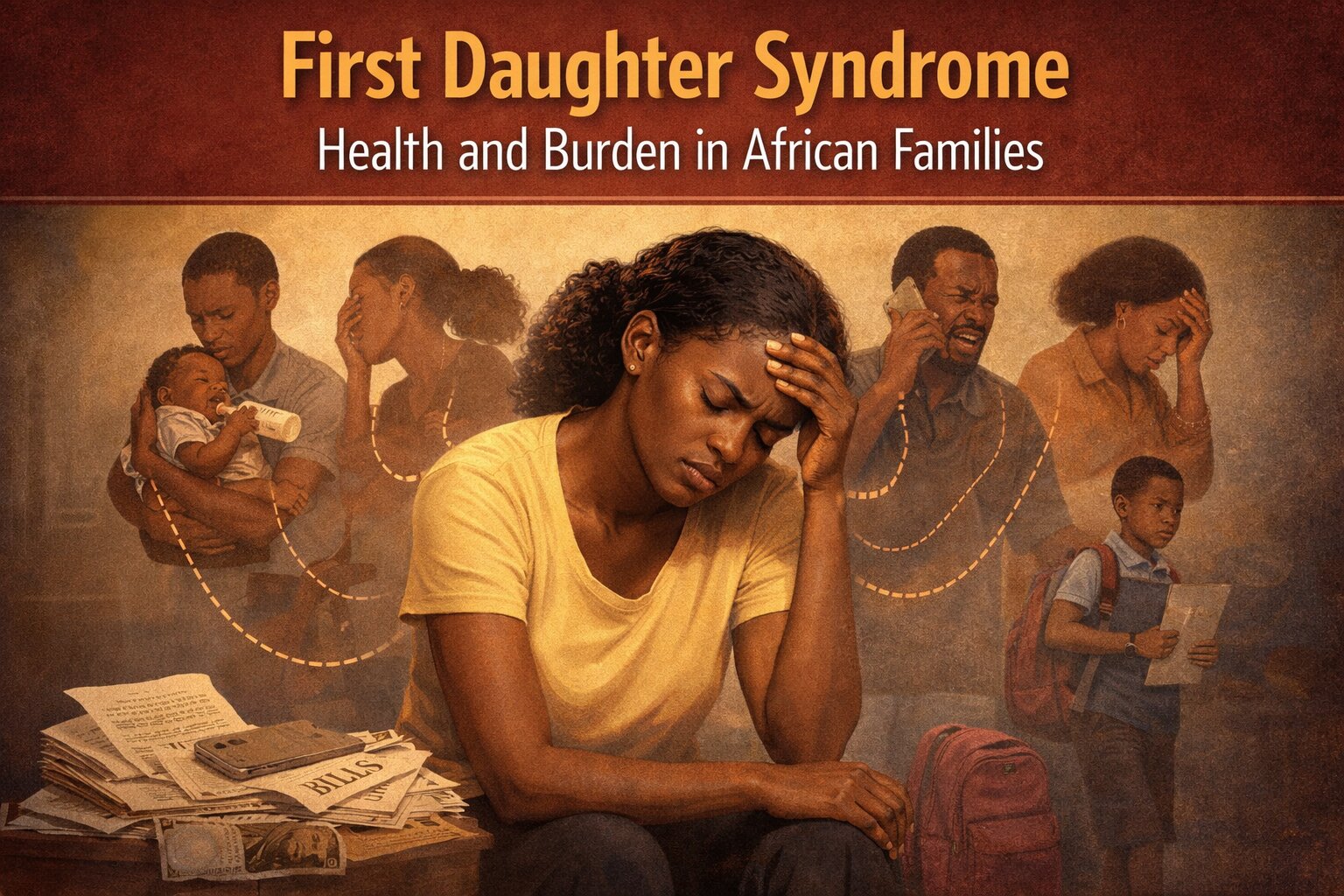
Composite image captioned First Daghter Syndrome; Health and Burden in African families. It depicts an African female sitting in the foreground and looking worried. In the background are multiple images of family members. Credit| ChatGPT. Click on image to enlarge.
Amaka is a 28-year-old Nigerian who works as an accountant in Lagos State. She sends money home to her family every month, pays her youngest sister's school fees, helps her mother with medical bills, and coordinates her younger siblings' schedules from miles away.
When her brother needed money to start a business, the family looked to Amaka to step in. When her parents argued, they each called Amaka to mediate. She can’t remember the last time she did something just for herself without feeling guilty.
From when she was 9 years old, Amaka learned how to wash ther parents’ bed sheets, and her younger siblings' clothes and napkins. She didn't learn these things because she wanted to – she did because she had to. It was what was expected of her as the 'big sister'. She was not allowed to throw tantrums or behave like a child that she was because she had younger siblings to take care of. She had to feed and babysit her younger siblings when their mother had somewhere to be. Ironic isn't it? A child babysitting other children, but for Amaka that was what she grew up knowing her whole life.
Amaka's’ story is not unique. Across Nigeria, Ghana, Kenya, and throughout Africa, the first or eldest daughter carries an invisible weight that shapes her entire life. In November 2025, a post by a Nigerian lady went viral on TikTok.
She wrote: "I will never forgive my parents for stealing my childhood"
She went ahead to give detailed information on how she was made an adult at a tender age. How she spent her days with responsibilities that kept her busy and tired while other children played. This burden has a name – it's called the First or Eldest Daughter Syndrome.
First Daughter Syndrome (FDS) is not an official medical diagnosis, but it describes a real and widespread experience. It refers to the emotional pressure, high expectations, and overwhelming sense of responsibility often placed on the oldest female child in a family.
When you are the first daughter, you are expected to be a role model, a second mother, a mediator, a pioneer, and often the family's safety net – all before you finish growing up yourself. These expectations start early, sometimes as young as 5 or 6 years old, and they follow you into adulthood.
Birth order psychology has been studied for decades and the research shows that firstborn children, regardless of gender, tend to be more responsible, conscientious, and achievement-oriented than their younger siblings (1). They often become natural leaders and develop strong organisational skills.
Some studies found that firstborn children show distinct patterns in mental health outcomes, self-esteem, resilience, and happiness compared with later-born siblings (2). The researchers discovered that being the oldest child comes with unique psychological pressures that younger siblings do not experience.
However, being the oldest does not just come with psychological pressure. Firstborns are the "trial and error" child. Parents are stricter with them because they are learning how to parent for the first time. Firstborns face higher expectations and less freedom than their younger siblings.
These birth order effects become more intense when gender enters the picture. While oldest sons may be praised for independence and leadership, oldest daughters are praised for being selfless, helpful, and caring. The expectations placed on them go beyond achievement – they are expected to sacrifice their own needs for the family.
In African families, FDS is not just about birth order. It is deeply woven into culture, tradition, and family values (3). Across Nigerian homes, the first daughter is given a title before she even knows what it means. She is Ada (Igbo), Ìyá Kéjì (Yoruba), or Adiaha (Efik/Ibibio). These names literally mean "first daughter" or "second mother” (3).
These names carry invisible weight. It tells the girl who she is expected to be: a caretaker, a peacekeeper, and a model for everyone watching. From childhood, African girls are taught to be selfless, to look after others, and to put family above self. This cultural message is more amplified for the first daughter.
In traditional African societies, the eldest daughter often helps socialise younger siblings, assists with household management, and provides emotional support to parents (3). While some of this responsibility can build character and teach valuable life skills, it crosses a harmful line when the child takes on adult burdens that steal her childhood.
Research on gender disparities in household labour shows that girls spend significantly more time than boys conducting unpaid household chores, with first daughters bearing the heaviest load (1). In African families with strong patriarchal values, this gender gap is even wider.
Being the first daughter in an African family has both spoken and unspoken roles attached to it. These roles cut across household duties, academic pressures, and emotional responsibilities.
.jpg)
A first daughter feeding her youngest sibling, while helping the other with his assignment. Credit| ChatGPT. Click on image to enlarge.
Holding the title of a first daughter in an African household often means becoming a third parent to your younger siblings by default. You change diapers, prepare meals, help with homework, settle fights, and put younger ones to bed. You are not just helping out – you are raising them.
This phenomenon is called parentification, a term used when a child takes on adult responsibilities because a parent is physically or emotionally unavailable (3). The child becomes the caregiver instead of being cared for.
A 2023 systematic review (or study of studies) examined 54 studies on parentification and found consistent evidence that children who take on adult responsibilities experience higher rates of anxiety, depression, and relationship difficulties later in life (4). The researchers noted that these effects are particularly strong when the parentification begins early in childhood and continues for longer periods.
In many African homes, if anything goes wrong while parents are away, the first daughter is automatically blamed and expected to explain what happened (3). She learns early that she is responsible not just for herself, but for everyone around her.
First daughters are not just expected to help at home – they are also expected to excel academically and professionally. You are the family's guinea pig, the one who must succeed so that younger siblings can follow your example (3).
Parents often invest heavily in the first daughter's education, but this investment comes with strings attached. You must get the best grades, attend a good university, secure a respectable job, and bring honour to the family name. Failure is not an option because younger siblings are watching, and the family's reputation is on the line.
First daughters often become high achievers not because they love success for its own sake, but because they have learned that perfection keeps the peace in the family (3). When you always perform well, parents are happy, siblings look up to you, and the family feels stable. But the pressure to maintain this image is often exhausting.
In many African families, the first daughter is expected to become a financial pillar once she starts working. Whether or not you earn more than your siblings, the family looks to you first when money is needed (3).
You pay school fees for younger siblings, you contribute to house rent, you send money for your parents' medical bills, you fund family emergencies. And when you hesitate or say you cannot afford it, you are called selfish or reminded of your duty as the first daughter.
Beyond money, you are also expected to provide emotional support. When your mother is stressed about her marriage, she confides in you. When your younger sibling is heartbroken, they come to you. When your father is disappointed, you meditate (3). You become the family's therapist, absorbing everyone's pain and stress while suppressing your own emotions.
A major part of First Daughter Syndrome is being punished for mistakes you didn't make (3). If a younger sibling breaks a plate, fails a test, or gets into a fight, the parents often turn to the first daughter with the question: "Where were you when this happened?"
Because she is viewed as a "second mother," her failure to prevent the younger sibling's mistake is treated as a personal offense. This often leads to:
This creates a high-stress environment where the first daughter feels she must control her siblings' every move to protect herself from pain. It damages the sibling bond, turning a relationship of love into one of fear and policing.
The nature of the responsibilities and expectations placed on first daughters in African families lead to a number of physical and mental challenges.
The constant pressure of being the first daughter takes a serious toll on mental health, including – significantly higher levels of anxiety, depression, and stress compared to their peers who do not carry these burdens (4).
You carry the weight of responsibilities every single day. You worry about your younger siblings' safety. You stress about meeting your parents' expectations. You feel guilty when you prioritize your own needs. This continuous worry creates a state of constant stress.
A research specifically examining adolescent caregivers found that young people who provide care for family members experience emotional distress, social isolation, and academic difficulties (5).The study noted that these caregivers often suppress their own needs and emotions to fulfill family expectations, leading to long-term mental health problems.
When you suppress your emotions for years – pretending to be strong when you are hurting, smiling when you are tired, those feelings do not disappear. They build up inside, leading to anxiety, depression, difficulty forming healthy relationships, and an inability to express your own needs.
Many first daughters report feeling lonely despite being surrounded by family (3). You are everyone's go-to person, yet you have no one to lean on. This loneliness is deepened by the cultural expectation that you should be strong and self-sufficient, so asking for help feels like weakness.
For more information on depression in African women, read: Postpartum Depression in African Women: Causes, Symptoms and Treatment
Perfectionism is one of the most common traits among first daughters (2). From childhood, you learn that your worth is tied to how well you perform. If you are helpful, obedient, successful, and selfless, you are valued. If you fail or fall short, you feel worthless.
This perfectionist mindset does not stop in childhood. It follows you into adulthood, affecting your career, relationships, and self-image. You become afraid of making mistakes. You overwork yourself to meet impossible standards. You say yes to everything because you fear disappointing others.
The result is burnout – a state of physical, emotional, and mental exhaustion. Burnout looks like constant tiredness that sleep cannot fix, feeling emotionally numb, losing interest in things you once enjoyed, and feeling overwhelmed by even small tasks.
First daughters often experience burnout in their 20s and 30s – a time when they should be building their own lives, because they have been running on without stopping for years.
With a history of putting others (siblings, parents) before themselves, first daughters are prone to develop the Messiah Complex (3). The Messiah complex is an irrational urge to save everyone – friends, partners, and colleagues, from their own problems. You take their struggles personally, which leaves you with no energy to fix your own life.
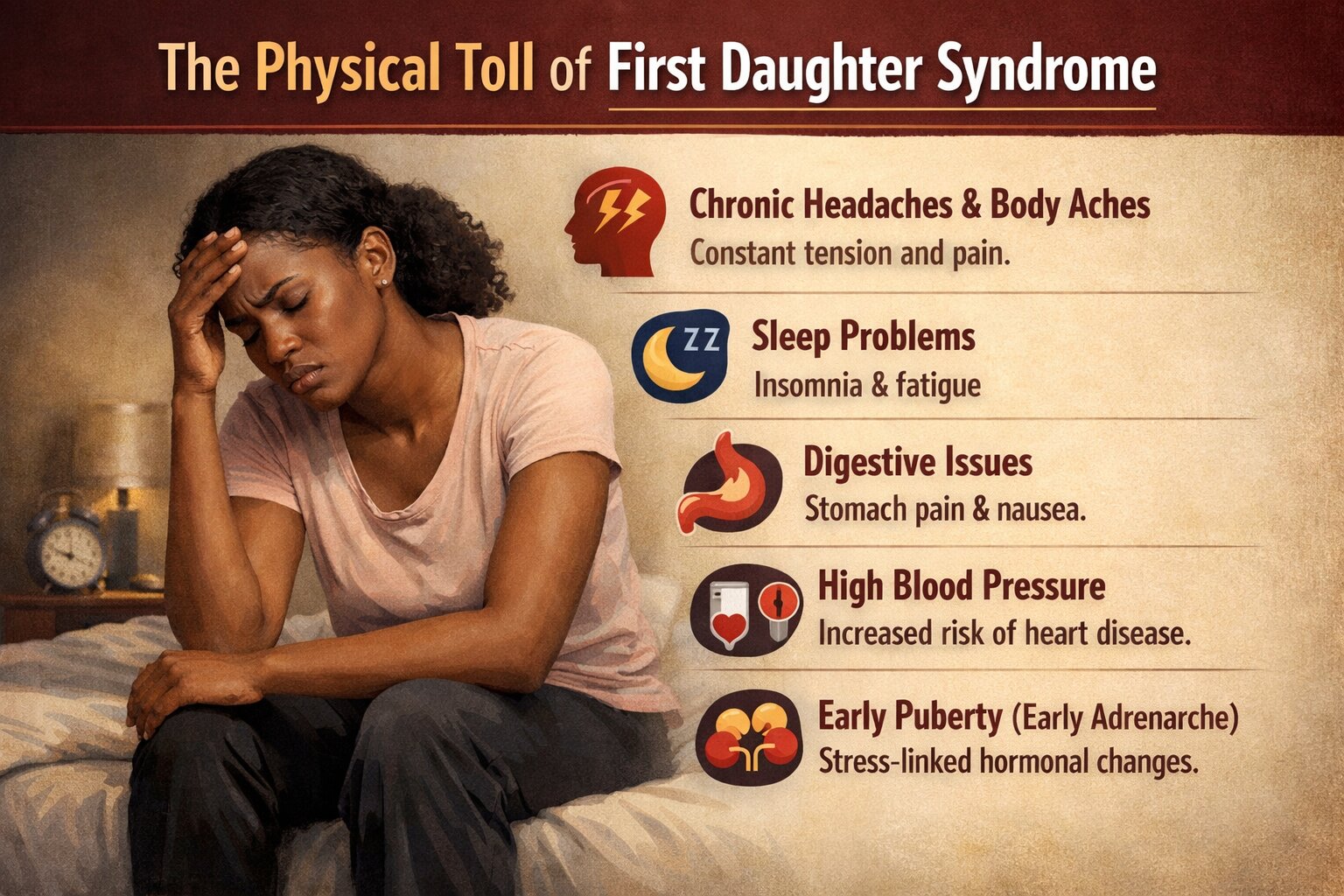
AI generated infographics on the physical effects of first daughter syndrome. Credit| ChatGPT. Vick on image to enlarge.
Mental and emotional stress does not just stay in your mind, it affects your body too. Prolonged stress associated with FDS can lead to several physical health problems:
A 2023 review on stress and growth in children found that chronic psychological stress during childhood can disrupt normal physical development, including effects on the endocrine system (hormones) and growth patterns (6).The researchers explained that stress activates the hypothalamic-pituitary-adrenal (HPA) axis, which controls how the body responds to stress. When this system is constantly activated in childhood, it can lead to long-term health consequences.
A 2020 study of 132 adolescents found that while helping with household chores did not necessarily cause distress, the parent's emotional well-being was directly linked to the child's psychological adjustment. Specifically, higher levels of emotional support provided by the child was associated with increased adolescent distress (7). However, strong peer attachment was shown to help lower this distress and improve the child's overall adjustment.
Related: Health Issues of African Women: What to Do About Them
FDS is a cultural and social system with fundamental structures that cause physical and emotional harm. For effective management, it needs direct confrontation and collaboration from all involved parties.
One of the hardest but most important skills for a first daughter to learn is setting boundaries. A boundary is a limit you set to protect your time, energy, and wellbeing.
Saying no does not make you selfish, it means you recognize your own limits and choose to respect them. Here are simple ways to start setting boundaries:
Parents play a huge role in either creating or preventing FDS. If you are a parent reading this, here are what you can do to support your first daughter:
One of the most healing steps a first daughter can take is to talk about her experience. For too long, first daughters have carried their burdens in silence because they did not want to seem ungrateful or weak (3).
Breaking the silence helps in several ways by offering the following:
Many first daughters reach their 20s and 30s without knowing who they really are apart from their family role. You have spent so much time being what everyone else needs that you have forgotten what you want.
Reclaiming your identity starts with asking yourself simple questions like:
Then, take small steps to explore those answers. Try a new hobby, spend time alone without feeling guilty. Pursue a dream that has nothing to do with making your family proud. Give yourself permission to be more than the first daughter – to be a full person with your own life (3).
Families can change and cultural expectations can evolve, but it starts with honest conversations. If you are a first daughter, consider having a calm and respectful conversation with your parents and siblings about how you feel.
Use "I" statements like: "I feel overwhelmed when I am expected to handle everything "instead of "You always dump everything on me." This reduces defensiveness and opens space for understanding.
If you are a parent, ask your first daughter how she is doing, and really listen. Acknowledge the ways you may have placed too much on her shoulders, apologize if needed. Then, work together as a family to create a healthier balance.
If you are a younger sibling, recognize the sacrifices your older sister has made and show appreciation. Offer to help her instead of always asking for help. Build a relationship based on mutual support, not one-sided caregiving.
Cultural change is slow, but it happens one family at a time. When we start seeing first daughters as children who deserve protection, support, and freedom to grow – not as second mothers or family servants, we create healthier, happier families.
First Daughter Syndrome is real, and its effects are deep. Across African families, from Nigeria to Ghana to Kenya, first daughters carry burdens that shape their mental and physical health, relationships, and sense of self. The cultural expectation that they be selfless caregivers from childhood creates a cycle of anxiety, perfectionism, burnout, and identity loss.
However, First Daughter Syndrome is not a life sentence. First daughters can heal by setting boundaries, seeking support, and reclaiming their identities. Parents can change by redistributing responsibilities and seeing their first daughters as children, not assistant parents. Families can grow by communicating openly and valuing each member's wellbeing equally.
If you are a first daughter reading this, know that you are not selfish for wanting rest. You are not weak for needing help. You are not ungrateful for setting boundaries. You are a person who deserves to be seen, valued, and cared for – not just for what you do, but for who you are.
Your family needs you, yes. But you also need yourself. And that is not something you should feel guilty about.
1. Cleveland Clinic. Is "eldest daughter syndrome" real? [Internet]. Cleveland: Cleveland Clinic; 2024 Oct 17 [cited 2026 Mar 10]. Available from here
2. Chatterjee D. Understanding ‘Eldest Daughter Syndrome.’. International J. of Creative Research Thoughts, (IJCRT). 2024 May 18.12(5);1586-1596. Available from here
3. Briggs P. “You’re the Mother Now”: The Rage of Nigeria’s First Daughters. Zikoko [Internet]. 2025 Oct 28. [Cited 2026 Mar 10]. Available from here.
4. Dariotis JK, Chen FR, Park YR, Nowak MK, French KM, Codamon AM. Parentification Vulnerability, Reactivity, Resilience, and Thriving: A Mixed Methods Systematic Literature Review. Int J Environ Res Public Health. 2023 Jun 21;20(13):6197. Available from here.
5. Armstrong-Carter E, Siskowski C, Belkowitz J, Johnson C, Olson E. Child and adolescent caregiving for family: Emotional, social, physical, and academic risk and individual differences. J Fam Psychol. 2022 Dec;36(8):1407-1417. Available from here.
6. Mousikou M, Kyriakou A, Skordis N. Stress and Growth in Children and Adolescents. Horm Res Paediatr. 2023;96(1):25-33. doi: 10.1159/000521074. Available from here
7. Chen CY, Panebianco A. Physical and psychological conditions of parental chronic illness, parentification and adolescent psychological adjustment. Psychol Health. 2020 Sep;35(9):1075-1094. Available from here
Related: Social Factors Shaping African Women’s Health
Published: April 14, 2026
© 2026. Datelinehealth Africa Inc. All rights reserved.
Permission is given to copy, use and share content for non-commercial purposes without alteration or modification and subject to source attribution.
DATELINEHEALTH AFRICA INC., is a digital publisher for informational and educational purposes and does not offer personal medical care and advice. If you have a medical problem needing routine or emergency attention, call your doctor or local emergency services immediately, or visit the nearest emergency room or the nearest hospital. You should consult your professional healthcare provider before starting any nutrition, diet, exercise, fitness, medical or wellness program mentioned or referenced in the DatelinehealthAfrica website. Click here for more disclaimer notice.