Obesity in African Children: Causes and Prevention
By Victory Onyenekwe. B.Sc. Ed (Physical and Health Education). Freelance Health Writer. Medically reviewed by: Michelle Buama Abebrese, MD.
December 2, 2025
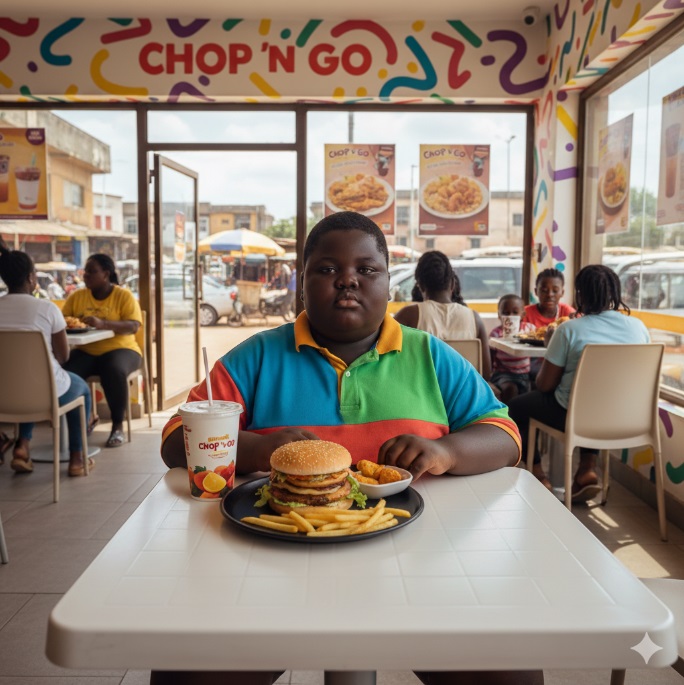
An obese African boy seated in a fast food restaurant, with ultra-processed food on his table. AI generated image from Gemini. Click on image to enlarge.
Obesity is rapidly increasing as a public health concern in Africa, shifting from primarily an adult issue to one that now also impacts children. In 2019, Africa was home to 24% of the world’s overweight children aged under 5. A World Health Organization [WHO] analysis reported in 2022 predicted an increase in obesity by 2023 among adults from 13.6% to 31% and from 5% to 16.5% in children and adolescents. This means that nutrition problems in African children are gradually moving from under-nourishment to obesity.
In this article, you will learn about the causes of childhood obesity in African countries and how it can be prevented to promote healthy children.
Obesity is characterised by excessive deposits of fat in the body that can cause damage to the health of an individual. It can also be described as an above normal body weight for height. Obesity is commonly diagnosed in adolescents and adults by calculating the body mass index [BMI]. In children, it is diagnosed when weight-for-height rate is greater than 3 standard deviations above the WHO Child Growth Standards median. Recent studies have shown that measuring the waist circumference or waist-to-height ration are more accurate ways of diagnosing obesity in Africans (adults and children alike) who tend to accumulate body fat around the abdomen.
In 2024, the World Health Organization [WHO] estimated that 35 million children under the age of 5 were overweight. Globally overweight/obesity prevalence rose by 47.1% in children over the last decades.
The prevalence of obesity among children under 5 years of age in Africa was estimated at 4.9% in 2022, which is below the global estimate of 5.6%. However, there are variations in the prevalence of obesity across different parts of Africa.
Statistics reported in 2023 by the Africa Regional Overview of Food Security and Nutrition indicated a higher prevalence in Northern and Southern Africa [South Africa and Botswana had the highest prevalence]. Northern Africa takes the lead in comparison to other sub regions.
In the Sub-Eastern region of Africa, high prevalence of obesity was reported in Comoros 9%, Rwanda 7.76% and Mozambique 7.39%. The Western region of Africa was recorded to have already achieved the 2030 World Health Assembly target (i.e., reduction and maintenance of the prevalence of childhood overweight to below 5%) for obese children.
General indications are that children living in urban settlements were more likely to be obese than those living in rural settlements. Many low- and middle-income countries within Africa face a double burden of obesity and undernutrition.
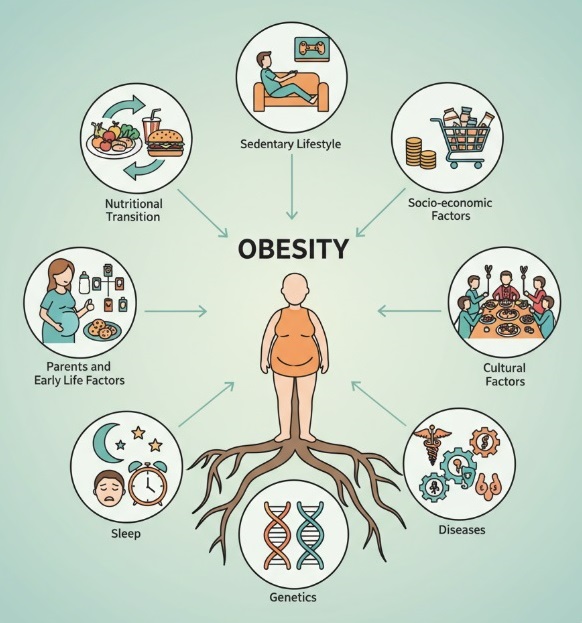
Causes of obesity. AI generated. Image credit Gemini. Click image to enlarge.
Childhood obesity can be caused by: [1, 2]
Nutritional Transition
There has recently been a shift from the consumption of traditional meals, rich in fibre and adequate nutrients, to overly ultra-processed foods [fast foods, sugary beverages, snacks]. These ultra-processed foods and quick-fix meals are readily available and aggressively marketed in urban settlements within Africa.
The World Health Organization recommends an average of 60 minutes of moderate-to-vigorous intensity physical activity for children aged 5- 17 years per day, across the week. Prolonged screen time, lying down or generally living an inactive life, contributes to obesity in African children.
The impact of socio-economic status on obesity affects both high- and low-income families. Children living in neighbourhoods with low-income status have less access to recreational centres, which results in a sedentary lifestyle. The urbanization and westernisation of parts of Africa, give children born in high-income homes access to fast foods that are energy-dense.
There are a lot of cultural factors that may lead to obesity. Some of these factors include:
Genes play a crucial role in the ability of children to gain excessive weight. Some children inherit traits that make it easier for them to gain weight. Parental obesity is also a strong risk factor for excess weight in children.
Predisposing genes for obesity can interact with environmental factors and be amplified or reduced accordingly.
The parental environment during the preconception period can influence the emergence of excess weight in childhood. Specifically maternal obesity is associated with a greater risk of obesity in an offspring, but paternal influence is also significant; the father’s obesity status prior to conception is also a risk factor for obesity in childhood. Other preconception environmental risk factors for obesity in an offspring include: smoking, maternal stress, exposure to air pollutants and assisted reproduction. [1]
Excessive maternal weight gain during pregnancy increases the risk of babies who are born large-for-gestational age, and these infants are at greater risk of obesity in later life. Maternal illnesses such as gestational diabetes can lead to the overnutrition of the foetus primarily as a result of maternal hyperglycemia during pregnancy. [1] Other factors include exposure to endocrine disruptors which can cause epigenetic changes that influence obesity risk.
A short duration of exclusive breastfeeding and the premature introduction of solid foods - especially sweetened beverages, processed food and snacks are risk factors for obesity.
Although uncommon in children, certain diseases such as hypothyroidism, growth hormone deficiency and Cushing’s syndrome can be contributing factors to the onset of obesity. So can some medications prescribed in specific condition that act through stimulating appetite, interfering with glucose metabolism (breakdown) and storage, water retention and decreased energy use.
Inadequate quantity and quality of sleep increases the chances of obesity. Short sleep duration is associated with changes in the hormonal metabolism that regulates appetite.
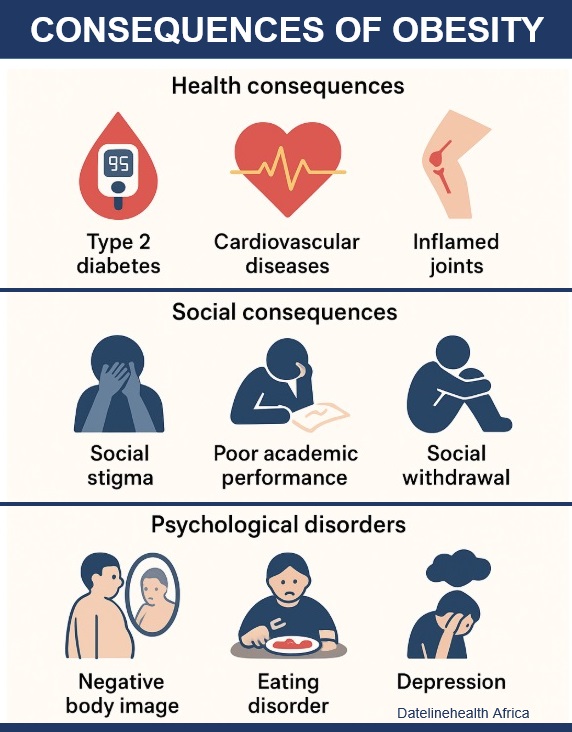
Image illustration of the consequences of obesity. Image credit Gemini
The consequences of childhood obesity are far-reaching, fundamentally affecting a child’s physical health, mental state and social integration. Let’s examine these diverse consequences.
Childhood obesity significantly increases the risk of non-communicable diseases (NDC) such as:
These diseases often continue into adulthood, reducing quality of life and creating long-term risk for chronic diseases.
Children living with obesity often face significant stigma. This frequently manifests as bullying and constant ridicule within their school, home, and community. Furthermore, they are often excluded from physical activities, because they are perceived as being slower or less capable than their classmates. Over time this emotional toll can interfere with learning, ultimately contributing to poor academic performance and self-imposed social withdrawal.
The medical and social effects of obesity place a significant toll on the mental well-being of children living with the condition. The most notable psychological consequences include:
To effectively prevent and reduce the incidence of overweight/obesity among children in Africa, the following key measures can be taken: [2]
Childhood obesity in Africa should not be misinterpreted in cultural sense as a sign of wealth, healthy growth or a beauty standard. Rather it must be considered as a serious health condition that poses significant long-term health risks to a child’s well-being.
To successfully address this challenge, a unified approach is required. Parents, schools, policy makers, healthcare providers and others must work together productively to ensure that the nutritional needs of the African child for healthy growth are fully met.
The government has a key responsibility to monitor and control food production within African countries, making certain that health guidelines are duly followed. Furthermore, childhood obesity trends within Africa should be regularly monitored and implementation of preventive methods effectively enforced.
1. Nogueira-de-Almeida CA, Weffort VRS, Ued FDV, Ferraz IS, Contini AA, Martinez EZ, Ciampo LAD. What causes obesity in children and adolescents? Jornal de pediatria. 2024;100 Suppl. 1: S48 -S56. Available from here.
2. Klingberg S, Draper CE, Micklesfield LK, Benjamin-Neelon SE, van Sluijs EMF. Childhood Obesity Prevention in Africa: A Systematic Review of Intervention Effectiveness and Implementation. International Journal of Environmental Research and Public Health. 2019; 16(7):1212. doi: 10.3390/ijerph16071212. Available from here.
Related:
Fighting the Growing Obesity Epidemic in South Africa
Estimating Chronic Health Risks in Africans: Is Waist Circumference Better than BMI?
What BMI Tells You about Your Health Status as an African
Published: December 2, 2025
© 2025. Datelinehealth Africa Inc. All rights reserved.
Permission is given to copy, use and share content for non-commercial purpose without alteration or modification and subject to source attribution.
DATELINEHEALTH AFRICA INC., is a digital publisher for informational and educational purposes and does not offer personal medical care and advice. If you have a medical problem needing routine or emergency attention, call your doctor or local emergency services immediately, or visit the nearest emergency room or the nearest hospital. You should consult your professional healthcare provider before starting any nutrition, diet, exercise, fitness, medical or wellness program mentioned or referenced in the DatelinehealthAfrica website. Click here for more disclaimer notice.