Snake Bites in Africa: All You Need to Know
By: Elizabeth Obigwe, B.Sc. Anatomy. Freelance Health Writer. Medically reviewed by the DLHA Team.
March 2, 2026
Image of a snake in its natural habitat, captioned: "Snake bites in Africa: All you need to know". Click on image to enlarge.
Imagine you are relaxing at home one evening when you suddenly hear screams outside. You rush out and discover that a snake has just bitten your neighbour. Your heart starts racing. What should you do next?
Moments like this can leave anyone anxious an unsure of the right action to take. But having the right information beforehand can reduce panic and help you respond quickly and correctly, possibly even saving a life instead of making the situation worse.
In this article, you will learn everything you need to know about snake bites, including:
A snake bite happens when a snake’s teeth (fangs) pierce a person’s skin.
Sometimes it is just a small wound, especially if the snake is not venomous. But if the snake injects venom, the toxin can spread through the body and affect important functions like blood flow, breathing, or how the nerves and organs work.
Venom is a toxin that is actively injected into another organism, usually through a bite or sting, using specialised body parts like fangs or a stinger. For example, snakes inject venom through their fangs.
There are about 400 snake species in Africa, but most of them are harmless. Only about 100 species are known to cause harm to humans, 30 of which can cause death if neglected. These dangerous species are members of the following families: stiletto snakes (Atractaspididae), colubrids (Colubridae), elapids (Elapidae) and vipers (Viperidae) [4]. Some examples of venomous and non-venomous snakes in Africa are given in Tables 1 and 2 below.
.jpg)
Table 1: Listing of common non-venomous snakes in Africa, with brief descriptions (colours, region & diet), and their images.
No, not all snake bites are deadly. According to the WHO, there are over 3,700 snake species in the world, of which 650 are venomous, but only 250 are known to cause serious illness or death in humans [1].
.jpg)
Table 2: Listing common venomous snakes in Africa, brief descriptions (colours, region, & venom or diet), and their images. Click on image to enlarge.
Most snakes are non-venomous. This means that if they bite, it may hurt, but their bite does not inject a toxic substance into the body.
Even among venomous snakes, some bites are “dry bites.” That is, the snake bites but does not inject venom.
When a snake bites and injects venom, it is called "envenomation", and this is when a snake bite can become dangerous.
Untreated severe envenoming can be life-threatening, and you may not be able to tell the difference between a dry bite and an envenomed bite. Hence, every snake bite should be treated as a medical emergency until proven otherwise by your healthcare provider.
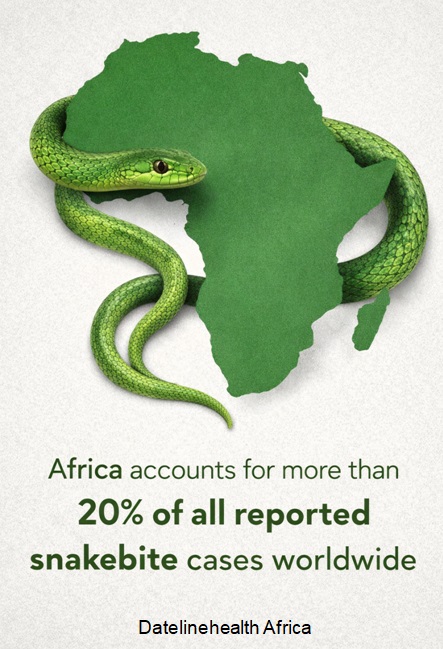
Ai generatedinfo poster of Africa's snakebite crisis. Click on image to enlarge.
Globally, about 4.5-5.4 million people are bitten by snakes each year. Out of t hese, around 1.8-2.7 million people develop serious illness, and between 81,000 and 138,000 die from complications [2].
In sub-Saharan Africa alone, nearly 500,000 snakebite envenomings occur every year. These result in about 30,000 deaths and at least as many permanent disabilities, such as limb deformities or amputations. This means that Africa accounts for more than 20% of all reported snakebite cases worldwide [3], showing just how significant the problem is on the continent.
The highest incidence of snakebite in Africa occurs in the West African savannah (grassland) region. These areas provide a suitable habitat for many venomous snakes [4].
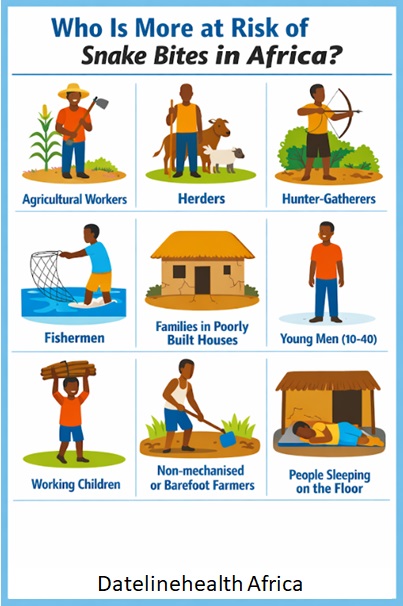
Info poster illustrating categories of people at most risk for snakebites in Africa. Click on image to enlage.
Snake bites mainly affect rural communities in tropical countries. People whose daily activities bring them into close contact with fields, bushes, rivers, and forests are at the highest risk [2, 5].
Snake bites are more common during the rainy or wetter months. This is because farming activities increase during this time, and it is also the breeding season for many snakes. As a result, human activity and snake activity overlap more frequently [5].
The symptoms of a snake bite vary depending on the type of snake involved. Bites from non-venomous snakes usually produce milder symptoms than bites from venomous snakes.
Among venomous snakes, the effects can also differ because their venom contains different types of toxins depending on their species. Some toxins affect the blood (haemotoxins), others target the nerves (neurotoxins), and some damage the muscles (myotoxins).
The symptoms of snake bite can be local (limited to the area around the bite) or systemic (spread through the body or affect specific organ systems). Below are some common symptoms of a snake bite [5, 6]:
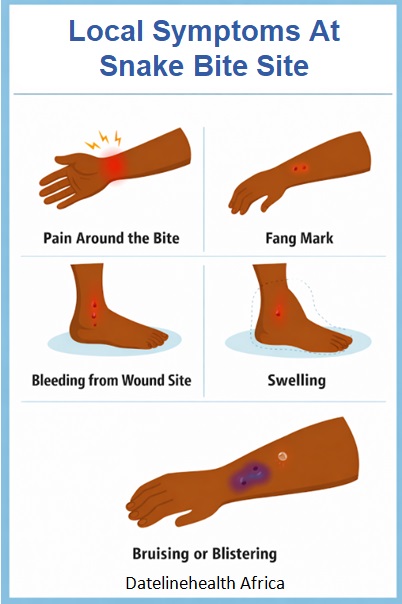
Info poster illustrating local symptoms of a snake bite. Click on image to enlarge.
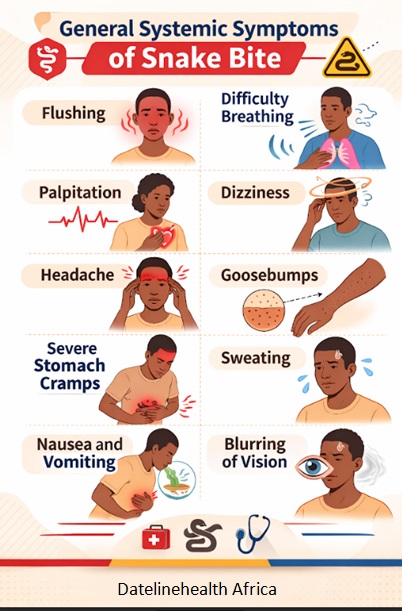
Info poster illustrating some general systemic symptoms of a snake bite. Click on image to enlarge.
(The above symptoms are often caused by anxiety or panic after the bite, even if no venom was injected.)
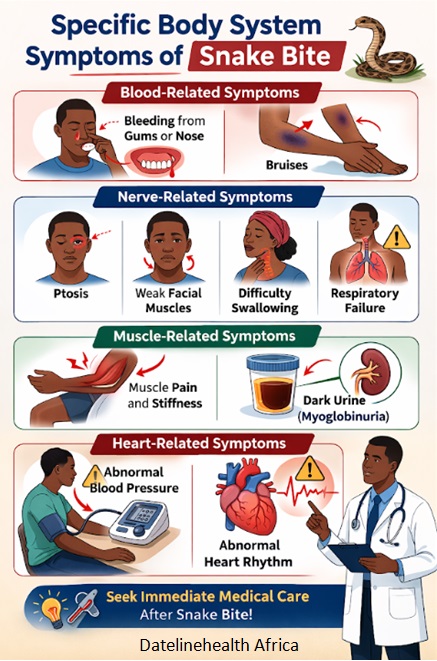
Info poster illustrating body specific symptoms of a snake bite. Click on image to enlarge.
Time is of the essence in the management of snake bites. If victims are left untreated or not treated early, they may develop complications or even die. Some of these complications are [7,8]:
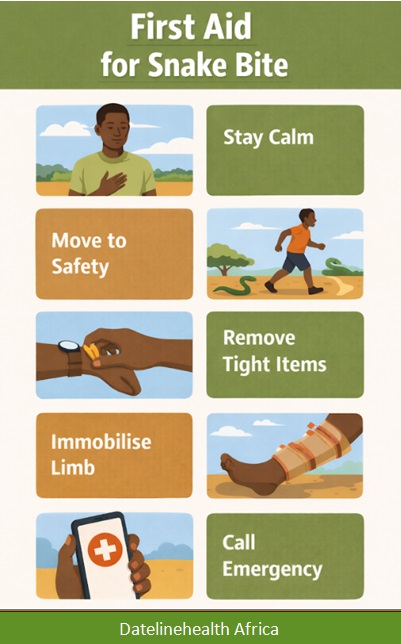
Info poster illustrating first aid step for snake bite. Click on image to enlarge.
1. Reassure the person and stay calm. Panic increases heart rate and helps venom spread faster.
2. Move the victim and any bystanders away from the snake to avoid further bites.
3. Remove rings, bracelets, anklets, or tight clothing near the bite, as swelling may begin to squeeze them.
4. Keep the person still and place the bitten limb in a comfortable splint to immobilise it. This slows the spread of venom through the lymphatic system and bloodstream.
5. Place the victim lying down with the bite below heart level. This position reduces the circulation of venom and helps keep the bite area less active. However, lay them on their side so that their upper airway is not obstructed by vomit or paralysed tongue muscles.
6. Call an emergency service immediately. If not available, get to a health facility that can administer antivenom and monitor for complications as fast as possible [9].
The main snake bite treatment for a venomous bite is the administration of antivenom.
If it is a dry bite, your healthcare provider will focus on managing any local symptoms and caring for the wound to prevent infection.
In addition to questions about your health history and medication use, your doctor may ask you the following questions and examine your symptoms to determine if you have been envenomated.
One of the common tests your doctor may use to determine if there is an envenomation is the 20 Minute Whole Blood Clotting Test (20WBCT). Blood is taken from your vein and put in a clean, dry glass bottle or vial and allowed to sit for 20 minutes at room temperature.
If clots form in the blood after 20 minutes, the result is negative, but if no clot forms and the blood remains liquid, the result is positive. The absence of a clot indicates coagulopathy (clotting failure), one of the symptoms of envenomation for certain snake species [9].
Your healthcare provider may run additional tests to properly establish envenomation and decide on the appropriate antivenom to administer.
Further treatment to manage symptoms and help you recover will also be given as appropriate.
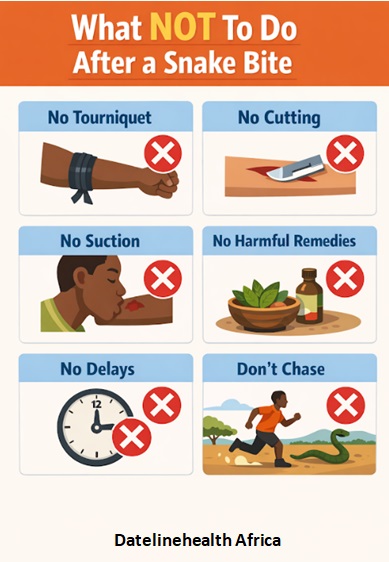
Info poster illustrating what not to do following a snake bite. Click on image to enlarge.
1. Do NOT use a tight tourniquet or band, as it can cut off circulation and cause severe tissue damage.
2. Do NOT cut the wound or try to suck out venom. This will increase the risk of infection and bleeding.
3. Do NOT apply harmful substances or remedies like traditional medicines, chemicals, herbs, or crusts, as they may do more harm by delaying proper care.
4. Do NOT wait for symptoms to appear; seek medical help immediately.
5. Do NOT chase or try to kill the snake to avoid risking more bites or wasting time.
1. Do not keep livestock, especially chickens, inside your house because they attract snakes.
2. Sleep on a raised bed instead of directly on the floor.
3, Avoid creating dark hiding places for snakes around your home or farm.
4. Clear away rubbish, wood piles, and building materials from near your house.
5, Keep grass short and remove thick bushes around your home.
6, Cut tree branches so they do not touch your house.
7. Use a flashlight and wear closed shoes when walking outside at night.
8. Do not put your hands into holes, nests, or hidden spaces where snakes may be hiding.
9. Never touch a snake, alive or dead. Some species pretend to be dead as a defence tactic [3].
Snake bites are common in Africa, especially in rural farming communities. Although the severity of snake bites can range from mild to life-threatening, many cases can be successfully treated, particularly when they are managed promptly with appropriate medical care.
The outcome often depends on how quickly the victim receives antivenom treatment. The longer the delay between the bite and proper treatment, the higher the risk of severe complications or death. Such delays may occur due to a lack of transportation, long distances to healthcare facilities, or the absence of trained personnel and essential equipment in primary health centres. In some cases, reliance on unhelpful traditional practices can further postpone effective medical care and worsen the patient’s condition.
For this reason, correct snake bite first aid should be given immediately after a snake bite. Victims should then be taken as quickly as possible to the nearest health facility that is properly equipped to manage snakebite cases.
1. Bawaskar HS, Bawaskar PH, Bawaskar PH. The global burden of snake bite envenoming. J R Coll Physicians Edinb. 2021;51(1):7-8. doi:10.4997/jrcpe.2021.102. Available from here.
2. World Health Organization. Snakebite. Geneva: WHO; [cited 2026 Feb 18]. Available from here.
3. Chippaux JP, Massougbodji A, Habib AG. The WHO strategy for prevention and control of snakebite envenoming: a sub-Saharan Africa plan. J Venom Anim Toxins Incl Trop Dis. 2019;25:e20190083. doi:10.1590/1678-9199-JVATITD-2019-0083. Available from here.
4. World Health Organization. Guidelines for the prevention and clinical management of snakebite in Africa . Geneva: WHO; [cited 2026 Feb 18]. Available from here.
5. Ralph R, Faiz MA, Sharma SK, Ribeiro I, Chappuis F. Managing snakebite. BMJ. 2022;376:e057926. doi:10.1136/bmj-2020-057926. Available from here.
6. Mehta SR, Sashindran VK. Clinical features and management of snake bite. Med J Armed Forces India. 2002;58(3):247-249. doi:10.1016/S0377-1237(02)80140-X. Available from here.
7. Waiddyanatha S, Silva A, Siribaddana S, Isbister GK. Long-term effects of snake envenoming. Toxins (Basel). 2019;11(4):193. doi:10.3390/toxins11040193. Available from here.
9. Kinda R, Sidibe S, Zongo D, Millogo T, Delamou A, Kouanda S. Factors associated with complications of snakebite envenomation in health facilities in the Cascades Region of Burkina Faso from 2016 to 2021. Trop Med Infect Dis. 2024;9(11):268. doi:10.3390/tropicalmed9110268. Available from here.
10. World Health Organization. Treatment. Geneva: WHO; [cited 2026 Feb 19]. Available from here.
Related:
First Aid for Epilepsy: Essential Life Saving Tips for Africans
How to Save A Life in an Emergency (Tips for Africans)
Published: March 2, 2026
© 2026. Datelinehealth Africa Inc. All rights reserved.
Permission is given to copy, use and share content freely for non-commercial purposes without alteration or modification and subject to source attribution.
DATELINEHEALTH AFRICA INC., is a digital publisher for informational and educational purposes and does not offer personal medical care and advice. If you have a medical problem needing routine or emergency attention, call your doctor or local emergency services immediately, or visit the nearest emergency room or the nearest hospital. You should consult your professional healthcare provider before starting any nutrition, diet, exercise, fitness, medical or wellness program mentioned or referenced in the DatelinehealthAfrica website. Click here for more disclaimer notice.