I am Josephine Simon and Here's My Vision for Health in 2026
By: Josephine Simon, BNSc. RN, RM. Winner of the DLHA’s Guest Post Competition 2026. Reviewed by an Independent Collaborative Team.
.jpg)
A portrait of Ms. Josephine Simon
Walking through the streets of Enugu, I see many young people heading to school every day. Nigeria has one of the youngest populations in the world, with more than 60% of its population under 25 [1]. Young people are the country’s greatest strength; they're energetic, innovative, and eager to make a difference. However, most are unaware of the health policies that impact their lives, and they have little to no influence in shaping the nation’s healthcare system.
During my clinical postings as a nursing student in 2024, I witnessed this gap firsthand. I saw patients struggle to afford basic medical care, not because treatment didn't exist, but because they didn't know how to navigate the system or advocate for themselves.
I watched health centres operate with barely any equipment, due to chronic underfunding. These experiences showed me that the health systems problem of Nigeria isn't just about money or infrastructure but about knowledge and accountability. When people lack understanding of health policies, they are unable to hold their health managers and leaders accountable as well as advocate for better implementation. This promotes a cycle of poor healthcare.
My vision for health in 2026 is to make a change.
I plan to launch an initiative to raise awareness in secondary school and university students in Enugu State about national and global health policies, public health, and the role of youth leadership in making change happen.
This isn't just about education, it's about creating a generation of young Nigerians who understand health systems, can advocate for better healthcare, hold their elected leaders accountable, and will become the health leaders Nigeria desperately needs.
Nigeria faces serious health challenges. Its maternal mortality rate (MMR) of about 1000 per 100,000 live births, remains among the highest in the world [2]. People in the country still battle infectious diseases like malaria, tuberculosis and HIV, while non-communicable diseases like diabetes and hypertension are rising fast [3].
According to the current Honorable Minister of Health and Social Welfare, Dr. Ali Pate, Nigeria currently spends US $120 in local currency equivalent per capita on healthcare. Just about a quarter of that (i.e., $30 in local currency) is contributed by governments, while citizens bear the most cost at two-thirds of the per capita spending [4]. It is no surprise that many health facilities are often poorly equipped, and many Nigerians are unable to afford basic healthcare.
However, what many people don't realise is that young people are almost entirely left out of conversations about these issues.
In our schools, students learn about diseases and biology in science classes. Still, no one teaches them about the policies that determine whether health centres receive funding, how the National Health Insurance Scheme works or what the United Nations Sustainable Development Goals mean for Nigeria’s healthcare [5]. They don't learn how to engage with policymakers or organize community health projects.
The result? A generation of young Nigerians who consume healthcare but don't understand how the system can work better for them.
We have brilliant young minds with fresh ideas about using technology to improve service delivery or make healthcare more accessible. Still, they don't know how to connect those ideas to policy change. They're passionate about health issues but lack the knowledge and skills to advocate effectively.
This has to change. Nigeria's health transformation cannot happen without the energy, innovation, and leadership of knowledgeable young people.
My Plan: The Youth Health Policy and Leadership Program
Starting in early 2026, I will expand on my framework and launch a comprehensive program to raise awareness in secondary school and university students in Enugu about health policy, advocacy and leadership. This program has three main parts.
I will work directly with secondary schools across Enugu to reach students in SS1-SS3. This won't involve changing their curriculum or adding new subjects. Instead, I'll liaise with school heads to arrange special class sessions to introduce students to the basics of health policy and leadership concepts.
During these school visits, students will learn about global health frameworks, including the World Health Organization's guidelines and the Sustainable Development Goals, particularly SDG 3, which focuses on health and well-being [6]. They'll understand that health challenges in Enugu and Nigeria are often connected to patterns happening across Africa and globally.

Ms. Simon (left) as participant in a panel discussion at an event, Click on image to enlarge.
I’ll also introduce them to Nigeria’s health policies. Students will learn about the National Health Act, what the Basic Healthcare Provision Fund does, and how health insurance functions in Nigeria [7].
The knowledge will help them understand why some health centers are effective while others struggle, and how policy decisions impact healthcare quality in their own communities.
Following these introductory sessions, interested students will be invited to participate in comprehensive workshops, which will offer in-depth training in health advocacy, leadership skills, and community health project development.
These workshops may be held virtually or in person, depending on resources and accessibility. For students whose parents have given consent, we'll build relationships with their families through proper consent forms and regular communication, ensuring that parents understand and support their children's participation. This parental engagement is essential for maintaining trust and enabling young people to participate safely in our programs.
At the university level, I'll work to establish Health Policy and Leadership Clubs at institutions such as the University of Nigeria, Nsukka, and the Enugu State University of Science and Technology.
These clubs will offer more advanced training. University students will learn to critically analyse health policies, asking questions such as: Is this policy effective? Who benefits from it? What are its gaps?
Club members will study successful health policy examples from other African countries. For instance, we'll examine Rwanda's community health worker system, which has significantly improved healthcare access in rural areas [8].
Students will also learn about Ethiopia's health extension worker program, which trains young women to deliver essential health services in their communities, as well as Kenya's innovations in mobile health technology that have transformed how people access health information and services [9].
.jpg)
Ms. Simon, second from left, leading a group discussion at an event Click on image to enlarge.
Students will also develop research skills, learn how to assess community health needs, analyze health data, and write policy briefs that present evidence-based recommendations. These are essential skills for anyone who wants to influence health policy, but they're rarely taught outside specialized public health programs.
Club members will be encouraged to put their learning into practice by organizing health awareness campaigns, participating in public health consultations when opportunities arise, and implementing community health improvement projects.
Both secondary school and university participants will be encouraged to design and implement community health projects that address real problems in their neighborhoods.
These include projects to improve health information in local communities, campaigns to address vaccine hesitancy, mental health awareness initiatives, and advocacy for better healthcare facilities. The students themselves will decide the specific projects based on what they see as the most pressing needs in their communities.
This practical component is crucial. It ensures that I’ll not just be teaching theory but actually developing young change-makers who can improve health outcomes now, not just in the future.
My initiative will create changes that reach far beyond the classroom. It will:
Health literacy refers to the ability to understand health information sufficiently to make informed decisions about your own health [9]. Right now, health literacy is low across Nigeria. By teaching young people about health systems and policies, I’ll cultivate a generation that understands how to navigate healthcare services, advocate for quality care, and make informed health decisions. As these young people become adults and parents, they'll spread this knowledge throughout Nigerian society.
Nigeria's health sector needs more professionals who understand policy, not just clinical care. Most of our healthcare workers are trained to treat patients but not to analyse policies, manage health systems, or lead organisations effectively. By introducing students to policy and leadership early, talented young people who might pursue careers in health policy, health systems management, or public health leadership could be identified and supported. These are the people who will run our health ministries, NGOs, and health programs in the future.
III. Facilitate Universal Health Coverage
Nigeria has committed to achieving Universal Health Coverage by 2030, meaning all Nigerians should be able to access quality healthcare without financial hardship [10]. However, progress has been slow. Nigeria's UHC Service Coverage Index score was 35.8 in 2023, down from 38.2 in 2018, indicating that we are moving away from rather than toward our goal [11]. This ambitious goal requires more than government action; it needs society-wide mobilization.
An educated and engaged youth population will hold governments accountable for their health commitments, volunteer for community health programs, and develop grassroots innovations to support national efforts. Young people who understand UHC will advocate for their families and communities to access health services and insurance schemes they may not otherwise be aware of.
Young people often see solutions that older generations miss. Across Africa, youth-led innovations are transforming healthcare delivery through mobile health apps, telemedicine services, community health networks, and creative health financing models [12].
In Rwanda, young innovators developed Ijwi ry'Ubufasha, an AI-powered system that provides confidential support to survivors of gender-based violence and connects them to relevant resources.
In Kenya, youths created Damu Sasa, a blood services management platform that ensures hospitals have adequate blood supplies.
Ethiopia's young entrepreneurs developed solutions such as Enat Infant & Child Nutrition, which provides complementary food to address under-five malnutrition [13].
By providing policy education alongside leadership training, I would be equipping Nigerian youth to develop solutions that actually work within the nation’s health system. They'll understand regulatory requirements, financing mechanisms, and policy processes, so their innovations can be implemented rather than remaining just good ideas.
Good governance includes diverse voices in decision-making. When young people understand health policy and have advocacy skills, they can participate effectively in health planning at the community, state, and national levels. Their participation ensures policies reflect the needs of Nigeria's predominantly young population, leading to more effective and fair health interventions.
Nigeria faces a growing mental health crisis, especially among young people, yet mental health remains heavily stigmatised and chronically underfunded [14]. Youths who are educated in global health will understand that mental health is as important as physical health. They can lead efforts to reduce stigma, establish peer support networks, and advocate for improved mental health services. Young people are often more willing to have open conversations about mental health than older generations.
Turning my vision into reality will require careful planning and partnerships.
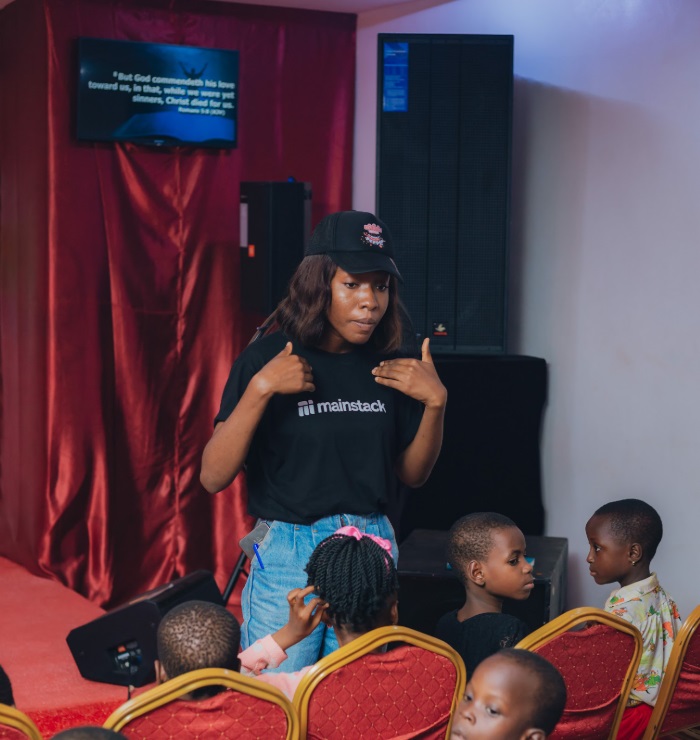
Ms. Simon (standing), speaks with young children at a children and teens event. Click on image to enlarge
The first six months will focus on creating a blueprint for the organisational structure and curriculum, as well as building relationships with schools. I'll register the initiative as a formal organisation with clear leadership and structure. I'll meet with education officials, school principals, and university administrators to explain the program and get their support.
I'll recruit a team of volunteers, including health professionals, educators, policy enthusiasts, and youth leaders who believe in this vision. Together, we'll refine curriculum materials for different age groups, grounded in proven approaches to health education and youth development.
After preparation, I'll launch pilot programs in three secondary schools across the Enugu metropolis, reaching approximately 50 students. I'll also facilitate the creation of a health club at one university, targeting 20 initial members.
I'll work with my team to conduct regular interactive sessions, workshops, and seminars with expert facilitators. My team will mentor students as they develop their first community health projects. And, importantly, my team will carefully monitor what works and what doesn't, documenting both challenges and successes to continually improve the program.
After the pilot year, my team will evaluate results by measuring changes in students' knowledge, attitudes, skills, and actual behaviours. Based on what we learn, we'll refine the program and expand to more schools and universities across Enugu State.
We'll develop a toolkit that other Nigerian states can use to implement similar programs. We'll establish an alumni network to keep program participants connected and engaged, creating a self-perpetuating model of youth leadership.
For this initiative to succeed in the short to long term, it requires attention to the following:
I’ll lead my team of collaborators to pursue diverse funding sources, including grants from health and education foundations, government funding where available, corporate sponsorships and donor impact investments.
This is crucial so that my team can conduct workshops and training sessions regularly in secondary schools and higher educational institutions.
We'll also focus on developing student leaders within the program who can mentor younger participants and eventually help facilitate sessions, creating a self-perpetuating model of youth leadership. By training volunteers from among university participants to help deliver sessions and coordinate activities, we'll build the human resource capacity needed to expand our reach without depending solely on external facilitators.
This will be essential for long-term sustainability. We'll track our impact through careful monitoring and research, and disseminate findings that demonstrate the value of youth health policy education. The evidence of achievements that we demonstrate will help attract continued funding and partnerships while also providing a model that other organizations can learn from and emulate.
No ambitious plan is without obstacles. Here are some of the significant challenges that I expect will be encountered when implementing this vision:
Implementing this vision will require significant short and long term financial resources for pre-program requirements, transportation to schools, venue rentals at universities, educational materials, workshop supplies, volunteer coordination, and program administration. Without adequate funding, my programs wouldn't reach as many students or achieve planned outcomes.
To address this challenge, I plan to start with personal income as seed capital to launch initial programs. Subsequently, I will apply for grants, specifically targeting the Nigeria Youth Futures Fund (NYFF), which offers small grants for grassroots-level initiatives and development grants focused on education, civic engagement, and youth-led social development projects. NYFF accepts rolling applications from both individuals and organizations, making it an ideal funding source to scale the program and ensure sustainability.
Beyond funding, we'll face logistical challenges, including students' demanding schedules and schools' reluctance to host external programs. We'll address this by keeping visits brief and highly engaging, demonstrating clear value to students' overall development, and maintaining flexible scheduling.
Getting parental consent for secondary school students requires clear communication and building trust through transparency about program activities and safety measures.
Some people might resist youth participation in health discussions, believing young people lack the experience to contribute meaningfully. We'll overcome this by ensuring our trained youth demonstrate competence through high-quality advocacy and projects while respectfully engaging with community leaders who support youth empowerment. Maintaining engagement beyond initial enthusiasm will require creating clear pathways for progression from workshop participant to volunteer to youth leader, celebrating student achievements, connecting participation to career opportunities and mentorship, and continuously innovating to keep content fresh and relevant.
My vision for health in 2026 is to build something important. Real and lasting health transformation requires investing in people, especially young people who will lead our health systems for the next sixty years. By establishing comprehensive policy education and leadership training programs in schools and universities in Enugu, I, working with my team of collaborators can start a broader movement that puts youth at the center of Nigeria's health transformation.
1. National Population Commission, Nigeria. Nigeria demographic and health survey 2018 (FR359). Abuja: NPC; 2019. [Cited 2025 Dec. 29]. Available from here. (PDF document).
2. World Health Organization. Trends in maternal mortality 2000 to 2017: Estimates by WHO, UNICEF, UNFPA, World Bank Group and the United Nations Population Division. Geneva: WHO; 2019. p.1-119. Available from here.
3. Institute for Health Metrics and Evaluation. Nigeria profile [Internet, n.d.]. Seattle: IHME; 2021 [Cited 2025 Dec 29]. Available from here.
4. Obokoh A. Nigeria soends $129 per capita on healthcare, government contributes only $30 – Minister. [Internet]. Nairametrics.com. 2025 September 2. [Cited Jan. 31, 2026] Available from here.
5. United Nations. Sustainable Development Goal 3: Ensure healthy lives and promote well-being for all at all ages [Internet, n.d.]. New York: UN; 2015 [Cited 2025 Dec 29]. Available from here.
6. World Health Organization. Health Systems Strengthening Governance. [Internet, n.d.]. Geneva: WHO; [Cited 2025 Dec 29]. Available from here.
7. Federal Ministry of Health, Nigeria. National Health Act, 2014. Abuja: FMoH; 2014. [Cited 2025 Dec 29]. Available from here. (PDF).
8. Binagwaho A, Farmer PE, Nsanzimana S, Karema C, Gasana M, de Dieu Ngirabega J, et al. Rwanda 20 years on: Investing in life. Lancet. 2014;384(9940):371-5. Available from here. (Summary only).
9. Nutbeam D. Health literacy as a public health goal: a challenge for contemporary health education and communication strategies into the 21st century. Health Promot Int. 2000;15(3):259-67. Available from here.
10. Federal Ministry of Health, Nigeria. National Health Policy 2016: Promoting the health of Nigerians to accelerate socio-economic development. Abuja: FMoH; 2016. [Cited 2026 Jan 13]. Available from here.
11. Nigeria Health Watch. Nigeria risks failing to meet its 2030 universal health target as performance lags [Internet]. Abuja: Nigeria Health Watch; 2024 Dec [Cited 2026 Jan 13]. Available from here.
12. Africa Health Collaborative. Africa Health Collaborative champions youth-led innovation at the 2025 AHAIC [Internet]. 2025 Mar 13 [Cited 2026 Jan 13]. Available from here.
13. Africa Health Collaborative. Young innovators reimagining Ethiopia's health future [Internet]. 2025 Oct 14 [cited 2026 Jan 13]. Available from here.
14. Abdulmalik J, Kola L, Fadahunsi W, Adebayo K, Yasamy MT, Musa E, et al. Country contextualization of the mental health gap action programme intervention guide: a case study from Nigeria. PLoS Med. 2013;10(8):e1001489. Available from here.
Published: February 9, 2026
© 2026. Datelinehealth Africa Inc. All rights reserved.
Permission is given to copy, use and share content freely for non-commercial purposes without alteration or modification and subject to source attribution.
DATELINEHEALTH AFRICA INC., is a digital publisher for informational and educational purposes and does not offer personal medical care and advice. If you have a medical problem needing routine or emergency attention, call your doctor or local emergency services immediately, or visit the nearest emergency room or the nearest hospital. You should consult your professional healthcare provider before starting any nutrition, diet, exercise, fitness, medical or wellness program mentioned or referenced in the DatelinehealthAfrica website. Click here for more disclaimer notice.