Parkinson's Disease Explained for Africans: Symptoms and Treatment
By Oluwasola Samuel, Freelance Health Writer. Medically reviewed by A. Odutola. MB BS, PhD, FRCSEd.
Jan. 19. 2026
.jpg)
An AI-generated image of an older Black man gripping a wooden cane, looking down with a thoughtful, heavy expression, suggesting fatigue or physical struggle.
When an elderly person in many African homes starts to show signs of uncontrolled shaking in the hands or head, walks slowly, looks unusually stiff, people often associate it with old age, stress, or even spiritual causes. But the truth is that these signs may point to Parkinson’s disease (a condition that affects the brain cells responsible for smooth movement).
Many African families fail to recognise the signs of Parkinson’s disease early because awareness is low and stigma is common. Some families hide them, others try herbs or spiritual treatments first leaving many undiagnosed.
In this article, you will learn about Parkinson's disease from the following viewpoints:
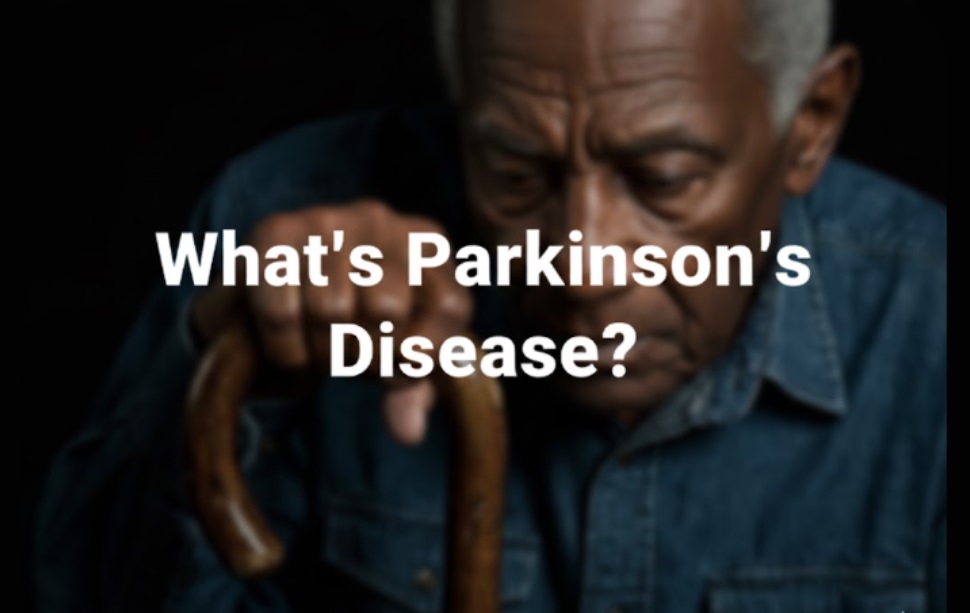
AI generated close up photo of an elderly man leaning on a cane against a dark shaded background. The photo is captioned “What’s Parkinson’s Disease?” in white text. Click on image to enlarge.
Parkinson’s disease (PD) is a brain condition that affects the way a person moves, walks, and controls their body. It happens when a special group of brain cells begin to die slowly. These brain cells produce dopamine, a chemical that helps the body coordinate smooth and controlled movements. When the level of brain dopamine drops, the body starts showing signs like tremor (shaking), stiffness, slowness, and uncoordinated movements.
Parkinson’s disease is not a normal part of ageing, even though it mostly affects older adults. It’s also not a spiritual attack, a curse, or a punishment from a divine being. This is a belief still common in many African communities today.
PD develops gradually, and the early signs may be easy to miss. A person may notice their handwriting getting smaller, their steps getting shorter, or their face looking less expressive. Others may feel weak, or struggle to button their clothes.
Parkinson’s disease is a chronic and progressive condition. This means the situation worsens over time. But early diagnosis and proper treatment can help maintain independence for many years. Understanding the condition especially in the African context where awareness is low is the first step to better care and support.
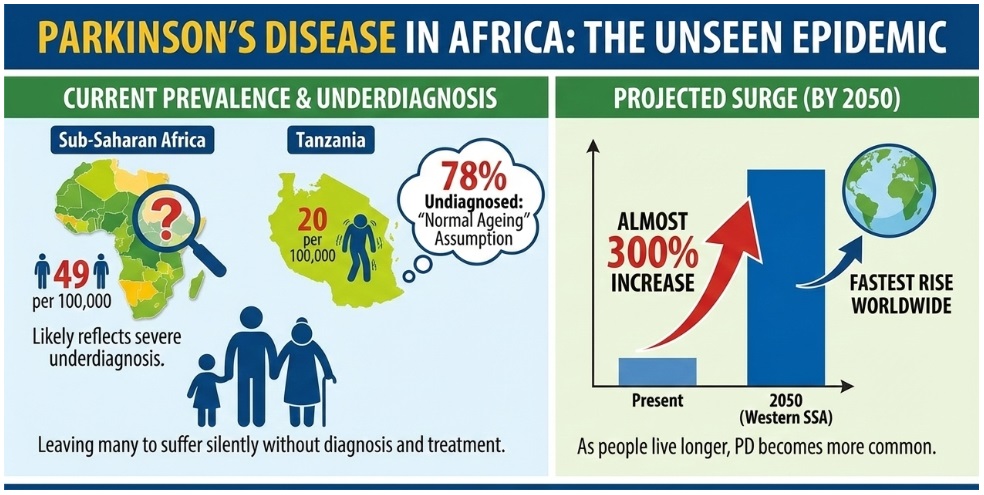
Infographics illustrating Parkinson’s disease prevalence in Sub-Saharan Africa, with indication of a projected rise by year 2050. Click on image to enlarge.
Recent studies report that PD prevalence in Sub-Saharan Africa is about 49 per 100,000 people, far lower than in regions like Latin America and the Caribbean. (1) These figures likely reflect severe underdiagnosis.
A community-based survey in Tanzania shows a different figure 20 per 100,000. It was also noted that 78% of people living with the disease have never been medically diagnosed. (2) This paints a picture about how many go undiagnosed as a result of poor awareness and or assumption that the disease is a part of normal ageing.
By 2050, PD cases in Western Sub-Saharan Africa are projected to increase by almost 300%. (3) This is the fastest rise anywhere in the world. As people live longer, more will reach the age where Parkinson’s disease becomes common. But African healthcare systems are largely unprepared. With limited data, few qualified neurologists, and poor access to quality healthcare, a lot needs to be done to tackle this impending menace.
Symptoms and signs of Parkinson's disease
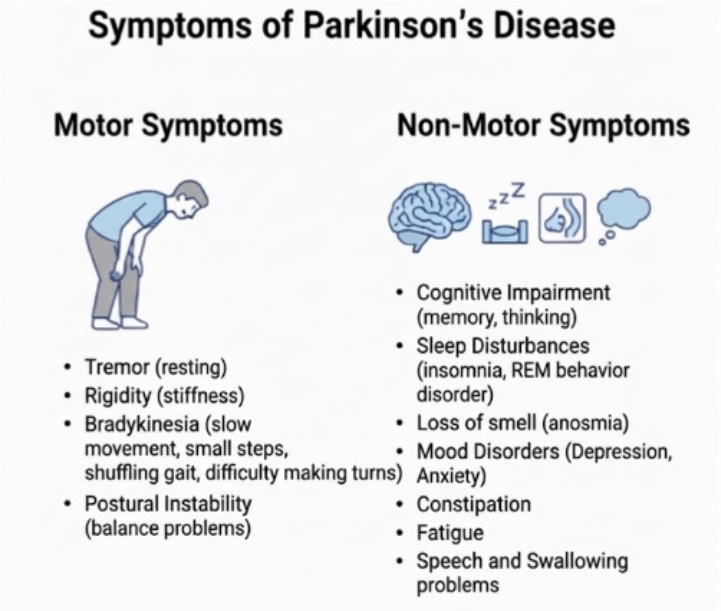
Info poster listing the motor and non-motor symptoms and signs of Parkinson's disease. Click on the image to enlarge.
The symptoms and signs of PD are generally grouped into:
Motor symptoms and signs are the conditions that people describe or notice first, and they include:
Tremor is a shaking movement that usually starts in one hand. It may look like the person is rolling something between their fingers. It is worse when the person is at rest and improves when the hand is in use.
Slow movements make daily activities take longer. Activities like standing up, walking, dressing, or writing become slow. The person may freeze in place or take very small steps. Gait may be shuffling and turns are difficult to make, causing a tendency to fall.
The muscles feel tight, making it difficult to bend, turn, or move freely. The stiffness can occur in the arms, legs, neck, or back.
Balance problems are common with PD because of the muscle stiffness and bradykinesia (slow movements).
Your family members may notice that one or both arms do not move naturally while walking.
You may stand or walk while bending forward without realising it.
Your face may appear less expressive. People may think that you look sad or uninterested, even when you are fine.
Your voice may become softer, shaky, or unclear. Some people sound like they are whispering.
Handwriting becomes smaller, cramped, and difficult to read.
Non-motor symptoms and signs are common but often ignored in many African homes because of poor awareness.
These include:
You may stop smelling things well. For example, you may not smell perfume, food, or smoke easily.
You may have trouble sleeping. You may also start acting out dreams, feel restless at night, or get annoyed too many times.
Difficulty passing stool is often one of the earliest signs. You may begin to feel discomfort in your bowel but be unable to pass stool easily.
Fatigue is one of the symptoms you may feel, even after resting well.
Depression, anxiety, irritability, or unexplained sadness are symptoms you may begin to feel if you have PD. Many families often think it's caused by stress or worry, but it's not.
You may begin to forget things easily, have difficulty planning tasks, experience confusion, or slow thinking later in the disease.
You may feel lightheaded when you stand up quickly due to low blood pressure.
You may begin to struggle to control urine (incontinence) or feel the urge to urinate frequently.
Food may take longer to go down. Choking or coughing during meals may be common.
.jpg)
Image titled “Parkinson’s disease: Cause” showing an AI-generated photo of the close up headshot of an elderly African man with a caption reading “low brain dopamine” overlying a drawing of the brain.
Parkinson’s disease is a neurological condition that develops when certain changes occur to cause the death of dopamine producing cells in a specific part of the brain. While researchers still do not fully understand the exact cause, a mix of genetic and environmental factors are believed to play a role in how the disease begins and progresses. (4)
Here are what is currently known about the causes and risk factors of PD:
The main symptoms of PD are linked to a drop in dopamine. (5) Dopamine is an important chemical messenger in the brain that helps regulate movement, balance, and coordination.
In PD, the cells in the brain that produce dopamine die gradually. As dopamine levels fall, it becomes harder for the brain to send clear movement signals to the body. This leads to symptoms and signs like tremors, stiffness, slow movement, and balance problems.
As this condition progresses and dopamine continues to decline, the symptoms and signs often become more severe over time.
Known risk factors that have been linked to PD include:
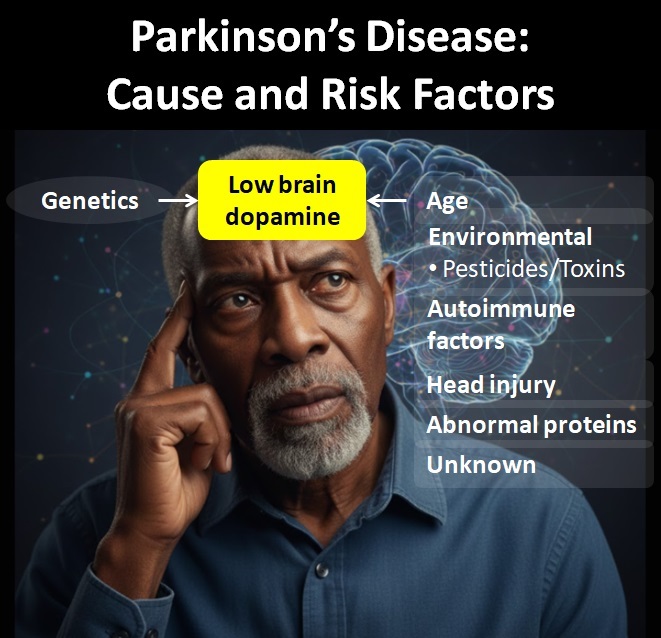
Info poster showing some of the common risk factors of Parkinson’s disease. Click on image to enlarge.
Age is the biggest risk factor for PD with an average age of age of 60 years
3. Genetic mutations
Some gene changes (mutations) have been linked to PD, but most cases are not inherited. Researchers estimate that genetics plays a role in about 10% of cases, particularly in people who develop PD at a younger age. (6)
For most people, PD results from a combination of genetic susceptibility and environmental or biological factors, rather than a single inherited gene.
Environmental factors like pesticides, herbicides, and industrial chemicals can kill the brain cells that make dopamine. These harmful chemicals also damage the brain’s energy system, making brain cells weak and easier to destroy. Over time, they cause harmful protein buildup and long-lasting brain inflammation. This slowly damages and increases your risk of Parkinson’s disease.
5. Autoimmune factors
Emerging research suggests that immune system dysfunction may also be involved. Some studies have found connections between PD and autoimmune conditions, such as rheumatoid arthritis. (7) While this does not prove a direct cause, it highlights the possible role of chronic inflammation and immune responses in the disease process.
However, ongoing research continues to explore how autoimmune activity may contribute to nerve cell damage in PD.
6. Head injury
A serious head injury or repeated trauma to the head can increase your likelihood of developing Parkinson’s disease later in life. Falls, accidents, and engaging in contact sports without head wear protection are contributing factors.
7. Abnormalities brain proteins
In PD, abnormal clumps of a protein called alpha-synuclein, also known as Lewy bodies, accumulate in the brain. These clumps interfere with normal brain function and may lead to cell death. The causes of the abnormal proteins are complex.
Men are slightly more likely to develop Parkinson’s than women (4). Poor nutrition, certain medical conditions and infections may also play roles in increasing your risk.
9. Idiopathic (Unknown) Factors
For most people, the cause of PD is unknown as it may be a combination of some of the earlier stated risk factors
Although it is unclear if PD can truly be prevented, a better awareness of its risk factors will help Africans to take actions to lower their odds of having the condition.
Diagnosis of PD involves:
The first step is a thorough enquiry about your medical history and symptoms. Your doctor will ask about when your symptoms started, how long you have had it, and whether it is getting worse or stable. The doctor may ask about your work history, the possibility of exposure to hazardous chemicals, the medications you are taking, and whether anyone in your family has similar symptoms.
In addition to a general body check, your doctor will focus on cheking the functional status of your brain and spinal cord (central nervous system).
Your doctor will carry out a motor examination or motor function tests , to observe the nature of your tremor, check for muscle stiffness, coordination, reflexes, walk patterns, and facial expression. They may ask you to perform simple movements, like tapping fingers, walking across the room, or walking and turning round.
Other brain and spinal cord examinations that your doctor may conduct include a check of your general sensations, your hearing, sense of smell, taste, sight, eye movements etc.
These physical checks allow your doctor to assess any gaps in the functioning of your brain and spinal cord and identify the characteristic signs of PD.
Although not always necessary, imaging tests can help rule out other conditions.
Common scans include:
They do not help diagnose PD but they are often used to rule out other similar health conditions such as strokes, tumours, or other brain injuries.
This is a specialised scan that shows the level of dopamine in the brain, which can help support a PD diagnosis.
Sometimes doctors prescribe a small dose of levodopa, a common PD medication, to see if symptoms improve. A positive response can confirm the diagnosis, as this drug specifically targets dopamine deficiency caused by PD.
There are no blood or urine tests that can diagnose PD directly. However, laboratory tests may be done to rule out other causes of tremors or stiffness, such as thyroid problems or infections.
This test is carried out if you have a family history or an early onset of PD.
Early diagnosis is crucial because when you start treatment early, it can help you manage your symptoms better and improve your quality of life.
There is currently no known cure for PD, but researchers are making vital discoveries and conducting clinical trials to find a cure in the not distant future. (8) However, there are some treatments (medication, therapy, or surgery) that are known to improve the symptoms of the condition.
These treatments include:
Medications are usually the most common, effective, and primary way of treating PD symptoms. These medications help replace or mimic dopamine, which is absent or low in people living with PD.
Some of the medications include:
Levodopa is considered the most effective and widely used medication for treating PD. After it is taken, levodopa enters your brain and it is converted into dopamine. As levodopa increases brain dopamine levels, it helps to improve tremors, muscle stiffness, slow movement, and overall coordination, making everyday activities like walking, dressing, and eating easier.
Carbidopa on the other hand is usually given together with levodopa. Carbidopa helps levodopa work more efficiently (as it prevents levodopa from breaking down too early in the body before it reaches the brain). This allows more levodopa to get into your brain and reduces side effects such as nausea, vomiting, and dizziness.
Dopamine agonists are medications that act like dopamine in the brain. They stimulate the same receptors (sites) that dopamine normally uses. Instead of being converted into dopamine like levodopa, dopamine agonists mimic dopamine’s effect, helping your brain send signals that control movement. This can reduce symptoms such as tremors, muscle stiffness, and slow movement.
Although dopamine agonists are not as strong as levodopa, they are often useful in the early stages of Parkinson’s disease, especially in younger patients. However, they can have side effects such as sleepiness, swelling of the legs, dizziness, or impulse control problems, so doctors carefully monitor patients and adjust treatment based on individual response.
Common medications in this class include:
These are a group of medications used to help manage PD by protecting dopamine in the brain. They work by blocking an enzyme called monoamine oxidase-B, which breaks down dopamine. MAO-B inhibitors slow down the breakdown of dopamine in the brain, allowing the brain to use its remaining dopamine for a longer time.
MAO-B inhibitors are often used in the early stages of PD to provide mild symptom relief. As the condition progresses, doctors may add MAO-B inhibitors to other treatments, like levodopa, to boost their effectiveness and extend how long they work during the day.
Common medications in this class include:
These medications work by blocking acetylcholine, a chemical in the brain whose activity becomes more pronounced when dopamine level drops in the brain. Anticholinergics are used to treat the tremor and muscle rigidity of PD but are recommended to be used with caution in elderly patients because of the risk of serious complications and side effects, including dry mouth, blurred vision, sedation, delirium, hallucinations, constipation and urinary retention.
Common medications in this class include:
Medications may work well, but many people also need therapies that help with movement, communication, and daily activities.
Here are some helpful therapies:
Physiotherapy plays an important role in managing PD, alongside medication. A trained physiotherapist (a healthcare professional who specialises in helping to restore movement and function) helps you learn safe and targeted exercises that improve balance, muscle strength, flexibility, and walking patterns.
These exercises focus on reducing stiffness, improving posture, and making movements smoother and more controlled. You will be taught techniques for standing up, turning, and walking with better confidence.
This therapy helps you adapt to daily tasks, such as dressing, bathing, and cooking, so you can stay independent for a longer time. Occupational therapy focuses on finding easier and safer ways to help you learn how to carry out everyday activities that may become difficult due to slow movement, stiffness, or poor balance.
An occupational therapist (a healthcare professional who helps people engage in activities they need to do in their daily lives) may suggest using simple tools, rearranging your home environment, or changing how tasks are done to reduce strain and prevent falls. They also teach you energy saving techniques and problem solving skills that help you continue caring for yourself with confidence, even as symptoms progress.
Many people living with PD often develop soft, unclear, or slurred speech. This makes it difficult for others to hear or understand them. This happens because the muscles that control your voice, tongue, and breathing become weak or slow. As a result, you may speak quietly, rush words, or sound monotone, which can affect confidence and social interaction.
A speech therapist (a healthcare professional who evaluates and treats disorders related to communication, voice and swallowing) teaches you practical techniques to help improve voice volume, clarity, and breathing control. These may include exercises to strengthen the voice muscles, slow down speech, swallowing, and improve pronunciation.
Physical activity helps improve muscle strength, flexibility, balance, and coordination. It can reduce stiffness, slow down movement problems, and lower your risk of falls. Even simple home based exercises done consistently can make a noticeable difference.
Lifestyle habits like getting good sleep helps the brain and body recover and reduces fatigue during the day. Eating healthy, balanced meals supports overall energy levels and helps manage issues like constipation. Mental engagement, such as reading, social interaction, or puzzles helps keep your brain active and may slow cognitive decline. Together, regular exercise and healthy lifestyle choices improve your overall wellbeing and quality of life.
When medication and supportive therapy no longer control symptoms well, you may be advised to consider surgery to help improve your symptoms and quality of life. Surgical options include the use of pinpoint high frequency radio waves to place lesions in specific deep brain structures that control motor movements or implant a stimulating electrode in one of the deep brain structures (Deep brain Stimulation).
DBS involves placing tiny electrodes in specific parts of your brain. These electrodes are connected to a device implanted near your chest that sends gentle electrical pulses. DBS can significantly reduce tremor, rigidity, and dyskinesia (involuntary movements) in people who still respond to levodopa but have fluctuations or side effects. It does not cure the disease but can improve quality of life over time.
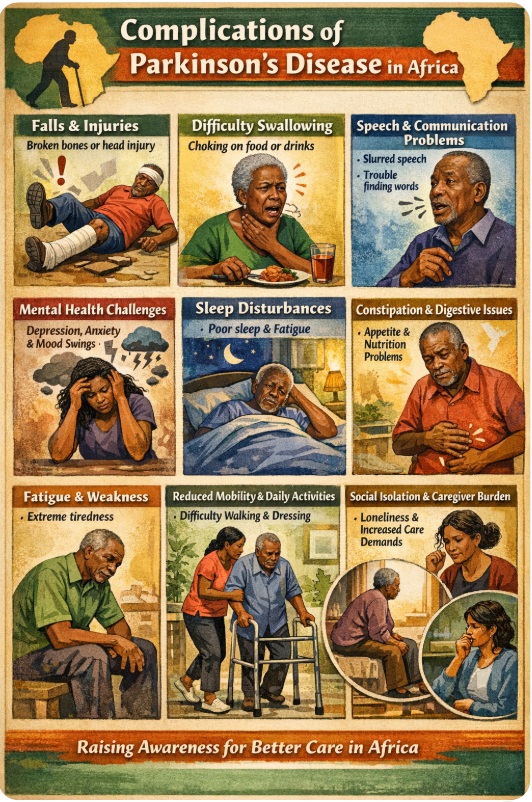
AI generated info poster illustrating some common complications of Parkinson's disease. Click on image to enlarge.
PD can lead to several complications if not diagnosed and managed early. These complications can affect both your body and quality of life. This makes daily activities harder and increases the burden on caregivers.
Possible complications include:
Understanding potential complications helps families take preventive steps and seek timely care.
You should see a doctor if you notice persistent changes in movement or daily activities that do not improve over time. Note warning signs like shaking in one hand or leg, slow movement, muscle stiffness, difficulty walking, frequent falls, or a change in posture. If simple tasks like standing up, dressing, writing, or speaking become a bit difficult, you should reach out to your doctor.
It is also important to see a doctor if non-movement symptoms appear, especially when they occur together with movement problems. These include constipation, sleep disturbances, loss of smell, mood changes such as depression or anxiety, memory difficulties, and constant tiredness. When you seek medical help early, it allows for proper diagnosis and timely treatment, which can slow symptom progression and reduce complications.
People with PD can live many years, even decades, after diagnosis. PD itself is not usually fatal. Most people die from other age-related conditions, not directly from this condition. Life expectancy depends on:
You can improve the quality of your life with proper and early treatment, regular follow-up, exercise, and strong family support.
Older people are mostly at risk of this condition. Your risk increases sharply after age 60, though a small number develop symptoms earlier in life. (9) Men are more likely than women to develop the condition. (4) Research also shows that environmental exposures such as long-term contact with pesticides or herbicides and a history of head injuries are linked to an increased risk of developing PD. (10)
No, stress does not directly cause PD. This condition develops mainly because of changes in the brain that affect dopamine-producing cells. However, long-term or severe stress can worsen symptoms in people who already have PD or who are at risk. Stress can increase tremors, stiffness, sleep problems, fatigue, and mood changes, making the condition harder to manage.
Yes, many people with PD can still drive, especially in the early stages of the condition. If you have this condition, it does not automatically mean you must stop driving. What matters most is how the symptoms affect your ability to drive safely. However, driving may become difficult if symptoms like slow reaction time, stiffness, tremors, poor coordination, vision problems, or reduced concentration interfere with control of the vehicle.
PD is usually not hereditary, however it sometimes runs in families, but this is rare. For most people, genetics play only a small role compared to age and environmental factors.
Parkinson’s disease, also known as PD, is a progressive condition that mainly affects movement. This leads to symptoms such as tremors (shaking), stiffness, slow movement, and balance problems. The exact cause is not fully known, but age, genetics, and long-term exposure to toxins such as pesticides can increase your risk.
Symptoms of PD can be improved with medications, regular exercise, physiotherapy, speech therapy, and emotional support. Early diagnosis and consistent care can greatly improve quality of life and help people live well with Parkinson’s disease. While PD cannot be fully prevented, the risk may be lowered by staying physically active, eating a balanced diet, protecting your head from injury, and reducing exposure to harmful chemicals.
2. Oluwole OG, Kuivaniemi H, Carr JA, Ross OA, Olaogun MOB, Bardien S, et al. Parkinson’s disease in Nigeria: A review of published studies and recommendations for future research. Parkinsonism & Related Disorders 2019 May 1;62:36–43. Doi: 10.1016/j.parkreldis.2018.12.004. Available from here.
3. Su D, Cui Y, He C, Yin P, Bai R, Zhu J, Lam JST, Zhang J, Yan R, Zheng X, Wu J, Zhao D, Wang A, Zhou M, Feng T. Projections for prevalence of Parkinson's disease and its driving factors in 195 countries and territories to 2050: modelling study of Global Burden of Disease Study 2021. BMJ. 2025 Mar 5;388:e080952. doi: 10.1136/bmj-2024-080952. Available from here.
4. National Institute of Neurological Disorders and Stroke. Parkinson’s disease. [Internet]. Last updated March 5, 2026. [Cited 2026 Jan 2]. Available from here.
5. American Association of Neurological Surgeons. Parkinson’s Disease. [Internet, n.d.]. [Cited 2026 Jan 2]. Available from here.
6. MedlinePlus. Parkinson’s Disease. [Internet]. Last updated May 1, 2012. [Cited 2026 Jan 2]. Available here.
7. Zheng Z, Zhang S, Zhang H, Gao Z, Wang X, Liu X, Xue C, Yao L, Lu G. Mechanisms of Autoimmune Cell in DA Neuron Apoptosis of Parkinson's Disease: Recent Advancement. Oxid Med Cell Longev. 2022 Dec 14;2022:7965433. doi: 10.1155/2022/7965433. Available from here.
8. NHS UK. Parkinson’s disease - Treatment [Internet]. Last reviewed November 3 2022. [Cited 2026 Jan 2]. Available from here.
9. National Institute on Aging. Parkinson’s disease: Causes, Symptoms, and Treatments [Internet]. Reviewed April 14 2022. [Cited 2026 Jan 2]. Available from here.
10. Rajawat NK, Bhardwaj K, Mathur N. Risk of Parkinson disease associated with pesticide exposure and protection by probiotics. Materials Today: Proceedings. 2022; 69:Part 4 p.A1–11. Available from here.
Related:
Vascular Dementia Explained for Africans: Causes, Types and Stages
Dementia: What Africans need to know
Alzheimer's disease: What Africans need to know
Lewy Body Dementia: What Africans need to know
Published: January 19, 2026
© 2026. Datelinehealth Africa Inc. All rights reserved.
Permission is given to copy, use, and share content freely for non-commercial purposes without alteration or modification and subject to source attribution.
DATELINEHEALTH AFRICA INC., is a digital publisher for informational and educational purposes and does not offer personal medical care and advice. If you have a medical problem needing routine or emergency attention, call your doctor or local emergency services immediately, or visit the nearest emergency room or the nearest hospital. You should consult your professional healthcare provider before starting any nutrition, diet, exercise, fitness, medical or wellness program mentioned or referenced in the DatelinehealthAfrica website. Click here for more disclaimer notice.