Umbilical Cord Care for African Newborn Babies (Tips)
By Kelechi Nwaowu, Freelance Health and Wellness Writer. Medically reviewed by Chiamaka Wisdom-Asotah, MB.BS.
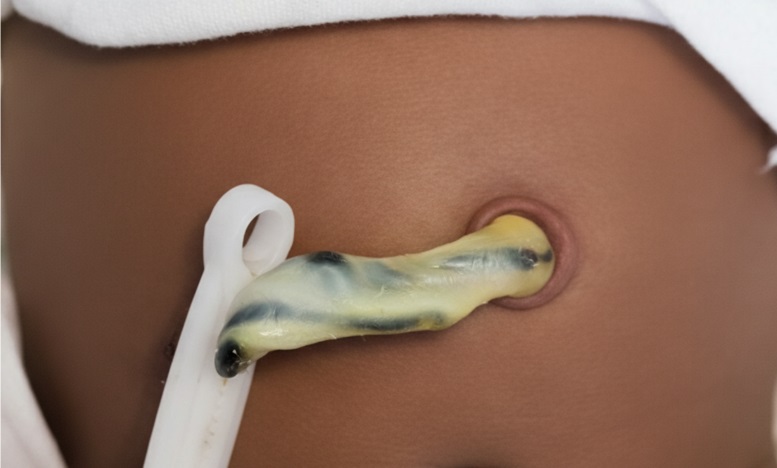
Newborn baby's umbilical cord stump with plastic clamp| Credit: Google AI Studio. Click on image to enlarge.
Bringing a new baby into the world is a moment of great joy for every family. After the baby is born and the umbilical cord is cut, a small stump remains attached to your baby's belly button. This stump needs special care to prevent serious infections that can threaten your baby's life.
Many newborn deaths in Africa happen because of infections that enter through the umbilical cord stump. This article will teach you the safe, proven ways to care for your baby's cord and protect them from harm.
Related: Postnatal Care is Essential for New African Mothers and Babies
The umbilical cord connects a baby to the mother during pregnancy. It's a lifeline that carries oxygen and nutrients from the mother to the baby in the womb. The cord contains blood vessels covered by a jelly-like substance and protected by a membrane.
When your baby is born, the cord is no longer needed. Healthcare providers cut the cord, leaving a small stump about 2 to 4 centimetres long attached to your baby's belly button. This stump will dry up and fall off on its own, usually within 5 to 15 days after birth (1).
After the cord is cut, the stump that remains begins to change. At first, it looks bluish-white and feels moist. Over the next few days, it starts to dry out. The stump gradually becomes darker, turning black or dark brown as it dries. Eventually, it shrinks as it dries up completely and falls off, leaving behind your baby's belly button.
Think of the cord stump as a small wound that is healing. Just like any wound on your skin, it needs to be kept clean to heal properly. During this healing time, your baby's body is working to close off the blood vessels and seal the area where the cord was attached.
The umbilical cord stump is a dangerous entry point for bacteria. Immediately after birth, bacteria from the environment start to settle on the stump. The stump provides a perfect environment for harmful bacteria to grow because it contains dead tissue that is moist and warm (2).
If dangerous bacteria get into the stump, they can travel through the blood vessels directly into your baby's bloodstream, causing a serious infection called sepsis. The stump can also become infected locally, causing a condition called omphalitis – a bacterial infection of the umbilicus and surrounding tissues (3).
Umbilical cord infections remain a serious problem in Africa. Neonatal mortality or death in newborn babies in Uganda decreased from 27 deaths out of 1,000 live births in 2016 to 22 deaths out of 1,000 live births in 2022, partly due to improved cord care practices (3). However, infections related to poor cord care continue to threaten newborn lives across the continent. This is why proper cord care is so important – it can save your baby's life.
The World Health Organization recommends a simple method called "Clean and Dry Cord Care" for babies born in health facilities and in places with good hygiene (2, 4). This method is safe, easy, and has been proven to prevent infections when followed correctly.
Clean and dry cord care means exactly what it says: keep the cord stump clean and keep it dry. You do not need to apply any special medicines, oils, or powders to the stump. Simply let it dry naturally in the open air.
Follow these simple steps every day to care for your baby's umbilical cord stump:
Before you touch the cord stump or the area around it, always wash your hands thoroughly with soap and clean water. Dry your hands with a clean towel. This is the most important step because dirty hands can transfer harmful germs to your baby (2).
The stump needs to stay dry to heal quickly. After bathing your baby (using a sponge bath), gently pat the cord stump and the area around it completely dry with a clean, soft cloth or gauze. Make sure no water is left behind.
Allow air to reach the stump as much as possible. Fresh air helps the stump dry faster. When the weather is warm, you can dress your baby in just a loose shirt and diaper to give the stump maximum air exposure.
When putting on your baby's diaper, fold the front part down so it sits below the cord stump. This prevents the diaper from rubbing against the stump and keeps urine and stool away from it. Many newborn diapers have a special cut-out area for the cord.
If the stump gets dirty from urine or stool, clean it gently. Use clean water and a soft, clean cloth or gauze. Gently wipe away any dirt, and then pat the area completely dry. Do not scrub or pull on the stump.
Never try to pull off the stump, even if it looks like it is hanging by a thread. Let it fall off on its own. Pulling it off early can cause bleeding and increase the risk of infection.
Watch related video below:
Until the cord stump falls off and the area heals completely, do not put your baby in a tub of water or bucket bath. Instead, give your baby sponge baths:
Many families especially in rural African communities have been using traditional substances on the umbilical cord for generations. While these practices come from a place of love and a desire to help the baby, science has shown that most of them are extremely dangerous and can kill your baby.
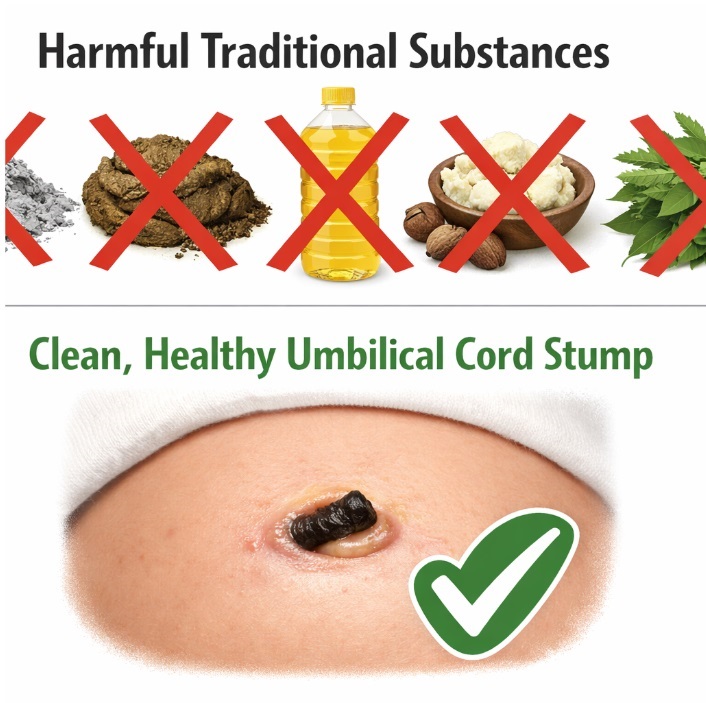
Harmful traditional substances for umbilical cord care including ash, cow dung, oils and herbs marked with red X symbols. Click on image to enlarge.
Traditional substances applied to the cord stump are not safe. Research across Africa has found that traditional families commonly apply the following substances to the umbilical cord (5, 6, 7):
Here is why these substances are deadly:
Mothers and traditional birth attendants in the State (Bayelsa) described their cord care practices as follows:
“After we cut the cord, we use hot water and (methylated) spirit to clean it, then we put breast milk on the cord, we also put the native leaf, “Never die” and “alligator” pepper so that the cord will not pain the baby. We put the “never die” leaves on fire ,squeeze it, and then put it (the extract) on the cord till after a very short while, the cord will fall.” — Traditional Birth Attendant, Sagbama LGA.
“After cutting the cord, at home we use hot water, to press it so that the heat will go inside the belly of the child. After, we use (methylated) spirit to clean it and then, after that we apply “ROBB” and then “alligator pepper” so that the hotness of the pepper will enter inside the stomach… that process will not allow the child’s cord to be painful or have any issues..” — Respondent 4, Ogbia LGA.
“First of all, we use (methylated) spirit to clean the navel (cord) so that it will not have an odour, then we use salt (cooking salt), “Never die” leaf, and ashes (from firewood) to finish it”. — Respondent 1, Ogbia LGA.
One mother reported:
"For my first baby, I used 'Close-up' (toothpaste) and it (the umbilical cord) fell off quickly but before I knew it 'air had entered the baby's stomach' because the cord was not dry, I regretted using it."
Toothpaste contains chemicals that are not meant for open wounds and can cause irritation, infection, and prevent proper drying of the cord stump.
The World Health Organization and scientific studies have clearly shown that applying these substances significantly increases your baby's risk of developing omphalitis (cord infection), sepsis (blood infection), neonatal tetanus, and death. Even if your grandmother or other family members used these substances and their babies survived, many other babies have died from these practices.
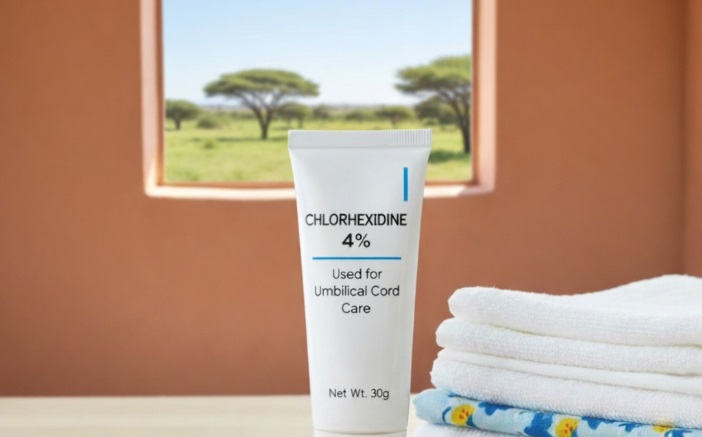
AI generated visual representation of a 4% Chlorhexidine antiseptic gel used for umbilical cord care. Image Credit| Gemini AI. Click on the image to enlarge.
Chlorhexidine for umbilical cord care is an antiseptic (germ killing) medicine that comes as a gel or liquid. It is specifically made for cleaning the umbilical cord in certain situations.
The World Health Organization recommends daily chlorhexidine (4%) application to the umbilical cord stump during the first week of life for newborns who are born at home in situations where neonatal (newborn) death rate is very high. A high neonatal death rate means that out of every 1000 babies born alive, 30 babies die (4). In these high-risk situations, studies have shown that applying chlorhexidine to the cord stump daily for the first seven days of life can reduce cord infections and save babies' lives.
If your baby is born in a hospital or health facility with good hygiene practices, chlorhexidine is usually not necessary. Clean and dry cord care works just as well in these settings. The WHO recommends clean, dry cord care for newborns born in health facilities and at home in low neonatal death rate situations. The use of chlorhexidine in these conditions may be considered only to replace application of a harmful traditional substance to the cord stump (4).
Important: Never use chlorhexidine or any other medicine on your baby's cord unless a trained healthcare provider prescribes it and shows you exactly how to use it. Do not buy medicines on your own to apply to the cord.
Omphalitis is a serious bacterial infection of the umbilical cord stump and the surrounding skin. It can happen when harmful bacteria enter the stump. Without quick treatment, the infection can spread throughout your baby's body and cause death.
You must watch your baby's cord stump carefully every day for signs of infection. Call your doctor or go to the nearest health centre or hospital immediately if you notice any of these warning signs:
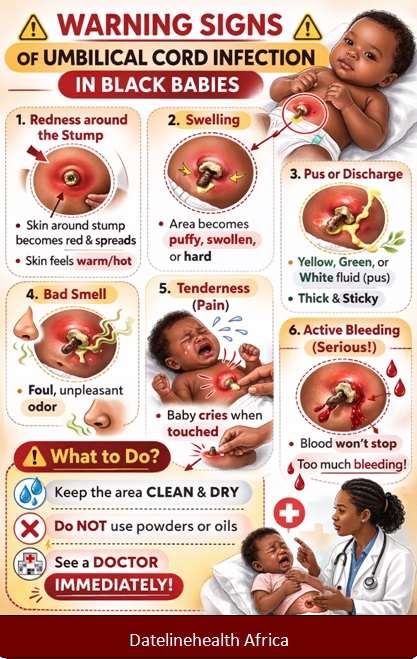
Info poster showing warning signs of umbilical cord infection. AI generated from ChatGPT. Click on image to enlarge.
Related: Why Tetanus Toxoid Vaccination in Pregnancy Matters in Africa
Some signs mean the infection has spread beyond the cord area into your baby's bloodstream. These are emergency signs – you must take your baby to the health centre or hospital immediately:
Do not wait if you see any of these signs. Cord infections can become deadly within hours if not treated. Quick medical treatment with antibiotics can save your baby's life.
Sometimes after the cord falls off, you may notice a small, moist, pinkish or reddish lump of tissue at the belly button. This is called an umbilical granuloma. It is not an infection but extra tissue that formed during healing.
An umbilical granuloma may produce a small amount of clear or yellowish fluid. It is usually not painful, and your baby does not have fever or other signs of being sick. Most granulomas are harmless and may go away on their own.
However, you should still take your baby to the doctor if you see a granuloma. The doctor can examine it to make sure it is not an infection and can treat it if necessary.
When you have been caring for the cord properly, it will dry up completely and fall off on its own. This usually happens between 5 to 15 days after birth, though it can sometimes take longer (1). The cord falling off is a natural part of healing.
When the cord stump falls off, you may find it on your baby's clothes, in the diaper, or on the bedding. This is normal. After the stump falls off, you will see the healing belly button underneath.
Caring for your baby's umbilical cord stump is one of the most important things you can do to protect your newborn from life-threatening infections. The clean and dry method is simple, safe, and scientifically proven to work. By keeping the stump clean, dry, and exposed to air, and by avoiding harmful traditional substances like cow dung, ash, and oils, you give your baby the best chance at a healthy start in life.
Remember to wash your hands before touching the cord, fold the diaper down to keep it away from the stump, give sponge baths until the cord falls off, and never pull on the stump.
Watch carefully for warning signs of infection and seek medical help immediately if you notice redness, swelling, pus, bad smell, or if your baby develops a fever or seems unwell.
Traditional practices passed down through generations may seem harmless, but science has shown they can be deadly. Trust in the proven, safe methods recommended by healthcare providers and the World Health Organization. Your baby's life is precious, protect it by following these simple cord care guidelines.
1. Children's Health Ireland. Umbilical cord care guideline. [Internet]. December 2023. [Cited January 16, 2026]. Available from here.
2. Kalufya NA, Seif SA, Masoi TJ. Knowledge and practice of umbilical cord care among young mothers of neonates in Tabora region: Analytical cross-sectional study. Medicine. 2022 Dec 9;101(49):e31608. Available from here.
3. Wogabaga J, Burgoine K, Kakuru A, Nambozo B, Chebet M, Tumuhamye J, Wanume B, Oguttu F, Musaba MW, Napyo A, Wani S. Incidence and risk factors for clinical omphalitis among neonates in Eastern Uganda using chlorhexidine gel for cord care: a community-cohort study. BMC Pediatrics. 2025 Jan 24;25(1):55. Available from here.
4. Israel CE, Attama KO, Opara HC, Ihudiebube-Splendor CN, Omotola NJ. Knowledge .and use of chlorhexidine gel in umbilical cord care among postpartum women at Poly General Hospital, Enugu, Southeast Nigeria: a cross-sectional study. International Health. 2024 May;16(3):334-43. Available from here.
5. Negash FB, Simel LL, Tekle LR, Berhane BB. Harmful Traditional Practices of Umbilical Cord in Edaga Hamus Community, Asmara, Eritrea. Pediatric Health, Medicine and Therapeutics. 2024 Dec 31:181-8. Available from here.
6. Burayu ET, Degefa BD. Exploring harmful traditional practices and its associated factors among puerperal mothers who delivered in public health facilities in southwestern Ethiopia. Scientific Reports. 2024 Nov 7;14(1):27065. Available from here.
7. Duru CO, Oyeyemi AS, Adesina AD, Nduka I, Tobin-West C, Nte A. Sociocultural practices, beliefs, and myths surrounding newborn cord care in Bayelsa State, Nigeria: A qualitative study. PLOS Global Public Health. 2023 Mar 28;3(3):e0001299. Available from here.
Published: February 22, 2026
© 2026. Datelinehealth Africa Inc. All rights reserved.
Permission is given to copy, use and share content for non-commercial purposes without alteration or modification and subject to source attribution.
DATELINEHEALTH AFRICA INC., is a digital publisher for informational and educational purposes and does not offer personal medical care and advice. If you have a medical problem needing routine or emergency attention, call your doctor or local emergency services immediately, or visit the nearest emergency room or the nearest hospital. You should consult your professional healthcare provider before starting any nutrition, diet, exercise, fitness, medical or wellness program mentioned or referenced in the DatelinehealthAfrica website. Click here for more disclaimer notice.