Why Late Nights Breed Loneliness and Anxiety — The Science
By: Foluke Akinwalere, Health & Medical Writer. Medically reviewed by the DLHA Team.
June 28, 2026
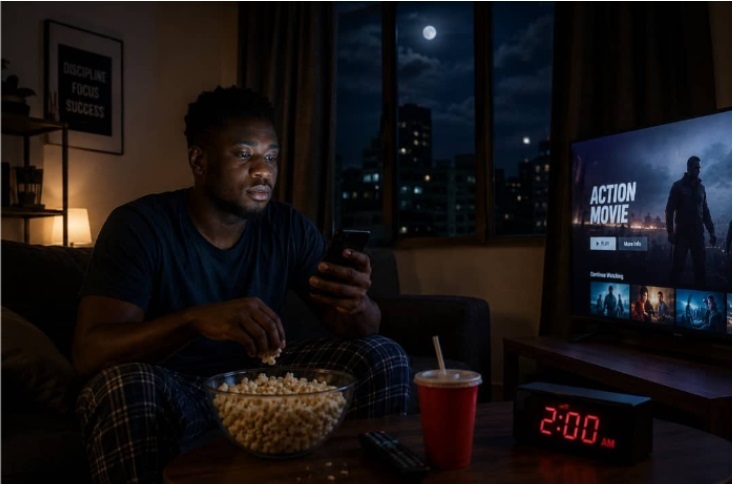
Image of a young African man, staying up at night, eating popcorn, watching a movie while scrolling through his phone. Image created from ChatGPT. Click on tmage to enlarge.
Introduction
If you are someone who stays awake until midnight or beyond, scrolling through your phone, watching movies, or simply unable to fall asleep early, you are not alone.
Across Africa and the rest of the world, late-night wakefulness has become routine for millions of people. Some people call themselves ‘night owls.’ Scientists call them evening chronotypes. But whatever you call them, a new study is raising important questions about what sleeping late may be doing to mental health.
Research presented at the SLEEP 2026 annual meeting, the leading global conference on sleep science and medicine, found that people who naturally sleep and wake up late are significantly more likely to experience anxiety and loneliness than those who sleep earlier. The findings are a timely reminder that sleep is not just about how long you rest; when you sleep matters too.
This is particularly important in modern African societies, where urbanisation, digital access, and changing work patterns are reshaping daily routines.
This blog explores a recent study on sleep timing and mental health, explains why late sleeping affects emotional well-being, and highlights what this means for Africans.
The study was conducted by a team of researchers from Brigham Young University in Provo, Utah, in the United States, and presented on June 17, 2026, at the SLEEP 2026 annual meeting in Baltimore, USA.
The study involved 442 adults who were recruited through Prolific, an online research platform. Researchers examined individuals with different sleep patterns, particularly comparing:
Participants reported their sleep habits, emotional states, and social experiences. The researchers then analysed connections between sleep timing and mental health indicators such as:
The goal was to understand whether when participants sleep matters just as much as how long they sleep.
The results were clear and consistent. People with a later sleep schedule, those who preferred going to bed and waking up late, had worse mental health scores compared to those who slept earlier. Specifically:
The study found that loneliness at night plays a major role in why late sleepers experience more anxiety. When researchers accounted for nighttime loneliness, the direct link between a late sleeper and anxiety disappeared. This means that it is the loneliness of those late-night hours, more than the late bedtime itself that drives the anxiety.
In statistical terms, general loneliness accounted for the larger share of this effect, but nocturnal loneliness still made a unique and meaningful contribution. Together, they explained a significant portion of why evening types have poorer mental health outcomes.
As the lead author, Alec Harlow noted, “People with later sleep patterns reported poorer mental health in part because they also experienced greater loneliness, including feelings of loneliness at night, and increased levels of anxiety. The findings suggest that both daytime and nighttime social experiences appear to be relevant when examining mental health among evening chronotypes.”
This is one of the most important questions the study raises, and there are several evidence-based explanations worth understanding:
Society is largely structured around early risers. School starts early. Work begins in the morning. Families wake up together at predictable hours. When someone’s natural sleep timing is shifted to later hours, they are often out of step with the rest of their social world. This mismatch, sometimes called ‘social jetlag’, means evening types may miss shared meals, morning conversations, communal activities, and the small but important daily rituals that help people feel connected.
Some evening sleepers may not get enough sleep because they go to bed late but still have to wake up early for work or school. This poor sleep quality can worsen emotional regulation, increase stress reactivity, and lower the brain’s resilience against anxiety. According to the American Academy of Sleep Medicine, healthy sleep requires not just adequate duration but also good quality, appropriate timing, and regularity.
Once nighttime loneliness sets in, it can feed into anxiety. A person who is awake alone at night may ruminate over problems, fear missing out, or feel cut off from support. These thought patterns are fertile ground for anxiety to grow.
Your body operates on a natural circadian rhythm, which controls sleep, mood, and energy levels.
This disruption can increase stress and anxiety over time.
Morning sunlight plays a crucial role in regulating mood, boosting vitamin D levels, and supporting mental clarity. Late sleepers often miss early daylight hours, which can negatively affect emotional well-being.
While the findings are meaningful, it is important to approach them with appropriate scientific caution. The study has a few limitations worth noting.
First, the samples of 442 participants were recruited from an online research platform, which may not represent the full diversity of the global population. People who participate in online paid research surveys tend to skew younger, more digitally connected, and from higher-income settings. This means the findings may not fully apply to rural populations or communities with limited internet access.
Second, the study was cross-sectional in design, meaning it captured a snapshot in time. This makes it difficult to determine cause and effect with certainty. We know that late sleepers are associated with loneliness and anxiety, but we cannot yet say definitively whether sleeping late causes loneliness or whether people who are already lonely and anxious tend to stay up later.
Third, the study was conducted primarily in the United States. Cultural norms around sleep, social interaction, and nighttime behaviour differ significantly across regions. The findings should be interpreted thoughtfully when applied to other country settings.
At first glance, a study from an American university presented at a conference in Baltimore might seem distant from the daily realities of life in Lagos, Nairobi, Accra, or Kampala. But looking closer, the relevance becomes clear.
Urban Africa has a growing culture of late nights. Young people in cities like Lagos, Johannesburg, and Kinshasa are increasingly staying up late, driven by grinding work schedules, unreliable electricity, data-hungry social media habits, long commutes that push evening activities later, and entertainment culture that peaks at night. Many Nigerians, for example, are familiar with the phrase ‘Lagos never sleeps’, and it is not just a metaphor.
This study gives scientific weight to something many Africans already feel but rarely discuss as a health issue: the mental health toll of being awake alone at odd hours. The link between nocturnal loneliness and anxiety may be even more pronounced in settings where mental health support is scarce, stigma prevents people from talking about loneliness, and the cultural expectation is to appear strong and self-sufficient.
In many African communities, loneliness is not taken seriously as a health condition. It is usually dismissed as ‘overthinking’ or treated as a spiritual problem rather than a psychological one. But the science is clear: loneliness, including the kind experienced at night, is a genuine risk factor for poor mental health, and it deserves public health attention.
Additionally, sleep disorders and poor sleep hygiene are largely underdiagnosed across Africa. Many people simply do not know that their chronotype (their sleep timing) can have downstream effects on their emotional well-being and anxiety levels. This study offers an entry point for conversations about sleep health that go beyond malaria nets and bed rest.
The findings from the SLEEP 2026 study are a powerful reminder that sleep touches every part of our lives, including how connected we feel to others and how well we manage anxiety. People who consistently sleep late are not just losing hours; they may be losing the social and emotional anchors that keep mental health stable.
If you regularly sleep late, feel lonely at night, and wake up anxious, you are not imagining things. Science now confirms that these experiences are connected. The when of sleep is just as important as the how long.
You do not have to overhaul your life overnight. Small steps matter. Gradually shifting your bedtime earlier by 15 to 30 minutes each week, reducing screen exposure late at night, and finding ways to stay socially connected during the day can all make a difference. If you are struggling with persistent anxiety or loneliness, speaking with a mental health professional is a meaningful step, not a sign of weakness.
For healthcare providers, community health workers, and public health communicators across Africa, this research is a call to expand the conversation around sleep, not just as a physical recovery mechanism, but as a pillar of mental and emotional well-being.
Source:
Related:
Quality Sleep Helps Boost Imagination and Critical Thinking
Need To Sleep Better? Study Suggests You Try These Exercises
Who is at risk of developing major sleep disturbances?
How to Get Your African Child To Sleep Better
Safety Note: If you or someone you know is struggling with loneliness, anxiety or any other mental health crisis, please reach out to your trusted friend, neighbor, or family member for help immediately. Contact your nearest health facility or a trusted crisis line in your country.
Published: June 28, 2026
© 2026. Datelinehealth Africa Inc. All rights reserved.
Permission is given to copy, use, and share content freely for non-commercial purposes without alteration or modification and subject to source attribution.
DATELINEHEALTH AFRICA INC., is a digital publisher for informational and educational purposes and does not offer personal medical care and advice. If you have a medical problem needing routine or emergency attention, call your doctor or local emergency services immediately, or visit the nearest emergency room or the nearest hospital. You should consult your professional healthcare provider before starting any nutrition, diet, exercise, fitness, medical or wellness program mentioned or referenced in the DatelinehealthAfrica website. Click here for more disclaimer notice.