Is Melatonin Safe for Kids? A Guide for African Parents
By: Elizabeth Obigwe, B.Sc. Anatomy. Freelance Health Writer. Medically reviewed by the DLHA Team
June 24, 2026
.jpg)
Illustration of a purple melatonin bottle, capsules, and a yellow sleep mask, with the hand-lettered question "Is melatonin safe for kids?" arched above on a lavender background. Click on image to enlarge.
If you’ve ever struggled to get your child to sleep, you are not alone. Many parents know the frustration of bedtime battles, late-night wake-ups, and children who seem wide awake long after everyone else is ready for bed.
In recent years, melatonin has become a popular sleep aid in many parts of the world, including Africa. Parents hear about it from friends, relatives, social media, and even healthcare providers. Some see it as a quick and harmless way to help a child fall asleep faster.
But is melatonin always the answer to your child’s sleep issue? Is it safe for use in kids?
While melatonin can be helpful in certain situations, it is not a magic solution for every child who has trouble sleeping. In many cases, poor sleep is caused by habits, routines, or underlying health issues like malaria that need attention first.
Before giving your child melatonin, it is important to understand what it is, when it may help, and when it may not. And this blog will explain all of these to you.
Melatonin is a hormone naturally produced by a very small-sized brain tissue called the pineal gland. The gland is about the size of a grain of rice, and it is located centrally below the brain and at the back of the brainstem. It helps regulate the body's internal clock, also known as the sleep-wake cycle. As darkness falls, the body produces more melatonin, signalling that it is time to sleep. When daylight returns, melatonin levels decrease, helping us stay awake and alert [1].
Melatonin is also available as a supplement, which tries to copy this natural process by giving the body an extra, external dose of the same hormone. It is available in various forms, including tablets, capsules, liquids, and gummies. Unlike sleeping pills that directly cause sedation, melatonin works by helping the body recognise that it is time to sleep.
Because it is available without a prescription in some countries and is often marketed as "natural," many parents assume it is completely risk-free. However, like any supplement, melatonin should be used thoughtfully and appropriately.
The effectiveness of melatonin depends on why the child is having sleep problems in the first place.
Research suggests that melatonin can help reduce the time it takes some children to fall asleep, particularly those with certain sleep disorders or neurodevelopmental conditions such as autism spectrum disorder and attention-deficit/hyperactivity disorder (ADHD) [2].
Melatonin may also be useful when a child's natural sleep schedule has become disrupted. For example, older children and teenagers sometimes develop delayed sleep patterns and struggle to fall asleep until very late at night.
However, you should understand that melatonin is not designed to knock a child out or guarantee a full night's sleep. In fact, experts note that melatonin may help some children fall asleep sooner but does not necessarily keep them asleep throughout the night [1].
Melatonin is not a cure for every sleep problem.
If a child is staying up late because they are watching videos on a phone, playing games, drinking caffeinated beverages, or following an inconsistent bedtime routine, melatonin is unlikely to solve the root cause of the problem.
Sleep difficulties can also be caused by medical conditions such as obstructive sleep apnea (breathing repeatedly stops and starts while sleeping), enlarged tonsils, anxiety, depression, iron deficiency, or other health issues. In such cases, simply giving melatonin may delay the identification and treatment of the real problem.
This is one reason healthcare professionals often recommend looking for the cause of a child's sleep difficulties before considering supplements. When the underlying issue remains untreated, the sleep problem may continue even if melatonin provides temporary relief.
Many parents assume that because melatonin is naturally produced by the body, it can be given freely without professional advice. However, that is not the case. There are several risks associated with the indiscriminate use of melatonin.
In some countries, poison control centres report melatonin as one of the most frequently ingested substances by young children who find it at home. This happens especially with gummies, as children love them because they taste like candy. So, it is important to handle melatonin as cautiously as you would handle any other medication—keep it out of children's reach.
A study found that children taking melatonin may experience side effects such as fatigue, daytime sleepiness, headaches, and other non-serious adverse effects [1].
There are also concerns about long-term use because research in children is still limited. Scientists continue to study the potential effects of prolonged melatonin use on growth and development, and important questions remain unanswered [1].
Another concern is dosing. Some melatonin products, especially gummies, may not always contain exactly the amount of melatonin stated on the label. When scientists tested commercial melatonin supplements, they found the actual melatonin content ranged from 83% less than the label claimed to 478% more [3]. That means your child could be getting far more or far less than you think.
In many African households, medications and supplements are sometimes shared among family members or used based on recommendations from friends. Melatonin should not be treated this way. A supplement that may be appropriate for one child may not be suitable for another.
Before considering melatonin, it helps to ask a simple question: Why isn't my child sleeping well?
In many cases, the answer has little to do with melatonin deficiency. Some common factors to look into are:
In many African homes, children share sleeping spaces. Noise, heat, light, and even mosquitoes disrupt sleep. A study in Tanzania found that providing basic bed kits such as mattresses, sheets, and mosquito nets significantly improved children's sleep [4].
Acute illnesses, chronic discomforts and sleep conditions like snoring can disrupt sleep.
Research in Ugandan schools found that poor sleep is strongly linked to anxiety and depression among adolescents [5]. The relationship goes both ways—mental health affects sleep, and poor sleep worsens mental health.
Early morning prayers, academic demands, family challenges, and even peer pressure can disrupt sleep patterns.
Excessive screen time is one of the most common causes of sleep problems among children and adolescents. Research consistently shows that digital device use is associated with poorer sleep quality and difficulty falling asleep [6].
Also, your child may have learned to depend on you being there to fall asleep. Or, they may resist bedtime because they've learned that if they cry or protest, you'll give in.
Before turning to melatonin, experts recommend focusing on these healthy sleep habits.
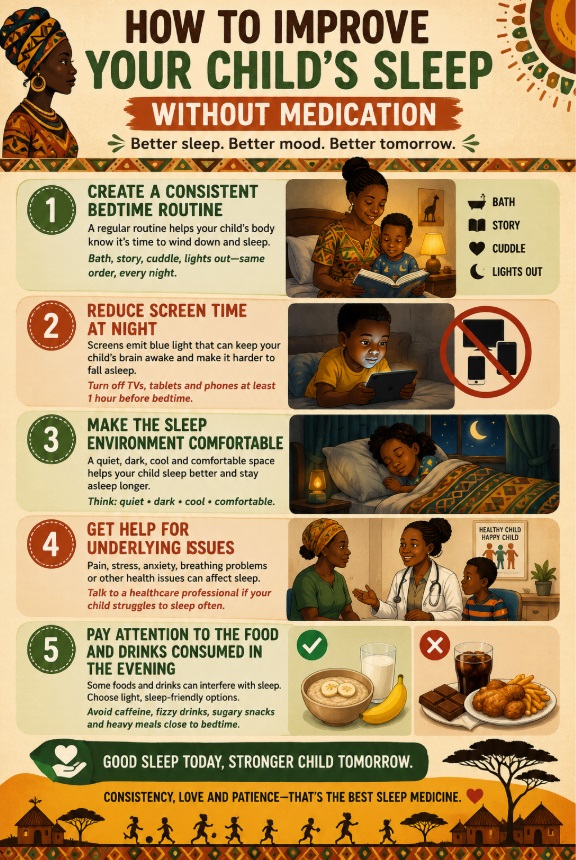
Info-poster showing healthy sleep habits. Clcik on image to enlarge.
Start with a consistent bedtime and wake-up time, even on weekends. Children sleep better when their bodies follow a predictable routine. Help them to start winding down an hour before bed. This could include bathing, reading a story, praying together, dimming the lights, or playing soft music. Keep it simple and repeat it every night.
The blue light from phones and tablets tricks the brain into thinking it is still daytime, suppressing natural melatonin production [6]. Try to keep screens away for at least one hour before bed.
As much as possible, reduce noise, light, and heat. Even small changes like covering windows or using a thin sheet instead of a thick blanket can make a difference.
If your child is sick, see a healthcare provider. If they're anxious, talk to them. If they're stressed about school, address the problem.
Caffeinated beverages such as cola drinks, energy drinks, tea, coffee, and some chocolate products can make it harder for children to sleep.
If you've tried sleep hygiene steps and your child still struggles with sleep, it's time to see a health professional. Some of the signs to look out for are:
A doctor can help identify underlying causes that you might not have considered. They can also safely evaluate whether melatonin or any other treatment is appropriate for your child. If your child needs melatonin, they will recommend the safest dose and duration.
Hence, it is important to consult a healthcare provider before starting melatonin, particularly for younger children or children with chronic medical conditions.
Melatonin can be a useful option for some children, but it should not be the first solution every time a child struggles to sleep.
Many sleep problems are linked to routines, screen use, stress, environmental factors, or underlying health conditions that require a different approach. While melatonin may help certain children fall asleep faster, it works best when used appropriately and under professional guidance.
As a parent, your goal should not simply be to make your child sleepy. The goal is to help them develop healthy sleep habits that support their growth, learning, and overall well-being for years to come.
1. Händel MN, Andersen HK, Ussing A, et al. The short-term and long-term adverse effects of melatonin treatment in children and adolescents: a systematic review and GRADE assessment. EClinicalMedicine. 2023;61:102083. Available here.
2. Paditz E. Melatonin for sleep disorders in childhood and adolescence. Monatsschr Kinderheilkd. 2024;172:44-51. Available here.
3. Owens J, Simakajornboon N, Kotagal S, Gringras P. Melatonin use in managing insomnia in typically developing (TD) children: a technical report. Sleep Med. 2025;128:89-94. doi:10.1016/j.sleep.2025.01.031. Available here.
4. Will-Dryden D, Mwambu W, Nordstrom T, Gruber R. Delivering sleep: bed kit distributions to children living in poverty in Tanzania. Sleep Med X. 2025;10:100155. doi:10.1016/j.sleepx.2025.100155. Available here.
5. Namirembe P, Nanyonga B, Ndekezi D, Nyangoma B, Kyomugisha R, Nyaruhuma A, et al. Epidemiology of sleep health and associations with mental health among in-school adolescents in Uganda: a cross-sectional mixed-methods study. Sleep Health. 2026;12(2):167-178. doi:10.1016/j.sleh.2025.12.007. Available here.
6. Silva SS, Silveira MAC, Almeida HCR, et al. Use of digital screens by adolescents and association on sleep quality: a systematic review. Cad Saude Publica. 2022;38(10). Available here.
Related
Sleep disorders - An Africa Perspective: Treatment
Melatonin Use for Sleep Problems: An Overview for Africans
Is Melatonin A Safe Sleep Medication? Learn What a New Study Says
Sleep medications: Types, Uses and Side Effects
Published: June 24, 2026
© 2026. Datelinehealth Africa Inc. All rights reserved.
Permission is given to copy, use and share content freely for non-commercial purposes without alteration or modification and subject to attribution as to source.
DATELINEHEALTH AFRICA INC., is a digital publisher for informational and educational purposes and does not offer personal medical care and advice. If you have a medical problem needing routine or emergency attention, call your doctor or local emergency services immediately, or visit the nearest emergency room or the nearest hospital. You should consult your professional healthcare provider before starting any nutrition, diet, exercise, fitness, medical or wellness program mentioned or referenced in the DatelinehealthAfrica website. Click here for more disclaimer notice.