7 Coping Tips for African Professionals on Workplace Mental Health Challenges
By: Foluke Akinwalere. Health & Wellness Writer. Medically reviewed by the DLHA Team.

A distressed African female employee sitting at a desk with a laptop and a document, holding her hand to her head in pain or frustration. AI generated image from ChatGPT
Across Africa today, millions of professionals are quietly battling emotional pressure, chronic stress, and workplace burnout. Some are carrying the weight of economic hardship on their shoulders. Others are balancing demanding jobs with family responsibilities, leadership expectations, and the pressure to “stay strong”.
Yet despite this reality, many African professionals still find it difficult to talk openly about their mental health. In many workplaces, stress is normalised, overwork is celebrated, and asking for help is often seen as weakness.
Mental health is not a luxury. It is the foundation of your productivity, creativity, and long-term wellbeing [1]. Although we cannot always control our workplace environment, we can develop practical habits that protect our emotional health.
This presentation shows 7 simple, culturally relevant tips to help African professionals cope with workplace mental health challenges and build a healthier work life.

Portrait of a calm, stress-free African employee wearing a maroon coloured shirt and sitting with her hands folded on a table. AI generated Image from ChatGPT
Workplace mental health refers to how your job affects your emotional, psychological, and social wellbeing. It involves how you think, feel, cope, and function at work.
In many African workplaces, factors that can strain mental health include:
Understanding these realities helps you recognise that your stress is not a personal failure, it is part of a larger structural challenge faced across the continent.

Image of a focused African female employee raising her hand in a stop gesture while setting healthy boundaries at work. Ai generated image from ChatGPT
In Africa, overwork is often seen as proof of dedication. But constant availability drains your energy and increases your stress levels [2].
Remember: boundaries are not disrespectful. They are simply a declaration that you value your time, energy, and health.

Image of three African professions smiling and having a positive conversation around a desk, showing supportive workplace relationships. AI generated image from ChatGPT. Click on image to enlarge.
A healthy support system at work can make stressful situations feel lighter. Talking with trusted colleagues provides encouragement, shared solutions, and emotional balance.
Supportive relationships can reduce loneliness and depression, a common but unspoken struggle among many African professionals.

African professional practicing a simple stress-relief technique at her desk during work. AI generated Image from ChatGPT
You don’t need expensive tools or long breaks to manage stress. Small actions throughout the day can significantly improve your mental state.
These small activities reset your mind, boost clarity, and help you stay grounded.

Female employee having a warm family moment with her family. AI generated iImage from ChatGPT. Click on image to enlarge.
Work-life balance is a big challenge in Africa. Many people support extended families, run side businesses, or experience demanding work cultures.
But balance is essential for long-term wellbeing.
Even small shifts can restore your energy and reduce burnout.

Stressed black African employee sitting at a desk with a laptop and notebook, holding her hand to her forehead. AI generated image from ChatGPT. Click on image to enlarge.
Burnout rarely happens suddenly. It builds gradually, and early warning signs are easy to overlook, especially in cultures where strength is emphasised.
When you see these red flags, take them seriously. Your mind and body are asking for rest and support.

Portrait of an African professional woman with a serious expression talking on a phone, seeking professional help. AI generated iImage from ChatGPT
There is still a strong stigma around mental health in many African societies. Some believe therapy is “for people who have lost their minds”, but this is far from true.
Mental health professionals help you understand your emotions, develop healthier coping strategies, and navigate difficult seasons:
Seeking help is not a sign of weakness, it is an act of courage, wisdom, and self-preservation.
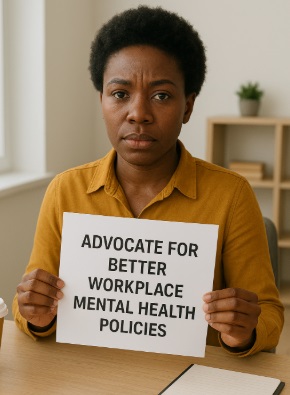
Image of African employee holding a sign that reads, “Advocate for Better Workplace Mental Health Policies”. AI generated image from ChatGPT
Improving workplace mental health is not just an individual responsibility. Organisations also play a role in protecting staff wellbeing.
When more employees speak up, organisations begin to see mental health as a priority.

Photo of happy, stress-free African professionals standing together in a modern office. AI generated image from ChatGPT
You deserve a work life that supports your wellbeing, not one that drains you. Workplace mental health is not a Western concept; it matters deeply in African settings where daily responsibilities, cultural expectations, and economic realities can heighten stress.
Start small. Choose one tip from this list and begin today.
Prioritising your mental health is not selfish. It is essential for your growth, stability, and long-term success. When you are mentally well, you show up stronger — for your family, your community, and your future.
Your mental health matters.
1. World Health Organisation, Addressing the Complex Hurdles to Optimal Mental Health in Africa’s Workplaces. Internet 10 October 2024. [Accessed December 5, 2025] Available from here.
2. Datelinehealth Africa. Signs of Workplace Stress. [Internet]. November 24, 2023, [Accessed December 2, 2025]. Available from here.
3. Akinwalere F. 10 Tips on Using Music To Boost Your Health and Wellbeing. [Internet] Datelinehealth Africa. May 9, 2024. [Accessed December 4, 2025]. Available from here.
Related
Simple Health Strategies for Families to Boost Mental Wellness
Mental Health Crisis in Nigeria - A Call for Urgent Action
Signs You Are Stressed Out At Work
How to Recognise Burnout in Yourself or Others - A Guide for Africans
Published: December 23, 2025
© 2025. Datelinehealth Africa Inc. All rights reserved.
Permission is given to copy, use, and share content freely for non-commercial purposes without alteration or modification and subject to source attribution.
DATELINEHEALTH AFRICA INC., is a digital publisher for informational and educational purposes and does not offer personal medical care and advice. If you have a medical problem needing routine or emergency attention, call your doctor or local emergency services immediately, or visit the nearest emergency room or the nearest hospital. You should consult your professional healthcare provider before starting any nutrition, diet, exercise, fitness, medical or wellness program mentioned or referenced in the DatelinehealthAfrica website. Click here for more disclaimer notice.