A Silent Killer: Lead Poisoning in Africa
By: Grace Ige B.Sc. Physiology. Freelance Health Writer and Datelinehealth Africa Volunteer. Medically reviewed by A. Odutola, MB.BS, PhD, FRCSEd.
May 28, 2026
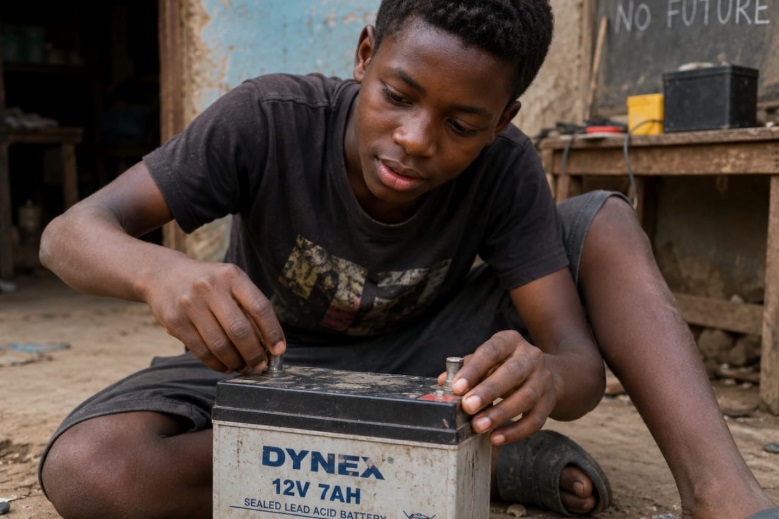
Image of a child repairing an old lead-acid battery. Image created from ChatGPT. Click on image to enlarge.
Lead poisoning remains one of Africa’s most overlooked health crises. Millions face exposure daily through unsafe housing, polluted soil, contaminated water, mining activities, battery recycling, and industrial waste.
In Nigeria for example, researchers have described lead poisoning as one of the country’s most significant undiscovered environmental health crises.
Across the continent, major sources of lead exposure include artisanal gold mining, informal battery recycling, contaminated water, polluted soil, old paint, cosmetics like “kohl” and “tiro”, food contamination, and industrial waste.
Millions of South African children have been reported to have blood lead levels above safe limits, yet many cases still go undetected or unreported.
Once lead enters the body, it spreads through the blood and damages nearly every organ. The body stores much of it in bones and teeth, where it stays for years.
In many African communities, weak environmental regulation, poor waste management, and limited testing allow the problem to continue silently. Many people live with lead poisoning without knowing the cause of their symptoms.
This blog aims to strengthen your awareness about lead poisoning in African communities, helping you to understand its dangers, and how exposure to lead, and its health impacts may be contained.
Lead is a toxic metal found in air, soil, water, and many everyday items. Lead exposure often comes from lead-based paints, contaminated dust, unsafe battery recycling, polluted water, and some African traditional cosmetic products. You take in lead when you breathe in dust or swallow contaminated food, water, or soil.

Pictures of lead-based pipes and wall paint we see around us. Images created by ChatGPT. Click on image to enlarge.
There is no safe level of exposure according to the World Health Organization.
In some affected Nigerian villages, soil lead contamination reached 185,000 ppm, far above the 400 ppm safety limit used in many developed countries.
Lead poisoning occurs naturally in bits from contaminated food and water, soil, and dust, and through inhalation of lead particles from industrial fumes, burning materials, and renovation dust.
When lead gets inside the body, the blood delivers it to several organs including the brain and bones where it especially continues to accumulate (with no apparent limit) and disrupts the normal function of the organ. Lead poisoning happens when this buildup starts to damage the brain, blood, kidneys, and other organs, often without clear early signs.
Lead stays in the blood for about 28 days but can remain in bones for up to 30 years. This long storage means past exposure keeps affecting health over time. You can start seeing its effects years after exposure.
The burden of lead poisoning and associated disease in sub-Saharan Africa is estimated to be quite high, but accurate country-to-country data is limited.
All persons exposed to lead contaminants are at risk, but children and pregnant women and their unborn babies bear the severest brunt of the effects of lead poisoning in the region.
For example, over 55 million children in sub-Saharan Africa are reported to have blood lead levels exceeding 10 micrograms per decilitre (µg/dL), twice the threshold deemed dangerous by the World Health Organization (WHO) and pregnant women and women of childbearing age in the region have been observed to have unacceptably high mean blood lead level of 26.24 μg/dL and 24.73 μg/dL respectively.
Important contributing factors for the elevated blood lead levels (BLL) and high burden of lead poisoning in sub-Saharan Africa include:
More research is needed to accurately and fully describe the burden of lead poisoning in sub-Saharan Africa countries collectively.
The effects of lead poisoning in the short and long-term.
Acute or short-term exposure to lead causes:
Chronic or long term exposure to lead with high level storage in the body oftentimes causes irreversible damage that affects the following:
Lead interferes with the production of hemoglobin, the product red blood cells use to carry oxygen throughout the body. When hemoglobin production drops, the body receives less oxygen, leading to anemia. People chronically exposed to lead often experience fatigue, weakness, headaches, dizziness, pale skin, rapid heartbeat, and shortness of breath.
Lead also increases oxidative stress in the blood. This damages cells and contributes to inflammation throughout the body. In children, reduced oxygen delivery affects brain development, growth, attention span, and physical energy levels.
The liver filters toxins from the bloodstream and helps regulate metabolism, hormones, and energy production. When lead enters the body, the liver works to process and remove the toxin. Continuous exposure may overwhelm and damage liver cells over time.
Lead exposure increases inflammation and oxidative damage inside the liver. This reduces the organ’s ability to detoxify harmful substances properly. Long term exposure has been linked to abnormal liver enzyme levels, reduced liver function, and cellular injury.
Because the liver supports many body systems, damage to this organ affects overall health, energy levels, digestion, immunity, and metabolism.
The body mistakes lead for calcium because both metals share similar chemical properties. Instead of rejecting lead, the body stores large amounts inside bones and teeth. In adults, up to 95% of absorbed lead settles in the bones.
This storage creates a long-term danger. Lead remains in bones for decades and slowly leaks back into the bloodstream over time. During pregnancy, breastfeeding, aging, fractures, stress, or diseases that weaken bones, stored lead enters circulation again and exposes organs repeatedly.
This means a person exposed years ago still carries internal contamination today.
Pregnant women face added risk because lead released from bones reaches the unborn child through the placenta.
The brain is one of the most sensitive organs to lead poisoning, especially during childhood. Lead damages brain cells, disrupts communication between neurons, and interferes with brain development.
Even small increases in blood lead levels are linked to a 2 to 5 point drop in IQ. These may reduce academic performance and future earning potential.
Studies have linked lead exposure to reduced IQ, poor academic performance, hyperactivity, impulsiveness, aggression, anxiety, and behavioral disorders.
In severe cases, lead poisoning causes seizures, developmental delays, coma, and permanent neurological damage. Children are at greater risk because their brains and nervous systems are still developing rapidly.
In adults, its effects could pass as just stress indicators including memory and concentration. But it points to a greater underlying issue.
While adults might need a larger dose of lead to get the effects, just a low dose of it affects children. Children face a higher risk of exposure due to frequent hand-to-mouth behavior and closer contact with contaminated surfaces. Informal mining and recycling activities increase exposure in many communities. They are not as conscious about their environments as adults.
Lead damages both the central nervous system and the peripheral nervous system. The toxin interferes with electrical signaling between nerves, muscles, and the brain.
This disruption causes numbness, tingling sensations, muscle weakness, tremors, poor coordination, slower reflexes, and chronic pain. Some people develop difficulty moving their hands, wrists, or legs after prolonged exposure.
In children, nervous system damage affects movement, balance, reaction time, emotional regulation, and sensory processing. High exposure causes severe nerve injury, paralysis, seizures, and long term neurological impairment.
Because nerves control communication across the entire body, lead poisoning affects movement, sensation, thinking, and behavior simultaneously.
Related: Harmful Chemicals Harming Male Fertility in Africa

An African baby playing on a carpet covered floor while putting lead based toys in his mouth. Image created by ChatGPT. Click on image to enlarge.
Although lead poses a danger to both adults and children, children suffer more. The reason children are more affected is that their brains and bodies are still developing. Lead interferes with growth, organ function, and normal body development in children.
About 1 in 3 children worldwide have blood lead levels above 5 µg/dL, a level linked to reduced intelligence and developmental harm. UNICEF reports long-term effects on learning and behavior.
Children absorb lead more easily than adults. Their bodies take in more lead from contaminated food, water, dust, toys, paint, and soil. Because young children frequently place objects and hands into their mouths, their exposure risk increases greatly.
Lead damages multiple systems in the body. It affects the brain, blood, bones, kidneys, liver, and nervous system. Exposure links to memory problems, poor concentration, slower learning, anemia, fatigue, weakened immunity, stomach pain, delayed growth, hearing problems, and behavioral difficulties.
Severe exposure causes seizures, muscle weakness, organ damage, developmental delays, and permanent neurological injury.
One of the most dangerous aspects of childhood lead poisoning is that many children show no obvious symptoms at first. Damage often develops silently while the body continues to grow.
Global action focuses on three areas.
UNICEF has advocated toughening measures to reduce lead in the environment and compliance of various industries with the rules and regulations regarding the use of lead.
The World Health Organization also supports countries with guidelines and monitoring. Many African governments have rules on lead in paint and fuel.
But the problem persists.
Enforcement is weak in many areas. Informal recycling exposes families to toxic dust. Old buildings still contain lead paint. Testing is not common, so many cases go unnoticed.
Awareness is the first step. People need to know where lead comes from and how it enters the body. If people ignore the risk, exposure continues without control.
Manufacturers still use lead in some production because it is cheap and effective. Replacing it increases cost. Strict rules and strict enforcement are needed to reduce its use.
The way forward is clear.
Until this happens at scale, the risk remains in homes, schools, and communities.
Lead exposure remains a serious public health issue, especially for children, because it damages the brain, affects learning, and limits long-term potential. The risk does not end after exposure since lead stays in the body and continues to affect health over time. Prevention remains the most effective approach, through removing lead from paint and products, improving waste management, and monitoring blood lead levels. Stronger awareness and consistent action protect individuals and communities and reduce the lasting impact of lead on future generations.
Resources:
Abba Musa A,Alkali BF, Aliyu H, Chibuyojo OB, et al. Lead Poisoning in Nigeria: Sources, Health Impacts and Policy Gaps (2005–2025). Journal of Chemistry and Allied Sciences. 2025;2(1), 165-175. Available from here.
World Health Organization. Lead poisoning and health. [Internet]. 2024 September 17. Geneva: World Health Organization; [Accessed 2026 May 5]. Available from here.
Agency for Toxic Substances and Disease Registry. Biological fate of lead. [Internet]. 2023 May 24. [Accessed 2026 May 5]. Available from here.
World Health Organization. WHO guideline for clinical management of exposure to lead. [Internet]. Geneva: World Health Organization, Geneva, 2021, 04, Background. [Accessed 2026 May 5]. Available from here.
Centers for Disease Control and Prevention. Lead exposure symptoms and complications. [Internet]. 2024 April 10. CDC, Atlanta (GA). [Accessed 2026 May 5]. Available from here.
Columbia University Mailman School of Public Health. How lead exposure damages the brain. [Internet]. 2010 July 9. Columbia University, New York (NY). [Accessed 2026 May 5]. Available from here.
Rees N, and Fuller H, The toxic truth: Children’s exposure to lead pollution undermines a generation of future potentials. [Internet]. 2020. New York (NY): UNICEF. [Accessed 2026 May 5]. Available from here.
Published: May 28, 2026
© 2026. Datelinehealth Africa Inc. All rights reserved.
Permission is given to copy, use and share content freely for non-commercial purposes without alteration or modification and subject to attribution as to source.
DATELINEHEALTH AFRICA INC., is a digital publisher for informational and educational purposes and does not offer personal medical care and advice. If you have a medical problem needing routine or emergency attention, call your doctor or local emergency services immediately, or visit the nearest emergency room or the nearest hospital. You should consult your professional healthcare provider before starting any nutrition, diet, exercise, fitness, medical or wellness program mentioned or referenced in the DatelinehealthAfrica website. Click here for more disclaimer notice.