New Ebola Outbreak in DR Congo and Uganda, 2026
By: Foluke Akinwalere, Health & Medical Writer. Medically reviewed by the DLHA Editorial Team.
Updated: June 13, 2026
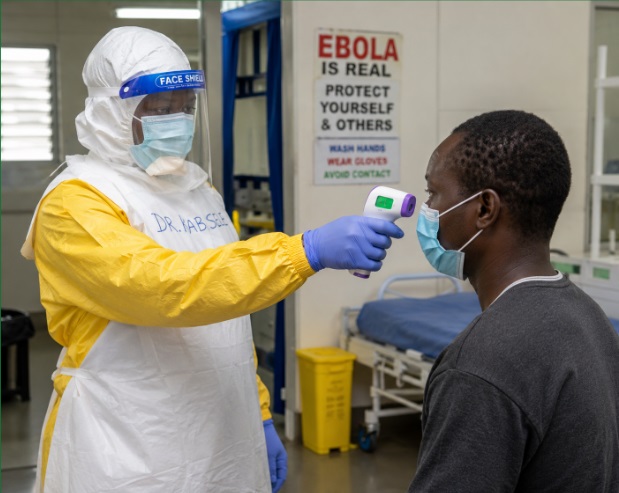
Photo of a healthcare worker in full protective gear scanning a patient's temperature in the clinic. Image created from ChatGPT Click to enlarge.
According to reports from the Democratic Republic of the Congo (DRC), a new outbreak of Ebola virus disease is spreading across part of the Central African country, raising serious public health concerns.
The outbreak, which began in the DRC, has now affected Uganda, and has been officially declared a Public Health Emergency of International Concern (PHEIC) by the World Health Organisation (WHO); the organisation’s highest level of global health alert.
Health authorities, including the U.S. Centers for Disease Control and Prevention (CDC), are working urgently to contain the virus. Several factors are complicating the response, including limited healthcare infrastructure, ongoing insecurity in parts of eastern DRC, cross-border population movement, and the absence of an approved vaccine for this particular strain.
This article gives a background on the outbreak, what is happening, why it matters, and what communities need to know to stay safe.
On 15 May 2026, the DRC Ministry of Health officially declared the outbreak, which marked the country’s 17th recorded Ebola outbreak since the virus was first identified in 1976.
It began in the Ituri province of eastern DR Congo, a region already facing challenges including conflict, limited healthcare infrastructure, and high population mobility.
515 confirmed Ebola cases were reported in the DRC including 91 deaths as of June 7, 2026 while Uganda had reported 19 confirmed cases, including 2 deaths (WHO).
As of 10 May 2026, the DRC has reported 676 confirmed cases and 136 deaths, while Uganda still reported 19 cases with two deaths as of 11 Jue 2026 (WHO)..
The actual number of confirmable cases may be higher due to limited laboratory testing capacity and gaps in surveillance in affected areas.
The World Health Organization continues to warn that the Ebola outbreak in the Democratic Republic of the Congo (DRC) is expanding rapidly, with rising case numbers, wider geographic spread, and cross-border transmission to Uganda.
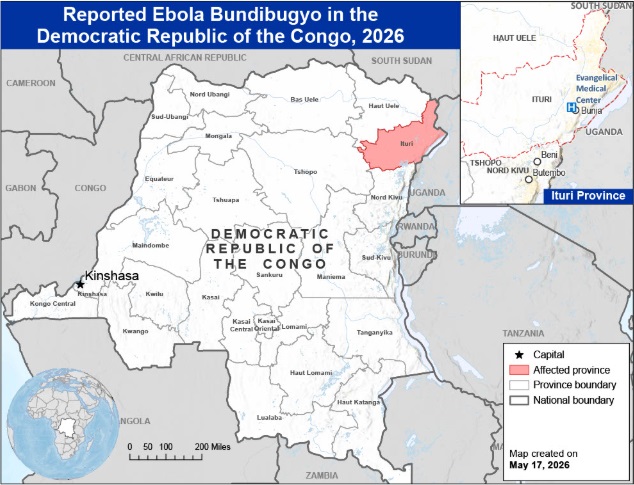
Health Zones affected by the Ebola virus in DR Congo. Report by CDC. Click image to enlarge.
Cases have been reported across multiple health zones, including Bunia, Rwampara, and Mongbwalu. Uganda has confirmed cases linked to cross-border travel, including infections identified in Kampala.
This outbreak is caused by the Bundibugyo virus disease (BVD), a rare and severe hemorrhagic fever caused by Bundibugyo ebolavirus, one of six known species capable of causing Ebola virus disease in humans.
It is less common than the Zaire Ebola virus strain, which was responsible for the West African outbreak 2014-2016.
Key Challenges:
Although supportive care, such as hydration and symptom management, can improve survival, the lack of targeted tools makes containment more difficult.
Initially confined to DR Congo, the outbreak quickly raised concerns when cases appeared in Uganda. Reports indicate that infected individuals traveled across borders, which led to confirmed infections in Kampala before the full scale of the outbreak was recognised.
Cross-border movement is common in this region for trade, family connections, and livelihood. Unfortunately, this also makes disease control more difficult.
Health officials emphasise that:
These factors contributed to the rapid escalation of the outbreak.
Unlike the more common Zaire strain, the Bundibugyo strain does not yet have a widely approved vaccine or treatment. This limits response options.
Some affected areas in eastern DR Congo experience ongoing conflict, making it difficult for health workers to reach communities.
The affected regions have limited medical resources, including:
These challenges make it harder to detect and isolate cases early.
People frequently move across borders for livelihood activities. This increases the risk of wider spread.
Experts warn that the outbreak could be larger than reported due to under-detection and gaps in surveillance.
Some communities may distrust health authorities, which leads to delays in reporting symptoms or seeking care.
Traditional burial practices, while important culturally, can increase exposure risk if not adapted during outbreaks.
The WHO has declared the outbreak a global health emergency and is coordinating response efforts, including:
The U.S. CDC has activated its emergency response systems to support international efforts. This includes:
African CDC and regional governments are working together to:
Uganda has also taken precautionary steps, including limiting public gatherings in affected areas.
While the outbreak is currently concentrated in Central Africa, global health experts are closely monitoring the situation.
The risk of international spread remains low but possible, especially with global travel.
This current outbreak serves as a reminder that:
The current Ebola outbreak in DR Congo and Uganda is a serious and evolving health emergency. While the situation is concerning, coordinated efforts by local communities, governments, and international organisations offer hope.
By staying informed, practicing preventative measures, and supporting public health efforts, communities can play a vital role in controlling the spread.
Ebola is deadly, but with awareness, early action, and collective responsibility, it can be contained.
What is Ebola, and How Is It Spread?
Ebola is a severe and often deadly disease caused by a group of viruses known as orthoebolaviruses. There are several known strains that cause Ebola disease in humans, including the Zaire, Sudan, Tai Forest, and Bundibugyo strains, which is the strain of the current outbreak in the DRC.
Ebola is spread through direct contact with the blood or body fluids of an infected person. This includes:
The virus can also be transmitted through contact with contaminated surfaces or objects, such as bedding, clothing, or medical equipment.
Ebola is not transmitted through the air. A person cannot become infected through casual contact, such as sitting near someone with the disease.
Transmission risk is highest in the following situations:
Healthcare workers are at particular risk when personal protective equipment (PPE) is unavailable or insufficient.
Symptoms typically appear between 2 and 21 days after exposure, with most cases presenting within 8 to 10 days. Early symptoms can resemble those of more common illnesses such as malaria or typhoid, which frequently delay diagnosis in resource-limited settings.
Early symptoms include:
Later symptoms may include:
Anyone experiencing these symptoms in an affected area or who has had contact with a known case should seek medical care immediately and inform healthcare providers of any potential exposure.
Communities remain at high risk during Ebola outbreaks, especially during traditional funeral practices.
In many African cultures, caregiving and burial practices involve close contact. While these traditions are important, they can increase the risk of infection during outbreaks.
Health experts have warned that close contact with the bodies of those who have died from the disease can increase the spread of infection. The cultural practices, such as washing and preparing the body, are deeply meaningful but can also expose family members and loved ones to the virus.
Dr. Jean Kaseya, Director General of the Africa Centres for Disease Control and Prevention, stressed the importance of following public health guidance, particularly in the absence of vaccines and effective treatments.
He warned, “We don’t want people infected because of funerals.”
Other challenges include:
Healthcare workers are also at high risk, especially when protective equipment is limited. Reports indicate that some health workers have already lost their lives during this outbreak.
Public awareness and simple preventive actions can help reduce the spread of Ebola.
Community leaders, religious leaders, and local influencers play an important role in spreading accurate information.
Sources:
Related: Vaccine-preventable disease outbreaks on the rise in Africa
Published: May 23, 2026
© 2026. Datelinehealth Africa Inc. All rights reserved.
Permission is given to copy, use, and share content freely for non-commercial purposes without alteration or modification and subject to source attribution.
DATELINEHEALTH AFRICA INC., is a digital publisher for informational and educational purposes and does not offer personal medical care and advice. If you have a medical problem needing routine or emergency attention, call your doctor or local emergency services immediately, or visit the nearest emergency room or the nearest hospital. You should consult your professional healthcare provider before starting any nutrition, diet, exercise, fitness, medical or wellness program mentioned or referenced in the DatelinehealthAfrica website. Click here for more disclaimer notice.