Depression in the Workplace: What Africans Need to Know
By: Foluke Akinwalere, Health & Medical Writer. Medically reviewed by the editorial team of DLHA.
May 5, 2026

Image of male and female professional African employees sitting at a workplace table and looking stressed out. Image created from ChatGPT.
Work is an important part of life. It gives purpose, income, structure, and identity. But for many African professionals today, work also comes with intense pressure; tight deadlines, job insecurity, long hours, financial responsibilities, and family expectations.
Some level of stress is normal. But when emotional strain becomes constant, draining, and overwhelming, it may signal something deeper. It may be a warning sign of depression in the workplace.
Across the African continent, conversations about workplace mental health are slowly increasing, but depression still goes unnoticed in many organisations. Employees often show up every day, complete their tasks, and appear “fine,” while quietly struggling inside.
Many of these professionals are afraid to speak up about their mental health because of stigma or fear of losing their jobs. Others don’t even recognise what they are experiencing. As a result, depression among African professionals remains hidden, and this affects their well-being, productivity, and workplace relationships.
Recognising the signs is not just about mental health; it is about protecting careers, improving performance, and saving lives. Early awareness helps individuals seek help and allows organisations to create supportive environments where employees can thrive.
This article explains how depression shows up in professional settings, why it is frequently missed, and what African workers and organisations can do to improve employee mental health in Africa.
According to the World Health Organisation, depression (also known as major depressive disorder, MDD) is a common mental disorder that affects how a person thinks, feels, and functions. It is not simply “feeling sad” or a sign of weakness. It is also different from regular mood changes or feelings about everyday life. It involves a depressed mood or loss of pleasure or interest in activities of daily living for long periods of time.
A person living with depression may experience:
These feelings may last for weeks or months and do not disappear just by “cheering up” [1].
In many African cultures, depression is misunderstood. Some see it as a spiritual problem, laziness, or a character flaw. This misunderstanding increases mental health stigma in African workplaces, making people hide their struggles instead of seeking support.
However, depression is real, treatable, and common. Recognising this is the first step toward healthier workplaces.
Related: What is Depression?
Depression does not stay at home when someone goes to work. It follows them into meetings, emails, deadlines, and team projects. This is why depression and productivity at work are closely linked.
Common symptoms of depression in employees in the workplace include:
Tasks that used to feel simple may suddenly feel exhausting. Even responding to emails can feel overwhelming.
Over time, declining performance may attract criticism or disciplinary action, which can worsen emotional distress. This creates a cycle where depression feeds poor performance, and poor performance deepens depression.
Related: Signs You Are Stressed Out At Work
Depression is a major global public health challenge and a leading cause of disability worldwide. The World Health Organisation reports that approximately 5.7% of adults worldwide, or around 332 million people, are living with depression. It is more common among women and can impact daily functioning, work performance, and relationships [1].
In Africa, depression and other mental health conditions affect a large share of the population. According to the WHO, nearly 150 million people in Africa are living with a mental health condition, yet access to care remains limited in many communities [2].
Although workplace-specific data are limited, studies show high depression rates in some groups, including healthcare workers, especially during the COVID-19 pandemic. This highlights how emotional distress in an occupational setting carries real personal and societal costs [3].
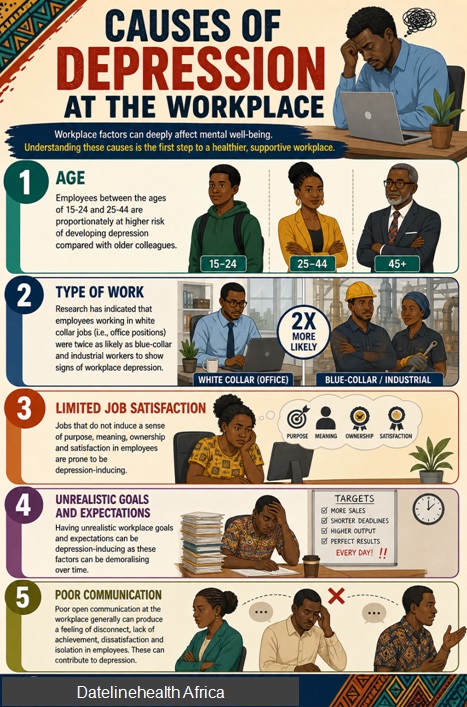
Info poster showing come causes of workplace depression. Image created from ChatGPT. Click on image to enlarge.
Depression is a serious problem that should be recognised early in the workplace by employers and employees alike in the interest of safety and wellbeing. For these reasons, it is very important to be aware of some of its common causes identified through research. These include:
Employees between the ages of 15-24 and 25-44 are relatively at higher risk of developing depression compared with older colleagues, because they lack adequate stress coping experience, and they are more likely to fill low-income and demanding positions with poor career growth and job satisfaction.
Research has indicated that employees working in white collar jobs (i.e., office positions) were twice as likely as blue-collar and industrial workers to show signs of workplace depression. This may be a result of job pressures, job monotony, the physical environment and a lack of interaction with other people.
Jobs that do not induce a sense of purpose, meaning, ownership and satisfaction in employees are prone to be depression-inducing.
Having unrealistic workplace goals and expectations can be depression-inducing as these factors can be demoralising over time.
Poor open communication at the workplace generally can produce a feeling of disconnect, lack of achievement, dissatisfaction and isolation in employees. These can contribute to depression.
One of the major obstacles to addressing depression is the stigma around mental health. Many employees fear that speaking up about their mental health will make them seem unreliable or unsuitable for leadership positions.
Many employees grow up hearing phrases like:
These messages can make them feel ashamed for feeling low. As a result, they keep their struggles to themselves and delay getting support, which can let their symptoms grow more severe over time.
In most African communities and by extension, workplaces, there is a general lack of or poor public awareness of mental health conditions. This contributes to high failure to recognise these conditions and consequently high unmet needs for mental health services.
Employees may worry that requesting time off or mental health support could cost them their jobs.
This environment encourages silence rather than healing, even as work-related depression in Africa is on the rise.
Many organisations still lack clear mental health policies, employee assistance programmes, or access to counselling services. Without structured systems, workers are left to cope alone, and managers are often not trained to recognise or respond to mental health challenges.
This makes mental health conditions in African workplaces harder to identify and manage early.
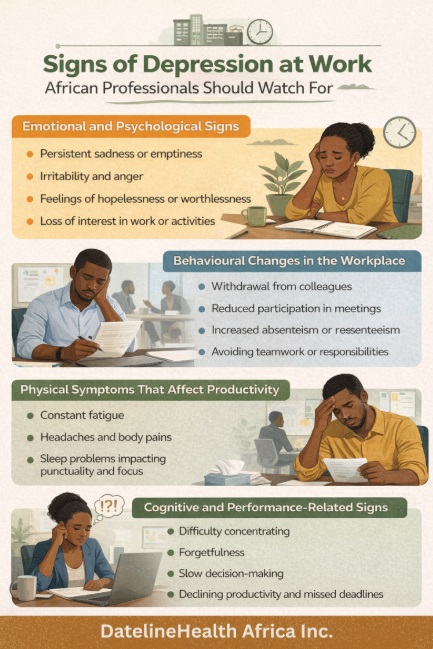
Info poster showing common signs of depression at work. Image created from ChatGPT. Click on image to enlarge.
Recognising the warning signs early can prevent long-term health and career consequences. Knowing how to recognise depression at work helps both individuals and organisations act in time.
Common emotional indicators include:
These feelings often last for weeks or months and do not improve with rest alone.
Behavioural changes are often more noticeable to colleagues and managers. These may include:
These behaviours are sometimes misinterpreted as laziness or lack of commitment rather than signs of distress.
Depression also affects the body, not just emotions. Workers may complain of:
These physical symptoms often worsen workplace stress and mental health challenges.
Cognitive symptoms include:
These signs directly impact job performance and increase the risk of disciplinary action or job loss.
In conversations about workplace mental health in Africa, burnout and depression are often used interchangeably, but they are not the same.
Understanding the difference matters because the support and solutions needed can be different. Confusing one for the other may delay the right help, especially for professionals already dealing with heavy workloads and life pressures.
Burnout is a state of emotional, mental, and physical exhaustion caused by prolonged workplace stress. It usually develops when job demands constantly outweigh a person’s ability to cope.
Common causes include:
Burnout is primarily work-related. It is the body and mind’s response to chronic job stress.
Someone experiencing burnout may feel drained, detached from their job, and less motivated. They may start to feel cynical about work or less satisfied with their achievements.
The good news is that burnout can often improve when workplace conditions change, rest is taken, or support is provided.
Related: Burnout in Nigeria's Workplaces: Risk Factors, Warning Signs and Solutions
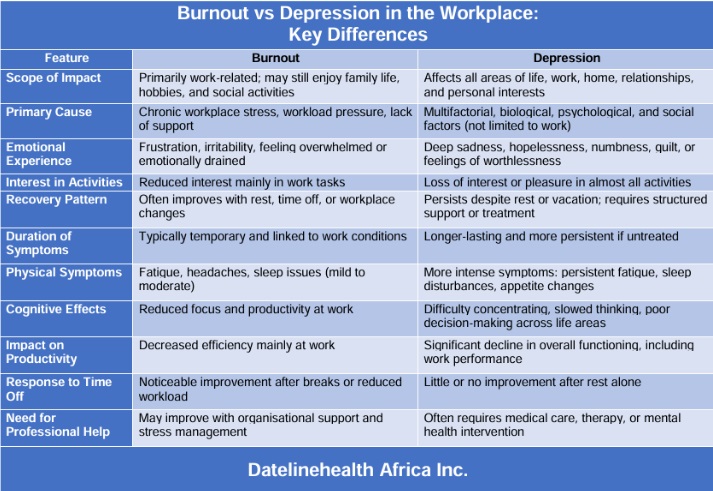
Table showing differences between burnout and depression in the workplace. Click on image to enlarge.
Although burnout and depression in the workplace can share symptoms like fatigue and low motivation, there are important differences.
If someone feels empty or hopeless both at work and outside work, depression may be more likely.
Depression can also bring a loss of pleasure in things that once felt enjoyable.
If someone takes a break and still feels persistently low, this may signal depression rather than burnout.
Burnout can cause tiredness and poor concentration, but symptoms of depression in employees are often more intense and longer-lasting. These may include:
These symptoms can strongly affect depression and productivity at work.
Related: How To Recognise Burnout in Yourself Or Others - A Guide For Africans
Whether it is burnout or depression, neither should be ignored.
Untreated burnout can gradually develop into depression, especially in high-pressure environments. This is one reason work-related depression in Africa is a growing concern in demanding sectors like healthcare, banking, and education.[4]
Addressing burnout early, through workload balance, supportive leadership, and rest, can prevent more serious mental health challenges.
At the same time, depression requires proper care, which may include counselling, therapy, or medical support. It is not something a person can “snap out of.”
However, only a qualified professional can diagnose depression. When in doubt, it is always safer to seek help.
Some roles naturally involve high responsibility, pressure, or emotional labour. These include: [4]
Doctors, nurses, pharmacists, and community health workers often face long shifts, staff shortages, and frequent exposure to illness, suffering, and death. Emotional fatigue can build up over time, increasing liability to work-related depression in Africa.
Educators often manage large class sizes, limited teaching resources, and heavy administrative duties. Many also carry the emotional weight of supporting students from difficult backgrounds, which can quietly affect their own mental well-being.
Targets, deadlines, and performance metrics are common in corporate spaces. Constant pressure to deliver results, job competition, and fear of redundancy can heighten workplace stress and mental health risks.
Small business owners and self-employed workers often face income uncertainty, rising costs, and little social protection. The stress of financial survival can contribute to anxiety and depression, even if it is rarely discussed.
Those working in crisis zones, conflict areas, or vulnerable communities may be exposed to trauma, displacement stories, and human suffering. Without adequate psychological support, this can take a toll over time.
Beyond job titles, certain work conditions also raise the likelihood of depression in the workplace:
When these conditions persist, they can increase your odds of affect depression and low productivity at work. , leading to fatigue, disengagement, and declining performance.
Not everyone in these professions will develop depression. However, recognising higher-risk environments helps individuals and organisations to act early.
Stronger mental health support for African workers, fair workloads, and open conversations can make a real difference. Supporting well-being is not only humane, but it also improves retention, morale, and productivity.
Small steps can help:
These support managing depression in the workplace, but they are not substitutes for professional care.
Professional help is strength, not a weakness. Options include:
Knowing when to seek help for depression at work is key. If symptoms last more than two weeks or affect performance, it is time to seek support.
Sharing with trusted people can reduce isolation:
Support systems matter, but professional care remains important.
IV. When to Seek Urgent Help
Severe depression requires immediate attention.
Warning signs include:
These are medical emergencies. Seek immediate help from health professionals or local emergency services.
Depression is not a personal weakness, a spiritual failure, or a lack of ambition. It is a medical condition that can affect anyone, regardless of education or professional status. Recognising the signs allows African professionals to protect both their careers and their well-being.
Addressing depression in the workplace improves not only individual lives but also organisational success and national development. With the right support systems, open conversations, and compassionate leadership, African workplaces can become a space where people thrive, not just survive.
Investing in employee mental health is not optional; it is essential for sustainable growth, healthier families, and stronger communities.
Investing in employee mental health in Africa is not optional — it is essential for sustainable growth, healthier families, and stronger communities.
1. World Health Organisation, Depressive Disorder (Depression), Internet [29 August, 2025], Accessed [February 11, 2026]. Available from here.
2. World Health Organisation African Region, Mental Health Conditions Affect 150 Million in Africa Amid Insufficient Care Services. Internet [10, October 2025], Accessed [February 12, 2026]. Available from here.
3. Hasen AA, Mohammed AA, Seid AA. Prevalence of anxiety, depression, stress and insomnia among healthcare professionals during COVID-19 in Africa: Umbrella review of existing meta-analyses. PeerJ. 2024 Oct 30;12:e18108. doi: 10.7717/peerj.18108. Available from here.
4. Riethof N, Bob P. Burnout Syndrome and Logotherapy: Logotherapy as Useful Conceptual Framework for Explanation and Prevention of Burnout. Front Psychiatry. 2019 Jun 14;10:382. doi: 10.3389/fpsyt.2019.00382. Available from here.
Related
Mental Health Crisis in Nigeria - A Call For Urgent Action
Published: May 5, 2026
© 2026. Datelinehealth Africa Inc. All rights reserved.
Permission is given to copy, use, and share content freely for non-commercial purposes without alteration or modification and subject to source attribution.
DATELINEHEALTH AFRICA INC., is a digital publisher for informational and educational purposes and does not offer personal medical care and advice. If you have a medical problem needing routine or emergency attention, call your doctor or local emergency services immediately, or visit the nearest emergency room or the nearest hospital. You should consult your professional healthcare provider before starting any nutrition, diet, exercise, fitness, medical or wellness program mentioned or referenced in the DatelinehealthAfrica website. Click here for more disclaimer notice.