Hysterectomy: Womb Removal Surgery Explained for African Women
By: Azuka Ezeike, MBBS, FWACS (Obstetrics and Gynaecology), FMCOG, MSc. (Public Health). Medically reviewed by A. Odutola, MB.BS, PhD, FRCSEd.
December 5, 2025.

A Black female doctor in a white lab coat is counselling a Black couple wearing sky-blue tops about uterine fibroids and the possible need for a hysterectomy. Google AI generated image. Click on image to enlarge.
.jpg)
Close up view of a cartoon illustration of the uterus (womb) in a human female. Click on image to enlarge.
The womb (uterus) is the signature organ in a woman. It is highly treasured because of its role as the home for the unborn child. In many African societies, it carries deep emotional and cultural value because of its link to fertility and motherhood. For this reason, the last thing most women want to hear is that their womb needs to be removed, even when they are done with childbirth
That’s why Mrs. Felicia declined the surgery when it was first recommended at her previous hospital. She wanted a second opinion and visited another hospital to confirm whether there was truly no alternative.
A hysterectomy is an operation that involves the removal of all or part of the womb (uterus) [1]. It is a major surgery and an irreversible procedure, so the decision to go ahead with it is usually well thought out.
While it is often a planned (elective) operation, it can also be done as an emergency in life-threatening situations. The reasons for a hysterectomy range from benign (non-cancerous) conditions like fibroids to cancerous diseases affecting the reproductive organs.
Hysterectomy is one of the most commonly performed women's reproductive organ (gynaecologic) surgeries worldwide. In the United States alone, 2021 data show that more than 14% of women aged 18 and above have had the procedure.
In a hospital in Cameroon, a study found that about 15 out of every 100 women who had gynaecologic surgery underwent a hysterectomy.
Despite the benefits of hysterectomy in the treatment of certain diseases, it is still a procedure that many African women find difficult to accept. This is mainly because fertility and childbearing are highly valued, and the thought of losing the womb can feel like losing a part of one’s identity or social standing as a woman.
In this article, you will learn why a hysterectomy may be recommended, the different types and surgical approaches, how to prepare for the procedure and what to expect during the recovery process.
There are different types of hysterectomy, and the choice depends on several factors [1].
In some cases of hysterectomy, the ovaries and fallopian tubes are removed as well
.jpg)
Illustration showing the different types of hysterectomy Silhouetted areas indicated parts of the womb and surrounding structures (as relevant) that are removed in each type
Your doctor will consider several factors before deciding which type of hysterectomy is most suitable for you.
These include:
In Africa, the abdominal hysterectomy is still the most commonly performed type. In many Western countries, however, laparoscopic hysterectomy is now more common because it is less invasive and allows for faster recovery [2].
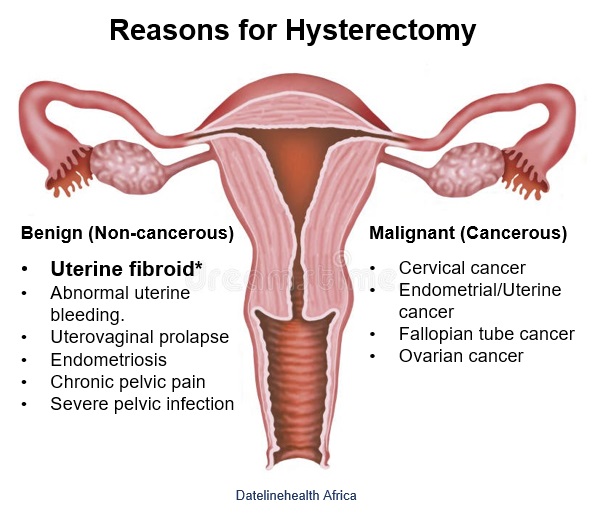
Illustration listing some reasons for hysterectomy. The commonest in Africa is uterine fibroid* Click on image to enlarge.
You may need a hysterectomy for several reasons [1, 3].
These reasons can be:
Benign (Non-cancerous) conditions
Malignant (Cancerous) conditions
In many hospitals across Africa, uterine fibroid is the leading reason for hysterectomy, especially among women who have completed childbearing [3, 4].
A hysterectomy is a permanent surgical procedure, so your doctor will take time to discuss it with you in detail. You may be encouraged to bring a close relative or caregiver along for these discussions, as their support can be helpful before and after surgery. Feel free to ask all your questions and make sure you understand every step of the process before giving your consent.
Because a hysterectomy can sometimes lead to blood loss, your doctor may ask you to arrange for blood to be available for transfusion. This can be done at the hospital’s blood bank or through family donors.
Before surgery, you will be asked to sign a consent form. This document shows that you understand the procedure and agree to go ahead with it. Take your time to read it carefully, and do not hesitate to ask questions about anything you don’t understand.
You may be required to make a payment for the surgery ahead of time, unless you are covered by health insurance or the hospital offers free care.
Most hospitals will admit you one or two days before the operation to complete all necessary checks and preparations.
You will be asked not to eat or drink anything on the morning of your surgery. Your last meal should be the night before the operation. This helps prevent complications during anaesthesia.
Before surgery, a nurse will insert a catheter (a small tube) into your bladder to help drain urine. In some cases, the area around the operation site may also be shaved; this is usually done in the operating room.
Before the operation, the anaesthetist, the doctor responsible for giving anaesthesia (the medication that makes you sleep and feel no pain during surgery) will come and review you on the ward. They will check your medical history, examine you and make sure you are fit for surgery.
There are two main types of anaesthesia used for hysterectomy. The type that you receive will depend on what you and your doctors consider better for your circumstances.
This involves an injection given in your lower back. It numbs pain and sensation from your waist down, including your legs. You will remain awake but will not feel any pain during the surgery.
With this option, you will be completely asleep during the operation. The medicine is given through a vein or as a gas through a face mask. You will not feel, see, or remember anything until the surgery is over.
The way a hysterectomy is performed depends on the type of surgery your doctor chooses.
The most common types include:
Your surgeon makes a cut on your lower abdomen to reach the womb. The cut may be vertical (up and down) or horizontal (side to side), depending on the size of your womb and other factors. The womb is carefully separated from surrounding organs and removed, and the wound is then closed with stitches.
In this type, your surgeon makes a few small cuts on your abdomen. A tiny camera and surgical instruments are passed through these openings to remove the womb. The womb may be taken out through the vagina or cut into smaller pieces and removed through the small openings, a process called morcellation. This method usually allows faster healing and leaves smaller scars.
Here, there is no cut on your abdomen. The surgeon reaches your womb through the vagina by making a small incision at the top of it. Through this opening, the womb is detached from its attachments and removed completely. This approach is less invasive and often leads to quicker recovery.
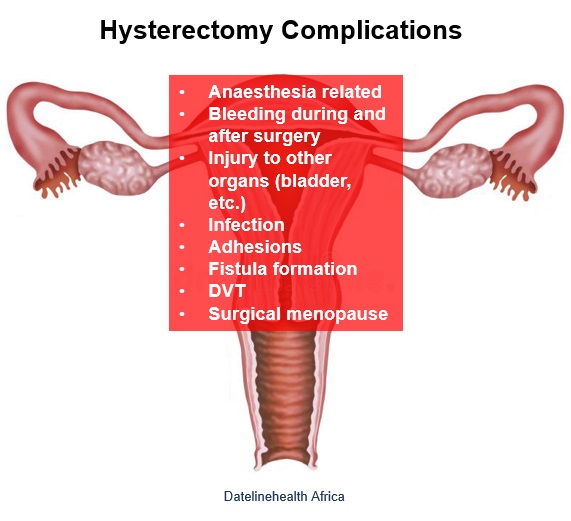
Illustration listing some of the complications of hysterectomy. Click on image to elarge.
A hysterectomy is generally a safe procedure, but like any surgery, it carries some risks and possible complications. This is why your doctors will carefully determine the best and safest approach for your surgery.
Some possible complications include [5. 6]:
The risk of complications is usually higher with abdominal hysterectomy compared to laparoscopic or vaginal hysterectomy.
The decision by your doctor for you to have a hysterectomy is not usually a light one because it involves the removal of a vital part of your body.
However, a hysterectomy can bring relief from long-standing pain and illness when it’s medically necessary. It’s important to understand its emotional and physical implications. With proper counselling, preparation, and care, your recovery can be smooth and steady.
If your ovaries are not removed during the hysterectomy, your hormone levels will remain normal, unless you are already in menopause. However, if your ovaries are removed, your hormone levels will drop, leading to symptoms of menopause such as hot flashes and mood changes.
If a total hysterectomy is done, there is a chance that the vagina may become slightly shorter, which could affect sexual intercourse. However, this is not common, and most women are still able to enjoy a satisfying sex life after recovery.
1. InformedHealth.org [Internet]. Cologne, Germany: Institute for Quality and Efficiency in Health Care (IQWiG); 2006-. In brief: Hysterectomy (surgical removal of the womb) [Updated 2025 Feb 25]. Available from here.
2. Rudnicki M, Shayo BC, Mchome B. Is abdominal hysterectomy still the surgery of choice in sub-Saharan Africa? Acta Obstet Gynecol Scand. 2021 Apr;100(4):715–7. Available from here
3. Chale GJ, Salim RM, Leshabari KM. Clinical indications for total abdominal hysterectomy among women seen in Dar es Salaam regional referral hospitals, Tanzania: a prospective, observational hospital-based study. Pan Afr Med J. 2021 Jan 6;38:10. Available from here
4. Egbe TO, Kobenge FM, Arlette MMJ, Eta-Nkongho E, Nyemb JE, et al. (2018) Prevalence and Outcome of Hysterectomy at the Douala General Hospital, Cameroon: A Cross-Sectional Study. Int J Surg Res Pract 5:092. doi: 10.23937/2378-3397/1410092. Available from here.
5. Settnes A, Moeller C, Topsoee MF, Norrbom C, Kopp TI, Dreisler E, et al. Complications after benign hysterectomy, according to procedure: a population-based prospective cohort study from the Danish hysterectomy database, 2004-2015. BJOG. 2020 Sep;127(10):1269–79. Available from here.
6. Michael D, Mremi A, Swai P, Shayo BC, Mchome B. Gynecological hysterectomy in Northern Tanzania: a cross-sectional study on the outcomes and correlation between clinical and histological diagnoses. BMC Women’s Health. 2020 Jun 12;20(1):122. Available from here.
Related: Myomectomy – The Fibroid Surgery African Women Need to Know
Published: December 5, 2025
© 2025. Datelinehealth Africa Inc. All rights reserved.
Permission is given to copy, use and share content freely for non-commercial purposes without alteration or modification and subject to source attribution
DATELINEHEALTH AFRICA INC., is a digital publisher for informational and educational purposes and does not offer personal medical care and advice. If you have a medical problem needing routine or emergency attention, call your doctor or local emergency services immediately, or visit the nearest emergency room or the nearest hospital. You should consult your professional healthcare provider before starting any nutrition, diet, exercise, fitness, medical or wellness program mentioned or referenced in the DatelinehealthAfrica website. Click here for more disclaimer notice.