By Oluwasola Samuel, Freelance health writer. Medically reviewed by: A. Odutola, MB.BS, PhD, FRCSEd.
July 4, 2026.
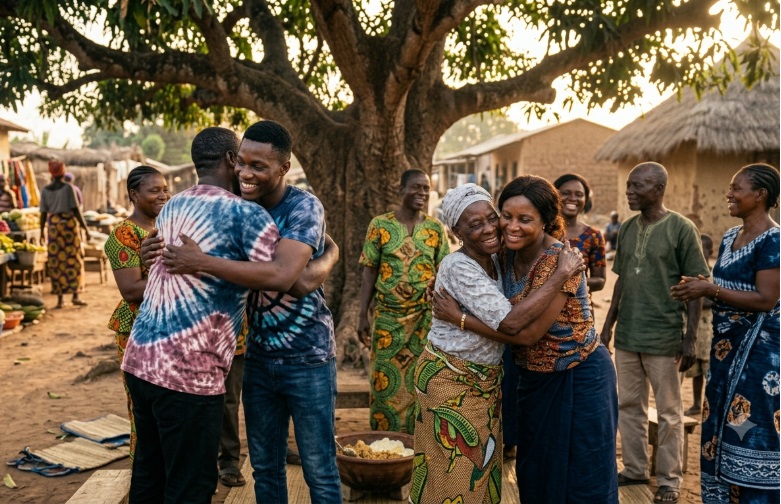
An AI-generated image of people hugging and in a happy mood during a family welcome. Other family members stand in the background with warm smiles. The scene of connection and bonding is happening under the shade of a big leafy tree in an African village setting. Image credit: ChatGPT. Click on image to enlarge.
Safety Note: If you or someone you know is struggling with thoughts of suicide, please reach out to your trusted friend, neighbor, or family member for help immediately. Contact your nearest health facility or a trusted crisis line in your country.
When was the last time someone asked how you were doing and actually waited to hear the answer? For many people across Africa, that simple act of being truly seen by another person is becoming harder to come by.
We call this feeling of being seen, valued, and held by others, "Connectedness" or “Social Connection”, or “Social Support". It is more than just having people around you. It is knowing that someone notices when you are struggling, and that you are not facing life's hardest moments alone.
Research increasingly shows that connectedness serves as a protective shield against the dangers of isolation. As it turns out, isolation is far more harmful than most of us realise. It does not just make us feel sad or lonely. It can quietly raise the risk of suicide, particularly in people already carrying invisible burdens of stress, grief, and other mental health issues.
This article looks at what the science says about:
Think about the last time you felt truly low. Chances are, what helped wasn't a perfect solution to your problem. It was maybe someone sitting with you to talk things through, a phone call, or a friend who showed up without being asked twice. We all have the instinct to lean on people when life gets heavy. It's both emotionally comforting and it protects us in our everyday life.
For years, conversations about suicide prevention have been mostly on individual struggles, depression, substance use, and family history. But researchers are increasingly turning their attention to something many easily miss: loneliness (1).
A three-year WHO commission on social connection set out to understand just how much this quiet feeling actually costs us (2). The findings were sobering; loneliness and isolation are linked to roughly 871,000 deaths worldwide every year. This places it in the same risk category as smoking or air pollution. 1 in 6 people globally is living with loneliness and isolation right now, often without saying a word (2).
This is why social isolation deserves far more attention in suicide prevention. It is not a minor detail. It is a big one, and one of the strongest predictors researchers have identified (3).
So why does connection help so much?
Connection helps because it gives people a reason to stay. It interrupts the heavy thinking that isolation tends to feed, and it means someone notices when a person has gone quiet.
That is the real power of being known and connected.
Isolation does not affect everyone equally. It tends to settle most heavily on two groups. The people just starting in life, and the people nearing the end.
Picture a grandmother who once had a house full of noise; children, grandchildren, and neighbours dropping by unannounced. Slowly, the house grows quiet. Her children moved away for work, her old friends passed on, and her knees no longer let her walk to her place of worship, the way she used to. The truth is that nobody decided to leave her alone; life simply happened.
That silence carries real weight. According to CDC data, adults aged 85 and older had the highest rate of death by suicide of any age group in 2023 (4). For many older Africans, the extended-family safety net that once meant someone was always nearby is gradually fading, especially in cities. More often, nobody notices the loneliness building until it becomes a crisis.
At the other end of life, young people are quietly carrying their own version of this weight. According to AFSP, suicide is the second leading cause of death among young people in the United States, with risk climbing sharply through adolescence (5).
For teenagers, belonging is like oxygen. A study of in-school adolescents across sub-Saharan Africa found that those who felt lonely were far more likely to have suicidal thoughts, while those with close friends were far less likely to (6).
Both ends of life ask the same quiet question. Does anyone see me? The answer to that question can be the difference between despair and hope.
Saving a life rarely looks dramatic. More often, it can be in the form of a text message saying "How are you?” “Thinking of you" or an invitation to watch a movie or a coffee invite. It can also be a neighbour who knocks just to say hello or check up on you.
These small moments are called touchpoints, and research suggests they matter far more than we realise. They tell a person indirectly that they are not invisible. For someone quietly struggling, that single thought can be enough to get them through another day.
You do not need training to offer a touchpoint. You do not need the perfect words. You simply need to show up, again and again, in small, consistent ways. A phone call or text message goes a long way to tell someone that they are seen and valued. Remembering someone's birthday, sitting with a grieving friend, is considered a touchpoint.
But there is a balance to strike here, and it matters. Checking in is not the same as checking up. Constant calls, prying questions, or showing up uninvited can feel less like care and more like surveillance. Nobody heals by being made to feel watched.
The goal is not to corner someone into talking but to gently remind them, through small and steady gestures that the door is open whenever they are ready to walk through it. Connection should feel easy and not forced.
Knowing that connectedness saves lives is one thing. But knowing what to actually do with that knowledge is another.
Here are real, practical ways families and communities can weave more belonging into everyday life:
You do not need a special occasion to reach out. A simple "how are you, really?" can mean more than you know. Make it a routine, not reserved for when there is a crisis.
It does not have to be elaborate. A weekly meal with extended family, a weekend group phone call to your ageing parents, or a small WhatsApp group you can use to check in daily. Familiar rituals like this give people something steady to hold onto.
Older relatives living alone and young people going through major transitions, starting university, losing a job, or going through heartbreak, deserve a little extra warmth during these seasons. Notice them and be proactive and intentional about seeing them overcome hard times.
Churches, mosques, community halls, and local clubs have always been the beating heart of African social life. Support and protect these spaces, because they quietly save more lives than we often realise.
Silence is often what allows isolation to deepen unnoticed. A simple, honest conversation at the dinner table about how everyone is really feeling can crack open a door that has been shut for years.
Connection is powerful, but it is not a replacement for proper care. If someone seems to be withdrawing deeply or expressing hopelessness, gently encourage them to speak with a doctor or counsellor, and offer to go with them.
The truth is that none of these practical steps requires perfection. It only requires you to show up, often, and with an open heart.
Long before researchers had a name for it, African communities already understood the power of connection. The philosophy of “Ubuntu”, often summed up in the phrase "I am because we are", has shaped how generations of Africans relate to one another. Your well-being was never just your own business. It belonged to the village, the compound, the extended family. A struggling child or an ageing widow was never left to carry the burden alone. Everyone shared the weight, so it became lighter.
Connectedness is, in many ways, suicide prevention. Communal living, shared meals, and extended family compounds, these were never just traditions. They were safety nets, built long before anyone understood their importance.
The same philosophy of community and social connectedness informed the foundation of the ground breaking Aro Village System pioneered in 1954 in Abeokuta, Ogun State, Nigeria by Thomas Adeoye Lambo, the first western trained psychiatrists in Africa.
The Aro Village System integrated family, community, and local ethno-traditional beliefs and practices into a system of community based care of mental illnesses. The philosophical foundation of the system has revolutionised psychiatric care worldwide through the recognition that community connectedness when properly intergrated into western models of psychiatric care produces the best recovery and rehabilitation outcome
However, Africa is changing quickly, and that change is putting real pressure on these old foundations. Africa’s urban population is projected to nearly double by 2050, rising from around 711 million people today to over 1.4 billion (7). As families move to cities in search of opportunity, the extended family network that once lived just a few doors or streets down is often left behind in the village.
Community /social connectedness is now been gradually replaced by smaller apartments, busier schedules, and a more individualistic urban lifestyle that can leave you physically surrounded by millions, yet quietly more alone than ever before.
The challenge ahead is not to choose between tradition and progress. It is to find new ways of carrying the spirit of Ubuntu and the Aro Village System into a rapidly changing Africa.
If there is one thing worth holding onto from this blog, it is this; No one is meant to carry life's hardest moments completely alone. People are not wired to live in isolation.
Hear how a suicide prevention expert who lost five friends to suicide starting in middle school, put it simply: "Belonging is really the secret sauce for how we, as humans, can navigate really hard things." That belonging does not require grand gestures. It lives in small, steady acts of presence, a phone call, a shared meal, a hand on a shoulder.
If you are struggling or worried about someone who might be, please do not wait. Speak to a doctor or mental health professional today.
Nigeria:
Mentally Aware Nigeria Initiative (MANI): 08091116264 / 08111680686
Kenya:
Befrienders Kenya: 0722 178 177 / 020 2051323
South Africa:
SADAG: 0800 567 567 | Lifeline South Africa: 0861 322 322
For other African countries, check with your trusted friends and family members, local traditional or religious leaders, local government officials in your community for information on well organised crisis support lifelines for suicide prevention.
You matter, and someone is waiting to hear from you
1. McClelland H, Evans JJ, Nowland R, Ferguson E, O'Connor RC. Loneliness as a predictor of suicidal ideation and behaviour: a systematic review and meta-analysis of prospective studies. J Affect Disord. 2020 Sep 1;274:880-896. doi:10.1016/j.jad.2020.05.116. Available from here.
2. World Health Organization. Social connection linked to improved health and reduced risk of early death. Geneva: WHO; 30 June 2025. Available from here.
3. Shoib S, Amanda TW, Saeed F, Ransing R, Bhandari SS, Armiya'u AY, et al. Association between loneliness and suicidal behaviour: a scoping review. Turk Psikiyatri Derg. 2023 Jun 9;34(2):125-132. doi:10.5080/u27080. Available from here.
4. Centers for Disease Control and Prevention. Suicide: Facts and Data. Atlanta: CDC; 2024. Available from here.
5. American Foundation for Suicide Prevention. Suicide Statistics. New York: AFSP; 2026. Available from here.
6. Aboagye RG, Ahinkorah BO, Seidu AA, Okyere J, Frimpong JB, Kumar M. In-school adolescents' loneliness, social support, and suicidal ideation in sub-Saharan Africa: Leveraging Global School Health data to advance mental health focus in the region. PLOS ONE. 2022 Nov 9;17(11):e0275660. doi:10.1371/journal.pone.0275660. Available from here.
7. Africa Center for Strategic Studies. Africa's Unprecedented Urbanization is Shifting the Security Landscape. Washington DC: Africa Center for Strategic Studies; August 2025. Available from here.
Related
Mental Health Now Leads Global Disability: Africa, Take Note
Published: July 4, 2026.
© 2026. Datelinehealth Africa Inc. All rights reserved.
Permission is given to copy, use and share content for non-commercial purposes without alterations or modifications and subject to source attribution.
DATELINEHEALTH AFRICA INC., is a digital publisher for informational and educational purposes and does not offer personal medical care and advice. If you have a medical problem needing routine or emergency attention, call your doctor or local emergency services immediately, or visit the nearest emergency room or the nearest hospital. You should consult your professional healthcare provider before starting any nutrition, diet, exercise, fitness, medical or wellness program mentioned or referenced in the DatelinehealthAfrica website. Click here for more disclaimer notice.