Of Mice, Dust, and Danger: An African Guide to Hantavirus
By Chinenye Abel, B.Sc. Information Systems. Medically reviewed by: O. Olatunbosun. MBChB, MSc Medical Microbiology & Parasitology.

A rat feeding on exposed food items in a kitchen environment. Image credit: ChatGPT. Click on image to enlarge.
It is one of those weekends when you feel pepped up to do some chores in your house. You step into your dusty garage or kitchen store, intending only to clear out the clutter. As you lift an old box off the floor, a small mouse runs across leaving behind a scattering of tiny droppings. You grab a broom and start sweeping, kicking up a cloud of dust.
It feels like a normal weekend chore. But unknown to you at that exact moment, you might have just taken a life-threatening breath.
When invisible particles from rodent waste mix with everyday dust, an unseen killer known as Hantavirus takes flight. It doesn’t require a rat bite to infect you; simply inhaling a mist of unseen (aerosolised) particles contaminated with rodent excreta is enough. What starts as a seemingly harmless cough or a mild fever can rapidly escalate into an aggressive, life-threatening respiratory crisis.
Human Hantavirus disease is uncommon but can be severe when it occurs. In this guide, you will learn exactly how this silent pathogen spreads, the warning signs you can’t afford to ignore, and the step-by-step safety measures you must take to protect yourself and your family before you pick up that broom.
Hantaviruses are members of the Hantaviridae family, which belongs to the order Bunyavirales. Each hantavirus species is generally linked to a particular rodent host, where the virus can persist as a long-term infection without causing noticeable illness.
While numerous hantavirus species have been discovered across the world, only a small proportion are known to infect humans and cause disease.
Based on geographic distribution, Hantaviruses are typically grouped as follows:
Several rodent species indigenous to Africa, together with some shrew species, have been found to harbour distinct hantaviruses. Hantavirus-like viruses have also been detected in bats, although their role in human disease remains uncertain.Also conditions that have overlapping endemic febrile illness features with hantavirus disease in Africa including malaria, Lassa fever and Ebola pose a challenge for the diagnosis of hantavirus disease.
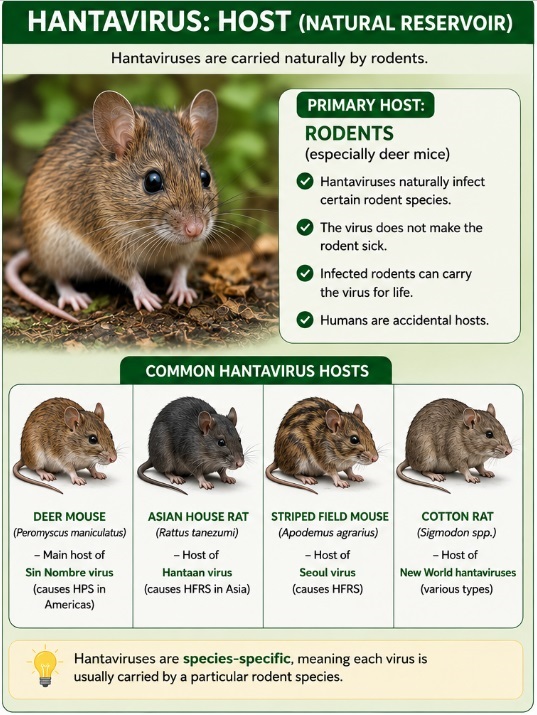
Several species of rodents are natural hosts of Hantavirus, Image credit: ChatGPT. Click on image to enlarge.
Hantaviruses are naturally maintained in rodent populations, such as mice, rats, and voles. Each hantavirus species is commonly associated with a particular rodent host. Infected rodents may carry the virus without showing obvious signs of illness and can release the virus through urine, feces, and saliva.
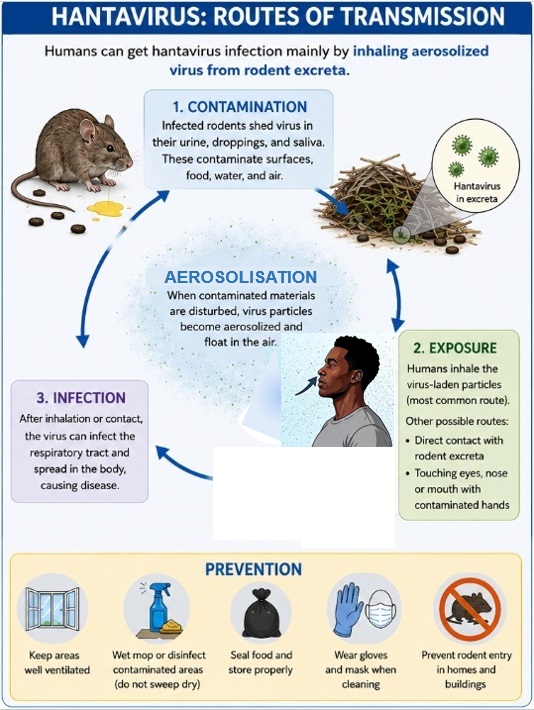
Info poster illustrating Hantavirus route of transmission. Image credit: ChatGPT. Click on image to enlarge.
People can become infected when they are exposed to these contaminated materials. Common routes of transmission include:
Hantavirus infection can cause two main illnesses:
Hantavirus CardioPulmonary Syndrome (HCPS)
This mainly affects the lungs. Symptoms usually appear 1–8 weeks after exposure to infected rodents.
Severe cases can cause fluid buildup in the lungs and may become life-threatening. About 38% of patients who develop respiratory symptoms may die.
Mainly affects the kidneys and usually develops 1–2 weeks after exposure.
Severe cases may lead to low blood pressure, shock, bleeding problems, and kidney failure.
The severity of HFRS depends on the hantavirus strain. Some strains cause severe disease with 5–15% fatality, while milder strains have less than 1% fatality. Recovery may take weeks to months.
Early diagnosis of hantavirus infection especially within sub-Saharan Africa can be challenging because its initial symptoms are similar to many other common illnesses that include influenza, COVID-19, viral pneumonia, leptospirosis, dengue fever, malaria, sepsis, and other infections that cause fever, body aches, or breathing problems.
A careful patient history is important during diagnosis. Doctors consider possible exposure to rodents, contact with rodent-contaminated areas, occupational risks, environmental exposure, recent travel to regions where hantavirus is present, and contact with suspected or confirmed cases.
Laboratory testing is required to confirm infection and this may be very challenging in SSA where laboratory infrastructures are limited.
Blood tests can detect hantavirus-specific IgM antibodies, which usually appear early in infection, or an increase in IgG antibody levels over time. During the early phase of illness, molecular tests such as reverse transcription polymerase chain reaction (RT-PCR) may be used to detect the virus’s genetic material (RNA) in the blood.
Because hantavirus samples may contain infectious virus, laboratory handling requires strict safety measures. Non-inactivated samples must be tested in high-level biosafety laboratories, and all biological specimens must be safely packaged using the triple packaging system during transport.
There is currently no specific treatment that completely eliminates hantavirus infection. Management focuses on supportive care, helping the body cope with the infection while preventing complications. Since hantavirus can progress rapidly, patients with severe illness are usually monitored closely in a hospital.
Treatment depends on the type and severity of infection. Supportive measures may include oxygen therapy to improve oxygen levels, and mechanical ventilation if breathing becomes severely affected. Intravenous fluids may be given to maintain hydration and electrolyte balance, while medications may be used to support blood pressure when needed.
In severe cases, advanced care such as intensive care monitoring, dialysis, or extracorporeal membrane oxygenation (ECMO) may be required. Dialysis is used when kidney function is seriously reduced, especially in cases of haemorrhagic fever with renal syndrome (HFRS).
The antiviral drug ribavirin may be considered in some cases of HFRS by healthcare professionals, depending on the specific strain and stage of illness.
Early medical attention and supportive treatment are important for improving outcomes.
Reducing contact with infected rodents is the most effective way to lower the risk of hantavirus infection. People should take extra precautions when entering places where mice or rats may have lived or left waste.
When cleaning areas that may contain rodent droppings or urine:
Keeping rodents away from homes and workplaces by sealing openings, storing food properly, and maintaining clean surroundings also helps reduce the chance of infection.
Anyone who develops flu-like symptoms after possible contact with rodents should seek medical attention quickly. Emergency care is especially important if there is difficulty breathing, a very fast heartbeat, severe weakness, dizziness, or signs of bleeding.
Early recognition and supportive hospital care are important because hantavirus infections can progress rapidly and may cause serious complications such as respiratory failure, shock, or organ damage.
Table 1 below compares the key clinical features of Ebola with Hantavirus.
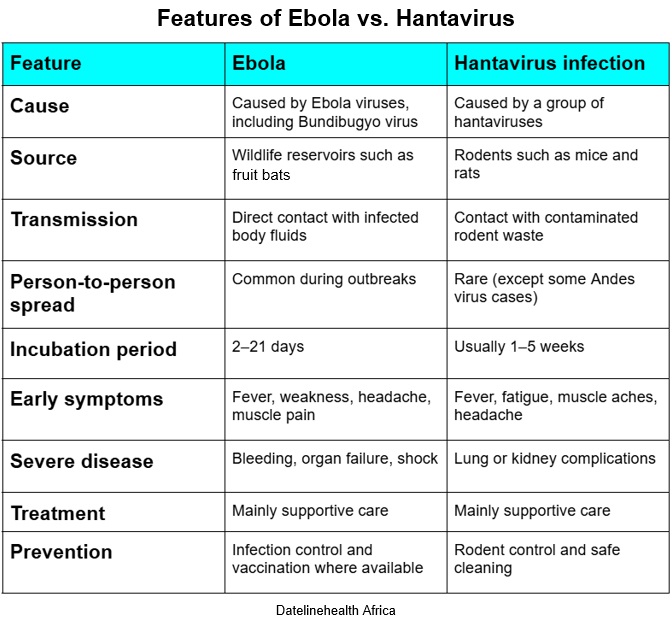
Table 1: Comparing the clinical features of Ebola virus disease with Hantavirus disease. Click on image to enlarge.
Both are zoonotic viral diseases, meaning they originate from animals and can cause severe illness. Early recognition and supportive medical care are important for survival.
Ebola is mainly a human-to-human transmitted outbreak disease once introduced into a community, while hantavirus is mainly an environment-associated infection acquired from rodents. Ebola control focuses heavily on preventing spread between people, whereas hantavirus prevention focuses on reducing contact with infected rodents and their contaminated environments.
Conclusion
Hantavirus is a rare but severe and often fatal Illness primarily contracted by inhaling contaminated rodent particles. As there is no specific antiviral treatment or widely approved vaccine, taking forward-thinking preventative measures, knowing the warning signs, and seeking early medical care remain your most powerful defenses.
While blood studies have shown that humans and animals in many African countries like Côte d'Ivoire, Guinea, Nigeria, Senegal, the Democratic Republic of the Congo, Ethiopia, Kenya, Madagascar, and South Africa, have antibodies to hantaviruses, human cases of the disease are extremely rare or more likely under-reported on the continent. The rarity is likely due to low awareness, poor diagnosis and the considerable clinical overlap with other infectious diseases like malaria, Lassa fever and Ebola that have associated severe fever as symptoms.
How do humans contract hantavirus?
The commonest way that you can catch hantavirus is by breathing in dust particles that is contaminated with rodent urine, droppings, or nesting materials. This can occur during cleaning of closed spaces like stores, sheds, garages. You can also catch hantavirus through direct contact with infected rodents or touching your mouth/nose after touching contaminated surfaces.
Hantavirus is rare in sub-Saharan Africa and no case of person-to-person infection has been described in the continent. This is also true of Asia and North America. However, in specific rare strains found in South America (like the Andes virus) the virus can be transmitted through very close, prolonged personal contact or exposure to bodily fluids.
There is no approved antiviral drug, cure, or vaccine available for hantavirus presently. Treatment relies on life-saving supportive therapies that include oxygen support and fluid management.
World Health Organization (WHO). Hantavirus [Internet]. 6 May 2026. [Cited June 20, 2026]. Available from here.
Centers for Disease Control and Prevention (CDC)..[Omternet] 13 May 2024. [Cited June 20, 2026]. Available from here.
World Health Organization (WHO).[Internet] 2 June 2026. [Cited June 20 2026]. Available from here.
Centers for Disease Control and Prevention (CDC). Zoonotic diseases [Internet]. 7 April 2025.[Cited June 20 2026]. Available from here.
Africa CDC. Hantavirus. [Internet, n.d.]. Cited June 22, 2026 Available from here.
Published: June 30 2026.
© 2026. Datelinehealth Africa Inc. All rights reserved.
Permission is given to copy, use and share content for non-commercial purposes without alteration or modification and subject to source attribution.
DATELINEHEALTH AFRICA INC., is a digital publisher for informational and educational purposes and does not offer personal medical care and advice. If you have a medical problem needing routine or emergency attention, call your doctor or local emergency services immediately, or visit the nearest emergency room or the nearest hospital. You should consult your professional healthcare provider before starting any nutrition, diet, exercise, fitness, medical or wellness program mentioned or referenced in the DatelinehealthAfrica website. Click here for more disclaimer notice.