The 9–14 HPV Armour: Protect Your Nigerian Daughter From Cervical Cancer
By Helen Otailku, B.Sc., Health Scientist, Freelance Health Writer and DLHA Volunteer. Medically reviewed by The DLHA Team
July 4, 2026.
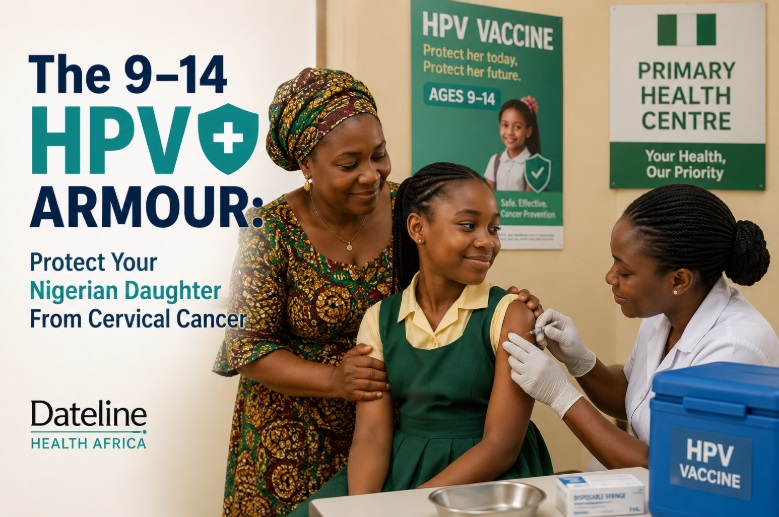
A Nigerian mother and her daughter at a primary health centre where a healthcare worker is administering the HPV vaccine to the girl’s upper arm. Girls mother stands besides her. The image is captioned, "The 9–14 HPV Armour: Protect Your Nigerian Daughter From Cervical Cancer". Photo Credit: ChatGPT. Click on image to enlarge.
When Mrs. Ayeni heard that the government was offering a free Human papillomavirus (HPV) vaccine for girls aged 9 to 14, she did not hesitate. “It is better to prevent diseases using vaccines than to seek cures,” the Abuja mother said after ensuring her 11-year-old daughter, Morenike, received her shot. Her instinct reflects what science has confirmed for decades: cervical cancer is mostly caused by HPV, and a single vaccine dose can protect a girl for life (1).
Read on to learn more about the link between HPV and cervical cancer, the harm it causes and how vaccination of young girls between 9 - 14 years of age provides them with lifetime protection against the harm of cervical cancer.
You may have heard the term HPV mentioned in relation to the government’s vaccination campaign. But what exactly is it, and why does it matter for your own daughter?
HPV is an special germ that is different from bacteria, prasites or fungi. It is the cause of a common sexually transmitted infection (HPV infection) that can affect the skin of the genital and anal areas, and the throat (2).
According to the World Health Organization, approximately 80% of sexually active adults worldwide will become infected with HPV at some point in their lives (2). This is not a rare or distant threat. It is one of the most widespread infections on earth.
The reassuring news is that in most cases, your immune system (i.e., your body's infection protection system) clears the virus naturally (2). However, not all HPV strains are equal. There are over 200 known types of the virus, and while many are harmless, some are classified as high-risk.
Persistent infection with certain types of HPV (the high risk strains) can cause abnormal cells that may develop into cancer (2). This process is slow; it typically unfolds over many years or even decades which is why cervical cancer often goes undetected until it has reached a mature stage, particularly in settings with limited screening access like Nigeria.
Of the high-risk strains, two stand out above the rest. HPV types 16 and 18 cause 70% of cervical cancer cases worldwide (2). These two strains alone are responsible for the majority of cervical cancer deaths in Nigeria each year.
Why Nigerian Parents Should Care About HPV and the HPV Vaccine
Here is a reasonable question that many Nigerian parents ask : My daughter is still a child. Why are we talking about this now? The answer is straightforward. HPV vaccines work best if they are given before someone is exposed to the virus. Studies suggest that vaccinating girls aged 9–14 years offers the highest biological and public health benefit (3). Vaccination at an earlier age, particularly before exposure to the virus and before sexual activity, produces a stronger immune response (3).
Vaccinating your daughter any time between ages 9 to 14 years, is not a statement about her behaviour or your values. Research shows that HPV vaccination is not associated with an earlier onset of sexual activity or increased incidence of sexually transmitted infections (3). It is simply sound, evidence-based medicine to protect her before the virus ever has a chance to take hold.
Think of the HPV vaccine as a practice run for your daughter’s immune system, one that could save her life.
The vaccine contains purified virus-like particles (VLPs) derived from the outer protein of the HPV (4) These particles mimic the appearance of the virus but carry no genetic material, meaning they cannot cause infection. In simple terms; the vaccine teaches your daughter’s immune system to recognise and destroy HPV before it ever gets a foothold.
Girls aged 9–14 years receive a single dose of the vaccine, which is effective in preventing infection with HPV types 16 and 18, the strains known to cause at least 70% of cervical cancers (5). That is all it takes to provide lasting protection against the viral strains most responsible for cervical cancer deaths in Nigerian women.
It is important to understand what the vaccine does and does not do. It is a preventive tool, not a treatment. It cannot clear an existing HPV infection. This is precisely why the window of ages 9 to 14 matters so much. The vaccine series is most effective when given before a person is exposed to the virus. (5)
If you need proof of what this vaccine can accomplish at scale, look no further than Australia. Australia’s national HPV vaccination programme commenced in 2007, and the 2025 Cervical Cancer Elimination Progress Report found that there was not a single documented case of cervical cancer among women under 25 across Australia in 2021 which is the latest available data (6), That is the power of sustained, population-wide vaccination. Nigeria is now on a similar path. The question is whether enough parents choose to act while the window is open.
More than 15 years of monitoring and research have accumulated reassuring evidence that HPV vaccination provides safe, effective, and long-lasting protection against cancers caused by HPV infections. Each HPV vaccine went through years of strict safety testing before being licensed, and Gardasil 9 was studied in clinical trials involving more than 15,000 females and males (7).
It is important for parents to know and be reassured that the HPV vaccine is a non-infectious recombinant vaccine containing purified virus-like particles; it does not contain live virus (7) and therefore cannot cause HPV infection. There is no way for the vaccine itself to give your daughter the disease it is designed to prevent.
Before administering the vaccine to a girl;
The single dose plan is in use in Nigeria, but other multiple dose plans are in use elsewhere in the world, where timing depends on the patient's age and immune status.
Mild, short-lived reactions are normal and actually indicate that your daughter’s immune system is responding as it should.
The most common side effects include soreness at the site of the injection.
The most commonly reported adverse but mild to moderate events include:
These reactions typically resolve within a day or two without any treatment. Around 92% of reports were classified as non-serious (7).
Some myths and misinformation about the HPV vaccine are circulating widely among Nigerian parents and all of them are contradicted by scientific evidence.
Deciding to protect your daughter with a vaccine that has been safely administered to hundreds of millions of girls globally is an evidence-based act of good parenting.
The HPV vaccine is available free of charge through government primary health centres and National Primary Health Care Development Agency (NPHCDA) outreach points across Nigeria. During campaign periods, schools serve as additional delivery points. No prior appointment is needed. Simply bring your daughter’s health card or immunisation record. If you missed a campaign drive in your area, do not wait for the next one. Walk into your nearest primary health centre and ask specifically for the HPV vaccine for your daughter. The opportunity to protect her is closer than you think.
Cervical cancer is preventable. The HPV vaccine is free, safe, and proven with your daughter requiring only one dose. Countries that have embraced widespread vaccination like Australia are already seeing cervical cancer disappear in young women. Nigeria is on that same path, but every unvaccinated girl represents a gap that misinformation and hesitancy must not be allowed to fill. Mrs. Ayeni did not wait and neither should you. Visit your nearest primary health centre today with your daughter for a dose that offers a lifetime of protection. If you found this helpful, subscribe to Dateline Health Africa because protecting your health and that of your loved ones starts with staying informed.
1. World Health Organisation (WHO). Safeguarding the future of women and girls in Nigeria against cervical cancer [Internet]. WHO Regional Office for Africa. February 6, 2024. [Accessed June 23, 2026]. Available from here.
2. Agha S, Nsofor I. HPV vaccine uptake among adolescent girls in Nigeria: The complex role of caregivers’ education. PLoS One. 2025;20(7):e0325684. doi:10.1371/journal.pone.0325684 Cervical cancer. Avaiable from here.
3. Geddes L. Why the HPV vaccine is offered to teenage girls and what parents need to know about it. [Internet].Gavi. VaccineWork. 18 September 2025. [Accessed June 24, 2026]. Available from here..
4. NIH. National Cancer Institute. Human papillomavirus (HPV) vaccine [Internet]. Last updated June 1 2026. [Accessed June 25, 2026]. Available from here.
5. World Health Organization (WHO). APO Group Newsroom Afive Newsroom. Nigeria to vaccinate 7.7 million girls against the leading cause of cervical cancer. [Internet]. October 24, 2023. [Accessed June 27, 2026]. Available from here.
6. UNSW Kirkby Institute. Australia on track to eliminate cervical cancer. But HPV vaccination and screening rates are falling [Internet]. November 18, 2025. [Accessed June 24, 2026]. Available from here.
7. CDC. HPV vaccination. [Internet]. August 20, 2024. [Accessed June 24, 2026]. Available from here.
Related links:
Published: July 4, 2026
© 2026. Datelinehealth Africa Inc. All rights reserved.
Permission is given to copy, use, and share content freely for non-commercial purposes without alteration or modification, and subject to source attribution.
DATELINEHEALTH AFRICA INC., is a digital publisher for informational and educational purposes and does not offer personal medical care and advice. If you have a medical problem needing routine or emergency attention, call your doctor or local emergency services immediately, or visit the nearest emergency room or the nearest hospital. You should consult your professional healthcare provider before starting any nutrition, diet, exercise, fitness, medical or wellness program mentioned or referenced in the DatelinehealthAfrica website. Click here for more disclaimer notice.