Can Drinking Too Much Water Be Harmful?
By: Kelechi Nwaowu, RN, RM. Freelance Health and Wellness Writer. Medically reviewed by: Swabirah Sulaiman, BSc. Physiology. Clinical Physiologist.
May 25, 2026
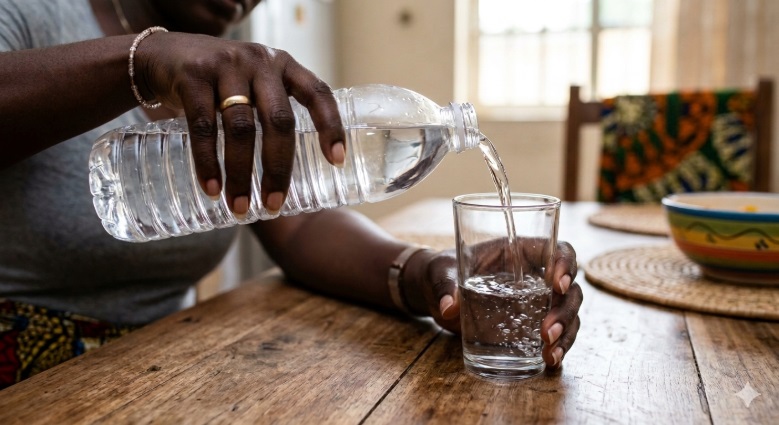
AI-generated image of an African woman pouring a bottle of water into a glass cup. Image Credit: Gemini AI
Chioma had just registered with a gym facility, and her trainer had told her class to drink plenty of water to stay hydrated. Chioma took this advice seriously, and for the past 12 days, she has been drinking lots of water. She forces herself to finish at least eight 75cl bottles of water in a day, which is 6 liters of water daily.
During her Saturday morning workout, her trainer kept on saying, "Stay hydrated!" as they ran laps around the field. Chioma picked up her can and drank a full bottle of water before the workout, another during their 20-minute run, and two more bottles afterward.
By the time she got home, Chioma felt strange. Her stomach was bloated and uncomfortable, with a pounding and dull headache. When she tried to eat lunch, she felt sick and she threw up. "Maybe I pushed too hard during exercise," she thought.
However, the symptoms got worse with time. Chioma started experiencing confusion, and her hands and feet started swelling. Her worried family quickly rushed her to the hospital, where she was diagnosed with water intoxication. Chioma had drunk so much water that it dangerously lowered the salt level in her blood, causing her brain to swell.
Most people know that not drinking enough water is unhealthy, but can drinking too much water be harmful? The answer is yes, and it can be just as harmful or as not drinking enough.
Read on to learn more about water intoxication or overhydration
Water is the foundation of life, and it is the most important part of your body. While we think of ourselves as solid, we are actually made mostly of water. As a healthy adult, water makes up about 70 to 75% of your lean body mass – which includes your muscles and organs (1). Even your bones, as hard as they feel, are made of about 30% water.
Because water is in every cell, it keeps you healthy in so many ways.
Water hydrates and nourishes your body, removes waste through sweat and urine, prevents kidney stones, supports healthy skin, aids digestion, and maintains normal body temperature (1). Without water, none of these functions would work, and life would be impossible.
When you do not drink enough water, you become dehydrated. Dehydration causes headaches, dizziness, dry mouth, dark yellow urine, and tiredness. Severe dehydration can damage your kidneys and even threaten your life.
Because of the harmful effects of not drinking enough water, healthcare professionals, fitness trainers, and health websites tell you to drink water regularly. The message "drink more water" is everywhere, but there is another side to this story that people rarely talk about, overhydration or water intoxication.
For more on the importance of water, read: 10 Health Benefits of Drinking Water
Water intoxication or overhydration is a serious medical condition that happens when you drink too much water, which causes an imbalance in your body's electrolytes (minerals like sodium that help your cells work properly) (2).
When you drink a normal amount of water, your kidneys filter out the extra water and remove it through urine; however, the kidneys can only process about 0.8 to 1 liter of water hourly (3).
If you drink more water than your kidneys can handle at a time, the excess water stays in your body and dilutes your blood.
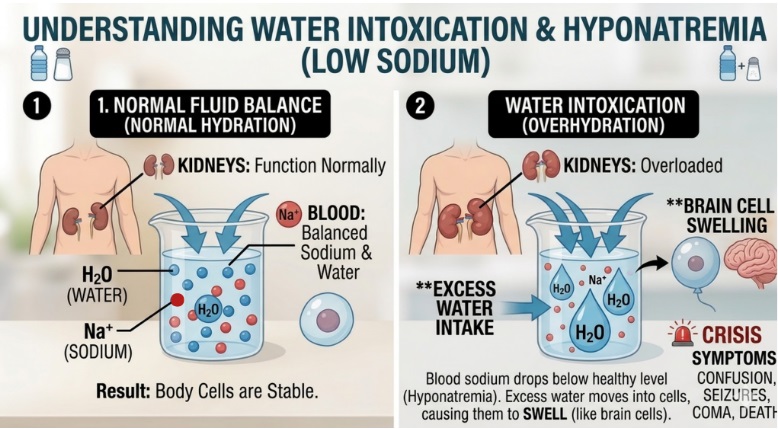
AI-generated illustration of what happens when you drink too much water. Image Credit| Gemini AI. Click on image to enlarge.
Think of your blood like soup. This soup needs the right balance of ingredients – water and minerals like sodium (salt) – for healthy living. When you drink too much water, it is like pouring gallons of water into a pot of soup. The soup becomes watery and tasteless because the water has diluted all the other ingredients.
In your body, this watery state leads to a medical condition called hyponatremia. Hyponatremia means having too little sodium (salt) in your blood (“hypo” means low, and “natremia” means sodium in the blood). Doctors diagnose hyponatremia when the sodium level in your blood drops below 135 millimoles per liter (mmol/L) (3).
When this happens, your body cells notice that the liquid outside them (your blood) now has less salt than the liquid inside them. So to balance things out, water moves from your blood into your cells, trying to even out the salt levels.
This movement of water from outside the cell to inside causes your cells to swell like balloons filling with water (2). Most cells can handle some level of swelling, but brain cells are trapped inside your hard skull with no room to expand. Hence, the swelling of the brain cells builds up pressure inside your head, which slows brain function and causes the symptoms of water intoxication (2).
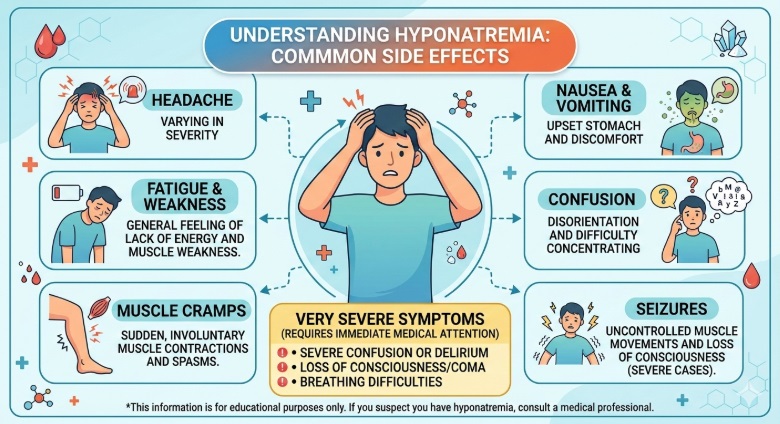
AI-generated infographic on the Signs and Symptoms of hyponatremia. Image Credit: Gemini AI. Click on image to enlarge.
The symptoms of water intoxication can appear gradually or suddenly, depending on the pace and quantity of water taken. Early symptoms often look similar to dehydration symptoms, which makes water intoxication confusing to diagnose (2).
The first signs of water intoxication usually include:
Many people who develop these symptoms assume they are dehydrated and drink even more water, making the problem worse (3). This is why recognizing water intoxication early is so important.
If water intoxication is not caught and treated early, the symptoms become much more serious and life-threatening. The seriousness is often shown by the following signs and symptoms (2):
A tragic case in 2007 involved Jennifer Strange, who died after drinking nearly 2 US gallons (7.6 liters) of water in an attempt to win a Nintendo Wii console in a radio station contest (4). Her death brought national attention to the dangers of water intoxication.
Water intoxication is rare, so it does not happen to everyone. For most healthy people with normally functioning kidneys, it is very difficult to drink yourself into water intoxication accidentally (2). But certain groups of people face higher risks.
Marathon runners, cyclists, hikers, and other endurance athletes like soldiers in training are at the highest risk of water intoxication (3). During long periods of intense exercise, they sweat heavily, and this sweat contains water and salt. When they lose sweat, they lose both the salt and the water.
However, many athletes have been taught to drink as much water as possible during exercise to avoid dehydration. Following this advice, some athletes drink large amounts of plain water without replacing the salt they have lost. This creates an imbalance in the blood where the water is more than the salt.
Between 2008 and 2023, the United States Military Health System reported 1,812 cases of exertion-related hyponatremia (low sodium from exercise) among active service members (3). A 2015 military report described a soldier who died during a 40-kilometer marching exercise in hot weather. He drank almost 13 liters of water during the exercise, while his peers drank closer to 10 liters. The excess water caused rather than prevented his fatal outcome (5).
Military training guidelines now recommend that soldiers drink no more than 1 to 1.5 liters of water per hour during heavy sweating (3).
The following medical conditions make it easier to develop water intoxication:
Babies, especially those under 6 months old, are extremely sensitive to water intoxication (6). Their small bodies and immature kidneys cannot handle extra water the way adult bodies can.
Because a baby's kidneys are still developing, they cannot filter and remove water as efficiently as adult kidneys. So, when a baby drinks water, even a small amount can dilute their blood and cause a sodium imbalance.
This higher risk of developing water intoxication is one of the reasons why the WHO advises that babies under 6 months old should be given only breastmilk (6, 7).
Some families believe they should give babies water in hot weather to prevent dehydration. This is wrong because breast milk provides all the water a baby needs, even in hot climates.
Want to know about breastfeeding? Read: 6 Breastfeeding Tips for New African Moms
There are no official guidelines from the World Health Organization about exactly how much water a person needs to drink each day (3). This is because the right amount of water is different for everyone. How much water you need depends on:
The best guide for how much to drink is to listen to your body. Drink when you feel thirsty, and check your urine color to see if you are properly hydrated.
Now that you understand the dangers of drinking too much water, you might feel confused about how much to drink. Proper hydration is simple when you follow these practical guidelines.
Your body has a built-in hydration sensor for thirst. When your body needs water, it sends you a signal – you feel thirsty. This is your body's way of telling you, "Please drink some water now."
For most healthy people, thirst is a reliable guide (3). Drink water when you feel thirsty, and stop when you feel satisfied. You do not need to force yourself to drink excess water when you are not thirsty.
However, children and older adults are the exceptions. Children often get so caught up in playing that they forget to drink water, and as people age, their sense of thirst becomes less sensitive. Because of this, elderly people may not feel thirsty even when their bodies need water. If you are caring for a child or an elderly person, offer them water at different times during the day, even if they do not ask for it.
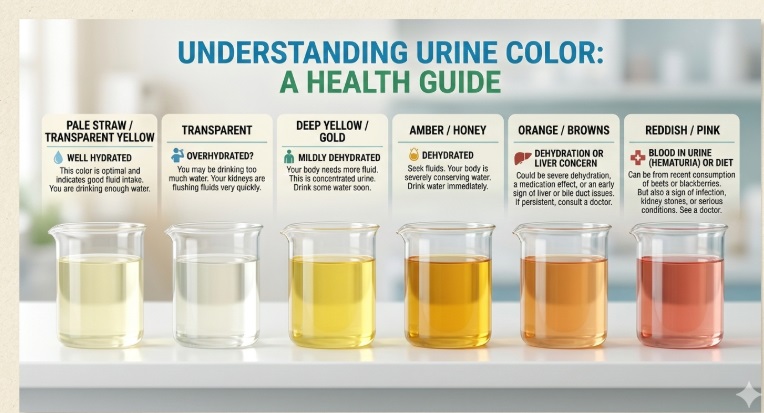
AI-generated infographic on the different urine colors and their possible meanings. Image Credit| Gemini AI. Click on image to enlarge.
Your urine color is one of the best ways to check if you are drinking the right amount of water.
Check your urine color a few times during the day, especially in the morning. Morning urine is usually slightly darker because you have not had water overnight, and that is normal. The goal is to keep your urine light yellow throughout the day.
Certain situations require you to drink more than usual:
A practical guideline by some experts suggests that you do not drink more than 1 liter of water per hour, since the kidneys filter 0.8 - 1 liter of water in an hour (3). Your kidneys need time to process the water you drink.
It is now easier to find health information online, but not all of it comes from experts and are accurate. This has led to many common misunderstandings about how much water we really need. Some of the common misunderstandings about water and hydration include the following:
More is not always better. Your body needs the right amount of water – not too little, and not too much. Drinking excessive water does not "flush out more poison" or make you healthier. In fact, it can harm you by causing water intoxication.
Urine color exists on a spectrum. There are other conditions apart from the level of water intake that can affect urine color. For example, the presence of malaria parasites in the blood, liver problems, some medications and supplements.
Dark yellow urine does not always mean you need more water; it could be your body drawing your attention to an existing situation that may not be water-related. If you have been drinking enough water, you do not need to drink excessively more to clear your urine. Seek medical advice from a health professional instead, especially if you are showing other symptoms like fever, unexplained body pain, etc.
The trending "8 glasses a day" rule is not based on scientific evidence. There is no official health guideline that says everyone must drink exactly 8 glasses (about 2 liters) of water daily (8).
The amount of water you need depends on your individual circumstances – your size, activity level, climate, diet, and health conditions. Some people may need 6 glasses, others may need 8 glasses. Let your body – thirst and urine color guide you – not an arbitrary number.
Water is essential for life; your body needs water every single day to survive and function properly. But like medicine, food, or anything else, water can become harmful when consumed in excess.
Water intoxication is rare, but it is real and can be dangerous. When you drink too much water too quickly, it dilutes the sodium in your blood, causing your cells – especially brain cells – to swell. This swelling increases the pressure inside your skull, leading to nausea or vomiting, headache, weakness. etc., and in severe cases, to confusion, seizures, coma, and even death.
Water keeps you alive, but drinking the right amount – not too much, not too little – is what keeps you healthy.
1. Datelinehealth Africa. 10 Health benefits of drinking water. [Internet] Updated 2025 May 18. [Cited 2026 March 4]. Available from here
2. Cleveland Clinic. Water intoxication: toxicity, symptoms & treatment. Cleveland (OH): Cleveland Clinic; 2024 Sep 17 [Cited 2026 Mar 4]. Available from here
3. ?Semeco A. What happens if you drink too much water? Medical News Today [Internet]. 2022 Oct 9 [updated 2025 April 10; [Cited 2026 Mar 3]. Available from here
?4. Clarke S, McHugh R. Jury rules against radio station after water-drinking contest kills Calif. mom. ABC News [Internet]. 2009 Nov 2 [Cited 2026 Mar 06]. Available from here.
5. Nolte HW, Hew-Butler T, Noakes TD, Duvenage CS. Exercise-associated hyponatremic encephalopathy and exertional heatstroke in a soldier: High rates of fluid intake during exercise caused rather than prevented a fatal outcome. Military Medicine. 2015 Jan;180(1):e152-5. Available from here.
6. Suzan ÖK, Kaya Ö, Kolukisa T, Koyuncu O, Tecik S, Çinar N. Water consumption in 0-6-month-old healthy infants and effective factors: A systematic review. Biomédica. 2023 Jun;43(2):181-99. Available from here.
7. World Health Organization. Infant and young child feeding [Internet]. Geneva: World Health Organization; 2023 [Cited 2026 Mar 04]. Available from here.
8. Valtin H. "Drink at least eight glasses of water a day." Really? Is there scientific evidence for "8 x 8"? Am J Physiol Regul Integr Comp Physiol. 2002 Nov;283(5):R993-1004. Available from here.
Related: 10 Health Benefits Of Drinking Water
Published: May 25, 2026
© 2026. Datelinehealth Africa Inc. All rights reserved.
Permission is given to copy, use, and share content freely for non-commercial purposes without alteration or modification and subject to source attribution.
DATELINEHEALTH AFRICA INC., is a digital publisher for informational and educational purposes and does not offer personal medical care and advice. If you have a medical problem needing routine or emergency attention, call your doctor or local emergency services immediately, or visit the nearest emergency room or the nearest hospital. You should consult your professional healthcare provider before starting any nutrition, diet, exercise, fitness, medical or wellness program mentioned or referenced in the DatelinehealthAfrica website. Click here for more disclaimer notice.