Oral Rehydration Solution Explained for Africans
By Kelechi Nwaowu, RN, RM, Freelance Health and Wellness Writer. Medically reviewed by the DLHA Team.
April 15, 2026.
.jpg)
AI-generated image of a community health worker teaching a group of villagers how to prepare ORS safely at home Image. Credit: Gemini AI. Click on image to enlarge.
Three-year-old Chinedu had been having watery diarrhea for two days. His mother, Ngozi, watched helplessly as her son became weaker. His eyes looked sunken; his lips were dry and cracked. When she pinched his skin, it stayed raised instead of flattening back immediately.
Ngozi lived in a rural village two hours from the nearest hospital, and she had no money for transport, let alone for treatment. She was terrified watching her son slip away.
Then her neighbor, a retired nurse, came to visit. She looked at Chinedu and said, "This child is dehydrated. We need to give him a special water to drink right now."
The nurse went to Ngozi's kitchen, measured some salt and sugar, mixed them with clean boiled water, and started giving Chinedu small sips every few minutes.
Within six hours, Chinedu's eyes looked less sunken and he started urinating again. By the next morning, he was sitting up and asking for food. A simple mixture of salt, sugar, and water had saved Chinedu’s life.
This is the power of Oral Rehydration Solution. It is one of the most important medical discoveries of the 20th century, and every parent, caregiver, and community health worker in Africa needs to know how to make it correctly.
Oral Rehydration Solution (ORS) is a special drink made from clean water, sugar, and salt in exact proportions. When someone, especially a baby has diarrhea or vomiting, they lose not just water but also important substances from the body – especially sodium (from salt) and glucose (from sugar).
ORS replaces the lost water, salt and sugar at the same time. This is what makes ORS work so well. Replacing lost water alone is not enough; salt alone is dangerous, while sugar alone does not help. But when you mix them in the right amounts, they create a life-saving solution.
A British medical journal – The Lancet, calls ORS "one of the most important medical advances of the 20th century" [1]. Since the 1970s, ORS has saved over 70 million lives worldwide, most of them are children under 5 years old [1].
Your intestines (the long tube in your belly that digests food) normally absorb water and nutrients from food and send them into your bloodstream. But when you have diarrhea from whatever cause, your intestines stop absorbing water properly. Instead, they push water out rapidly, causing watery stools [2)]
When you lose too much water through diarrhea and vomiting, you become dehydrated [2]. Dehydration means your body does not have enough water to work properly, so your blood becomes thick. Your heart struggles to pump, your kidneys cannot filter waste and your brain does not get enough oxygen. In severe cases, dehydration kills.
ORS works through a scientific process called co-transport. The sodium (salt) and glucose (sugar) in ORS work together like a team. When they enter your intestines together, they help pull water from the ORS into your bloodstream, even when diarrhea is making your intestines push water out [2]. This is why ORS works better than plain water.
Think of it this way: your intestines have tiny doors that water needs to pass through to get into your blood. During diarrhea, these doors are mostly closed. But when salt and sugar arrive together, they open the doors and escort the water through. This is how ORS rehydrates your body even while diarrhea continues.
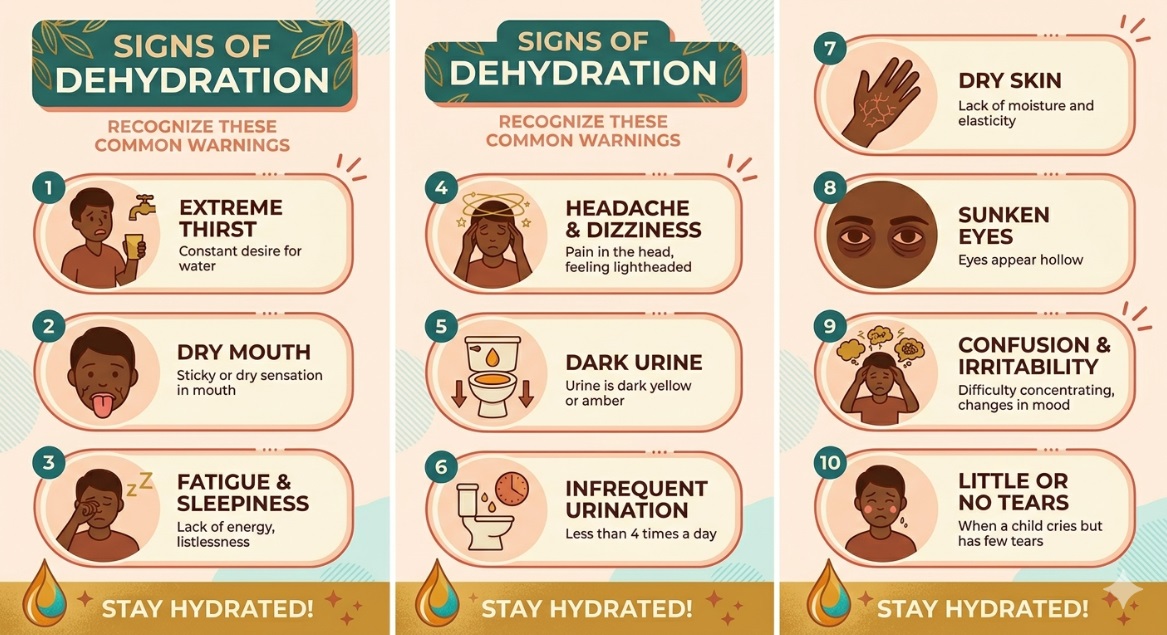
AI-generated Infographics on the signs of dehydration. Image Credit| Gemini AI. Click on image to enlarge.
ORS is used to replace lost fluids [2]. Therefore, it should be used whenever someone – whether child or adult has any of the following:
Start giving ORS as soon as the diarrhea or vomiting begins. Do not wait for dehydration to develop as prevention is easier than treatment.
ORS is a highly important drink and is heavily recommended by the WHO for the following two reasons:
Diarrheal diseases are one of the leading killers of African children. Every year, approximately 443,832 children under 5 years old die from diarrheal diseases globally, with the majority of these deaths occurring in Sub-Saharan Africa and South Asia [3].
Most of these deaths are completely preventable because children do not die usually from the diarrhea itself, but from the dehydration caused by diarrhea.
A 2020 study examining the burden of diarrheal diseases in Africa showed that there were approximately 1.008 billion diarrhea cases and 515,031 deaths across the continent [4] These high numbers are linked to poor access to clean water, poor sanitation, population growth and vaccination gap in Africa.
The tragedy is that dehydration from diarrhea is not a complicated medical problem to treat. ORS is cheap, safe, and highly effective, and when used correctly, ORS prevents about 93% of diarrhea deaths [5]. Yet many African children still die from dehydration simply because their families do not have ORS or do not know how to make it.
Made at home or bought commercially ORS is a relatively cheap treatment for dehydration n babies. It saves life especially where access to healthcare in rural areas can be challenging.
Commercial ORS packets are available in many pharmacies and health centers across Africa. These packets contain already measured ORS powder that you just mix with clean water. The WHO recommends homemade ORS when commercial ORS is unavailable. One is not better than the other for use.
In an emergency, when a child is losing fluids rapidly, homemade ORS can save a life while you arrange transport to a hospital. The ingredients – water, salt, and sugar – are available in almost every home. You do not need to travel, nor do you need to spend extra money. You can make ORS immediately, day or night, and start treatment right away
Commercial ORS packets face the following challenges in Africa:
These are why knowing how to make and give ORS at home is so important..
Every year, hundreds of thousands of African children die from dehydration caused by diarrhea – deaths that are almost entirely preventable with Oral rehydration solution (ORS). It is one of the simplest yet most powerful medical interventions ever discovered. It is a mixture of clean water, sugar and salt that can save a child's life within hours when prepared accurately and given promptly. Every parent, caregiver, teacher, or community health worker needs to know how to make and give ORS correctly.
1. Mahfuz M, Khan AT, Yunus M. Development of oral rehydration salt solution: A triumph of medical science. The Indian Journal of Medical Research. 2024 Sep 30;160(1):6. Available from here.
2. Aghsaeifard Z, Heidari G, Alizadeh R. Understanding the use of oral rehydration therapy: A narrative review from clinical practice to main recommendations. Health science reports. 2022 Sep;5(5):e827. Available from here
3. World Health Organization. Diarrhoeal disease [Internet]. Geneva: World Health Organization; 2024 March 7 [Cited 2026 Mar 30]. Available from here
4. Thystrup C, Majowicz SE, Kitila DB, Desta BN, Fayemi OE, Ayolabi CI, Hugho E, Buys EM, Akanni GB, Machava NE, Monjane C. Etiology-specific incidence and mortality of diarrheal diseases in the African region: a systematic review and meta-analysis. BMC Public Health. 2024 Jul 12;24(1):1864. Available from here
5. Munos MK, Walker CL, Black RE. The effect of oral rehydration solution and recommended home fluids on diarrhoea mortality. International Journal of Epidemiology. 2010 Apr 1;39(suppl_1):i75-87. Available from here
How to Make and Give Oral Rehydration Solution (ORS) at Home
Published: April 15, 2026.
© 2026. Datelinehealth Africa Inc. All rights reserved.
Permission is given to copy, use and share content for non-commercial purposes without alteration or modification and subject to source attribution.
DATELINEHEALTH AFRICA INC., is a digital publisher for informational and educational purposes and does not offer personal medical care and advice. If you have a medical problem needing routine or emergency attention, call your doctor or local emergency services immediately, or visit the nearest emergency room or the nearest hospital. You should consult your professional healthcare provider before starting any nutrition, diet, exercise, fitness, medical or wellness program mentioned or referenced in the DatelinehealthAfrica website. Click here for more disclaimer notice.