How to Make and Give Oral Rehydration Solution (ORS) Safely at Home
By Kelechi Nwaowu, RN, RM, Freelance Health and Wellness Writer. Medically reviewed by the DLHA Team
April 15. 2026
.jpg)
AI-generated image of a community health worker teaching a group of villagers how to prepare ORS safely at home Image. Credit| Gemini AI. Click on image to enlarge.
Highlights:
The World Health Organization has tested and approved specific ingredients and method for preparing homemade oral rehydration solution (ORS) [1]. This recipe is safe and effective when made correctly. This blog covers the following important information about ORS:
Read on.
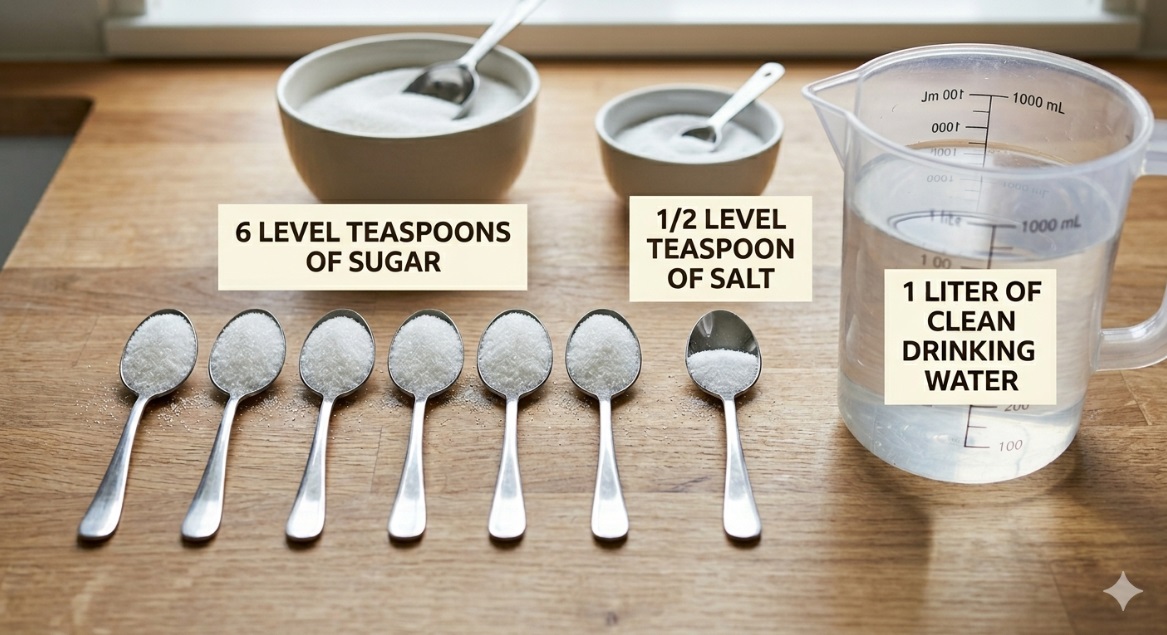
The 3 ingredients for homemade ORS preparation. Image Credit| Gemini AI. Click on imafe to enlarge.
You need only three ingredients to make your ORS at home [2]
That is all. Do not add anything else – no lemon, no flavoring, no honey, no milk. Adding other ingredients changes how ORS works and may make it unsafe.
This is the most important part because ORS only works if you use the correct measurements. To achieve this accuracy you need the exact measurement of water, sugar and salt.
First, is 1 litre of water. To accurately measure 1 litre of water, use a measuring jug or water bottle – they already have their measurements written on them, for example 1l, 50cl, 75cl etc. if you do not have a 1 liter measuring jug you can use a 50cl water bottle. 100cl = 1 litre, so you need two bottles of 50cl water to get 1 litre of water for your ORS. In order to avoid errors from using 60cl or 75cl, Find a 50cl water bottle and reserve it for your ORS preparation
The second ingredient is 6 level teaspoons of sugar. 1 teaspoon is around 5 grams, so 6 teaspoons will have around 30 grams of sugar. If you do not have a teaspoon, you can use a tablespoon. 1 tablespoon equals 15 grams, so you need two tablespoons of sugar to make your ORS.
The last ingredient is ½ level teaspoon of salt. If you are using a tablespoon instead it will be 1/6 of it. Carefully divide the measurement into 2 (if you are using a teaspoon) or 6 (if you are using a tablespoon), then use one part of the divided salt.
In order to maintain accurate measurements, you need to understand what "level" is.
Level means that when you scoop sugar or salt with a teaspoon or tablespoon, the top should be flat, not heaped. Use a clean utensil like a knife or spoon to scrape off the excess, so the teaspoon/tablespoon is filled exactly to the rim with no extra on top [2].
Follow these steps carefully to safely and accurately prepare your ORS:
1: Wash your hands: Wash your hands thoroughly with soap and water before you start, and dry them with a clean towel.
2: Get clean water: If you have access to bottle water, use that. If not, boil tap or well water for 1 – 3 minutes, then let it cool to room temperature or lukewarm before use. Never use water directly from a river, stream, or well without boiling or treating it first.
3: Measure the water: Pour exactly 1 liter of clean, cooled water into a clean container. If you do not have a measuring jug, use the standard size water bottles sold in shops. It can come in 1.5litres, 1.0 litre or 50cl .Check the label to confirm and follow the directions as described above.
4: Add the sugar: Add 6 level teaspoons (or 2 level tablespoons) of white sugar to the water.
5: Add the salt: Add half a level teaspoon (or one-sixth level tablespoon) of salt to the water.
6: Stir well: Stir the mixture for at least 1 minute until all the sugar and salt completely dissolve. You should not see any grains of sugar or salt at the bottom.
7: Taste to check: ORS should taste slightly salty and slightly sweet, but not very salty. If it tastes very salty, you added too much salt. Throw it away and make a new batch. Do not give strong salty ORS to anyone.
8: Start giving ORS immediately: Do not wait. Start giving small, frequent sips right away.
Based on the WHO regulations, the following things should be strictly followed when preparing ORS:
The water you use to make ORS must be clean and safe. Contaminated water can make diarrhea worse instead of better. If someone already has diarrhea from dirty water, giving them more dirty water with salt and sugar will not help – it will add more germs to their body.
Salt is necessary in ORS, but too much salt is bad, especially for babies and young children.
Excessive salt in blood (hypernatremia) can cause:
This is why you must measure salt carefully. Half a teaspoon seems like a tiny amount, but it is exactly the right amount for 1 liter of water. Do not add more.
Because homemade ORS does not contain preservatives, it does not last long. If at room temperature, use it for 24 hours, then throw away any leftovers (6).
Also discard the ORS and make a new one if:
Note: When you make your ORS, write the time and the date you made it on the container so you remember when to throw it away.
In order for ORS to work and replace lost fluids as it is supposed to, certain factors like dosage and what to do when the person receiving the ORS vomits are considered.
The amount of ORS a person needs depends on their age and how much fluid they are losing. Below is the WHO Recommendations on the amount of ORS to give according to the individual’s age [4]:
Give small sips every 1 to 2 minutes using a clean spoon or cup after each watery stool. These sips should at least be up to 50 to 100 milliliters (about quarter to half a cup).
Let the child drink as much as they can, at least up to 100 to 200 milliliters (half to one cup) after each watery stool.
This group should generally drink as much as wanted after each watery stool, at least 2 litres in a day.
Note that these are minimum amounts for each group and should be taken in sips. You can give more ORS if the person wants to drink more (4). Ensure to continue giving ORS until the diarrhea stops.
Vomiting is a common occurrence when someone has diarrhea or other forms of illness. It can even happen due to the intensity with which the person is drinking the ORS. Do not stop giving ORS if the person vomits, instead do the following [4]:
The key is to give ORS slowly and frequently rather than in large amounts all at once. Even if the person vomits the ORS, some of it stays in the stomach and gets absorbed. However, if the person is continuously vomiting that they cannot keep down even small sips of ORS, take them to the hospital immediately. They may need intravenous fluids (fluids given through a needle directly into the vein) and better management by health professionals.
If a baby who is being breastfed is losing fluid and is on ORS, continue breastfeeding as often as the baby wants. Give ORS in addition to breast milk, not instead of breast milk [4)] This is because breastmilk provides nutrients and additional fluids that will help the baby recover.
For children eating solid food, continue giving normal food if the child can eat. Examples of good foods to give during diarrhea are fish, bananas, potatoes, eggs, and well-cooked vegetables [4].
Avoid very fatty or spicy foods, offer food regularly, but do not force the child to eat if they do not want to. The old advice to "starve a fever" or stop feeding during diarrhea is wrong and risky. Children need nutrients to recover, therefore continue feeding (4).
.jpg)
Infographics showing signs of dehydration. Click onimage to enlarge.
While homemade ORS works well for mild to moderate dehydration, some cases are too serious for home treatment. Go to the hospital immediately when you notice the following signs [4]:
If you see any of these signs, do not rely on homemade ORS alone. ORS is a powerful treatment, but it is not a cure for the infection causing diarrhea. The person needs urgent medical care at a hospital where they can receive other forms of treatment.
Related: Tips for African Parents on Caring for a Child with Fever at Home Safely
While homemade ORS saves lives, there are alternative options when available:
These contain the exact WHO-recommended formula already measured in a packet. You just have to add the powder to 1 liter of clean water, stir, and it is ready. Commercial ORS packets are more accurate than homemade ORS and are the preferred option when available.
The World Health Organization recommends giving zinc supplements along with ORS to children with diarrhea. Zinc reduces the duration and severity of diarrhea, improves outcome and reduces risk of occurrence by up to 3 months [4].
Zinc supplements come as tablets that can be dissolved in water or ORS, and they are usually available at pharmacies and health centers. The combination of ORS and zinc supplement is more effective than ORS alone. Ask your healthcare provider about zinc supplementation.
Oral Rehydration Solution is one of the simplest yet most powerful medical interventions ever discovered. It is a mixture of clean water, sugar and salt that can save a child's life within hours when prepared accurately.
Every year, hundreds of thousands of African children die from dehydration caused by diarrhea – deaths that are almost entirely preventable with ORS.
Every parent, caregiver, teacher, or community health worker, needs to know how to make ORS correctly.
Homemade ORS is a bridge that prevents dehydration and keeps a sick person alive while you get them to proper medical care or while their body fights off the infection. It is not a substitute for medical treatment, but it is often the difference between life and death.
Know ORS ingredients, remember the key preparation points, and share this knowledge with others. It is a simple solution that might save someone you love.
2. Rehydration Project. Oral rehydration solutions (ORS) made at home [Internet]. Wired Health Resources; [Cited 2024 May 22]. Available from here
3. Mittal R, Lai AM, Coskin R, Kaplan JM, Doyle J. Comprehensive Overview of Hypernatremia: Pathophysiology, Diagnosis, and Management. British Journal of Hospital Medicine. 2025 Dec 25;86(12):1-32. Available from here
4. Médecins Sans Frontières. Appendix 14: Treatment plan A: Health education to prevent dehydration [Internet]. MSF Medical Guidelines; [Cited 2024 May 22]. Available from here
Dr. Richard Cash: ORT Co-Pioneer; A Tribute from Africa
Oral Rehydration Solution Explained for Africans
Published: April 15, 2026.
© 2026. Datelinehealth Africa Inc. All rights reserved.
Permission is given to copy, use and share content for non-commercial purposes without alteration or modification and subject to source attribution.
DATELINEHEALTH AFRICA INC., is a digital publisher for informational and educational purposes and does not offer personal medical care and advice. If you have a medical problem needing routine or emergency attention, call your doctor or local emergency services immediately, or visit the nearest emergency room or the nearest hospital. You should consult your professional healthcare provider before starting any nutrition, diet, exercise, fitness, medical or wellness program mentioned or referenced in the DatelinehealthAfrica website. Click here for more disclaimer notice.