3 Common Painkillers You Should Not Take on an Empty Stomach
By: Favour Gospel. 600-level PharmD student and DLHA Volunteer. Medically reviewed by the DLHA Editorial Team
July 28, 2026.
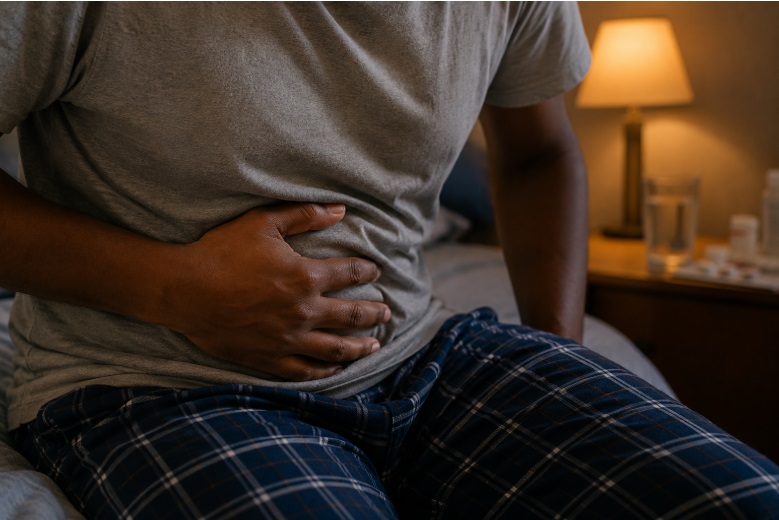
A close up and partial image of an African man holding his abdomen because of stomach discomfort. Persistent abdominal pain, nausea, or indigestion after taking NSAIDs such as ibuprofen, naproxen, or aspirin may be an early sign of stomach irritation. AI generated illustration created with ChatGPT.
Painkillers (also called analgesics) are medicines used to relieve pain. They are categorised into; Paracetamol, Opioids and NSAIDs. All painkillers relieve pain but they have different ways by which they do so. Some pain killers relieve pain and reduce fever while some are effective in reducing swelling and inflammation. Some painkillers have worse adverse effects than others.
Check out Ada’s story below for some insight into adverse effects of painkiller
Ada is a 21 year old university student in Kumasi, Ghana, who wakes up with a dull ache in her right leg, every morning. The pain started after an injury during a sports competition.
It has been a habit of hers to skip breakfast every morning in order to meet up with early morning lectures and long queues for campus transport. Due to the pain in her leg, she would take two tablets of Ibuprofen 200mg, before leaving her room. Within an hour, the pain would ease, allowing her to sit through lectures and walk around campus without much discomfort. The medicine worked so well and because it was easy to buy without a prescription, she never questioned whether she was using it correctly.
This routine continued for months. At first, nothing seemed wrong. Then she began noticing a burning sensation in her upper abdomen. Occasionally, she felt nauseated after taking the tablets. She blamed the discomfort on stress, irregular meals, and the pressure of school so she simply took another painkiller whenever the pain returned.
Ada did not realize that taking ibuprofen on an empty stomach every morning had been quietly damaging her stomach's protective lining. The medicine relieved her leg pain, but it also reduced the natural substances that acted as a shield to her stomach from its own acid. Over time, repeated exposure to ibuprofen increased her risk of developing gastritis (stomach inflammation), stomach ulcers, and even stomach bleeding.
Ada's story is not unique. Across Nigeria and many other African countries, students, traders, drivers, artisans, and office workers often rely on over the counter painkillers to get through the day. A woman with menstrual cramps swallows ibuprofen tablets, a market trader uses naproxen for knee pain after a long day at work, often without eating first. Many people assume that if a medicine is sold over the counter, it is completely safe but this assumption can be dangerous.
This article explains which painkillers cause the most stomach harm on an empty stomach, why it happens, who faces higher risk, and what to do instead.
NSAIDs (Non-Steroidal Anti-inflammatory drugs) are medications that reduce pain, relieve fever and decrease inflammation. They are available as OTC (over the counter) and prescription medications (1, 2).
Common non-prescription strength NSAIDs include:
Common prescription-strength NSAIDs include:
How Do NSAIDs Work?
NSAIDs reduce pain by blocking enzymes called cyclooxygenase (COX) enzymes. These COX enzymes play vital roles in the production of prostaglandins which are chemicals that cause pain, swelling, and fever. Even though these prostaglandins cause pain, they also protect the stomach lining from stomach acid.
When NSAIDs reduce prostaglandin production by blocking COX enzymes, the stomach becomes more at risk to irritation and injury. This can lead to erosion, damage to the stomach mucosal lining, and ulcers which may result in bleeding.
Aside from inhibiting the COX enzymes, NSAIDS can cause direct damage to the epithelium of the intestine by making it more permeable and unstable. Taking NSAIDs after food rather than on an empty stomach increases its safety (2, 3).
Ibuprofen remains one of the most commonly used painkillers worldwide. It is usually taken for headaches, menstrual cramps, migraines, bone and joint pain, dental pain and soft tissue pain. It is generally safe for most healthy adults when it is taken occasionally and according to the recommended dose. Taking it on an empty stomach increases the chance of stomach irritation. Over time, repeated exposure can lead to gastritis (inflammation, irritation, or swelling of the stomach’s internal lining), stomach ulcers, or bleeding (4, 5).
Naproxen is often used to treat pain or inflammation caused by damage in the joints(arthritis), inflammation of certain parts of the spine (ankylosing spondylitis), inflammation of the tendons(tendinitis), bursitis, gout, or menstrual cramps (6, 7).
Common side effects of Naproxen are indigestion, heartburn, stomach pain, nausea, headache, dizziness, drowsiness, itching, rash, swelling or ringing in your ears (7).
Naproxen stays active in the body longer than ibuprofen, which means it has more hours of contact with the stomach lining (2).
Aspirin (also called Acetylsalicylic acid) is used to treat mild to moderate pain. In addition to relieving pain and reducing fever, it is commonly prescribed in low doses to certain patients in order to reduce the risk of heart attack and stroke (8).
Aspirin damages the stomach lining directly on contact, and also blocks the COX enzymes. It also affects platelets, which makes any bleeding that starts harder for the body to stop. If you take low dose aspirin because it was prescribed by your doctor for heart disease or stroke prevention, do not stop taking it on your own. Instead, speak with your healthcare provider if you experience stomach discomfort or have concerns about side effects.
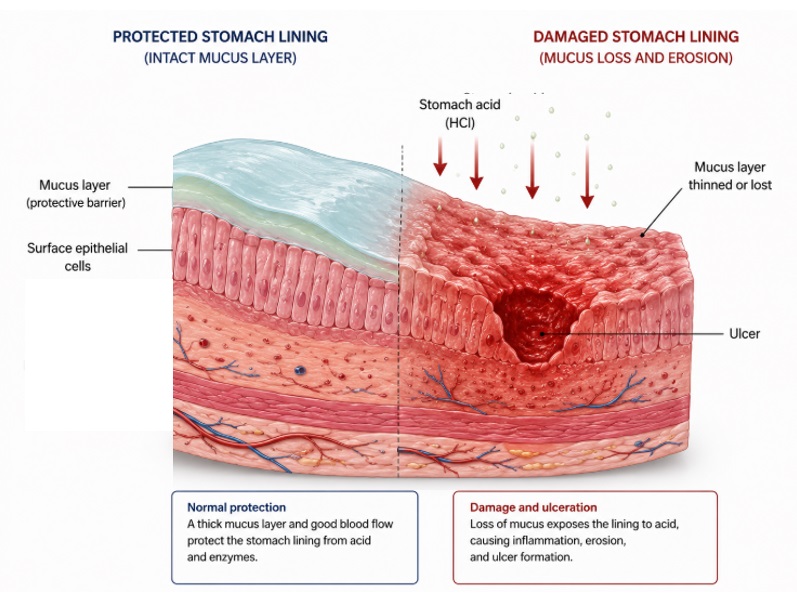
Comparison of a healthy and damaged stomach lining. Loss of the protective mucus barrier allows stomach acid to damage the underlying tissue, increasing the risk of NSAID induced gastritis and peptic ulcer formation. Source: AI generated illustration (ChatGPT). Click on image to enlarge.
When you have an injury or inflammation, your body produces prostaglandins which contributes to pain, swelling, and fever. For NSAIDs to relieve pain, they block enzymes known as cyclooxygenase (COX) enzymes, which are responsible for making prostaglandins.
Prostaglandins do more than cause pain. They also help protect the stomach by stimulating the production of mucus and bicarbonate (i.e. base or alkaline chemical salt), which form a protective barrier against stomach acid. They also support healthy blood flow to the stomach lining, allowing it to repair itself when damaged.
When NSAIDs are taken, it reduces prostaglandin production and weakens the stomach’s natural protection. Because protection is weakened, stomach acid can then irritate the stomach lining more thereby increasing the risk of inflammation, ulcers, and bleeding.
When you take NSAIDs with food, stomach damage is not completely prevented, but direct irritation is reduced. This makes these medicines easier to tolerate. This is why it is recommended that ibuprofen, naproxen, and aspirin are taken after a meal or with a snack. A person whose stomach lining is being damaged may have no symptoms at first, but over time, that damage can progress to gastritis, stomach ulcers, or gastrointestinal bleeding.
If you need pain relief for several weeks, do not simply start self-medication on your own. Talk with your healthcare provider and be monitored by them.
Anyone can develop stomach problems from NSAIDs but some people have a much higher risk than others.
As people age, the stomach lining becomes more at risk of injury. Adults aged 65 years and older have a greater risk of developing stomach ulcers and gastrointestinal bleeding when taking NSAIDs, especially if they use them regularly (9).
If you have previously had a stomach ulcer or gastrointestinal bleeding, taking NSAIDs may cause the ulcer to return or worsen. These medicines should only be used under medical supervision in such cases.
If you take any of the common NSAIDs daily without professional guidance, your risk of stomach injury is high.
The risk of bleeding is higher when NSAIDs are combined with medicines such as:
If you take any of these medicines, speak to your doctor or Pharmacist before using an NSAID.
Alcohol has the ability to irritate the stomach lining. If it is combined with NSAIDs, the risk of stomach ulcers and bleeding increases.
If you have chronic kidney or liver disease, inflammatory bowel disease, or serious heart conditions, please consult a healthcare professional before using NSAIDs regularly. NSAIDs may worsen the existing health problems (9, 10).
Helicobacter pylori (H. pylori), is a stomach bacterium that causes ulcers. If it is present, it increases the risk of NSAID-induced ulcers.
These symptoms may seem minor but do not ignore them if they occur repeatedly (11, 12). If you continue to take NSAIDs despite persistent stomach discomfort, it can increase the risk of ulcers.
If you notice these signs, stop the drug immediately and see a healthcare professional immediately (11).
Always read the medication leaflet before taking NSAIDS to be familiar with side effects. If anything in the leaflet is unclear, ask the pharmacist before using the medicine.
Acetaminophen (paracetamol), is the most commonly taken painkiller and it is recommended as first-line medication for pain by the World Health Organization (WHO). It is also used to reduce fever, and is available in different forms including syrups, tablets, effervescent tablets, injection, suppository, and other forms.
Paracetamol does not block prostaglandins in the stomach the way NSAIDs do, so it doesn't carry the same ulcer or bleeding risk. It works well for headaches, fever, and mild-to-moderate pain but it has no effect on inflammation. Paracetamol may be safer for the stomach, but it should still be used responsibly. Taking more than the recommended dose can damage the liver. Adults should generally not exceed 4,000 mg (4 g) within 24 hours unless instructed otherwise by a healthcare professional. People with liver disease, heavy alcohol users, or people taking other medicines that contain paracetamol may require lower doses.
Always follow the dosing instructions and avoid taking more than recommended.
If an NSAID is unavoidable, take it with a glass of milk, toast, or a small snack first. Food reduces stomach irritation, but it does not prevent ulcers or bleeding.
Enteric coated tablets are tablets that are covered with a special coating that resists stomach acid and dissolves only after the medicine reaches the site of absorption. Some NSAIDs come in this form. The coating helps protect the active ingredient from stomach acid and reduces direct contact between the medicine and the stomach lining. Ask your pharmacist whether an enteric-coated version is available for the NSAID you need.
Painkillers such as ibuprofen, naproxen, and aspirin are effective medicines when used correctly, but taking them on an empty stomach increases the risk of stomach irritation, ulcers, and gastrointestinal bleeding. Whenever possible, take these medicines after food and only for the shortest period needed. If you need frequent pain relief, have persistent pain, or develop warning signs such as severe stomach pain, vomiting blood, or black stools, stop using the medicine and seek medical care immediately. Using painkillers correctly helps relieve pain while reducing the risk of preventable complications.
Yes. They work in different ways to manage pain. They can be taken together but do not exceed the maximum daily dose of either medicine.
Stop taking the medicine and seek immediate medical attention if you develop severe stomach pain, vomit blood, pass black or tarry stools, develop yellowing of the skin or eyes, experience difficulty breathing, or notice swelling of the face or throat after taking a painkiller.
2. Tawfik AG, Gomez?Lumbreras A, Del Fiol G, Kawamoto K, Trinkley KE, Reese T, et al. Nonsteroidal Anti?Inflammatory Drugs and Risk of Gastrointestinal Bleeding: A Systematic Review and Meta?Analysis. Clin Pharmacol Ther. 2025 Sep 7;119(1):46–62. doi:10.1002/cpt.70054. Available from here.
3. Lichtenberger LM, Zhou Y, Jayaraman V, Doyen JR, O’Neil RG, Dial EJ, et al. INSIGHT INTO NSAID-INDUCED MEMBRANE ALTERATIONS, PATHOGENESIS AND THERAPEUTICS: CHARACTERIZATION OF INTERACTION OF NSAIDS WITH PHOSPHATIDYLCHOLINE. Biochim Biophys Acta. 2012 Jul;1821(7):994–1002. doi:10.1016/j.bbalip.2012.04.002. Available from here.
4. Moore RA, Derry S, Wiffen PJ, Straube S. Effects of food on pharmacokinetics of immediate release oral formulations of aspirin, dipyrone, paracetamol and NSAIDs – a systematic review. Br J Clin Pharmacol. 2015 March 17;80(3):381–8. Available from here.
5. NHS.UK. Ibuprofen for adults: painkiller that also treats inflammation. [Internet]. 2025 Aug. 27. [Cited 2026 Jul 4]. Available from here.
6. NHS.UK.[Internet]. Naproxen: a painkiller that also treats inflammation.2026 June 25. [Cited 2026 Jul 4]. Available from here.
7. Drugs.com. Naproxen: Uses, Dosage, Side Effects, Warnings. [Internet]. 2024 Jan. 24. [Ccited 2026 Jul 4]. Available from here.
8. Cleveland Clinic. Aspirin: Uses, Warnings & Interactions. [Internet, n.d.]. [Cited 2026 Jul 5]. Aspirin: Uses, Warnings & Interactions. Available from here.
9. Uskur T, Kurt BF. Polypharmacy and Drug-Drug Interactions in Elderly Patients With Gastrointestinal Bleeding: A Single-Center Retrospective Study. Cureus. 2025;17(1):e77866. doi:10.7759/cureus.77866. Available from here.
10. FDA Drug Safety Communication: FDA strengthens warning that non-aspirin nonsteroidal anti-inflammatory drugs (NSAIDs) can cause heart attacks or strokes | FDA [Internet].2015 July 9. 2026 [Ccited 2026 Jul 5]. Available from here.
11. NHS.UK. nhs.uk NSAIDS. [Internet]. 2026 April 28. [Cited 2026 Jul 5]. NSAIDs. Available from here.
12. Healthline. NSAIDs and Side Effects: Common & Urgent. [Internet]. 2019 July 23 [Cited 2026 Jul 5]. NSAIDs and Side Effects: Common & Urgent. Available from here.
Related:
Drug Facts for Africans: Ibuprofen
Drug Facts for Africans: Acetaminophen
Best Over-the-Counter Medications for Period Pains
Commonly Used Primary Care Pain Medications in Nigeria
Published: July 28, 2026.
© 2026. Datelinehealth Africa Inc. All rights reserved.
Permission is given to copy, use and share content for non-commercial purposes without alteration or modification and subject to attribution as to source.
DATELINEHEALTH AFRICA INC., is a digital publisher for informational and educational purposes and does not offer personal medical care and advice. If you have a medical problem needing routine or emergency attention, call your doctor or local emergency services immediately, or visit the nearest emergency room or the nearest hospital. You should consult your professional healthcare provider before starting any nutrition, diet, exercise, fitness, medical or wellness program mentioned or referenced in the DatelinehealthAfrica website. Click here for more disclaimer notice.