Aflatoxin in Nigerian Food: Health Risks and Safety Tips
By Helen Ohunene Otailku, B.Sc. Ed, Health Education, Freelance Health Writer. Medically reviewed by: O. Olatunbosun, M.B.B.S., MSc. (Clinical Microbiology and Parasitology).
August 14, 2026.
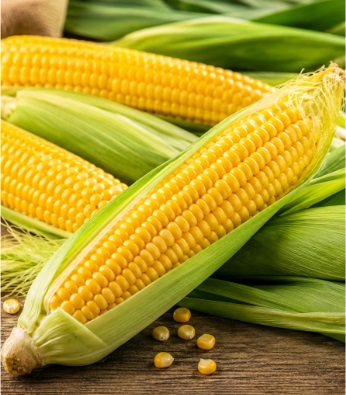
A high-resolution photograph of several fresh ears of yellow maize arranged on a rustic wooden surface. Some cobs are partially covered with green husks, while others are fully exposed, showing rows of bright golden kernels. Loose kernels and maize silk are scattered around the cobs, with green leaves in the background. Photo Credit: ChatGPT
On a regular basis, homes in Nigeria buy maize, groundnuts, and other go-to foods, with the hope that what looks like normal food is okay to cook and eat. A slight smell or discolored kernel among good ones can be a warning sign of a hidden hazard - aflatoxin contamination.
Aflatoxins are widespread in some Nigerian foods, and because they cannot be seen with the naked eye, most homes have zero idea what they are consuming. The article provides you with information about aflatoxin that exists in Nigerian staple food, the health risks and safety tips to protect your food and that of your loved ones.
Aflatoxins are toxic compounds produced by certain fungi (a type of germ) primarily Aspergillus flavus that grow on crops in the field and storage (1). They are harmful to human health (1).
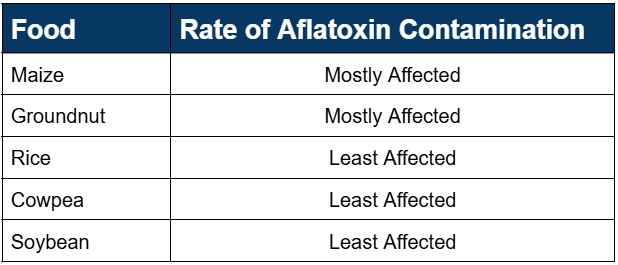
Table showing a list of foods available in Nigeria that are at high risk of aflatoxin contamination.
The most powerful form of group 1 human carcinogen, Aflatoxin B1 is linked to cancer (2). A small amount eaten regularly can build up over time causing havoc.
A visible mould may not be a true check for food contaminated with aflatoxins which makes it so hard to detect because you can't see it with your naked eyes (3). With the safety regulations in place you can protect yourself to a large extent.
The National Agency for Food and Drug Administration and Control (NAFDAC), has set a limit for the amount of aflatoxins that manufacturers can allow in maize and groundnuts else the batch can be seized. For maize, a maximum of 10ppb (parts per billion), meaning 10 micrograms of toxin per kilogram of maize. For groundnuts which contain more Aflatoxins, 15ppb (4, 5).
These limits help to keep consumers' exposure to Aflatoxins within a manageable range but enforcement is an institutional problem where testing devices are absent or limited (4).
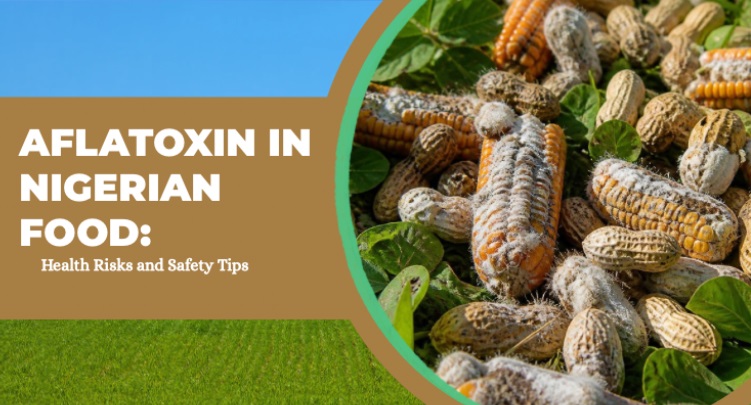
A graphic about aflatoxin contamination in Nigerian food. The left side features the title “AFLATOXIN IN NIGERIAN FOOD: Health Risks and Safety Tips” in white text on a brown background, while the right side shows maize cobs and groundnuts covered with visible white and gray mold. Green leaves and a blue sky appear in the background, with curved green and brown design elements separating the text and image. Photo Credit: Canva. Click on image to enlarge.
Aflatoxin contamination in Nigerian food is caused by heat, moisture, and poor handling. The mould and fungi responsible for this food poisoning thrive in warm and moist conditions.
They can infect crops at several points; from farm, sellers to the homes:
Anyone eating contaminated food faces health risks, some groups of people face even higher health risks.
People at higher risks of aflatoxin contaminations in Nigerian foods are:
The real health risks behind aflatoxin contamination isn't in a single bad batch of grain but the daily low intake from meals cooked with contaminated foodstuff.
Several hours or days after eating aflatoxin contaminated food can lead to liver disease, stomach pain and vomiting.
Months and years of eating aflatoxin contaminated food on a regular basis has been linked to liver cancer (hepatocellular carcinoma) especially with Hepatitis B patients (2).
Another health risk with eating aflatoxin contaminated food is that it weakens the immune system, exposing the body to infections, and in children specifically leads to impaired growth and development (2).
With the absence of a laboratory to 100% lower the risk of aflatoxin contamination in Nigeria food, here are some safety tips:
Nigeria has the capacity to fight this problem. NAFDAC maintains a testing mandate for Aflatoxins in food and regulatory limits (5).
The International Institute of Tropical Agriculture, in collaboration with the United States Development of Agriculture and local partners invented Aflasafe, a biocontrol product that uses non-toxic producing strains of Aspergillus flavus to push out the bad strains in the field.
With field trials evidence show that alfasafe can reduce aflatoxin contamination in treated groundnuts and maize by 85 to 95% from farm to storage (6, 7).
Despite this profound initiative, some gaps still remain such as:
Closing these gaps will require the consistent investment in post-harvest facilities, more access to biocontrol tools for smallholder farmers, and sustained public health awareness, alongside the safety tips every home can adopt today.
Imagine a closer look at grains at the food store, a preference for sellers with good turnover, and safe storage once the food gets home, that purchase becomes relatively safe.
Aflatoxin contamination is widely preventable, even with little to no access to lab tests, through wiser purchasing, storage and hygienic food preparation.
1. World Health Organization. Aflatoxins. [Internet. 2018]. WHO: Geneva; [Accessed 6 August 2026]. Available from here.
2. Aflatoxin B. Chapter: Mycotoxins as food carcinogens. In ScienceDirect. [Internet, n.d]. Accessed 6 August 2026. Available from here.
3. Onyedum SC, Adefolalu FS, Muhammad HL, et al. Occurrence of Aflatoxin in Some Food Commodities Commonly Consumed in Nigeria. J. Food Sci. 2015;4(5). doi:10.5539/jfr.v4n5p81. Available from here.
4. International Crops Research Institute for the Semi-Arid Tropics (ICRISAT). Policy Brief 35: Aflatoxins in Nigerian Groundnut. Continuous threat to health, agriculture and foreign trade. [Internet]. April 2018. [Accessed 6 August 2026]. Available from here.
5. National Agency for Food and Drug Administration and Control (NAFDAC). Food Safety Guidelines. Guidelines and requirements for inspection of food storage facilities/warehouse and issuance of e-permit for bulk raw materials in Nigeria. Doc. Ref. No: FSAN-GDL-010-01. [Internet]. NAFDAC: Abuja, Nigeria. 2025. [Accessed 6 August 2026]. Available from here.
6. Ola OT, Ogedengbe OO, Raji TM, Eze B, Chama M, Ilori ON, Awofisayo MA, Kaptoge L, Bandyopadhyay R, Ortega-Beltran A and Ndarubu AA. Aflatoxin biocontrol effectiveness in the real world—Private sector-led efforts to manage aflatoxins in Nigeria through biocontrol-centered strategies. Front. Microbiol. 2022.13:977789. doi: 10.3389/fmicb.2022.977789. Available from here.
7. International Institute of Tropical Agriculture (IITA). IITA partners with Harvestfield Industries Limited for the commercialization of a biocontrol product in Nigeria, Aflasafe. [Internet]. IITA: Ibadan, Nigeria. Dec. 2020. [Accessed 6 August 2026]. Available from here.
Related: 5 Common Foodborne Illnesses in Nigeria and How to Protect Your Family
Published: August 14, 2026
© 2026. Datelinehealth Africa Inc. All rights reserved.
Permission is given to copy, use and share content for non-commercial purposes without alteration or modification and subject to source attribution.
DATELINEHEALTH AFRICA INC., is a digital publisher for informational and educational purposes and does not offer personal medical care and advice. If you have a medical problem needing routine or emergency attention, call your doctor or local emergency services immediately, or visit the nearest emergency room or the nearest hospital. You should consult your professional healthcare provider before starting any nutrition, diet, exercise, fitness, medical or wellness program mentioned or referenced in the DatelinehealthAfrica website. Click here for more disclaimer notice.