How a Simple Blood Test Can Predict Alzheimer's 10 Years Early
By Oluwasola Samuel, Freelance health writer. Medically reviewed by A. Odutola. MBBS, PhD, FRCSEd.
July 22. 2026.
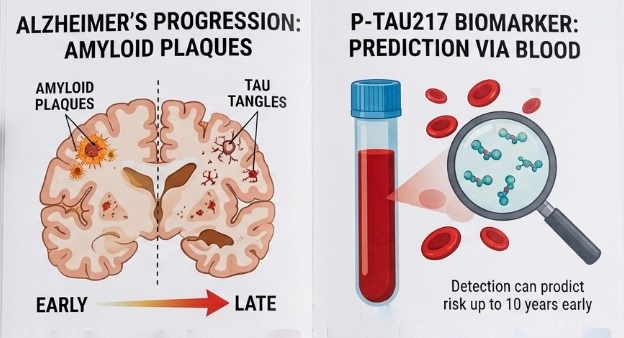
Composite image showing a caricature cross section of the brain with labeled Alzheimer's features and a vial of blod with text listing p-tau217 as a blood biomaker of early Alzheimer's. Click on image to enlarge.
Time is the most valuable weapon we have against Alzheimer’s disease. For decades, the biggest challenge has been that by the time symptoms appear, brain changes are already deeply rooted. Now, scientists have developed and are trialing a blood test that can flag Alzheimer’s risk up to 10 years before the first signs of forgetfulness begin. Here is a look at a breakthrough study; the simple science behind it, what it means for the future of Alzheimer’s disease prevention, and what you can learn from it.
This study, published in the Journal of the American Medical Association (JAMA), pooled data from six long-running ageing and Alzheimer's studies across the United States, Japan, and Australia. It followed 2,684 healthy older adults who were free of memory problems when the study began. Each of the participants had a p-tau217 blood test and was followed for a median of 5.4 years, with some tracked for as long as 20 years. PET imaging was conducted when participants enrolled in the studies to get a baseline imaging status of their brains, and memory function tests (cognitive function) were conducted annually at follow-up.
P-tau217 measures a form of tau, a protein that builds up in the brain in Alzheimer's disease. The higher a person's p-tau217 level, the more likely they are to develop cognitive impairment, meaning early memory or thinking problems that can progress to dementia.
The study findings tell a clear story.
"This is a critical step toward better understanding what p-tau217 can tell us about a person's risk for cognitive impairment," said Dr Rachel Buckley, lead author of the study and a cognitive neuroscientist at the Mass General Brigham Neuroscience Institute. "What really sets this work apart is that it estimates an individual's level of risk for cognitive impairment," he added.
To understand what the study means for you or a loved one having significant memory loss and for the future of Alzheimer’s disease prevention, let’s dive deep to explain the simple blood test (p-tau217 test) that is showing potential for flagging Alzheimer’s disease at least 10 years before the onset of symptoms.
To understand how a blood test can predict Alzheimer’s, we have to look at a tiny protein called p-tau217 (phosphorylated tau 217).
In a healthy brain, tau proteins act like train-track ties. They stabilise the tracks that brain cells use to transport food and nutrients. However, in a brain developing Alzheimer’s, these proteins undergo a chemical change called "phosphorylation." This change causes the tracks to twist and buckle into tangled knots, disrupting communication between brain cells.
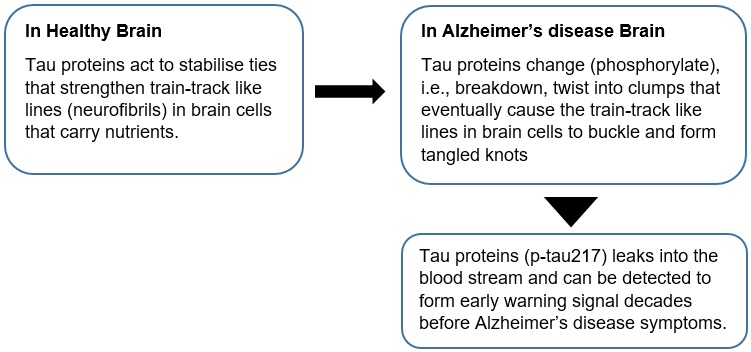
Illustration of how Tau proteins work in brain cells and how the p-tau217 blood test can be used as an early warning signal of Alzheimer’s disease. Click on image to enlarge.
What makes p-tau217 a medical breakthrough is its unique ability to act as an early leak.
Long before tangles cause noticeable memory loss, increasingly small amounts of p-tau217 escape the brain and enter the bloodstream. Think of it like a smoke detector for the brain. It flags the very first signs of trouble up to a decade before a fire breaks out.
Until recently, doctors could only detect these changes using incredibly expensive imaging scans (PET scans) or painful spinal taps. Today, highly sensitive laboratory tests can spot this chemical marker (p-tau217) in a standard blood draw, offering a window for early lifestyle changes and targeted medical interventions.
Notwithstanding these limitations, researchers believe that the study’s real value is in its potential in helping to identify healthy, at-risk adults who could join prevention trials, speeding up the search for treatments that might delay or stop Alzheimer’s disease.
The arrival of an officially approved and routine simple blood test in clinical care would be a massive shift in how healthcare providers approach brain health. For the general public, this science translates into several life-changing advantages:
While the study is exciting and points towards a revolutionary clinical achievement, it is important to understand the practical limits. Currently, the p-tau217 test is not yet approved for general screenings of healthy individuals. It is presently being prescribed by doctors for adults showing early signs of cognitive changes or those at high risk. The hope is to get to the place where the test can be cost-effective and readily available for use as a disease-modifying screen for the early detection of Alzheimer’s disease and consequent preventive intervention.
Up until the current time, early diagnosis of Alzheimer’s feels like a battle that remains to be won. By the time memory loss becomes noticeable, major brain changes have already occurred and are set in stone. The breakthrough p-tau217 blood test may completely flip that script once approved for routine clinical use. The test will change our current approach from a late-stage reaction to an early, proactive detection, giving families and physicians the most valuable tool of all: time.
While a blood test cannot cure the disease on its own, it opens the door to a future where Alzheimer's can be detected early, managed, slowed, or even prevented before it ever steals a memory.
The p-tau217 test potentially opens the door to an era where brain health is monitored as routinely as heart health—and that is a breakthrough worth celebrating.
You do not have to wait for the future to start protecting your brain. Here is how you can use this breakthrough news today:
Source: Buckley RF, Townsend DL, Birkenbihl CJ, et al. Prognostic Value of Blood-Based P-Tau217 Levels for Progression to Cognitive Impairment. JAMA. Published online July 14, 2026. doi:10.1001/jama.2026.12556. Available from here.
Related:
Dementia: What Africans need to know
Alzheimer's disease: What Africans need to know
10 things Africans should be doing to lower dementia risk
15 Modifiable risk factors of Dementia Africans need to know
Published: July 22, 2026.
© 2026. Datelinehealth Africa Inc. All rights reserved.
Permission is given to copy, use and share content for non-commercial purposes without alteration or modification and subject to source attribution.
DATELINEHEALTH AFRICA INC., is a digital publisher for informational and educational purposes and does not offer personal medical care and advice. If you have a medical problem needing routine or emergency attention, call your doctor or local emergency services immediately, or visit the nearest emergency room or the nearest hospital. You should consult your professional healthcare provider before starting any nutrition, diet, exercise, fitness, medical or wellness program mentioned or referenced in the DatelinehealthAfrica website. Click here for more disclaimer notice.