Cancer Rates Are Rising in Young Adults; Are You at Risk?
By: Oluwasola Samuel, Freelance health writer. Medically reviewed by: A. Odutola, MB.BS, PhD, FRCSEd.
July 24, 2026.
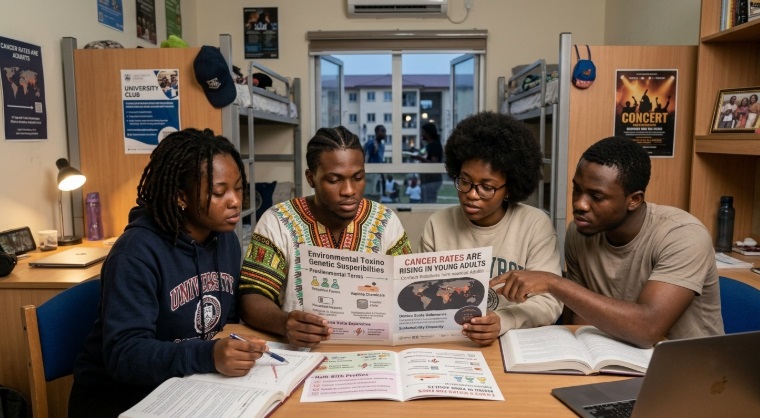
An AI Image of four young African university students sitting together around a study table in a campus dormitory room. They are reading a health awareness leaflet titled "Cancer Rates Are Rising in Young Adults." The table is covered with open textbooks, notebooks, and a laptop, reflecting an academic environment. Click on image to enlarge.
Many people assume that only old people are usually diagnosed with cancer. This assumption is held by millions of young Africans today. Doctors are now urgently asking us to reconsider in light of recent findings.
In the United States, more than a dozen kinds of cancer are on the rise among people under the age of 50. (1) And this is not just a Western story. The same trend is showing up in Africa, where young adults are increasingly being diagnosed with cancers that previous generations only worried about in old age. The difference is that in Africa, most of these cancers are caught too late.
This article is not meant to frighten you. It is meant to inform you, and to remind you that when it comes to cancer, knowing is always better than not knowing.
Globally, early-onset cancer, defined as cancer diagnosed in adults under the age of 50, is rising at an alarming rate. A 2025 study published in ESMO (European Society of Medical Oncology) found that in 2022 alone, nearly 1.25 million new cancer cases were recorded in young adults aged 20 to 40 worldwide. (2) By 2050, researchers project that early-onset cancer incidence will rise by a further 12.8%, with mortality climbing by 12.9%.
To be honest, these are not small numbers. They represent real people, in the prime of their lives, who never saw it coming. Africa is not insulated from this recent trend.
For young African women, breast cancer is the most pressing concern. It is already the most common cancer among women on the continent, and research shows that women of African ancestry may be biologically predisposed to developing more aggressive subtypes at younger ages than women of other ancestry groups. (3)
Cervical cancer remains the most common cause of cancer-related deaths in African women, with between 60% and 70% of cases diagnosed only at a late stage, when treatment options are limited, and survival outcomes are far worse. (4)
For young African men and women alike, colorectal cancer is rising too. A 2025 peer-reviewed study confirmed that incidence among young African adults is increasing, driven by limited disease awareness, restricted access to screening, and lifestyle and genetic factors. (5) Liver cancer, fuelled in part by chronic hepatitis B infections acquired in childhood, also carries a particularly high burden in Northern and Eastern Africa.
The picture across the continent is clear. Cancer is arriving earlier, and far too many young Africans are not ready for it.
When cancer is caught early, the story usually has a good ending because it is usually a small tumour. The procedure is straightforward, and the person usually goes on to live a full and healthy life. But when cancer is caught late, which is what happens to the majority of Africans diagnosed today, the story becomes far more complicated, and far more painful.
A 2024 study published in The Lancet Global Health looked at cancer survival rates across sub-Saharan Africa and found that less than half of patients diagnosed with some of the most common cancers, including liver, lung, and stomach cancer, were alive just three years after diagnosis. (6) For breast cancer, three-year survival ranged from as low as 31% in some countries to 94% in others, a gap that reflects not the biology of the disease but the reality of healthcare access. (6)
In high-income countries, breast cancer survival rates exceed 90%. (7) However, in most African countries, that same disease is still claiming lives simply because of late diagnosis.
This is what makes the rise of early-onset cancer in Africa so urgent. Young Africans are developing cancer at ages when they feel invincible. They dismiss symptoms, and don't get screened. And by the time a diagnosis comes, the cancer has often already spread (metastisised).
The gap between what is happening and what most young Africans believe about their own cancer risk is wide. This gap is costing many young lives today.
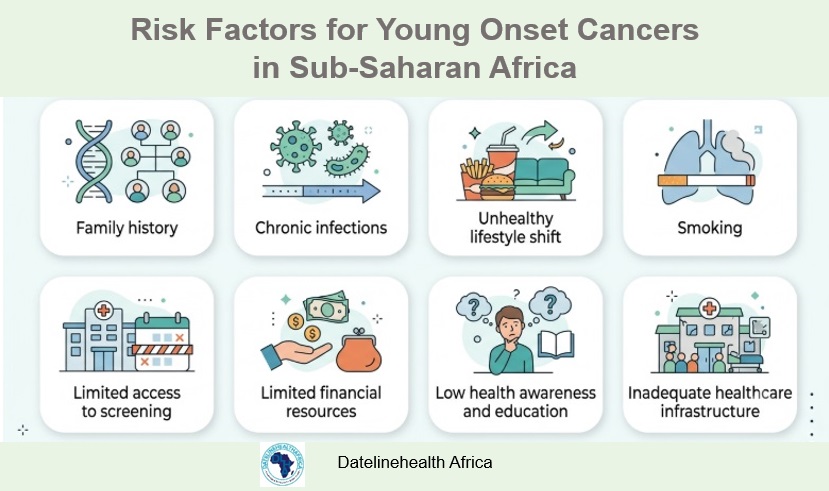
An info-poster titled "Risk Factors of Early Onset Cancers" displaying eight risk factors putting young sub-Saharan Africans at risk for early onset cancers. The factors are: family history, chronic infections, unhealthy lifestyle shift, smoking, limited access to screening, limited financial resources, low health awareness and education, and inadequate healthcare infrastructure. Click on image to enlarge.
Cancer does not appear out of nowhere. In most cases, it builds quietly over time. It happens due to a combination of things we are born with and the lives we live. Understanding what feeds that process is the first step towards interrupting it.
These factors below put young Africans at risk of early cancer:
If a parent, sibling, or close blood relative has had cancer, your risk is higher than average. This does not mean cancer is inevitable for you. But it does mean you need to know about it, talk about it, and act on it earlier than someone with no family history. Better still, once you have a family history, get screened to know your risk.
In Africa, certain infections dramatically raise cancer risk in ways that are not widely talked about. The hepatitis B virus, which is highly prevalent across the continent and often acquired in childhood, is one of the leading causes of liver cancer in young African adults. Human papillomavirus, or HPV, is the primary driver behind virtually all cases of cervical cancer.
Rapid urbanisation across Africa is changing how people eat, move, and live. Diets that were once rich in whole grains, vegetables, and legumes are being replaced by processed foods high in sugar, salt, and unhealthy fats. Physical activity is declining, alcohol consumption is rising, and obesity rates are climbing. Each of these shifts quietly raises cancer risk.
Tobacco use remains a significant and growing cancer risk factor in Africa, linked to cancers of the lung, throat, mouth, and bladder.
Perhaps the most painful risk factor of all is one that has nothing to do with lifestyle or genetics. Millions of young Africans simply do not have access to affordable, timely cancer screening. Without screening, early-stage cancers go undetected until symptoms become impossible to ignore, and by then, it is often later than anyone would have hoped.
A substantial portion of Africa's population lives below the poverty line, unable to afford the high costs of cancer diagnostics and treatment. (8) For many young Africans, the choice between feeding a family today and paying for a cancer screening tomorrow is not a simple one. As a result, screening gets postponed indefinitely.
Limited access to health education and support services remains one of the key barriers facing young adults with cancer in Africa. Many people simply do not know what the early warning signs of cancer look like, which cancers they are most at risk for, or that screening is even available to them. Misconceptions about cancer are sometimes rooted in cultural beliefs. This in turn discourages people from seeking medical attention early. Many even attribute cancer symptoms to supernatural causes or view the disease as a death sentence. This creates stigma around the diagnosis and leads to delayed treatment.
Across sub-Saharan Africa, inadequate screening and diagnostic facilities, a shortage of specialised medical staff, and poor cancer registry systems mean that even motivated patients who want to be screened may find nowhere accessible to go.
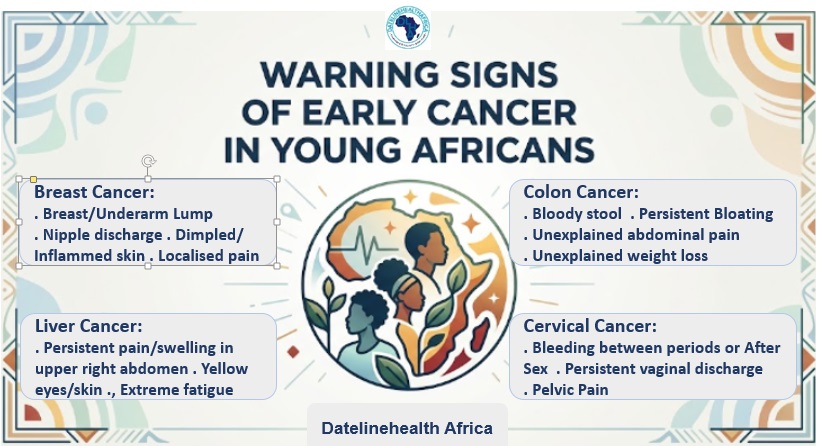
A health awareness banner titled "Warning Signs of Early Cancer in Young Africans" set against a cream background with decorative African-inspired patterns in the corners. Click on the image to enlarge.
Your body is always communicating with you, but the question is: are you listening?
The rise of early-onset cancer and unusual symptoms in young people should never be ignored.
An Oncologist and Director of the Early Onset Cancer Program at Yale Cancer Centre said that "It's incredibly important to bring symptoms to your doctor." She goes further, "For example, a lump in the breast, abdominal pain, changes in bowel habits that really are not going away. Certainly blood in the stools. Sometimes even symptoms such as unusual fatigue that doesn't seem to go away." (9)
These are not any warnings, they are specific, real, and are worth acting on.
Here is what to watch out for about early-onset cancer in young Africans:
Blood in your stool, persistent changes in bowel habits, unexplained abdominal pain, bloating that does not go away, or unexpected weight loss.
A new lump in the breast or underarm, changes in breast size or shape, nipple discharge, or skin that looks dimpled or inflamed.
Unusual bleeding between periods or after sex, pelvic pain, or an unusual vaginal discharge that persists.
Persistent pain or swelling in the upper right abdomen, unexplained weight loss, yellowing of the skin or eyes, or extreme fatigue.
Many young Africans attribute cancer symptoms to stress, infections, or everyday discomfort. As a result, they delay and seek help until the cancer has already advanced. Please note that if you notice any of these symptoms, don't assume you are too young and don't wait for things to get worse before you consult your healthcare professional.
Think about the last family gathering you attended. The laughter, the food, the stories shared around the table.
Now think about this: when was the last time anyone at that table said anything about their health history?
For most African families, the answer is never.
One's health status is seen as private. Some people stigmatise certain illnesses. Cancer is often not spoken about because of the stigma around it.
Family history is one of the most important factors when it comes to assessing one's level of risk of cancer. When a close blood relative (parent, sibling, uncle, aunt, or grandparent) has had cancer, your own risk of developing the same or a related cancer rises. The closer the relative and the younger they were at diagnosis, the more significant your level of risk becomes.
This is not meant to frighten you, but it is meant to empower you.
Knowing your family history gives your doctor information they cannot get from a scan or a blood test. It can move the starting age for your screening forward by years, sometimes decades. And in cancer, years matter.
A lady who survived stage 3 colorectal cancer at 33 said, "Just ask the question or make a joke about it, and sometimes just little icebreakers will help." (9)
The truth is that it can feel uncomfortable to ask family members about their health history, but having those conversations is worth it, to save a life.
In African culture, we have always believed that it takes a village to raise a child. It also takes a family to protect one another's health. Start that conversation today.
One thing you should take away from this article is this: You are not powerless.
There are real, practical steps you can take today to lower your cancer risk and catch any problems early, before they become difficult to treat.
Here is what you can do:
Sit down with your parents, aunts, uncles, or older siblings and ask about any history of cancer in the family. Note which relative was affected, what type of cancer it was, and how old they were when diagnosed. Write it down and share it with your doctor. According to the CDC, your family health history is one of the most powerful tools your doctor has to assess your personal cancer risk. (10)
Do not wait till you begin to feel symptoms. Depending on your family history and personal risk factors, your doctor may recommend starting cancer screening in your 20s or 30s.
The HPV vaccine protects young women against cervical cancer. According to WHO, it is recommended for both girls and boys. (11) The hepatitis B vaccine protects against liver cancer. If you or your children have not been vaccinated, speak to a healthcare provider about doing so as soon as possible.
Eat more whole foods and less processed food. Move and exercise regularly, cut back on alcohol, and quit smoking if you smoke. Research confirms that lifestyle factors including obesity, alcohol use, and physical inactivity are significant drivers of early-onset cancer risk. (12) Every positive change you make today is an investment in your health tomorrow.
If something in your body feels different and has been there for more than two to three weeks, see a doctor. Do not wait for it to get worse. Early detection is the single most powerful advantage you have against cancer.
If multiple close relatives have had cancer, particularly at a young age, ask your doctor about a referral to a genetic cancer risk specialist. These specialists help patients evaluate their cancer risk, often with genetic testing, so that prevention and screening plans can be tailored specifically to them.
Conclusion
Cancer is no longer a disease that waits patiently for old age. It is showing up earlier, in bodies that feel healthy, in lives that feel full, in people who had no idea anything was wrong. Across Africa, too many young people are finding out too late.
But here is what we want you to hold onto. Early detection saves lives. A single conversation with a doctor, one honest question at a family gathering, and one screening appointment you stop putting off; these small acts of courage can change everything.
You do not have to wait until something feels wrong. You can act now, while you feel well, while you have time, while early detection is still on your side.
Talk to a doctor today. Your future self will thank you for it.
1. Shiels MS, Berrington de González A, Best AF, et al. Incidence rates of some cancer types have risen in people under age 50. Cancer Discovery. 2025 May 8. doi:10.1158/2159-8290.CD-24-1678. National Institutes of Health News Release. Available here.
2. André F, Rassy E, Achutti-Duso B, Boilève A, Smolenschi C, Delaloge S, Barlesi F. The rising tides of cancers among young adults. ESMO Open. 2025 Sep 3;10(9):105553. doi:10.1016/j.esmoop.2025.105553. Available here.
3. World Health Organization. Global Breast Cancer Initiative (GBCI). [Internet]. Geneva: WHO; 2021. [Cited 2026 June 29]. Available here.
4. World Health Organization. Cervical cancer. Fact Sheet. [Internet}. Geneva: WHO; 2024. [Cited 2026 June 29]. Available here.
5. Anazodo FI, Ezeah CG, Eleje CC, Anigbo GE, Ofordu EU, Uju PQ, et al. Rising incidence and mortality of colorectal cancer in young African adults: need for a better care plan. Cureus. 2025 Jun 12;17(6):e85866. doi:10.7759/cureus.85866. Available here..
6. Joko-Fru WY, Chitawo B, Mbowane C, Chokunonga E, Korir A, Somdyala N, et al. Cancer survival in sub-Saharan Africa (SURVCAN-3): a population-based study. Lancet Global Health. 2024;12(6):e945-e956. doi:10.1016/S2214-109X(24)00130-X. Available here.
7. World Health Organization Global Breast Cancer Initiative. Breast cancer inequities. [Internet]. Geneva: WHO; 2021. [Cited 2026 June 29].. Available here.
8. World Health Organization Regional Office for Africa. UHC Day: High health-care costs in Africa continue to push over 150 million into poverty: new WHO report. Brazzaville: [Internet]. WHO AFRO; December 2024. [Cited 2026 June 29].. Available here.
9. Anthony C, Farmer B. Early-onset cancers are on the rise. Knowing your family history is crucial. [Internet]. KFF Health News. June 16, 2026. [Cited 2026 June 29]. Available here.
10. Centers for Disease Control and Prevention. Genetic testing for hereditary breast and ovarian cancer. [Internet]. Atlanta: CDC; Reviewed October 2024. [Cited 2026 June 29]. Available here.
11. World Health Organization. WHO updates recommendations on HPV vaccination schedule. WHO News Item. [Internet]. Geneva: WHO; December 20, 2022. [Cited 2026 June 29]. Available here.
12. Lampejo T, Durandt C, Bhola PT, Mulinde E, Meehan B, Eckert E, et al. Colorectal cancer in Africa: a scoping review. Colorectal Disease. 2021;23(5):1131-1145. doi:10.1111/codi.15531. PMC7931121. Available here.
Related:
Breast Cancer: What Africans Need to Know
Cervical Cancer: What African Women Need to Know
Colorectal Cancer in Africa: A Fact Sheet
Common Gynaecological Cancers in African Women
Published: July 24, 2026
© 2026. Datelinehealth Africa Inc. All rights reserved.
Permission is given to copy, use, and share content freely for non-commercial purposes without alteration or modification, and subject to attribution as to source.
DATELINEHEALTH AFRICA INC., is a digital publisher for informational and educational purposes and does not offer personal medical care and advice. If you have a medical problem needing routine or emergency attention, call your doctor or local emergency services immediately, or visit the nearest emergency room or the nearest hospital. You should consult your professional healthcare provider before starting any nutrition, diet, exercise, fitness, medical or wellness program mentioned or referenced in the DatelinehealthAfrica website. Click here for more disclaimer notice.