Rethinking W-Sitting: A Guide for African Parent
By: Rukhsar Jabbar. M.Sc. Physiotherapy. Freelance Health Writer. Medically reviewed by: E. Odekina, M,B.B.S. Family Physician
August 10, 2026..
.jpg)
A child demonstrating the W-Sitting, with the knees bent and feet positioned outside the hips while seated on the floor. Image credit: Gemini AI. Click on image to enlaerge.
Imagine walking into your living room on a warm afternoon. Your child is sitting on the rug, completely absorbed in a cartoon or building a tower with blocks. When you look closely at their posture, you notice something unique. Their bottom is flat on the floor, but their knees are bent, and their feet are tucked out to the sides, pointing backward. From above, their lower body forms a perfect letter "W".
If you are like millions of other caregivers around the world, a small alarm bell might go off in your head. You might recall a social media post, a parenting forum warning, or advice from an elder claiming this posture ruins a child's joints. Naturally, you begin to worry. You are not alone. This is one of the most heavily searched child health topics globally. Parents constantly ask: is W-sitting harmful for my little one?
When observing w-sitting toddlers, it is easy to assume that such an extreme looking position must be doing damage. For decades, traditional advice from well meaning teachers and family members has been to correct the child immediately. However, when we look at actual scientific data, the truth is far more reassuring.
This article separates internet myths from medical facts to give you peace of mind.
W-sitting, also called “television sitting,” is a sitting posture where children sit on the floor with their hips flexed, thighs turned inward (adducted), and legs rotated maximally inward at the hip. When viewed from above, the arrangement of their legs resembles the letter W. W - Sitting posture is most common in children between the ages of 3 to 6 years old. It is a time when young bodies are flexible.
At this stage of growth, a child's hip joints naturally have a greater degree of turning their thighs inward because of the natural shape of their thigh bones. This natural twist makes the position very accessible and comfortable for them, whereas most adults would find it painful or impossible to replicate. It is simply one of many normal child sitting positions used during floor play [1].
There is a mechanical purpose behind this choice of posture. Young children are still developing their core muscles, balance, and trunk control. When children sit with their legs crossed, their base of support is small, requiring muscles in their abdomen and back to keep them upright.[3].
By spreading their legs into a W shape, children create a wider,and more stable base [3]. This wide foundation acts like a kickstand on a bicycle. It locks their lower body into place so they do not have to exert energy to stay balanced [3]. This mechanical advantage frees up their hands and allows them to focus completely on playing with toys, drawing, or watching television without falling over.
As a normal part of child development, children build better core strength and their bone structure shifts naturally. As their hips undergo natural alignment changes, the comfort of this position fades. Most children naturally phase out of this habit and stop using it by the time they reach 8 to 10 years of age.
For years, the internet has claimed that this posture causes permanent joint damage, bone deformities, and walking problems. Medical research has, however, proven otherwise.
A systematic review published by researchers found no scientific evidence to advise against w-sitting in developing children [1]. Furthermore, major pediatric orthopedic studies have confirmed that hip problems are not more common in children who prefer this position compared to those who do not [2]. The medical community now widely views it as a normal developmental variation rather than a medical problem.
On the other side, some pediatric specialists and physical therapists remain cautious about prolonged, exclusive W-sitting in children. Their concern is not that an occasional twist will break a bone, but rather that spending hours every day in the thigh inwardly rotated position applies continuous rotational forces on growing bones and tightens specific leg muscles [3].
While it is not the crisis the internet makes it out to be, balance is key. Occasional use during play is harmless, but it should not be the only way your child sits on the floor.
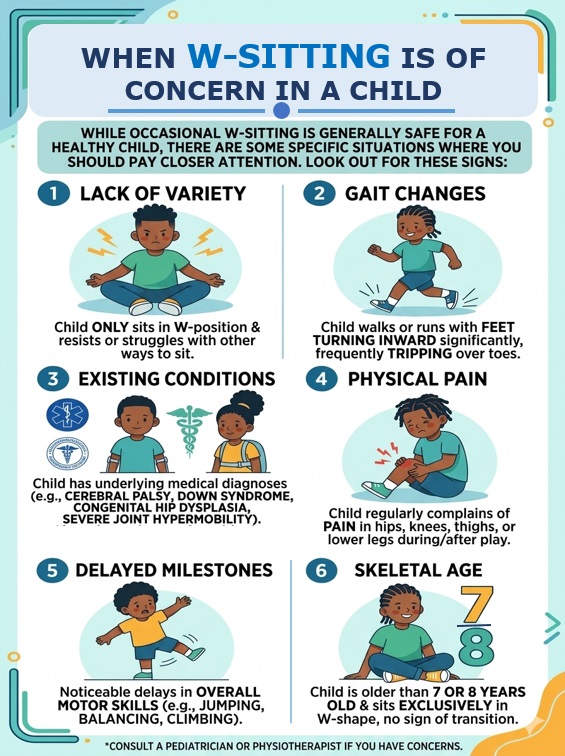
Info-poster illustrating when w-sitting is of concern. Image was generated from Nano Banana based on Datelinehealth Africa prompts. Click on image to enlarge.
While occasional w-sitting is generally safe for a healthy child, there are some specific situations where you should pay closer attention. You should look out for these signs:
Knowing when to worry about W-sitting simply means watching for these signs. If your child is moving well, running without pain, and keeping up with peers, their sitting preference is nothing to fear.
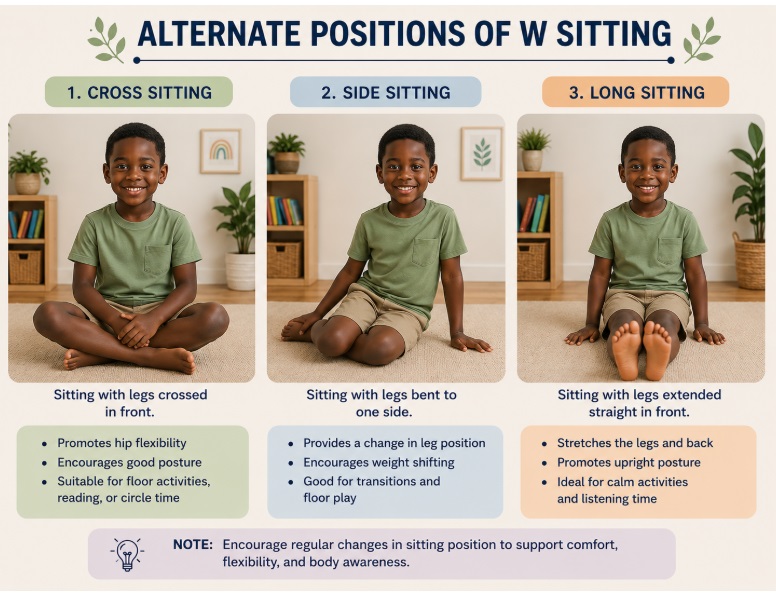
Infographic depicting alternative sitting positions for a W sitting posture. This image was generated by ChatGPT, OpenAI. Click on image to enlarge.
If you notice your toddler using this posture frequently, you do not need to panic, yell, or make them feel bad. It can make them defensive or anxious about playing on the floor. Instead, focus on gently expanding their sitting posture by introducing fun, comfortable alternatives.
Pediatric clinical guidelines say helping a child use different sitting positions stops their muscles from getting tight and helps them move more naturally [3]. You can introduce these healthy alternatives during playtime:
If your child cannot sit in any other position, despite encouraging modifications, or if you notice any of the warning signs mentioned earlier, it might be time to seek a professional opinion. A medical doctor will examine your child and can perform an initial physical check and guide you on the next steps. They can also suggest you see a physiotherapist for help.
Return to that peaceful scene in the living room. Seeing your child sitting on the floor with their legs forming a W shape might look alarming at first glance, but there is no cause for alarm. Research has shown that it is not a medical problem. For the majority of toddlers, it is simply a comfortable and stable way to sit while they focus on being a kid.
Keep a casual eye on their movement, encourage a variety of sitting styles when you can, and visit the hospital if you notice any of the warning signs that there is something wrong. If your child is happy, active, and pain-free, you can worry less about the shape of their legs on the rug and enjoy watching them grow.
A: It is a posture where a child sits on their bottom with their knees bent and feet tucked outside their hips. It happens because young children have naturally flexible hip joints and use this wide base to stay stable without pressurizing abdominal muscles [3].
A: For a typically developing, healthy child, clinical research shows it is not harmful or dangerous [1, 2]. It is a common developmental variation that children use for comfort while their bodies grow.
Q: At what age should W-sitting stop?
A: Most children naturally stop sitting this way between the ages of 8 and 10 as their bones mature, their hip anatomy changes, and their abdominal muscles' strength increases.
A: High-quality medical studies have found no evidence that this posture causes hip problems in healthy children [1, 2].
Q: How do I get my child to stop W-sitting?
A: Gently prompt them to try alternative shapes like sitting cross-legged, stretching their legs straight out, or sitting on a small stool or floor cushion [3].
1. Nordon DG, Passone C de GB, da Silva CAA, Grangeiro PM. W-sitting in childhood: a systematic review. Acta Ortop Bras. 2024;32(6):e279277. Doi: 10.1590/1413-785220243206e279277. Available from here.
2. Rethlefsen SA, Mueske NM, Nazareth A, Abousamra O, Wren TAL, Kay RM, et al. Hip dysplasia is not more common in W-sitters. Clin Pediatr (Phila). 2020 Oct;59(12):1074–9. Doi: 10.1177/0009922820940810. Available from here.
3. Palisano RJ, Orlin MN, Schreiber J. Campbell’s Physical Therapy For Children. Ebook, 5th edition. 2017. Elsevier. St Louis, Mo. USA. ISBN: 978-0-323-390187. Available for download here.
Published: August 10, 2026.
© 2026. Datelinehealth Africa Inc. All rights reserved.
Permission is given to copy, use and share content for non-commercial purposes without alteration or modification and subject to attribution as to source.
DATELINEHEALTH AFRICA INC., is a digital publisher for informational and educational purposes and does not offer personal medical care and advice. If you have a medical problem needing routine or emergency attention, call your doctor or local emergency services immediately, or visit the nearest emergency room or the nearest hospital. You should consult your professional healthcare provider before starting any nutrition, diet, exercise, fitness, medical or wellness program mentioned or referenced in the DatelinehealthAfrica website. Click here for more disclaimer notice.