How to Use AI to Combat Health Misinformation in Africa
By: Mosope Ososanya, Freelance Health Writer. Reviewed by: Adebowale Bello. B.Tech Microbiology. DLHA Fellow.
August 1, 2026
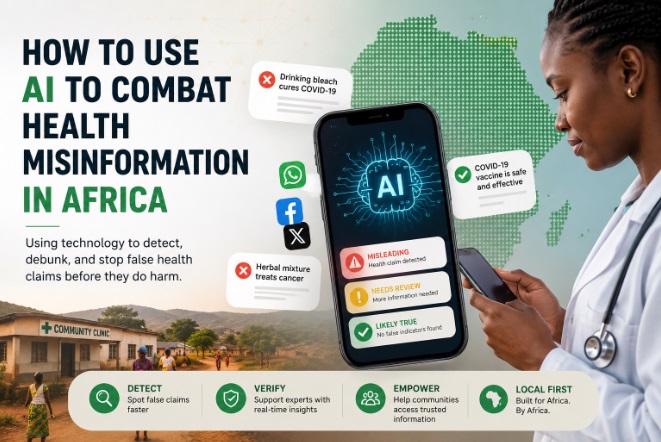
AI-powered health misinformation detection in Africa, showing a healthcare professional using AI to identify false medical claims on a smartphone, with the African continent, social media, and community healthcare elements in the background. AI-generated: ChatGPT-4. Click on image to enlarge.
Artificial intelligence (AI) has made it easier than ever for false health information to spread. For example, a fake video, a blog post, or a WhatsApp message packed with made-up "medical facts" can be easily forwarded across family group chats in five different countries, shared by well-meaning relatives who simply want to protect the people they love. This is what health misinformation in the digital age looks like.
As much as technology, particularly AI, is a major facilitator of health misinformation in Africa, it is also one of our best tools for fighting back. The same technology making health misinformation faster, and more convincing is one of the most powerful tools for detecting and countering it. AI-assisted systems can analyse misinformation circulating in specific communities and respond with clear, simple, corrective messaging [1].
How technology and digital platforms fuels the misinformation crisis across sub-Saharan Africa has been discussed in a previous article. This one will look at the other side: How AI can support Africans to identify, challenge, and reduce health misinformation before it becomes widespread and causes harm.
Health misinformation spreads across the internet in seconds, even faster than the truth in most cases. Research on X, formerly known as Twitter, found that false news reaches 1,500 people about six times faster than true stories do, and is 70% more likely to be retweeted [2]. By the time a human fact-checker verifies one false claim, thousands of people may have already seen, shared, or believed it. No team of human fact-checkers can keep up with the pace of spread.
This is where AI becomes valuable. AI-powered tools can monitor, scan, and analyze massive volumes of online content in real time, flagging suspicious health claims, tracking how they're spreading, and identifying which communities are most exposed, at a scale no team of experts could manage on their own [3].
That doesn't mean AI is replacing doctors, researchers, or fact-checkers. AI is best seen as an assistant, not an authority. It helps health experts find misinformation faster, prioritise the most urgent cases, and respond before false claims spread and cause harm [3].
AI-assisted detection can catch a false claim in its first few hours online.
In Zambia, the UNDP launched iVerify in 2021, an AI-powered fact-checking initiative to detect, verify, and respond to online misinformation and disinformation. The platform combined AI-powered scanning with human fact-checkers to catch and correct false claims linked to vaccine hesitancy, during the country's 2021 elections. This helped to stop some false claims before they could spread widely [4].
Deepfakes are no longer a distant threat and they are already circulating on African timelines. Africa Check has debunked multiple AI-generated videos falsely portraying respected health experts, including one that manipulated Professor Salim Abdool Karim's face and voice to make it appear he was criticising COVID-19 vaccines, something he never said [5].
In Kenya, a deepfake video that went viral on Facebook showed a fake doctor claiming that pharmaceutical companies were selling harmful drugs while also promoting a "miracle cure." Fact-checkers later revealed that the video had been manipulated using footage taken from an unrelated video [6].
Nigeria has also seen similar cases. In 2025, Africa Check debunked an AI-generated video falsely claiming that Nigerian doctor and health influencer Aproko Doctor (Dr. Chinonso Egemba) had developed a cure for hypertension, using his likeness and reputation to promote a fake medical product [7].
During the COVID-19 pandemic, the Nigeria Centre for Disease Control (NCDC) partnered with UNICEF to use chatbots that answered people's questions, tracked common concerns, and corrected false health information as it spread [4].
The Africa CDC is also using AI-powered surveillance systems to monitor social media and other online sources for signs of disease outbreaks and emerging health misinformation. This helps health officials spot false claims and respond before they spread widely or cause harm [8].
With an estimated 1,500 to 3,000 languages spoken across Africa, one of misinformation's biggest allies has always been the language gap [9]. Health chatbots and AI tools are increasingly being designed to understand multiple African languages. They monitor online conversations for false health claims, identify changes in public opinion, and provide accurate health information in languages people are most comfortable using [10].
AI has great potential, but it is not a silver bullet. Like any tool, it has limitations, and understanding those limits is just as important as recognising its strengths.
Most AI-powered health tools used across Africa currently function in only a few languages, mainly English and French. This means many people who speak the continent's thousands of other languages may not be able to access or benefit from these tools [9]. As a result, key health messages, and the tools meant to correct false ones, often never reach the communities that need them most.
AI can only reach people who have access to the internet, and right now, an estimated 63% of people living in African countries have no internet access at all [11]. Unreliable electricity and limited digital infrastructure also make it difficult to use AI-powered tools in many parts of Africa. As a result, the limited digital infrastructure tools are often more accessible in cities, while rural and underserved communities, where health misinformation can spread quickly, are left behind [12].
Perhaps the biggest challenge with AI is that the same technology used to fight misinformation can also create it. AI models can sometimes "hallucinate," meaning they generate information that sounds convincing but is completely false [13].
In healthcare, this can have serious consequences. An AI chatbot could provide inaccurate medical advice, or an AI fact-checking tool could mistakenly flag accurate health information as false.
That is why AI should support human experts, not replace them. Human reviewers, healthcare professionals, and trained fact-checkers are still needed to check AI's findings, provide context, and make informed decisions. AI can quickly scan large amounts of information and flag suspicious content, but people must make the final call on what is accurate and what is not [14].
You cannot build an AI tool that serves African communities if it doesn't understand African languages. To address this, the Masakhane African Languages Hub, with support from Google.org, the UK's FCDO, the IDRC, and the Gates Foundation, is funding the development of high-quality datasets across more than 50 African languages, including datasets designed for healthcare applications [15]. More initiatives like this, across more languages, are essential if AI-powered fact-checking is ever going to reach the majority of Africans in the language they actually speak.
Africa already has homegrown fact-checking expertise doing this work daily.
Organisations like Africa Check have spent years tracking and debunking false health claims. They understand how misinformation spreads in local communities and across African media platforms [5, 6]. As AI-generated misinformation becomes more common, these organisations should be supported with long-term funding, better technology, and stronger partnerships, not pushed aside in favour of imported solutions that may not reflect African realities.
Using AI to fight health misinformation in Africa requires team work. The WHO's Africa Infodemic Response Alliance brings together health authorities, the Red Cross, and community networks to track and respond to health misinformation collaboratively [16].
Similarly, the Cambridge-Africa Health Data Initiative is working directly with government ministries in Nigeria and Kenya to build AI into national health surveillance systems, rather than leaving governments to catch up after the fact [8].
AI tools that work well in other parts of the world may not work as well in African communities. A tool designed for English-speaking users with reliable internet and electricity may struggle in rural areas with poor electricity, limited internet access and many people speaking local languages.
For AI to effectively fight health misinformation in Africa, it needs to be built using African data, support African languages, and reflect the realities of the communities it is meant to serve, not something to adapt later [9].
AI gives Africa a solid opportunity to fight health misinformation at the speed it spreads. It can detect suspicious claims, monitor information across platforms, identify deepfakes, and help health experts respond before false information reaches millions. This makes AI a powerful tool but not a replacement for human judgement.
AI should support the work of doctors, researchers, journalists, fact-checkers, and public health organisations. AI-powered tools and platforms also need to reflect African realities by understanding local languages, working in rural settings, and being trained on data that represents the people of Africa.
The fight against health misinformation requires combining better technology with stronger health systems, trusted institutions, and most importantly, people who know how to question what they see online before sharing it.
Related: Tech Age Woes: How Digital Health Misinformation Cost African Lives
Published: August 1, 2026.
© 2026. Datelinehealth Africa Inc. All rights reserved.
Permission is given to copy, use and share content for non-commercial purposes without alteration or modification and subject to attribution as to source.
DATELINEHEALTH AFRICA INC., is a digital publisher for informational and educational purposes and does not offer personal medical care and advice. If you have a medical problem needing routine or emergency attention, call your doctor or local emergency services immediately, or visit the nearest emergency room or the nearest hospital. You should consult your professional healthcare provider before starting any nutrition, diet, exercise, fitness, medical or wellness program mentioned or referenced in the DatelinehealthAfrica website. Click here for more disclaimer notice.