Why Do People Laugh? An Explainer for Africans
By Adebowale Bello. B.Tech Microbiology, Freelance Health Writer. Medically reviewed by the DLHA team.
March 15, 2026.

An image of two happy African women laughing during friendly conversation outdoors. AI generated from ChatGPT
An elderly man came out to make a speech at a wedding and as he did so, he mixed up two names in a way that changed the meaning entirely. For a second, the hall went silent and then someone from the back row let out a small, uncontrollable snort. Another person tried to hold it in and failed and within seconds, the room was shaking with laughter including the elder himself. No one had planned to laugh. No one wanted to be “disrespectful”, yet the laughter spread quickly, almost automatically, turning tension into relief and awkwardness into connection.
Scenes like this happen everywhere, in classrooms, family meetings, religious gatherings and social ceremonies.
People laugh when they hear jokes but also when they feel nervous, surprised, embarrassed or deeply relieved.
Sometimes, laughter brings people closer. Sometimes it happens at the wrong moment and often, it spreads from one person to many people without anyone knowing exactly why.
So what is laughter, really? Why do we laugh so easily, especially around other people? And why does something as simple as a “ha ha ha” sound have the power to ease tension, strengthen bonds and even change the human mood?
This article answers these questions and shows laughter as a biological response, a psychological signal and one of the most powerful and healthy tools humans use to connect with one another.
Laughter is something everyone does, from babies to elders. It is more than just a reaction to a joke and is a natural human response that involves your brain, your breathing, your voice and even your facial muscles.
Laughter is made up of short, repeated breaths that come out as sounds, often when we feel happy, surprised or even nervous. This is why laughter is different from crying, shouting or just talking.
Laughter is a natural part of being human and it is both a bodily response and a social tool, helping people express emotions, reduce tension and connect with others in everyday life.

An image of a group of young African women having fun and laughing together. Image Credit: Freepik. Click on image to enlarge.
Humans laugh for a variety of reasons and laughter serves multiple social and biological purposes. Here are a few reasons why you laugh:
Laughter is a powerful way for people to connect. When we laugh together, our brains release endorphins, natural chemicals that make us feel happy and calm. These feel-good chemicals also help strengthen trust and closeness between people [1, 2]. In African communities, this can be seen during family gatherings, market days, weddings or storytelling sessions around the fire. People laughing together in these situations are not just having fun, they are building relationships and reinforcing social bonds.
Scientists believe that laughter evolved in humans as a way to bond in larger groups. Unlike primates that groom one by one, humans could use laughter to connect many people at once, making it easier to maintain social harmony [2, 3].
You may tend to laugh much more often when you are with other people than when you are alone. Research backs this up by showing you are 30 times more likely to laugh when you're with someone because laughter acts as a social signal that says, “I am friendly” or “this situation is safe” [1]. This social laughter helps to ease interactions even when no one is telling a joke because it strengthens group connections and encourages cooperation, showing that it is an essential part of human social life.
Laughter also tends to occur at specific points in conversation, strengthening shared attention and social cohesion. Even when people say something that is funny, much of the laughter in natural conversation reflects social coordination rather than humour per se.
Laughter is also a tool for managing emotions. It can reduce nervousness and lighten serious situations.
Researchers distinguish between two types of laughter: Spontaneous and Controlled.
Spontaneous laughter is automatic, like when children are playing or someone slips and finds it funny. Controlled laughter is deliberate and often used to ease an awkward moment or show friendliness [4]. Laughter in these moments can help you balance emotions even if the situation itself is stressful or serious.
Laughter does not always mean that something is funny. It can communicate a range of social and emotional messages and people use laughter to show agreement, share experiences, relieve stress or signal that they are not a threat [1]. These moments of laughter are a way to express feelings and maintain harmony in the group, proving that laughter is a tool for communication as much as for fun.
If you have ever laughed in a room just because someone else started laughing, you know how fast laughter spreads. Scientists call this contagious laughter and studies show it is a real biological and social phenomenon. When we hear someone laugh, our brains automatically react and mirror neurons, which are special brain cells that help us copy the actions and emotions of others, get activated and this makes you more likely to laugh along even if you did not find the original joke particularly funny.
In social settings like weddings, casual events or religious gatherings, laughter may spread quickly. One person starts laughing at a playful mistake or an amusing story and soon everyone around joins in. This happens because laughter signals safety and togetherness, helping people bond in groups. Contagious laughter also strengthens communities and in African villages, it is common to see elders, children and neighbours all laughing together during storytelling or communal work which creates a feeling of belonging.
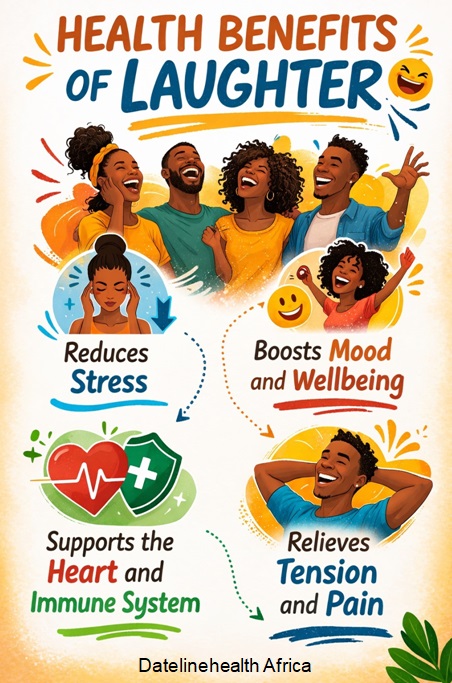
Info poster on the health benefits of laughter. AI generated from ChatGPT. Click on image to enlarge.
Laughter is more than just fun and it can also be good for your body and mind. Researchers have found that regular laughter affects both mental and physical health in measurable ways.
Here are some health benefits of laughter:
Laughter lowers levels of cortisol and other stress hormones in the body. Studies show that even short periods of genuine laughter can reduce stress and make people feel calmer. This is why a shared laugh at a family gathering or a playful moment in school can instantly lighten the mood [5].
Laughter also increases the release of endorphins and dopamine, chemicals that improve mood and create a sense of pleasure. In African communities, laughter during storytelling, ceremonies or games helps people feel connected and happy [5].
Research indicates that laughter can improve blood vessel function and circulation, which is good for heart health. Some studies also show laughter may boost immune activity, increasing infection?fighting cells in the body. This explains why laughter is often encouraged in social and cultural practices, from festive dances to playful family interactions [5].
Because laughter releases endorphins, it can act as a natural pain reliever. Experiments show that people’s tolerance for mild pain rises after laughing, which may help explain why laughter is common even in stressful or difficult situations (5).
Sometimes laughter happens at moments when it seems out of place such as; during a serious discussion, a tense meeting or even at a funeral. Scientists call this nervous laughter and it activates areas of the brain involved in emotional regulation and social signaling, similar to regular laughter and has both social and biological purposes.
Here are some reasons why you may laugh at the wrong time:
When you feel anxious, embarrassed or unsure how to react, laughter can help you release built-up stress. It triggers the same endorphin release as regular laughter, providing a brief calming effect and helping you cope with uncomfortable emotions.
If you experience tense moments, laughter helps you communicate that you are a non-threatening signal to others and shows that you don't mean harm. This can be observed in various social interactions, where laughter helps reduce conflict and maintain harmony.
If you happen to laugh at unexpected times, don't feel too embarrassed, because it is a natural response that helps you manage stress and communicate socially, thereby making it an essential part of human interaction.

Close up portrait of an African baby. AI generated from ChatGPT.
Laughter is universal, meaning all humans laugh, no matter where they live. Babies start laughing within months of birth, even before they learn language. But while everyone laughs, the triggers and social rules around laughter can differ from culture to culture.
What makes people laugh is shaped by local customs, values and social norms. For example, jokes, teasing or playful behaviour that are funny in one culture may not be understood the same way in another.
A study comparing laughter across different countries found that cultural context strongly influences when and why people laugh [6]. Despite these differences, laughter almost always has a social purpose and even if the specific jokes or triggers differ, it can still strengthen bonds.
Interestingly, research shows that laughter is contagious across cultures too. Hearing laughter can trigger the same response in listeners, even if they do not understand the language or context. This suggests that laughter is partly hardwired in the brain to promote social cohesion, beyond cultural differences. While laughter may be shaped by cultural norms and social expectations, it always plays a role in human connection [6].
While laughter is usually a healthy and social behavior, scientists note that too much or inappropriate laughter can sometimes signal underlying medical or psychological conditions.
Some neurological disorders can cause uncontrolled laughter. For example, people with certain types of epilepsy, stroke or brain injuries may laugh involuntarily, even when nothing is funny. Studies show that this is linked to abnormal activity in the brain regions that regulate emotion and vocal expression [7, 8].
Excessive or inappropriate laughter can also appear in some mental health conditions, including mania, schizophrenia or pseudobulbar affect. In these cases, laughter may not match the person’s emotions or the social context, and it can disrupt daily life.
If someone laughs constantly at serious moments and seems unable to control it, it may be wise to see a doctor. However, knowing that excessive laughter can sometimes be a symptom does not mean all unusual laughter is a problem.
Laughter is beautiful and this universal human behaviour engages the brain, body and even social interaction. When you laugh, your stress levels reduce and your body releases feel-good chemicals, your immune system could also get stronger while you feel closer to friends and acquaintances with whom you share a laugh. Even if you may laugh nervously at times, don't be ashamed because such laughter also helps to relieve tension and maintain harmony in social settings.
While rare cases of excessive or inappropriate laughter may signal neurological or psychological conditions, the vast majority of laughter is healthy, natural and beneficial. When you understand why people laugh, it helps you to appreciate laughter as a vital part of human life and a tool for connection, healing and joy that is as relevant in African communities as anywhere else in the world.
As you recognize the social, emotional and biological roles of laughter, you can better value those everyday moments of joy, shared connection and well-being in your family, school, workplace and community.
Laughing during serious or sad moments is often the body’s way of coping with strong emotions. When a situation feels overwhelming, laughter can release tension and help the person regain control.
Yes, it is normal. Nervous laughter happens when the brain is unsure how to respond to a situation. Laughing becomes a quick way to ease tension, signal friendliness or protect oneself from embarrassment. This is common during interviews, meetings or when speaking to elders or authority figures.
Children laugh more because they are more playful, curious and less worried about judgment. Their brains are still developing and they respond more freely to new and funny situations. As people grow older, responsibilities, stress and social expectations often reduce how freely they express laughter.
People differ in personality, upbringing, stress levels and life experiences. Someone raised in a relaxed and expressive environment may laugh more easily, while someone who has faced hardship or strict social norms may laugh less. Neither is wrong and it is simply a difference in emotional expression.
Yes, it is completely normal. Remembering a funny moment can trigger the same brain response as hearing a joke in real time. Many people laugh while recalling past events, replaying jokes or even thinking about conversations they had earlier in the day.
1. Scott SK, Lavan N, Chen S, McGettigan C. The social life of laughter. Trends in cognitive sciences, 2014;18(12), 618–620. Available from here.
2. Manninen S, Tuominen L, Dunbar RI, Karjalainen T, Hirvonen J, Arponen E, Hari R, Jääskeläinen IP, Sams M, Nummenmaa L. Social laughter triggers endogenous opioid release in humans. Journal of Neuroscience, 2017;37(25), 6125–6131. Available from here.
3. Dunbar RIM. Laughter and its role in the evolution of human social bonding. Philosophical transactions of the Royal Society of London. Series B, Biological sciences, 2022;377(1863), 20210176. Available from here.
4. Kamiloglu RG, Tanaka A, Scott SK, Sauter DA. Perception of group membership from spontaneous and volitional laughter. Philos Trans R Soc Lond B Biol Sci 3 January 2022; 377 (1841): 20200404. Available from here.
5. Hajar R. Laughter in Medicine. Heart views : the official journal of the Gulf Heart Association, 2023;24(2), 124. Available from here.
6. Bryant GA, Bainbridge CM; Laughter and culture. Philos Trans R Soc Lond B Biol Sci 7 November 2022; 377 (1863): 20210179. Available from here.
7. Beckwith NL, Khil JC, Teng J, Liow KK, Smith A, Luna J. Inappropriate Laughter and Behaviours: How, What, and Why? Case of an Adult with Undiagnosed Gelastic Seizure with Hypothalamic Hamartoma. Hawai'i Journal of Medicine & Public health: A Journal of Asia Pacific Medicine & Public Health, 2018;77(12), 319–324. Available from here.
8. Algahtani H, Shirah B, Algahtani S, Abdelgaffar N. Laughter-Induced Seizures: A Rare Type of Reflex Epilepsy. Journal of epilepsy research, 2024;14(1), 50–51. Available from here
Related: Why do people cry: An explainer for Africans
Published: March 15, 2026.
© 2026. Datelinehealth Africa Inc. All rights reserved.
Permission is given to copy, use and share content for non-commercial purposes without alteration or modification and subject to attribution as to source.
DATELINEHEALTH AFRICA INC., is a digital publisher for informational and educational purposes and does not offer personal medical care and advice. If you have a medical problem needing routine or emergency attention, call your doctor or local emergency services immediately, or visit the nearest emergency room or the nearest hospital. You should consult your professional healthcare provider before starting any nutrition, diet, exercise, fitness, medical or wellness program mentioned or referenced in the DatelinehealthAfrica website. Click here for more disclaimer notice.