An African Parent’s Guide to Intestinal Worms in Children
By Chinonso Cynthia Ukah, BNSc, RN, RM, RPHN. Freelance Health Writer. Medically reviewed by O. Olatunbosun, MB.BS., MSc. (Clinical Microbiology and Parasitology).
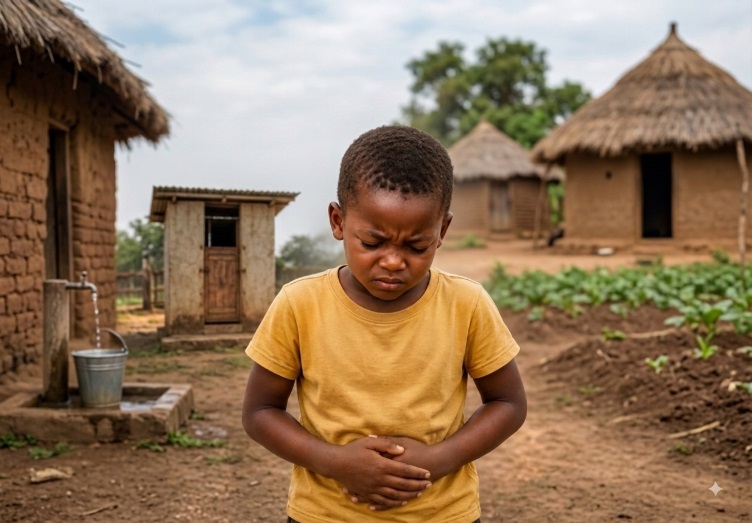
An African male child standing in a village compound and holding his tummy in apparent pain. Click on image to enlarge.
In many African communities, it is common practice to deworm a child, especially when the usual malaria or typhoid treatment does not seem to work.
It is true that worm infestations are common in children especially in the tropics and affect millions globally. For example, Ascaris lumbricoides, commonly known as roundworm, is one of the most common intestinal worm infestation in children and affects hundreds of millions to billions of people globally [1].
However, while worm infestations are common, they are not the cause of every illness. A child with fever, stomach pain, poor appetite, weight loss, or tiredness may have worms, but these symptoms can also be caused by other medical conditions. Assuming that every illness is due to worms can delay the correct diagnosis and treatment, and in some cases, lead to serious complications.
The purpose of this article is to raise awareness about common parasitic worm infestations, detailing how they spread, how they are diagnosed and treated and outlining actionable sanitation practices to prevent household transmission.
Worm infestations are diseases caused by parasitic worms, also known as helminths. These parasites survive by living in the body of a human or animal host, where they feed on nutrients and, in some cases, blood or body tissues. Many intestinal worms produce eggs or other stages that leave the body in faeces and can contaminate the environment.
You may come across several terms used to describe worm infestation. For example:
There are different types of worms that can affect children, but the most common ones include roundworm, hookworm, pinworm, whipworm, and tapeworm. Each one spreads differently and lives in different parts of the body.
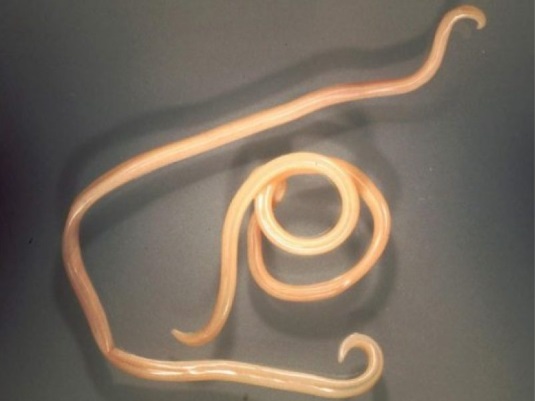
Roundworm (Ascaris lumbricoides). Image Credit: Asian Scientist. Click on image to enlarge.
Roundworm (Ascaris lumbricoides) is one of the most common worms in children and the most common soil-transmitted helminth infection in the world. The adult worms live in the small intestine. Children get it through the faecal-oral route that is, swallowing tiny worm eggs in food or water that have been contaminated with the faeces (poo) of an infected person. This can happen when children play with soil that has been contaminated with poo of an infected person, dirty their hands in the process, and then use the same hands to eat. The eggs can also stick to unwashed fruits and vegetables [1, 4].
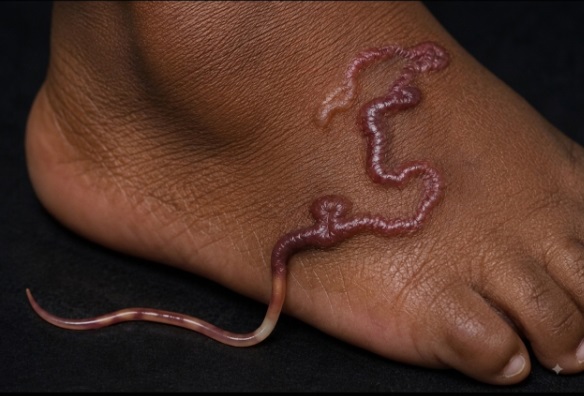
Image: Hookworm larva penetrating a dark-skinned foot, with part of the worm visible outside the skin. Image Credit: Gemini AI. Click on image to enlarge.
Hookworm (Ancylostoma duodenale, Necator americanus) is a type of worm that infects children and lives in the small intestine for up to several years (adult hookworms). Children usually get it when their bare skin comes into contact with soil containing hookworm larvae. This is why walking barefoot on contaminated soil can increase the risk of infection [4].
.jpg)
Image of a pinworm. Click on image to enlarge.
Pinworm (Enterobius vermicularis) is a tiny, white worm whose main host is humans. The infection spreads easily when children live in close contact with other infected people, especially within the same household. Female pinworms lay their eggs around the anus, which can cause intense itching. When a child scratches the area and then puts unwashed hands into their mouth, they can swallow the eggs and become infected again [4].
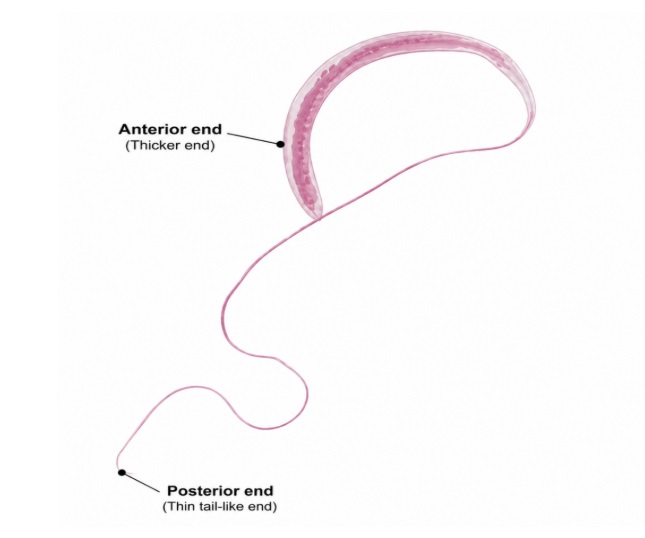
A pinkish-white whipworm. Arrows pointing to its thick and thin ends. Image Credit: ChatGPT. Click on image to enlarge.
Whipworm (Trichuris trichiura) is a roundworm that lives mainly in the caecum, which is part of the large intestine. It is common in areas where sanitation and hygiene are poor. Children get it by swallowing tiny, mature eggs found in contaminated soil, food, or dirty hands. These eggs develop best in warm, humid conditions, which is why transmission can increase during the rainy season [4].
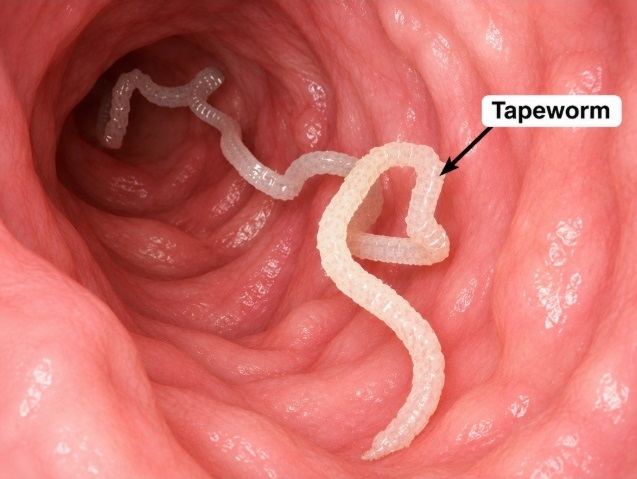
A tapeworm coiled inside the folds of the intestine. Image Credit: ChatGPT. Click on image to enlarge.
Tapeworm is a long, flat worm that lives in the intestine. Some tapeworm infestation are acquired by eating raw or undercooked beef or pork containing infective larvae. Other tapeworms may be acquired through contaminated food or water [4].
Children are exposed to intestinal worms during their everyday activities [2, 3]. Walking barefoot on contaminated soil, putting unwashed hands in the mouth, eating unwashed fruits and vegetables, and drinking contaminated water are some of the common ways children become infected.
The illustration below shows two different pathways by which worms can infect a child and move through the body before reaching the intestine.
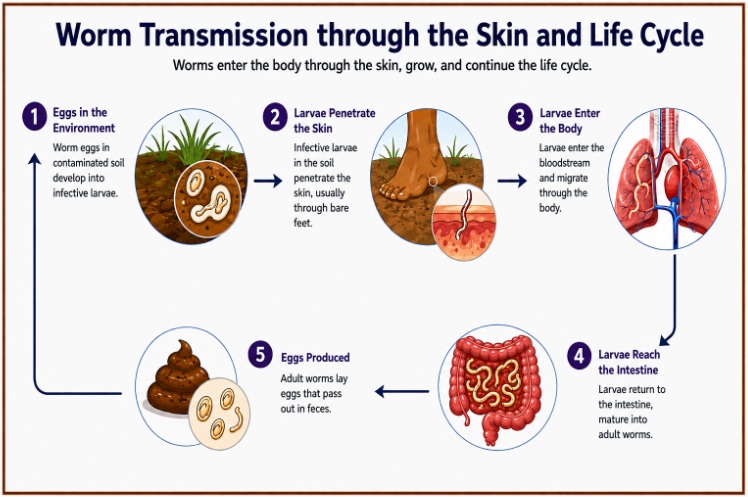
Illustration showing the human life cycle of skin transmitted parasitic worms in children and how they spread. Click on image to enlarge.
Here is a simple breakdown of what happens [5]:
1. Adult worms live in the body: Depending on the type of worm, adult worms may live in the intestine or other parts of the body.
2. Eggs are produced: Adult worms produce eggs, which are released as part of the worm's life cycle.
3. Eggs or larvae leave the body: The eggs or larvae leave an infected person, commonly through the faeces.
4. They develop in the environment or an intermediate host: After leaving the body, some worm eggs or larvae develop in soil, water, food, or an animal host until they reach an infective stage.
5. The infective stage enters the child: A child may become infected by swallowing contaminated food, water, or material from dirty hands; having skin contact with contaminated soil; or eating infected, undercooked animal products. Some larvae will develop in the intestine or migrate through the body to reach the intestine and develop there.
6. The worms mature and the cycle continues: The worms mature in the intestine or another part of the body. Adult worms may then produce eggs, allowing the life cycle to begin again.
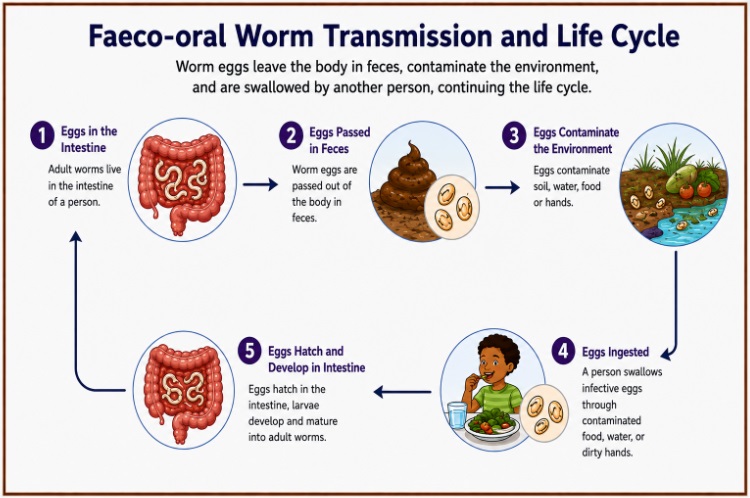
Illustration showing the human life cycle of faeco-orally transmitted parasitic worms in children and how they spread. Click on image to enlarge.
Some worm infestation are usually asymptomatic, meaning there may be no signs that your child is infected. However, the following signs and symptoms may be present depending on the kind and quantity of worm in the child's body [5]:
Note:– Most of these symptoms are not specific to worm infestation and can occur with many other childhood illnesses.
.jpg)
Medical illustration showing two mechanical complications of untreated worm infestation in children: Intestinal obstruction on the left, and rectal prolapse on the right. Click on image to enlarge.
Complications develop. Untreated worm infestation can lead to blood loss and other devastating problems in an affected child. Some of these problems include:
There are several methods used to diagnose worm infestation. The method used depends on the type of worm, its stage of development, where it is located in the body and the symptoms the child has [9].

An African female doctor with two assistants performing an endoscopy on a child in a hospital. Endoscopy is a method used to look for worms in the intestine when a stool examination fails to detect it. Image Credit: Gemini AI. Click on image to enlarge.
1. History and Physical Examination: Diagnosis usually starts with medical history and physical examination. Your child’s doctor (paediatrician) may ask about the child’s complaints and when it started. They may ask whether the child is feeding well or not, vomited or not, passing loose stool or not, passing worms in stool or not, and when you last gave your child worm medicine. If the child has had episodes of vomiting in the past, they may ask you when the vomiting started.
2. Stool/Faecal examination: After the history and physical examination, your child’s doctor will likely request a stool test, also known as an ova and parasite (O&P) test. Here, your child's poo is collected and examined under a microscope for worm eggs or larvae. Techniques such as Kato-Katz and stool concentration methods may be used [9]. For suspected pinworm infection, a perianal tape test is preferred for collecting samples because stool examination often does not detect the eggs.
3. Other tests: Other tests, such as endoscopy/colonoscopy, cellophane/scotch tape tests, blood tests, PCR and imaging tests such as X-ray, CT scan and MRI, may be needed when the diagnosis remains uncertain or when complications or less common parasites are suspected [9].
Worm infestations are treated with anthelmintic medicines. These medicines work by killing or removing worms from the body. The medicine, dose, frequency, and duration of treatment depend on the type of worm infection the child has.
Common anthelmintic medicines prescribed by healthcare providers include [10]:
NB - Doses shown are examples of commonly recommended treatment dosages and may vary according to the child's age, weight, parasite species, clinical condition and local/national guidelines. Anthelmintic treatment should be prescribed or recommended by a qualified healthcare professional.
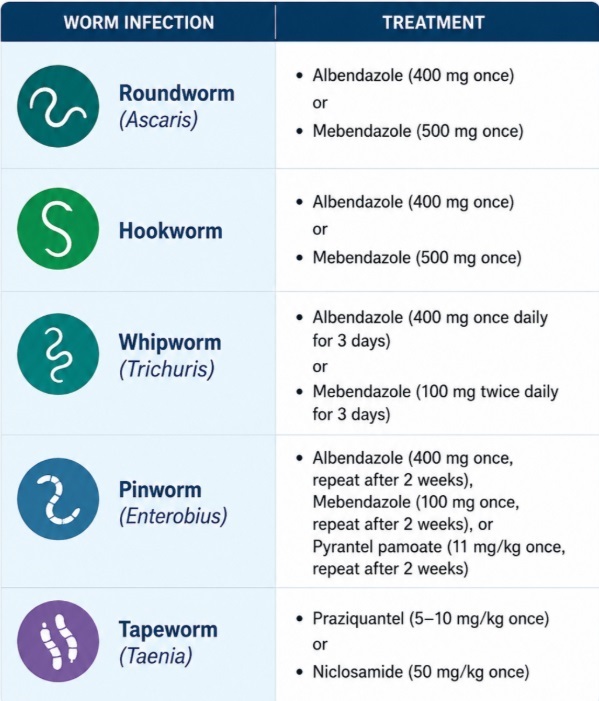
Table showing worm infestation in children, their treatments and doses. Image adapted from CDC and WHO recommendations. Click on image to enlarge.
.jpg)
Infographic showing 11 hygiene practices to prevent worm infestation in children. Clcik on image to enlarge..
You can reduce the risk of worm infestation in children by encouraging them to:
1. Adopt regular hand washing with soap and water especially after using the toilet, playing outside, and before eating.
2. Keep their fingernails short and clean. Discourage nail-biting and putting dirty fingers in the mouth.
3. Always wear shoes outdoors. This helps to protect children from hookworm larvae in contaminated soil.
4. Use toilets or latrines. Avoid open defecation and dispose of children's stool safely.
5. Wash fruits and vegetables. Fruits and vegetables bought from the roadside should be properly washed with clean, safe water before eating or cooking.
6. Drink safe water. Use properly treated or boiled water when the safety of the water supply in your area is uncertain.
7. Eat well-cooked meat and fish. Avoid giving children raw or undercooked meat or fish as they might be harbouring tapeworms.
8. Play in clean environments. Regularly clean the floors of your home, toilets, play areas, and frequently touched surfaces.
9. Wash clothes and bedding regularly. Particularly important when a child has pinworms to prevent reinfection. When pinworm infection is confirmed, household members and caregivers may need simultaneous treatment according to healthcare-provider advice because reinfection is common.
10. Avoid contaminated soil. Keep children away from areas contaminated with human faeces.
11. Participate in preventive deworming programmes. In areas where soil-transmitted worm infestation are common, WHO recommends preventive deworming programmes for eligible children. Depending on the prevalence of infection, treatment may be given once or twice a year through local health programmes
Most worm infestation are not medical emergencies, but some infestation can become serious, especially when the worm burden is heavy or complications develop. Take your child to a healthcare facility urgently if they have:
Worm infestation are common in children, but they are preventable and treatable. Good hygiene, safe food and water, proper sanitation, wearing shoes outdoors, and recommended deworming programmes can help protect children. Most importantly, don't assume that every abdominal (belly) problem, fever, poor appetite, or tiredness is caused by worms. If your child has persistent, severe, or unusual symptoms, seek medical care for the correct diagnosis and treatment.
Yes. Some worm infestation cause no noticeable symptoms, so a child may have worms without appearing sick.
Yes. Severe or long-lasting helminth infestation can affect nutrition, growth and school performance.
Yes. Some types of worms can spread between family members, especially when hygiene is poor. Pinworms, for example, can spread through contaminated hands, bedding, clothing and surfaces. Other worms are usually picked up from contaminated soil, food or water.
It depends on the child's age, location and local health recommendations. In areas where intestinal worms are common, including parts of sub-Saharan Africa, WHO recommends periodic deworming. This may be once or twice a year depending on how common worm infestation are in the area.
No. There is no proven food that can replace proper treatment for worm infestation.
1. Hajare ST, Mulu T, Upadhye VJ, Chauhan NM, Eriso F. Prevalence of Ascaris lumbricoides infestation among elementary school children and associated risk factors from Southern Ethiopia. J Parasit Dis. 2022;46(3):643-652. doi:10.1007/s12639-022-01475-5 Available from here.
2. Hakizimana E, Kim JY, Oh S, Yoon M, Yong TS. Intestinal parasitic infestation among children aged 12–59 months in Nyamasheke District, Rwanda. Parasites Hosts Dis. 2023;61(3):304-309. doi:10.3347/PHD.23045 Available from here.
3. Centers for Disease Control and Prevention. Parasitic Infections in Children [Internet]. Atlanta (GA). 2024 Jun 20 [Cited 2026 Aug 18]. Available from here.
4. Braseth AL, Elliott DE, Ince MN. Parasitic infestation of the gastrointestinal tract and liver. Gastroenterol Clin North Am. 2021;50(2):361-381. doi:10.1016/j.gtc.2021.02.011 Available from here.
5. Centers for Disease Control and Prevention. Hookworm (intestinal) [Internet]. Atlanta (GA). Lat reviewed Septmber 17, 2019. [Cited 2026 Aug 18]. Available from here.
6. Osazuwa F, Ayo OM, Imade P. A significant association between intestinal helminth infection and anaemia burden in children in rural communities of Edo state, Nigeria. N Am J Med Sci. 2011;3(1):30-34. doi:10.4297/najms.2011.330 Available from here.
7. Degarege A, Erko B, Negash Y, Animut A. Intestinal helminth infection, anemia, undernutrition and academic performance among school children in Northwestern Ethiopia. Microorganisms. 2022;10(7):1353. doi:10.3390/microorganisms10071353 Available from here.
8. Donkoh ET, Berkoh D, Fosu-Gyasi S, Boadu WIO, Raji AS, Asamoah S, et al. Evidence of reduced academic performance among schoolchildren with helminth infection. Int Health. 2023;15(3):309-317. doi:10.1093/inthealth/ihac044 Available from here.
9. Khurana S, Singh S, Mewara A. Diagnostic techniques for soil-transmitted helminths – recent advances. Res Rep Trop Med. 2021;12:181-196. doi:10.2147/RRTM.S278140 Available from here.
10. World Health Organization. Deworming in children [Internet]. Geneva: World Health Organization; 2023 Aug 9 [cited 2026 Aug 18]. Available from here.
Published: August 31, 2026
© 2026. Datelinehealth Africa Inc. All rights reserved.
Permission is given to copy, use, and share content freely for non-commercial purposes without alteration or modification and subject to source attribution.
DATELINEHEALTH AFRICA INC., is a digital publisher for informational and educational purposes and does not offer personal medical care and advice. If you have a medical problem needing routine or emergency attention, call your doctor or local emergency services immediately, or visit the nearest emergency room or the nearest hospital. You should consult your professional healthcare provider before starting any nutrition, diet, exercise, fitness, medical or wellness program mentioned or referenced in the DatelinehealthAfrica website. Click here for more disclaimer notice.