How to Spot Spoiled Food at the Market: A Practical Guide for Nigerian Shoppers
By Helen Ohunene Otailku, B.Sc. Ed, Health Education, Freelance Health Writer. Medically reviewed by A. Odutola. MBBS, PhD.
August 28. 2026

A food-safety infographic for Nigerian shoppers showing a woman examining produce, five spoilage-sign icons (tomato, fish, vegetables, meat, and cheese), and quick tips: look closely, use your senses, ask questions, buy fresh. Photo Credit: ChatGPT. Click on image to enlaege.
A measure to ensure food safety, is being able to spot spoiled food. Approximately, 91 million cases of foodborne illnesses and 137,000 Africans die every year as recorded by the World Health Organization; with infants from age of 0 to 5 years old experiencing the greatest risk.
Spoiled food usually goes unnoticed as one of the leading causes of illnesses. It could be in the form of soft looking pepper, tomatoes or onions or that swollen canned milk that the vendor convinces people to buy.
Before food enters the cooking pot, a shopper's eyes, nose and hand can be a first line of defense in spotting visibly spoiled food at the market. The buyer can see, smell, and feel any unusual food he/she is about to buy and desist from it.
In the interest of health and food safety, this guide provides you with practical ways to spot spoiled fish/meat, fruits/vegetables, flour/legumes/grains, milk/eggs and packaged or canned goods at Nigeria markets.
.jpg)
An educational collage centering on meat and fish freshness, featuring a butcher holding a knife and tray of raw protein, surrounded by four corner images labeled with freshness criteria: colour, smell, texture, and cold chain issues. Photo Credit: Canva. Click on image to enlarge.
Meat and fish spoil faster than most other food types, and these animal proteins usually lack safe cold storage. They are rather left openly in the market. Extra caution should be taken to spot signs of spoilage when shopping. You should look out for:

A central image of a smiling woman holding fresh produce is surrounded by four corner images illustrating common signs of food spoilage: mould, smell, texture, and discoloration. Photo Credit: Canva. Click on imahe to enlarge.
When it comes to vegetables and fruits, visual signs are most times a sure way to spot spoilage.
As a Nigerian shopper, here are five practical guides:
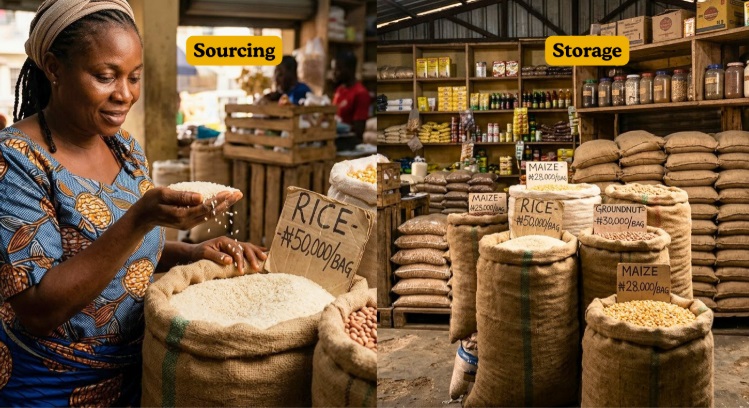
A split-screen image comparing grain sourcing and storage in a market setting. On the left (Sourcing), a woman inspects raw rice grains from a burlap sack. On the right (Storage), open and stacked sacks of rice, maize, and groundnuts fill a well-stocked grain warehouse with price signs attached. Photo Credit: Canva. Click on image to enlarge.
Flour, beans, groundnuts, and maize carry hidden risks before they reach the market known as Aflatoxin, a toxin produced by moulds that can develop in grains due to poor storage (2, 3).
Aflatoxin cannot be spotted with the human eye if the effect on the produce is small. A reliable prevention guide is careful sourcing and proper storage.
Carefully look for vendors who store their grains off the ground, inside dry containers. To source properly stored flour, legumes, and grains, look out for the following:

A collage featuring a central, smiling Black woman farmer holding fresh eggs and milk, framed by four distinct educational categories related to food storage: preservation, egg quality, powdered milk smell, and milk packaging. Photo Credit: Canva. Click on image to enlarge.
In accordance with the Food and Agriculture Organization (FAO), shoppers should focus on buying eggs that are well preserved. That is clean and refrigerated eggs (4).
Look at the egg’s shell and smell. Any cracks, powdery substance, or sulphurous smell are signs that it is spoiled.
Spoiled milk smells bad; it gives off a sour (tangy) smell, even before the milk visibly curdles. Fresh milk, on the other hand, is mildly sweet and has a clean smell.
Check the expiry date on the milk package to see if it has passed and avoid use. Follow the manufacturer's guide and ensure the milk seal is not broken.

An educational infographic centered on "Canned & Packaged Foods" with a yellow circle title. Four surrounding corners highlight quality checks: Expiry Dates (printed date on a can), Bulging cans (swollen, old tin cans), Seal Integrity (a torn paper label and open can), and Smell & Colour (a man pinching his nose in disgust). Photo Credit: Canva. Click on image to enlarge.
Expiry dates on the surface of the can or packaged food should be up-to-date. Avoid goods with missing, faded, or changed date stamps.
Swollen, leaking or badly damaged cans may contain gas from bacterial activity and should not be tested.
Broken seals, punctured cans, or torn packages should not be bought, as they are signs of possible spoilage.
A bad smell and unusual colour when a can or package is opened signals a warning sign.
Having said all and done, a general rule every Nigerian shopper should be aware of includes:
Keep raw food separate from ready-to-eat food items, such as bread and fruit, when shopping.
After buying, cook or store raw foods like fish, meat, or anything that can spoil easily in the refrigerator. Keep grains and flour inside closed containers at home.
Spotting spoiled food in the market by using your eyes, nose and hands as a means to see, smell and feel them acts as a defense against bringing unsafe food into the home; thereby causing illnesses.
Looking out for changes in the colour and texture of food items, and the mode of storage and expiry date of food are some practical ways to spot spoiled food in the market. Also, ensure that you preserve each food type properly and cook well.
Being able to spot safe food as you shop helps to protect yourself and family from foodborne diseases associated with spoiled food consumption.
1. World Health Organization. RegionalOffice for Africa. Food Safety. [Internet, n.d.]. Accessed August 27, 2026. Available from here.
2. Abdurrazaq M, Tijanu MB, Atta H. Assessment of Aflatoxin Contamination in Maize and Groundnuts during Storage in Giwa Community, Kaduna State Nigeria. UMYU Journal of Microbiology Research (UJMR). 2022;7(2),24-29. DOI: 10.47430/ujmr.2272.004. Available from here.
3. Akullo JO, Okello DK, Mohammed A, Muyinda R, Amayo R, Magumba D, et al. A Comprehensive Review of Aflatoxin in Groundnut and Maize Products in Africa: Prevalence, Detection and Mitigation Strategies, Journal of Food Quality, 2025, 2810946, 21 pages, 2025. Doi: 10.1155/jfq/2810946. Available from here.
4. Abbott JC, Stewart GF. Chapter 3: Egg packaging, transport and storage [Internet]. In FAO Marketing Guide No. 4, Marketing eggs and poultry, first published in 1961. [Retrieved 27 August 2026]. Available from here.
Related:
Aflatoxin in Nigerian Food: Health Risks and Safety Tips
5 Common Foodborne Illnesses in Nigeria and How to Protect Your Family
Published: August 28, 2026.
© 2026. Datelinehealth Africa Inc. All rights reserved.
Permission is given to copy, use and share content for non-commercial purposes without alteration or modification and subject to attribution as to source.
DATELINEHEALTH AFRICA INC., is a digital publisher for informational and educational purposes and does not offer personal medical care and advice. If you have a medical problem needing routine or emergency attention, call your doctor or local emergency services immediately, or visit the nearest emergency room or the nearest hospital. You should consult your professional healthcare provider before starting any nutrition, diet, exercise, fitness, medical or wellness program mentioned or referenced in the DatelinehealthAfrica website. Click here for more disclaimer notice.