Does Parental Divorce Raise Depression Risk in Adult Children?
By: Foluke Akinwalere, Health & Medical Writer. DLHA Fellow. Medically reviewed by the DLHA Team.
August 17, 2026
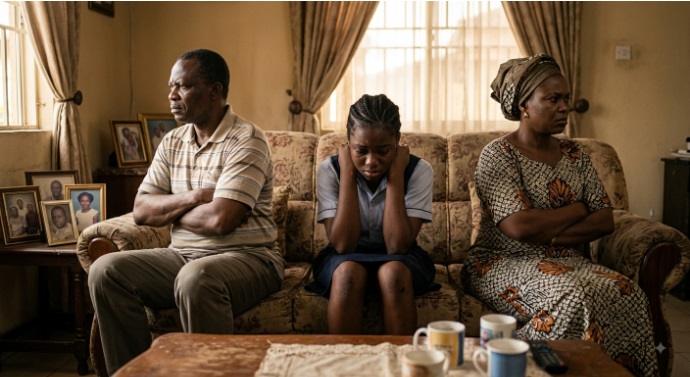
Image of African parents, sitting, backing each other with their daughter in the middle, looking depressed. Image created from Gemini. Click on image to enlarge.
New research suggests that family structure alone tells us very little about a child's emotional future. What else may be at play? Find out.
In many African households, family structure and marriage are deeply revered pillars of community life. From West to East and Southern Africa, cultural and religious teachings strongly encourage couples to keep their unions intact at almost any cost. When marital friction arises, elders, relatives, and spiritual leaders often offer one primary piece of advice: “Stay together for the sake of the children.”
Because of this deeply ingrained cultural value, divorce is frequently viewed not only as a personal failure but as an event that inflicts lasting harm on children. For decades, society has assumed that when parents separate, the emotional disruption of a broken home directly causes long-term mental health challenges for the children, leading to depression, anxiety, and relationship difficulties in adulthood.
But what does science actually say?
The findings may surprise you, and they carry an important message for African families navigating separation, blended homes, and single parenting.
A large new study published in the journal Psychiatry Research in July 2026 sets out to answer this question directly. Researchers followed data from more than 128,000 adults to find out whether growing up with divorced or unmarried parents truly raises the risk of depression later in life, or whether something else is really going on.
The research was led by Mary Kate Schilke, a psychology lecturer at Tyndale University in Canada, alongside colleagues from the University of Texas at Arlington and the University of Toronto. The team analysed data collected between 2021 and 2024 through a large U.S. federal health survey, drawing on responses from the participants.
Participants were grouped based on their childhood family background: those whose parents stayed married throughout their childhood, those whose parents divorced, and those whose parents never married at all.
About 26% of respondents had experienced parental divorce as children, while 2% had parents who never married. Researchers then compared rates of lifetime depression and ongoing mental distress across these three groups, before digging deeper to see what else might explain any differences.
At first glance, the numbers seemed to confirm what many people already assume. Adults whose parents divorced were 41% more likely to have been diagnosed with depression at some point in their life, compared with adults whose parents stayed together. Those whose parents never married had a 31% higher likelihood of depression as well.
Broken down simply:
Adults from divorced or unmarried-parent households were also more likely to report frequent mental distress in general, not just a formal depression diagnosis.
However, here is where the study takes an important turn. When the researchers factored in whether a person had grown up with a parent who struggled with mental illness or substance use, the picture changed dramatically. The added risk linked to divorce shrank by 68% once parental mental illness was accounted for, and by 49% once substance use was factored in. Once both were considered together, the link between parental divorce and adult depression was no longer considered statistically meaningful.
In other words, divorce alone was not the main story. What mattered more was what else was happening in the home.
As with any research, this study is not the final word, and it is worth understanding its boundaries before drawing firm conclusions.
First, the data show a correlation, not proof of cause and effect. Researchers can say that divorce and depression tend to appear together, but they cannot say with certainty that one directly causes the other.
Second, the study relied on adults recalling their childhood experiences, including whether a parent struggled with mental illness or substance use. Memory is not always exact, and some experiences may have been under-reported or misremembered over time.
Third, the dataset did not capture important timing details, such as how old a child was when their parents divorced, or whether a parent’s substance use began before or after the separation. This matters because a divorce that follows years of household conflict may affect a child very differently from one that happens more peacefully.
Finally, the study was based on a United States population. Family dynamics, community support systems, extended family involvement, and cultural attitudes towards divorce differ significantly across African societies. While the core lesson, that environment matters more than marital status, is likely to hold true broadly, the exact numbers may not translate directly to African contexts without further local research.
These limitations do not weaken the value of the findings. They simply remind us to treat the results as a strong signal rather than an absolute rule.
In many African communities, divorce carries heavy stigma. Children from separated homes are sometimes labelled as “broken” or told they will struggle in life because their parents did not stay together. This narrative can follow a child into adulthood, shaping how they see themselves long before any real difficulty appears.
What this research suggests is that the label itself is not the danger. A child raised by loving, stable, well-supported parents who happen to be divorced can grow up just as emotionally healthy as a child from a two-parent home. What truly puts a child's future mental health at risk is untreated parental depression, addiction, unresolved conflict, and a lack of support systems around the family, regardless of whether the parents are married, separated, or never married at all.
This is a message worth sharing in churches, mosques, extended family gatherings, and community conversations where divorce is often judged harshly without looking at the fuller picture.
One of the clearest takeaways from this study is how much weight parental well-being carries in a child’s long-term development. Mental illness and substance use disorders in a household create instability, unpredictable routines, and emotional strain that children absorb, whether or not the parents eventually separate.
In many African households, conversations about a parent’s own mental health struggles or drinking habits are rarely addressed openly. Stigma, shame, and limited access to mental health services often mean these issues go untreated for years. This study reinforces why that silence carries a real cost, not just for the parent, but for the next generation as well.
Supporting parents through treatment and community care may do more to protect children's future mental health than any judgement passed on their marital status.
For separated or single parents raising children across African homes, this research offers real, practical encouragement:
The idea that divorce alone destines a child to a lifetime of depression does not hold up under closer scientific scrutiny. This large-scale study reminds us that what truly shapes a child’s long-term mental health is not whether their parents stayed married, but the environment they were raised in, particularly whether their parents had access to support for mental health and substance use struggles.
For African families, this is a call to replace judgement with compassion. Rather than asking whether a child's parents divorced, perhaps the more useful question is whether that child grew up feeling safe, supported, and loved. That, far more than a marriage certificate, appears to be what protects mental health well into adulthood.
Source:
Schilke MK, Baiden P, Fuller–Thomson E. Long after the split: The association between parental divorce and mental health in adults. Psychiatry Research, 2026; 365,117337, doi: 10.1016/j.psychres.2026.117337. Available from here.
Related
Parenting Stress Affects Children’s Mental Health, Study Finds
Family Instability Affects Children Beyond Childhood, Study Shows
Published: August 17, 2026
© 2026. Datelinehealth Africa Inc. All rights reserved.
Permission is given to copy, use, and share content freely for non-commercial purposes without alteration or modification and subject to source attribution.
DATELINEHEALTH AFRICA INC., is a digital publisher for informational and educational purposes and does not offer personal medical care and advice. If you have a medical problem needing routine or emergency attention, call your doctor or local emergency services immediately, or visit the nearest emergency room or the nearest hospital. You should consult your professional healthcare provider before starting any nutrition, diet, exercise, fitness, medical or wellness program mentioned or referenced in the DatelinehealthAfrica website. Click here for more disclaimer notice.