New Study Links Social Media Use With Mental Health Risks in Children
By: Foluke Akinwalere, Health & Medical Writer. Medical reviewed by editorial support from the DLHATeam.
March 26, 2026
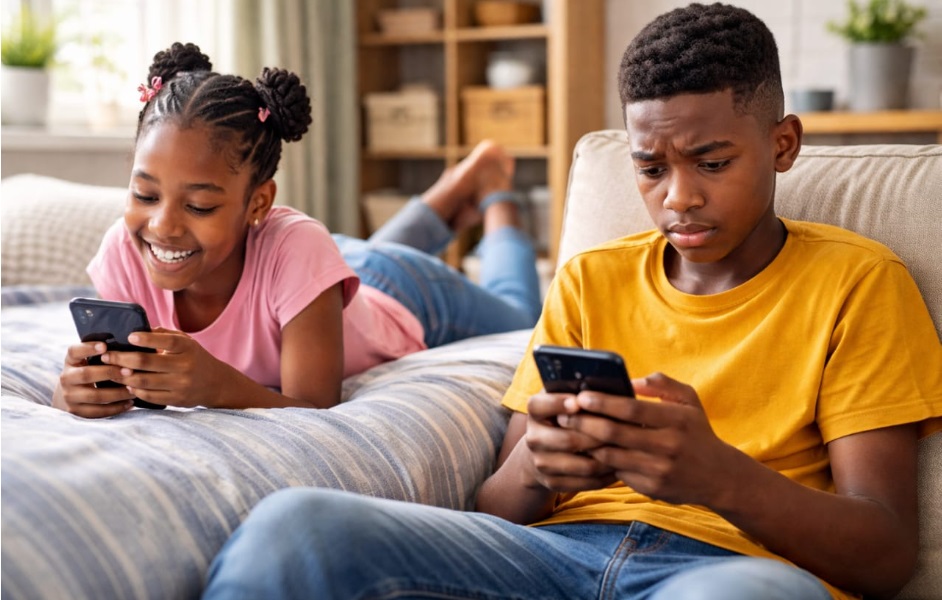
AI generated image of two African siblings in a bedroom, viewing their phones. Image created from ChatGPT. Click on image to enlarge.
Your child is quiet… but not because he is calm. He is scrolling and laughing at a video, comparing himself to strangers. He is absorbing content you may never see.
Across Africa, smartphones and internet access are growing rapidly. Children are now spending more time online than ever before. But behind the entertainment and connection lies a growing concern: What social media may be doing to children's mental health?
A recent large review (study of studies) published in JAMA Pediatrics raises serious concerns, suggesting that social media may be contributing to depression, anxiety, and risky behaviors among children and teenagers.
This is not just a “Western problem". It is most probably an African reality too.
This was not a small or isolated study.
Researchers led by Samantha Teague, a psychology lecturer at James Cook University in Australia, conducted a comprehensive review of over 150 studies consisting of 18,933 articles examining digital media use and mental health in children and adolescents.
The study included nearly 19,000 children aged 2 to 19 years (median, 13 years) from different countries and backgrounds in Europe (62 studies), North America (60 studies), Asia (22 studies), Australia (5 ), and Latin America (1).
The researchers looked at:
Then they compared these behaviors with mental health outcomes such as:
Because this was a large review, the findings are considered strong and reliable.
The review, which analysed many studies on children and digital media use, showed findings that were clear, consistent and concerning.
It found that:
It concluded that social media:
According to Ms Teague, the impact of social media on children’s health is significant as the risks are “comparable with other modifiable lifestyle factors, such as physical inactivity and unhealthy diet”.
Other key insights include:
This period of adolescence is a critical stage of identity formation, when children are most vulnerable to peer-pressure, comparison, and emotional instability.
In simple terms:
Not all screen time is equal, but social media stands out as the biggest concern.
Dr. Victor M. Fornari, Vice chair for Child and Adolescent psychiatry at Zucker Hillside Hospital and Cohen Children’s Medical Center, who examined the study’s results, shared his perspective, saying, “The challenge is really to say, ‘What is the impact of digital use on our youth, particularly social media?’, because there’s been such a great concern about what is contributing to the increase of anxiety and depression, suicidal ideation and behavior in our youth.”
While the findings are important, there are a few limitations to keep in mind:
The study showed a link, not a direct cause. This means social media may contribute to mental health problems, but it may not be the only cause.
Other factors like family environment, school stress, and personality also play a role.
Not all social media use is harmful. The research objectives centered around social media use and mental health. It did not examine how the beneficial effects of social media (chatting and connecting for example) may confound the mental health association.
Every child is different. Some children may thrive online and find support and community. Others may feel isolated and develop anxiety or depression. The research did not take the individual differences into account as part of the study.
Since the research reviewed studies with participants predominantly located in Europe, North America and Asia, its findings cannot be considered globally generalisable.
Many African parents still see social media as harmless entertainment. But the reality is changing fast.
Smartphone use is increasing across Nigeria, Kenya, South Africa, and other African countries. Children now have early and often unsupervised access to social media platforms. The negative health impact of Smartphone use on African children may already be be occurring but unidentified
In many African homes, depression is misunderstood and anxiety is dismissed as “overthinking”. Emotional struggles are also rarely discussed. These mean children may be suffering silently.
Social media exposes African children to:
This can lead to:
Unlike traditional bullying, social media bullying:
This can deeply affect a child’s mental health.
Many parents especially in Africa did not grow up with social media. As a result, they:
According to Dr. Fornari, “Often parents say they give a cell phone to their children so they know how to text when they’re coming home from school or where they are, without really realising that the cell phone today is really a small handheld computer that has access to the internet, social media and games.”
Here are some tips for African parents to guide their children’s social media use wisely.
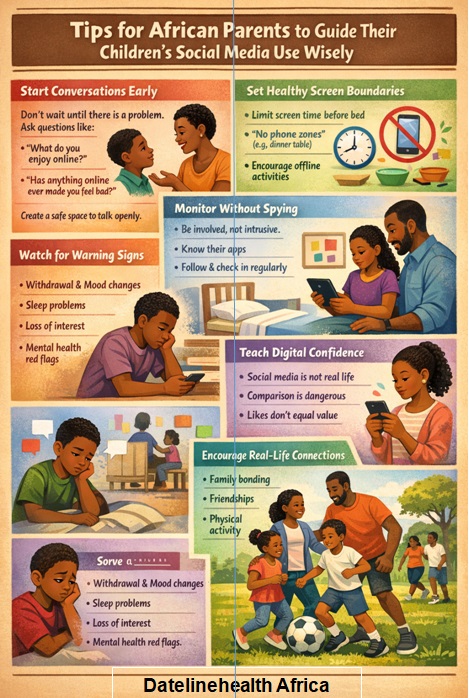
Infographics illustrating tips for African parents on how children can be guided to use social media wisely. Click on image to enlarge
Don’t wait until there is a problem. Ask questions like:
Create a safe space where your child can talk freely.
You don’t need to be extreme, just consistent.
Be involved, not intrusive.
Help your child understand:
Look out for:
These may be signs of mental health struggles.
Children still need:
These protect mental health and build resilience.
Children copy what they see. If you are always on your phone, they will be too.
Show them:
Social media is not the enemy, but uncontrolled use can be harmful.
The study provides growing and strong evidence that social media use:
But there is good news. With awareness, guidance, and open communication, parents can protect their children from the harmful mental health effects of social media, not by controlling their children’s world, not by preparing them adequately for it.
Because in today’s digital age, raising a healthy child is not just about food and education; it is also about what they consume online.
Teague S, Somoray K, Shatte A, et al. Digital Media Use and Child Health and Development: A Systematic Review and Meta-Analysis. JAMA Pediatr. Published online March 09, 2026. doi:10.1001/jamapediatrics.2026.0085 Available from: here
Related:
The Influence of Social Media on the Health of African Youths
Physical Activity in Preteens Reduces Risk of Depression and Anxiety
7 Ways Screen Time Affects Motor Skills Development in African Children
Early Age Smartphone Use Harms Kids Mental Health in Adulthood, Study Finds
Published: March 26, 2026
© 2026. Datelinehealth Africa Inc. All rights reserved.
Permission is given to copy, use, and share content freely for non-commercial purposes without alteration or modification and subject to source attribution.
DATELINEHEALTH AFRICA INC., is a digital publisher for informational and educational purposes and does not offer personal medical care and advice. If you have a medical problem needing routine or emergency attention, call your doctor or local emergency services immediately, or visit the nearest emergency room or the nearest hospital. You should consult your professional healthcare provider before starting any nutrition, diet, exercise, fitness, medical or wellness program mentioned or referenced in the DatelinehealthAfrica website. Click here for more disclaimer notice.