Recovery Realities of Adult Amputees in Nigeria
By: Onyinyechi Kalu (MBBS), Health and Wellness Writer. Medically reviewed by: Bimola Lekan-Dairo. Bachelor of Physiotherapy (BPT).
July 21, 2026.
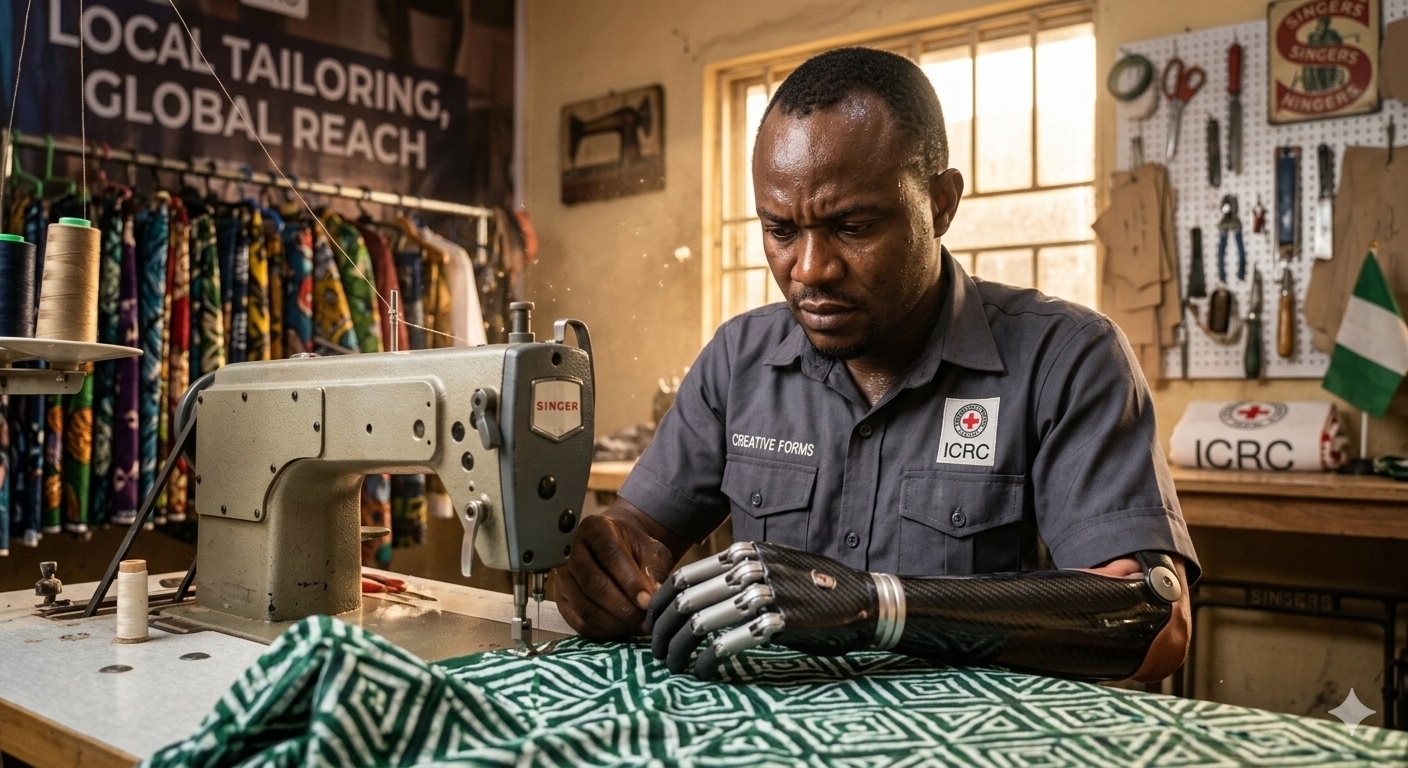
An adult African man with a left forearm fitted prosthesis sewing on a machine in demonstration of resilience, rehabilitation and support. The man is in a rehabilitation programme for people with trauma-related disability that is sponsored by the International Committee of the Red Cross (ICRC). Image credit: Nano Banana 2 from prompts created by Datelinehealth Africa. Click on image to enlarge.
Introduction
Stella's Story: Stella is fifteen, and lives in a major Nigerian city with her parents. Her father is wheelchair bound following bilateral below-knee amputation following complications from diabetes. The city that Stella and her father live in lacks resources and infrastructure for wheelchairs and other mobility devices.
Stella and her uncle are tasked with taking her father to the general hospital for appointments, to the market, to church, and to neighbourhood roads where sympathisers occasionally give them money. The money hardly meets the family's daily financial needs.
Stella’s father has been living with his condition for several years now. Because he’s unable to afford prosthetics, he relies on a wheelchair to get around. Recently, he no longer communicates as he used to; he's become quieter and withdrawn and says that he no longer enjoys his daily living activities.
Stella’s father is years into his journey, and this is what his life looks like now: a renegotiation of roles and daily survival. Many more Nigerian amputees share this reality and worse.
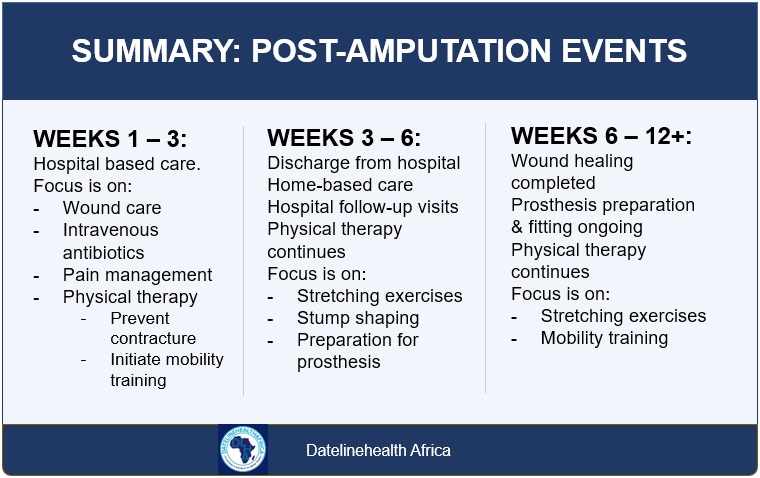
Summary of post amputation events. Click on image to enlarge.
The first few weeks following amputation involve an extended hospital stay, physical therapy, and community-based recovery with assistance from family and sometimes non-governmental organisations. Although recovery is influenced by factors like delayed presentations and sparse clinical resources, here's what a typical timeline in Nigeria may look like:
The first 1-3 weeks are usually spent in the hospital for close monitoring after surgery. Medical care teams focus primarily on wound care, intravenous antibiotics, and pain management.
The early phases of physical therapy start around this time, aimed at preventing joint contractures and learning basic mobility with a wheelchair and/or crutches.
Discharge usually happens around this time, with family members often stepping into primary caregiving roles alongside regular hospital follow-up visits. The cost of transportation may hinder these hospital visits.
Physical therapy continues with gentle stretching exercises that can be done at home and stump shaping with elastic bandages to reduce swelling and prepare the residual limb for a prosthetic.
Wound healing is usually complete by this time, and the residual limb is prepared for prosthetic fitting. Because the services are not readily available in most primary or secondary care centres near where amputees live, they rely on contributions from international and local charities to access a prosthesis.
Adjusting to life after losing a limb in Nigeria involves navigating physical, mental, financial, and social changes at once.
For a lot of Nigerian amputees, losing a limb literally translates to a lifetime in a wheelchair or on crutches. Major cities in Nigeria have not been adapted with mobility devices in mind; broken pavements, busy roads, and the absence of ramps make basic movement a daily struggle. For those without a prosthetic or a family member to help, getting to work or to hospital appointments is a significant challenge.
There are prosthetics available in Nigeria, but these options are mainly concentrated in a few urban centres, requiring long journeys for fitting and follow-up care. Also, many available devices may not be well suited to the Nigerian climate or the physical demands of daily life in the country.
Basic prosthetics, when available, can run into hundreds of thousands or even millions of naira, which is way more than what someone earning minimum wage or unemployed can realistically afford.
A study of amputees in Lagos found that only 22.4% used prostheses frequently. About 26% of them declined one, believing it would interfere with their ability to seek alms since begging had become their main source of income.
Most Nigerians are also uninsured, meaning surgeries, ongoing physical therapy, and fees for prosthetics all come out of pocket, further worsening an already difficult daily financial situation.
Without jobs, reliable access to vocational rehabilitation, and access to other systems meant to support re-entry into work and society, most unemployed amputees resort to street begging.
A hospital study of the quality of life of amputees in Lagos, Nigeria found that after amputation, only 38% of amputees were employed. Of those who remained unemployed, 75% of them turned to begging as their primary source of livelihood.
Even when they are actively seeking job opportunities, they face societal biases in the formal job sector.
Many amputees experience stigmatisation from friends and family and loss of self-worth. Mobility is one of the aspects closely tied to a person’s overall quality of life. So much dignity is wrapped up in independence.
Psychological counselling and formal peer-support networks are not as common in Nigeria, so many people living with limb loss battle depression, anxiety, and public self-consciousness (or public-focused awareness) largely on their own.
Recovery after limb loss is not only physical; it also involves emotional and social rebuilding. The few things that consistently make a difference are:
While coming to terms with what has happened and how the reality has changed may be one of the hardest parts of recovery, research consistently shows that those who do so tend to cope better overall.
Having people who show up consistently, not just in the first few weeks but months later when the reality of daily life has set in, makes a measurable difference.
Peer communication and shared experiences are often what gets people through when the formal support systems fall short. There is a particular kind of relief that comes from speaking with someone who already understands and is living the same reality.
Beyond individual coping, what researchers and amputees keep calling for are better financial support, accessible employment opportunities, inclusive work environments, and stronger community and peer networks built around dignity and participation.
Despite the systemic gaps, individuals and organisations are making moves to help.
John Amanam, founder of Immortal Cosmetic Art, produces tailor-made prosthetic limbs locally, and has been active since 2019. His organisation also runs a pro bono unit for those who cannot afford care.
IfeanHealth Nigeria works with amputees across the country, combining prosthetic access with peer support and community building for people navigating life after limb loss.
The International Committee for the Red Cross (ICRC) Nigeria runs physical rehabilitation centres across Nigeria, providing prosthetic and orthotic care to conflict survivors and others living with disabilities.
In November 2024, the Nigerian Federal Government approved the implementation of the WHO Rehabilitation 2030 initiative and inaugurated a National Rehabilitation Technical Working Group. A pilot integrated rehabilitation program was recently launched at primary health care centers across Nigeria, offering physiotherapy, occupational therapy, prosthetics and orthotic services closer to communities.
There are ongoing conversations at the policy level about providing more patient-centred, accessible rehabilitation infrastructure across Nigeria.
Resources and support after amputation in Nigeria exist, and many more are emerging. Several foundations and centres across Nigeria now offer them. Here is a list of sources:
Bestojis Orthopaedic & Rehabilitation Foundation
International Committee of the Red Cross (ICRC) Nigeria
Cornerstone Prosthetics and Orthotics
Support for Tropical Amputee by Nikolaj Demidenko (STAND)
If someone you love has lost a limb, here's how you can support them:
For many Nigerians living with an amputated limb, recovery involves every aspect of their life, not just physical. Recovering from amputations looks different for everyone, but having support from family, community, and the right resources makes all the difference.
Enweluzo GO, Asoegwu CN, Ohadugha AGU, Udechukwu OI. Quality of Life and Life after Amputation among Amputees in Lagos, Nigeria. J West Afr Coll Surg. 2023 Jul-Sep;13(3):71-76. doi: 10.4103/jwas.jwas_28_23. Available here.
Oloruntola EO, Eze CJ, Alao GO, Opateye M, Gbadebo OT, et al. Experiences and needs of persons who have undergone limb amputation in Saki West, Oyo State, Nigeria, International Health, 2025;17(3):324–333. doi: 10.1093/inthealth/ihae068. Available from here.
Federal Government of Nigeria. FG begins PHC rehab rollout to boost community care. Punch Newspapers. July 2026. Available here.
Related: Shifting Trends and Preventable Causes of Limb Amputation in Adult Nigerians
Published: July 21, 2026
© 2026. Datelinehealth Africa Inc. All rights reserved.
Permission is given to copy, use, and share content freely for non-commercial purposes without alteration or modification and subject to source attribution.
DATELINEHEALTH AFRICA INC., is a digital publisher for informational and educational purposes and does not offer personal medical care and advice. If you have a medical problem needing routine or emergency attention, call your doctor or local emergency services immediately, or visit the nearest emergency room or the nearest hospital. You should consult your professional healthcare provider before starting any nutrition, diet, exercise, fitness, medical or wellness program mentioned or referenced in the DatelinehealthAfrica website. Click here for more disclaimer notice.