Shifting Trends and Preventable Causes of Limb Amputation in Adult Nigerians
By Onyinyechi Kalu, MB.BS. Health and Wellness Writer. Medically reviewed by: Bimola Lekan-Dairo. Bachelor of Physiotherapy (BPT).
July 15, 2026.
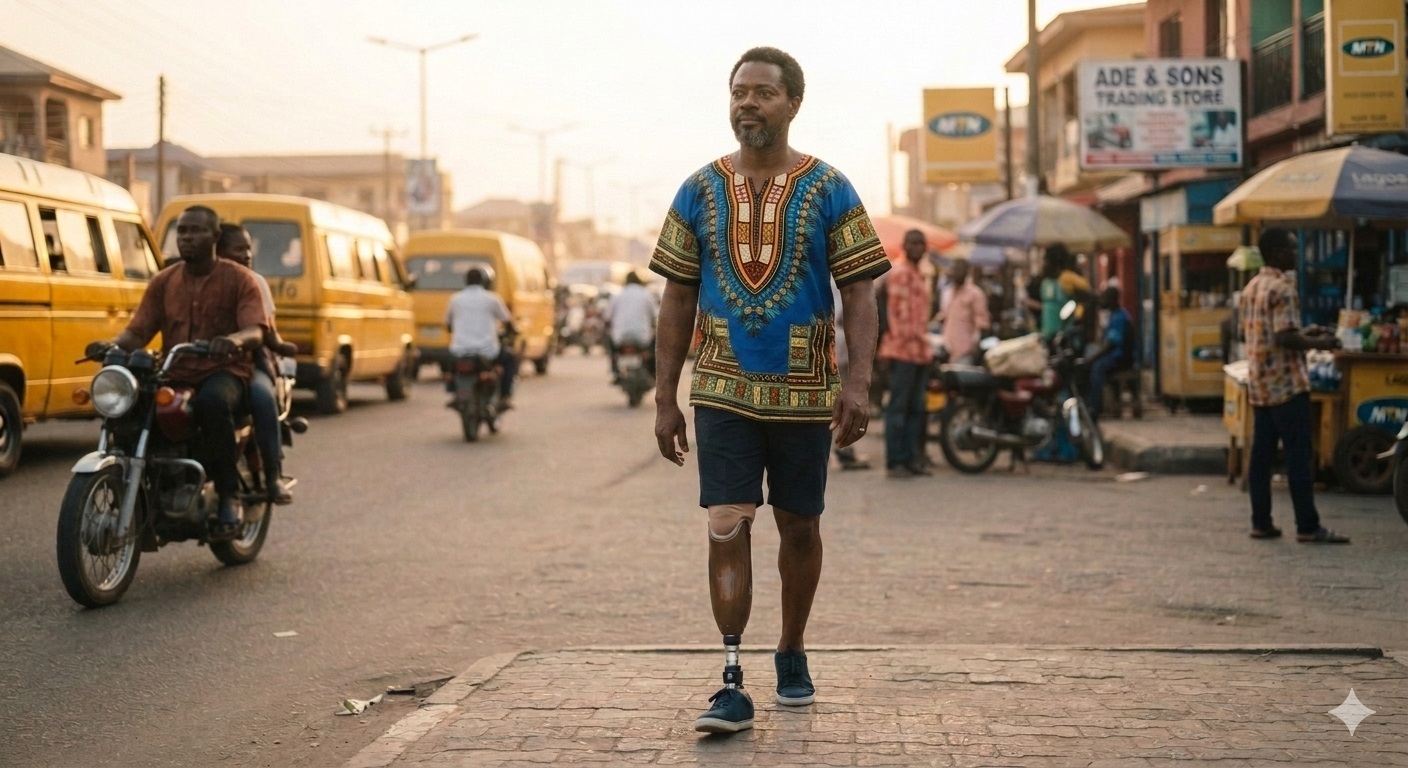
Featured image: A middle aged, dignified-looking Nigerian male, wearing a prosthesis in the right leg and walking along a typical bustling Lagos street. Image credit with prompts by Datelinehealth Africa: Gemini Nano Banana 2. Click on image to enlarge.
A farmer gets bitten by a snake and waits two days before reaching a hospital. By the time he arrives, an amputation is one of the few options left.
A trader with diabetes ignores a small wound on her foot because she does not have time to be sick and instead sources local remedies. She loses that foot eventually.
A civil servant has been managing his blood pressure with prayers and herbal concoctions instead of proper medications. Left uncontrolled, it slowly damages his blood vessels, making him more likely to lose his limb too.
You have probably heard stories like these and wondered how something that started so small and seemed harmless ended up becoming so serious. You probably assumed that accidents and injuries as a result of violence are a major reason that people in Nigeria may lose their limbs.
That's still true in some parts of the country. In northeastern and northwestern Nigeria, where insecurity from terrorism and banditry has displaced thousands of people over the past few years, conflict-related injuries with traumatic limb amputations have become tragically common. Organizations like The International Committee of the Red Cross (ICRC) run physical rehabilitation centres across Nigeria for people with traumatic limb amputations and more, providing prosthetic and orthotic care to help people rebuild their lives.
Trauma is still a major cause, but non-communicable conditions like diabetes, peripheral artery diseases that build slowly and without proper management are now responsible for a growing share of amputations across the country. Most of these are preventable.
Amputation is the surgical or traumatic removal of a limb, or part of one: a hand, foot, arm, or leg, and in more severe cases, the whole limb or more than one. It can happen suddenly, in a road accident or as a result of violent injury. It can also be the result of a health decline that ends in a surgical decision made to save a life.
The following are characteristic of amputations in Nigeria:
Age: Unlike in Western countries, the average Nigerian amputee is much younger, typically between 33 and 53 years old.
Gender: Amputations are more frequent in males, who account for 58% to 70% of cases, primarily due to their higher exposure to traumatic accidents.
Level of Amputation: Lower limb amputations (both above and below the knee) dominate, making up 7- 8 out of 10 (70% to 80%) of all procedures.
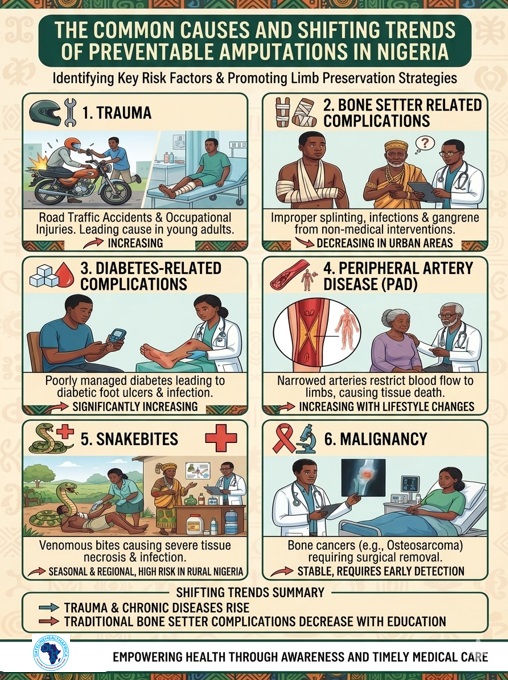
Info-poster showing common causes and shifting trends of preventable amputations in Nigeria. Image credit with prompts by Datelinehealth Africa: Gemini Nano Banana 2. Click on image to enlarge.
Several conditions can lead to amputation in Nigeria, each with its own risk factors and opportunities for prevention.
Road accidents remain a major cause of amputation in Nigeria, particularly amongst commercial transportation users and motorcycle riders, majority of who are young males.
A bad fracture handled improperly by traditional bone setters without proper medical training, can go untreated long enough to cause infection, vascular compromise, or compartment syndrome. These are complications that may eventually require amputation to save a person’s life.
Diabetes does not take a limb overnight. It starts small: altered sensations in your feet, an unnoticed sore because you can no longer feel properly. Left untreated, that small wound can become infected, the surrounding tissue can die, and amputation becomes the option that saves your life. A recent review at a Nigerian teaching hospital found that diabetic foot disease was the single leading cause of lower limb amputation, accounting for more cases than trauma.
Learn how to recognise and care for a diabetic foot ulcer here.
Smoking, high blood pressure, and high levels of cholesterol not only affect your heart, it also affect your blood vessels. In Peripheral Artery Disease (PAD), there is narrowing of the blood vessels carrying blood to your limbs. When this happens, wounds heal more slowly or sometimes not at all, leading to severe infections that require amputation.
What makes PAD especially dangerous is how it often progresses without obvious symptoms. It shares many of the same risk factors that drive diabetes-related complications, which is part of why the two so often overlap.
A snakebite can be the start of a long, dangerous journey, especially in rural communities where the nearest hospital may be hours away.
What often determines a good prognosis is time. Delays as a result of long journeys to the hospital, traditional remedies that don't work, and poor first aid (such as applying tight tourniquets and making unnecessary incisions) can worsen tissue damage and eventually lead to amputation.
Read more about what to do immediately after a snakebite here.
Bone cancers like osteosarcoma are also a real cause. A 2025 scoping review led by Nigerian researchers found that osteosarcoma has the highest incidence among people of African descent. It tends to affect children and young adults, and when it is caught late (because of cost, distance to specialist care, or not recognising the warning signs), amputation becomes the only option to remove the tumour and prevent the disease from advancing.
Prevention looks different depending on the cause, but one thing cuts across all of them: the earlier you act, the better your chances. Waiting, whether out of fear, denial, or lack of access to proper care, can lead to serious complications.
Trauma, especially from road accidents, is harder to predict or fully prevent. It depends on infrastructure, enforcement, and circumstances often beyond what you can control. But the other conditions give windows to act before the damage becomes irreversible.
Here are things you can do:
You don't have to wait to get diagnosed before you start looking out for yourself. While trauma and accidents are unpredictable, a lot is still within your control. And if you have been diagnosed already with diabetes, hypertension, or PAD, follow up consistently with your doctor/healthcare provider and be part of your care process.
Amputation doesn't always result from a single dramatic event like trauma. Shifting trends in causes are being noticed in Nigeria as elsewhere. These trends include wound that are left untreated, blood sugar levels left unchecked for long periods, cancerous lesions, or poorly treated snake bites. Knowing the risk, acting early, and getting proper care promptly can make all the difference and save you from a preventable amputation.
ICRC Nigeria — The impact of our work, January to December 2025.[Internet, n.d.]. Available from here.
Akinmokun OI, Otubi GE. Major limb Amputations in a Tertiary Hospital in South Western, Nigeria: Are There Changes in Demographic and Reasons for Amputation Yet? Nigerian Hospital Practice, 2024; 34(5-6):71-75. Available from here.
Ezeme C, Oladeji EO, Baiyewu LA, Okunola MO, Ogunlade SO. Motorcycle Road Traffic Injuries in a Tertiary Hospital in Nigeria: A Reflection of the Trauma Care Crisis. Cureus. 2023 Dec 26;15(12):e51141. doi: 10.7759/cureus.51141. Available from here.
Hart F, Orupabo F. Evolving patterns of lower limb amputations at a Nigerian tertiary hospital: a retrospective study. International Surgery Journal, 2025;12(8), 1263–1268. Doi: 10.18203/2349-2902.isj20252274. Available from here.
Olajugba OJ, Oladeji EO, Adesola D, Abdullateef RO. Rockson G, at al. Challenges of osteosarcoma care in Africa: a scoping review of the burden, management and outcome. ecancer. 2025;19:1835. Available from here.
Related articles
Self-Care for Diabetic Foot Ulcer in Africa – A Nurse’s Perspective
Snake Bites in Africa: All You Need to Know
Peripheral Artery Disease in Sub-Saharan Africa; What Is It?
Hypertension in Nigerian Adults: Essential things to know
Type 2 Diabetes: What Africans Need to Know
6 Practical Foot Care Tips for African Diabetics
Published: July 15, 2026
© 2026. Datelinehealth Africa Inc. All rights reserved.
Permission is given to copy, use, and share content freely for non-commercial purposes without alteration or modification and subject to source attribution.
DATELINEHEALTH AFRICA INC., is a digital publisher for informational and educational purposes and does not offer personal medical care and advice. If you have a medical problem needing routine or emergency attention, call your doctor or local emergency services immediately, or visit the nearest emergency room or the nearest hospital. You should consult your professional healthcare provider before starting any nutrition, diet, exercise, fitness, medical or wellness program mentioned or referenced in the DatelinehealthAfrica website. Click here for more disclaimer notice.