Routine Tests in Pregnancy: A Practical Guide for African Women
Maimuna Abubakar, Medical Laboratory Technician, Health Content Writer. Medically reviewed by: T. Oyetunji, MB.BS., FWACP (Family Practice).
July 20, 2026

A pregnant African woman checking out the results of the laboratory tests conducted on her. Sitting beside her is a smiling female African nurse. Image credit: Gemini AI. Click on image to enlarge.
I've seen many African women who, after attending antenatal and the doctor requests for some tests, the usual thing they say is “I don't need to do them”. They feel it's a waste of money. And this happens because they have no idea why these tests were requested and what the test results say about them or their baby.
Understanding laboratory tests in pregnancy go a long way in helping African women make informed decisions that keep them safe throughout their pregnancy journey. It helps them understand their health status as well as that of their developing foetus.
In this article, you will learn about some of the laboratory tests you do during pregnancy, understand why each test is requested, and how they support maternal health. You will also know some important questions you should ask about your test results.
When you go for antenatal visits, some tests are requested at your first and subsequent visits. These tests help your healthcare provider in keeping you safe and healthy through your pregnancy journey. Laboratory tests help to achieve the following:
One of the first reasons routine tests are performed during pregnancy is to confirm the pregnancy. Blood or urine pregnancy tests detect the hormone human chorionic gonadotropin (hCG), which is produced after a fertilized egg implants in the uterus. Confirming pregnancy early allows women to begin antenatal care promptly, estimate gestational age, and receive appropriate screening and monitoring throughout pregnancy.
Your doctor can obtain a lot of information regarding your health status and that of your baby from your test results. For example, results from Complete Blood Count ( CBC), blood glucose test, urine test, etc., tell your doctor different things about your health. Ultrasound scanning also helps your doctor to obtain valuable information about the growth and development of your baby and identify concerns that may affect your own health throughout the pregnancy.
Doing these tests helps your doctor and other healthcare providers to monitor your health during pregnancy and after delivery (1, 2).
Blood grouping and the Rhesus factor help your doctor to know your rhesus status. There might be a risk when a rhesus-negative woman gets pregnant with a rhesus-positive partner, which results in a rhesus-positive foetus. If this happens, there is always a need for intervention to prevent haemolytic disease of the newborn in future pregnancies (1).
Screening for HIV, syphilis, and hepatitis is carried out during your first antenatal visit. Early detection of these infections allows your doctor to administer medications that prevent transmission to the baby. Always go for the tests, never think it's a waste of money (3).
Results from CBC tell when your haemoglobin level is low. This is an indicator of anaemia which requires prompt and proper attention. Also, your urine test results showing the presence of glucose is an indication of gestational diabetes. When this happens, more tests are requested for proper diagnosis and early treatment.
Now that you understand how laboratory tests support your health and that of your baby during your pregnancy, you would appreciate why it's vital for you to always go for your routine checkup and do the tests your doctor requests.
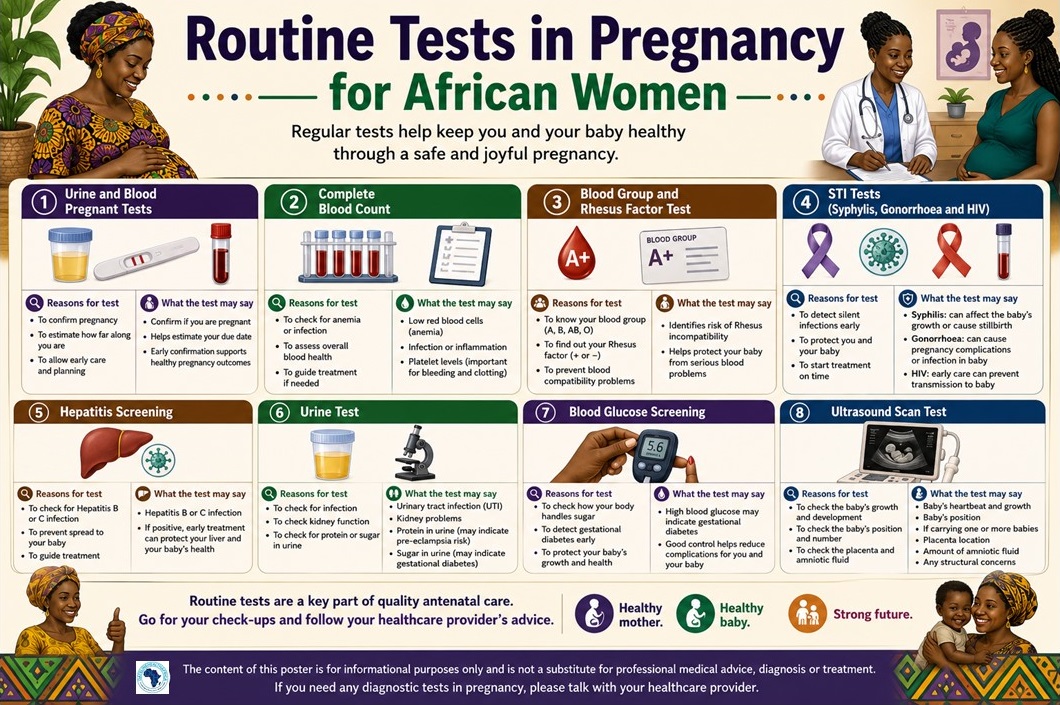
Info-poster illustrating routine tests conducted in pregnancy on African women with reasons and what the tests mean. Image credit: ChatGPT, based on prompts developed by Datelinehealth Africa.
Some tests your doctor requests you do during your first or subsequent visits are:
A pregnancy test is one of the first routine tests performed when pregnancy is suspected. It detects human chorionic gonadotropin (hCG), a hormone produced by the placenta after a fertilized egg implants in the uterus. The test can be performed using either a urine or a blood sample.
Urine pregnancy tests are commonly used because they are quick, cheap, convenient and highly accurate when performed one to two weeks after a missed menstrual period. Blood pregnancy tests are more sensitive and can detect smaller amounts of hCG, allowing pregnancy to be confirmed earlier than urine tests. They may also be used when a healthcare provider needs additional information about the pregnancy.
A positive pregnancy test usually indicates pregnancy, while a negative result may mean you are not pregnant or that the test was performed too early for hCG to be detected. If pregnancy is still suspected after a negative result, your healthcare provider may recommend repeating the test after a few days or performing a blood test.
This test helps your healthcare provider to detect anaemia, blood disorders and the overall status of your blood health (2, 3). Anaemia is one of the most common medical disorders in pregnancy and contributes to maternal death especially in developing countries (1). This test measures your complete blood level and its components, including haemoglobin (Hb) level, white blood cells, platelets, red blood cells, etc.
Haemoglobin is the main pointer to anaemia. When your haemoglobin gets lower than normal, your doctor prescribes dietary changes and medications early to avoid further complications.
This is one of the tests your doctor requests at your first antenatal visit. Testing for blood groups helps in obtaining background information on the status of the mother, should blood transfusion be required any time before, during, as well as after childbirth. Testing for the Rh factor helps to identify women who are at risk of Rh incompatibility, which can cause haemolytic disease of the newborn in future pregnancies if left unmanaged (1).
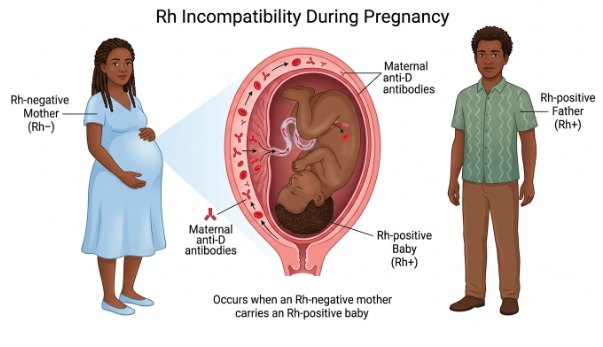
Illustration of Rh incompatibility during pregnancy between an Rh-negative mother and an Rh-positive father. Image credit: Gemini AI. Click on image to enlarge.
Routine Sexually Transmitted Infections (STI) testing during antenatal care in Nigeria usually covers HIV and Syphilis. Comprehensive screening for other STIs like chlamydia, gonorrhea, or Hepatitis B is also available as needed.
HIV screening is vital for pregnant women to help prevent mother-to-child transmission. When HIV is detected at the early stage of pregnancy and appropriate interventions are taken, the rate of mother-to-child transmission reduces from 32% to less than 1% (1). So, knowing your HIV status prior to being pregnant or early in pregnancy helps your healthcare providers to plan for as well as prevent HIV mother-to-child transmission.
However, some pregnant women avoid knowing their HIV testing status, preferring the idea of “what you don't know doesn't kill you”. This is not true, knowing your status and taking action as needed is always the best thing to do.
The syphilis test, which is mostly written as VDRL (Venereal Disease Research Laboratory), checks for a current or past sexually transmitted infection caused by a bacterium called Treponema Pallidum. The infection can be transmitted to the baby from an infected mother. In most cases, about 70-100% of infants become infected with syphilis when it's left untreated in a pregnant woman. Research also shows that one-third of pregnancies may result in stillbirth when the infected mother doesn't take her medications (1). These figures show how syphilis largely affects the health of both the baby and the mother. For this reason, it's important you go for the test whenever your doctor requests it.
Pregnant women under age 25 are screened for gonorrhea at their first prenatal visit and in the third trimester. Those above 25 years old are screened if they have risk factors (e.g., a new sex partner, multiple partners, or other STIs). Gonorrhoea screening uses a simple urine test or cervical swab. If untreated, gonorrhea can lead to miscarriage, premature birth, and severe eye infections in newborns. These are important reasons to get screened.
Screening for hepatitis is mostly done during your first antenatal visit. Most hospitals in Nigeria check for Hepatitis B while others may include hepatitis C screening. This test is done to prevent transmission from the mother to the baby. A study shows that up to 85% of infants born to infected mothers may become infected if preventive measures are not taken at birth (1). This can be prevented when the doctors know the status of the mother.
A urinalysis test is one of the tests your doctor requests at almost every antenatal visit. Urine test during pregnancy, can help the doctor know about the following (2, 3):
Blood glucose screening is performed during pregnancy to detect gestational diabetes, a type of diabetes that occurs only during pregnancy. It poses health issues for both the mother and the baby. The test for gestational diabetes is done between 24 and 28 weeks of pregnancy (4).
When there's the presence of sugar in urine, it usually calls for more attention. Your doctor requests more tests, such as the Glucose challenge and Oral Glucose Tolerance Test (OGTT). This is to help the doctor understand how well your body tolerates or absorbs glucose (4)
A pregnancy ultrasound scan is an imaging test performed routinely during antenatal care to assess the health and development of the baby. Unlike blood or urine tests, it uses high-frequency sound waves to produce images of the baby and other structures within the uterus. Ultrasound scans are painless, have no known harmful effects on the mother or baby, and can be performed at different stages of pregnancy.
An ultrasound scan can help to:
After your laboratory tests, you will receive a report containing your results. Looking at all the figures, abbreviations, and medical terms in the report can sometimes be confusing. Most laboratory reports contain your test result alongside a reference (normal) range.
Find time to discuss the result with your healthcare provider to ask questions and understand what each result means, whether it falls within the expected range for your stage of pregnancy, and whether you need further tests, treatment, or follow-up.
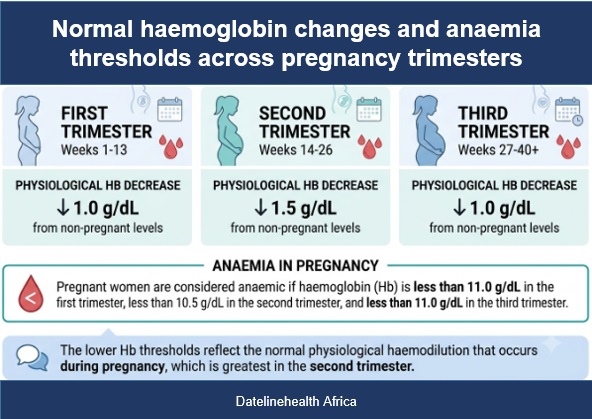
Normal haemoglobin changes and anaemia thresholds across pregnancy trimesters. Image credit: Gemini AI. Click on image to enlarge.
A Complete Blood Count (CBC) report usually contains many blood parameters including:
Your doctor compares these results with the laboratory's reference range while considering your stage of pregnancy.
If any of the blood parameters are outside the expected range, ask your doctor what the result means, what may have caused it, and whether you need treatment or repeat testing. (6)
Your blood glucose test report shows your blood sugar level together with the laboratory's reference range. Your doctor interprets the result based on your gestational age, medical history, and the type of blood glucose test performed.
Always ask if your result is normal for your stage of pregnancy and whether you need further tests or follow-up care (4).

A pregnant woman preparing for the gestational diabetes screening. Image credit: Gemini AI. Click on image to enlarge.
A urine test report may contain findings such as glucose, protein, ketones, bacteria, or white blood cells. These findings provide important information about your health during pregnancy.
For example, the presence of glucose in urine may require further blood sugar testing, while protein in the urine may require additional assessment for pregnancy-related conditions such as pre-eclampsia. Your doctor will interpret these findings together with your symptoms and other test results before making a diagnosis. If your urine test result is abnormal, ask whether you need further tests or treatment. (2)

Close up image of a black mother;s hand holding a baby picture obtained during ultrasound scan. Image credit: Chat GPT with prompts created by Datelinehealth Africa. Click on image to enlarge.
Unlike blood and urine tests, an ultrasound report provides information about your baby's growth and development. Your doctor interprets the findings based on your stage of pregnancy and other clinical information.
Some common terms you may see on your ultrasound report include:
An abnormal ultrasound result does not always mean there is a serious problem with your pregnancy. In some cases, your doctor may recommend repeating the scan or requesting additional tests to better understand the findings. If there is anything you do not understand in your report, ask your doctor to explain what it means and whether any follow-up testing or care is required.
Before undergoing any laboratory test during pregnancy, it is helpful to understand why the test is being recommended and how the results may influence your care. Asking questions can help you make informed decisions and reduce anxiety about the testing process.
Some useful questions you should ask include:
1. Why is this laboratory test being recommended?
2. What condition or complication is this test screening for?
3. Do I need to prepare for the test, such as fasting or avoiding certain medications?
4. Are there any risks or side effects associated with the test?
5. When will my results be available?
6. What happens if my results are abnormal?
7. Will I need to repeat the test later in pregnancy?
8. How will the results affect my pregnancy care or treatment plan?
Discussing these questions with your healthcare provider can help you better understand your antenatal care and the role laboratory tests play in protecting your health and that of your baby.
You went to the hospital as usual because you have always been consistent with your antenatal visits. After your test results were handed over to you, you went back to the doctor, and he prescribed some drugs for you. You have no idea what they are for because you don't understand the results you got from the lab. These are questions you should always ask to understand your laboratory results:
Always ask this question when you don't understand what the test entails. If you didn't ask before the test, you should ask when the result is ready. This is to help you understand why it was requested and how to prepare for it.
Ask your doctor if your result is normal for your gestational age. Some test results are not the same at every stage of pregnancy.
Some tests require further testing, always ask about that or enquire if you need to be on treatment.
4. What risks does this result show?
Ask about the risks associated with the test results. So you understand how well to handle it.
5. Do these results affect my baby's health?
Some test results point to some conditions that might be a risk to your foetus. Ask if and how it affects your baby.
You should ask if you need to make changes to what you eat or do. For example, a test result pointing to gestational diabetes, anaemia, etc., might require changes or adjustments in your meals.
Always ask these questions or any questions you have regarding your test results, your health, or the health of your foetus. This will help you have a healthy pregnancy journey.
As a pregnant woman, when you understand your test results, it goes a long way to help you in many ways. Understanding your results helps you to:
Regular antenatal checkups are very important for you as a pregnant woman, as they support your health and that of your developing foetus. Never skip your visit and go for your tests as requested by your doctor.
If you don't understand any test or test result, never hesitate to ask questions. Following instructions for every test will help the healthcare workers get accurate results.
Remember to always take your daily iron and folic acid as your doctor prescribed to prevent iron deficiency anaemia. Your health and that of your baby are a priority; treat them as such.
1. Alkhatib A. The Role of Laboratory Medicine for Health During Pregnancy. EJIFCC. 2018;29(4):280–284. Available from here.
2. MedlinePlus. Prenatal Panel [Internet]. Last Updated 224 Sep. 23. [Cited 2026 July 1]. Available from here.
3. Padoan A. Laboratory tests to monitoring physiological pregnancy. Journal of Laboratory and Precision Medicine. 2020;5(0). Available from here.
4. NIDDK. Gestational Diabetes. [Internet]. Last updated: 2017 May. [Cited 2026 July 1]. Available from here.
5. NHS, UK. Ultrasound scans in pregnancy [Internet]. 2023 Nov. 13. [Cited 2026 July 16]; Available from here.
6. Moghaddam TF, Barjasteh S. Maternal Hemoglobin Levels during Pregnancy and their Association with Birth Weight of Neonates. Iran J Ped Hematol Oncol. 2015;5(4):211–217. Available from here.
Related: What Africans Need to Know about Antenatal Care
Published: July 20, 2026.
© 2026. Datelinehealth Africa Inc. All rights reserved.
Permission is given to copy, use and share content for non-commercial purposes without alteration or modification and subject to source attribution.
DATELINEHEALTH AFRICA INC., is a digital publisher for informational and educational purposes and does not offer personal medical care and advice. If you have a medical problem needing routine or emergency attention, call your doctor or local emergency services immediately, or visit the nearest emergency room or the nearest hospital. You should consult your professional healthcare provider before starting any nutrition, diet, exercise, fitness, medical or wellness program mentioned or referenced in the DatelinehealthAfrica website. Click here for more disclaimer notice.