Take Control: How To Stop Doomscrolling and Protect Your Mind
By Kelechi Nwaowu, Freelance Medical & Health Writer. Medically reviewed by the DLHA Team.
June 22, 2026
.jpg)
A young African man lying in a dark bedroom, with his face illuminated by the blue light of a smartphone screen late at night. Image credit: Magnific. Click on image to enlarge.
Picture Tunde, a 28-year-old unemployed fresh graduate who lives in Lagos, Nigeria. His bedside alarm goes off at 6 a.m., and before his feet touch the floor, his phone is already in his hand. He tells himself he is just checking one quick thing; however, forty minutes later, he is still lying in bed scrolling through TikTok posts about fuel price increases, election tribunal updates, reports of kidnappings on the Abuja-Kaduna road, and a viral video of a protest that turned violent. When he eventually puts the phone down, he feels heavy, anxious, and already tired, and hours have rolled by.
If any part of that sounds familiar, this article is for you.
What Tunde is experiencing is called doomscrolling, and it is far more common and harmful than most people realise.
This article explains, in plain terms and without judgment, what doomscrolling is, why the brain gets trapped in it, what it does to your mental health, and what you can actually do to control it.
Doomscrolling is as the name implies, scrolling through doom. It is the habit of continuously scrolling through negative, distressing, or alarming news content online, usually on social media or news apps, even when doing so makes you feel anxious, overwhelmed, or sad (1). Note that the most important qualifier in the definition is "even when doing so makes you feel anxious, overwhelmed, or sad." What separates doomscrolling from ordinary news reading is that the person keeps going on, despite feeling worse.
The term began circulating widely during the COVID-19 pandemic, when millions of people found themselves glued to news full of death numbers, lockdown updates, and conflicting health advice (2). Doomscrolling as a behaviour is not new. It is simply the digital version of a deeply human impulse – the need to stay informed about threats, especially when the world feels unsafe.
The platforms most commonly used for news in Africa are not traditional newspaper websites. They are TikTok feeds, WhatsApp broadcast groups, Facebook pages, and X (formerly Twitter) timelines. For many urban Nigerians, Ghanaians, Kenyans, and South Africans, the morning routine begins not with a newspaper but with a phone. And those social media feeds are rarely full of good news, as they carry endless news of fuel subsidy removals, election outcomes, insecurity alerts, and health crises. The potential for doomscrolling is built directly into the social media algorithm, and this feeds the basic human need to stay updated and vigilant.
Doomscrolling is difficult to stop because when you get hooked, your brain is wired differently, and social media platforms are designed to exploit that wiring. There are two overlapping explanations for why it’s difficult to stop. These are the brain's old bias towards bad news (the negativity bias) and how social media algorithms amplify that bias.
There is a small structure deep inside your brain called the amygdala. It is the brain's emotional alarm system, and its primary job is to detect threats and trigger a response (3). For most of human history, this served as a survival mechanism, favouring the ancestors who immediately noticed the presence or heard the sound of a predator and ran, while the ones who ignored it were captured and preyed on.
As a result of this, the human brain is hardwired to pay more attention to negative information than to positive or neutral information. Psychologists call this the negativity bias (4). In practical terms, it means that a threatening headline captures your attention faster and holds it longer than a cheerful one. Bad news simply feels more urgent to the brain, not because it necessarily is, but because evolution trained it to react that way.
In the modern context, this means that every alarming headline, every update about violence or economic collapse, registers in the brain as a potential threat that must be monitored. So the brain keeps you scrolling, not out of curiosity, but out of a misguided attempt at vigilance (2). It is looking for the moment when the danger resolves, but on social media, it never does. There is always another threat waiting on the next scroll.
If the negativity bias is the brain's vulnerability, social media algorithms are the exploit. Platforms like Facebook, TikTok, and X are designed to keep users engaged for as long as possible. The longer you stay on the platform, the more advertising revenue is generated. Engagement, therefore, is the goal, and the most engaging content is almost always emotionally charged, divisive, or alarming (4)
These platforms use what psychologists call a variable reward schedule, which is the same psychological mechanism that makes slot machines so difficult to walk away from. Each scroll offers the possibility of something new. It could be a shocking update, a major revelation, or a viral video. Because the reward is unpredictable, the brain releases small amounts of dopamine (a chemical that drives pleasure and motivation) in anticipation of each new piece of content (5). This creates a loop where you scroll, receive a small reward, and feel the urge to scroll again.
Added to this is the infinite scroll design; there is no natural endpoint on most social media feeds. There is no last page, no final headline and no last content. The feed simply continues, and the brain, already primed by negativity bias and dopamine anticipation, has nothing stopping it. The result is doomscrolling – a neurological trap, not a character flaw.
The effects of doomscrolling on mental health are not vague or speculative; they are well-documented across multiple peer-reviewed studies. This section discusses the four most significant consequences of doomscrolling, each of which builds on the others to create a broader pattern of distress.
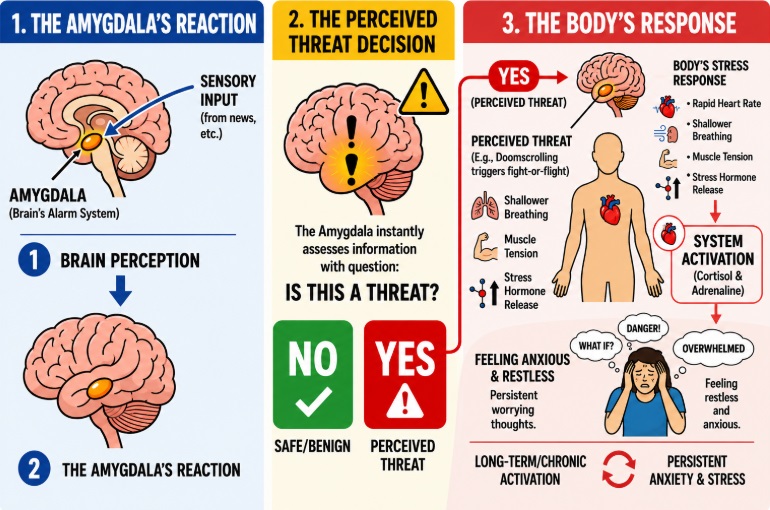
An infographic showing how doomscrolling activates the brain's threat response. Image credit: Gemini AI. Click on image to enlarge.
The most consistently documented effect of doomscrolling is increased anxiety. A 2022 study published in the journal Technology, Mind, and Behavior, which formally measured doomscrolling as a distinct behaviour, found that the habit was significantly associated with anxiety, online vigilance, and poor self-control in news consumption (2)
When the brain processes repeated threatening headlines through the amygdala, it does not calmly file them away. Instead, it stays alert in vigilance (6). In response to this perceived threat, the body releases its primary stress hormone called cortisol. Because each new alarming headline extends that stress response, this repeated activation of cortisol over time keeps the nervous system in a low-level state of high alert, even when nothing genuinely threatening is happening around the person. As a result, everyday situations such as traffic, a delayed salary payment, or a WhatsApp message left unread begin to feel more threatening than they are, because the brain has been trained to expect danger.
Beyond anxiety, doomscrolling is also linked to depressive symptoms and a growing sense of helplessness. Another study published in 2022 found that individuals who doomscroll experienced significantly greater levels of psychological distress, which in turn leads to lower mental well-being and life satisfaction (7).
This connection to depression is not difficult to understand. Imagine when a person spends so much time reading about flooding in Anambra, violence in Plateau State, economic hardship across the country, and no sense of how any of it will improve, the natural psychological response is a feeling of helplessness – the sense that the world is in decline, and there is nothing one can do about it. Over time, repeated exposure to this pattern erodes the emotional resilience needed to function normally and find meaning in daily life.
One of the most practically damaging effects of doomscrolling is its impact on sleep, and this is a two-way problem. First, many people doomscroll late at night, which means they are absorbing alarming content precisely when the brain needs to be winding down. The stress hormones triggered by distressing news keep the nervous system activated, making it difficult to fall asleep or stay asleep.
Second, the blue light emitted by phone screens suppresses the release of melatonin, which is the hormone that regulates the sleep-wake cycle (8). This means that even if the content were neutral, prolonged night screen use still interferes with sleep. Imagine then, when the content is actively alarming, the combined effect on sleep quality becomes more significant.
Poor sleep, on the other hand, makes the amygdala more reactive the following day, meaning the person is even more sensitive to threat signals and more likely to reach for the phone in search of reassurance. The cycle continues, and the effects keep growing.
Doomscrolling does not affect the mind alone. According to Harvard Medical School experts, prolonged doomscrolling is associated with nausea, headaches, muscle tension in the neck and shoulders, low appetite, elevated blood pressure, and fatigue (9).
These symptoms are the predictable physical consequences of sustained stress hormone (cortisol) activation. When the body remains in a state of low-grade fight-or-flight response, as it does during extended doomscrolling, it diverts resources away from normal maintenance functions. Digestion is affected (hence nausea and stomach discomfort), muscles remain in a state of partial tension (hence headaches and shoulder pain), and the immune system becomes less effective over time. In addition, the simple physical posture of doomscrolling, that is, head bent forward, shoulders rounded, lying or sitting still for long periods, compounds its effects on the muscles.
Recognising doomscrolling in yourself is not always straightforward, because the habit often masquerades as staying informed. The checklist below is designed to help. If you identify with three or more of these patterns regularly, your news consumption may already be affecting your well-being.
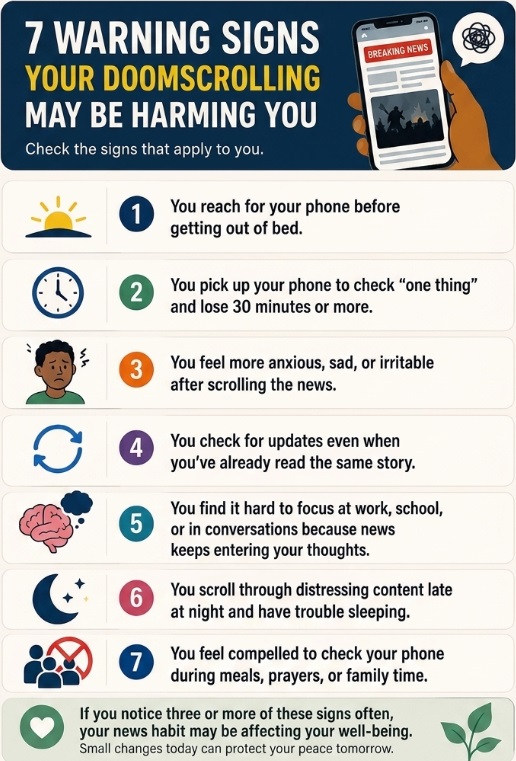
A checklist infographic showing seven warning signs of harmful doomscrolling. Created with Gemini. Click on image to enlarge.
Breaking the doomscrolling cycle does not require deleting your apps, disconnecting from news entirely, or ignoring what is happening in your community. It requires replacing a reactive, compulsive habit with a more intentional one.
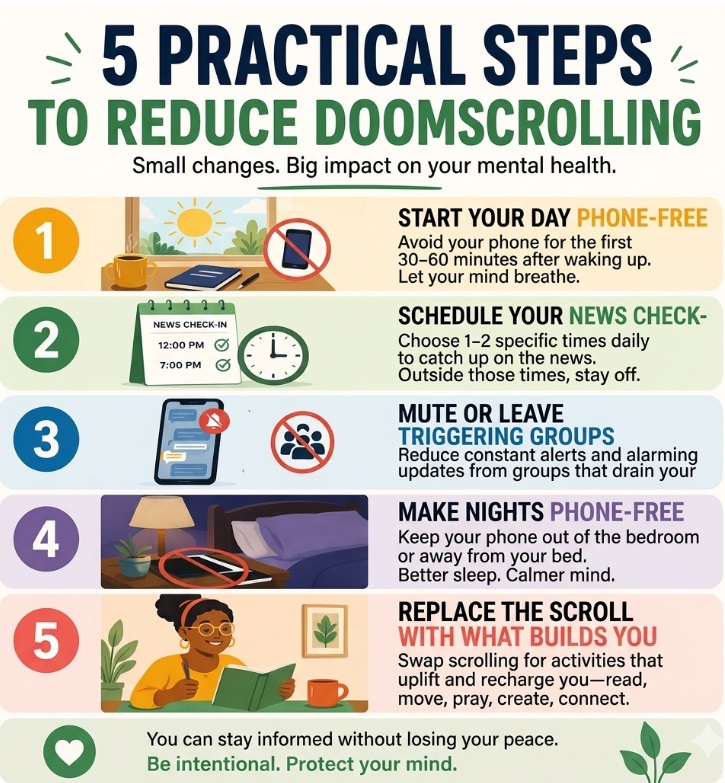
An infographic showing five practical steps to reduce doomscrolling. Created with Gemini. Click on image to enlarge.
The following strategies are practical steps designed for the African digital environment, where WhatsApp, TikTok, X (Twitter) and Facebook are often the primary channels for both news and personal communication.
For most people, the strategies above are enough to reduce doomscrolling and its effects. However, for some, the anxiety and low mood that doomscrolling causes are part of a deeper pattern that goes beyond news consumption alone.
A counsellor, psychologist, or psychiatrist can help you understand and address these patterns. You can access their services at neuropsychiatric hospitals across various states in your country, private mental health facilities, and online health platforms.
Seeking this kind of help is not a sign of weakness. It is exactly what a person who takes their health seriously does, and your mental health is as real and as worth protecting as any other part of your body.
In an environment full of alarming news, doomscrolling is not laziness nor lack of discipline. It is the predictable outcome of a brain wired for threat detection, operating inside online platforms built to exploit that wiring.
Understanding why it happens is the first step toward changing it. The second step is choosing, deliberately, to relate to information consumption differently – not by becoming uninformed, but by deciding when, how, and for how long you let the news into your day.
Your mental health is worth that change.
1. Güme S. Doomscrolling: A review. Psikiyatride Güncel Yakla??mlar. 2024;16(4):595-603. Abstract available from here.
2. Sharma B, Lee SS, Johnson BK. The dark at the end of the tunnel: Doomscrolling on social media newsfeeds. Technol Mind Behav. 3(1), 144–156. Doi: 10.1037/tmb0000059 Available from here.
3. ?AbuHasan Q, Reddy V, Siddiqui W. Neuroanatomy, Amygdala. [Updated 2023 Jul 17]. In: StatPearls [Internet]. Treasure Island (FL): StatPearls Publishing; 2026 Jan-. Available from here.
4. Watson J, van der Linden S, Watson M, Stillwell D. Negative online news articles are shared more to social media. Scientific Reports. 2024 Sep 16;14(1):21592. Available from here.
5. Sharpe BT, Spooner RA. Dopamine-scrolling: a modern public health challenge requiring urgent attention. Perspectives in Public Health. 2025 Jul;145(4):190-1. Abstract available from here.
6. Kirk PA, Holmes AJ, Robinson OJ. Threat vigilance and intrinsic amygdala connectivity. Human brain mapping. 2022 Jul;43(10):3283-92. Available from here.
7. Satici SA, Gocet Tekin E, Deniz ME, Satici B. Doomscrolling Scale: its Association with Personality Traits, Psychological Distress, Social Media Use, and Wellbeing. Applied Research in Quality of Life. 2023 Apr;18(2):833-47. Available from here
8. Chkhaidze A, Millar BM, Revenson TA, Mindlis I. Scrolling your sleep away: The effects of bedtime device use on sleep among young adults with poor sleep. International Journal of Behavioral Medicine. 2025 Aug;32(4):634-9. Available from here
9. Salamon M. Doomscrolling dangers. Harvard Health Publishing: Mind & Mood [Internet]. 2024 Sep 1 [Cited 2026 Jun 8]. Available from here
Published: June 22, 2026
© 2026. Datelinehealth Africa Inc. All rights reserved.
Permission is given to copy, use and share content freely for non-commercial purposes without alteration or modification and subject to attribution as to source.
DATELINEHEALTH AFRICA INC., is a digital publisher for informational and educational purposes and does not offer personal medical care and advice. If you have a medical problem needing routine or emergency attention, call your doctor or local emergency services immediately, or visit the nearest emergency room or the nearest hospital. You should consult your professional healthcare provider before starting any nutrition, diet, exercise, fitness, medical or wellness program mentioned or referenced in the DatelinehealthAfrica website. Click here for more disclaimer notice.