Is Wearing Perfume Safe? What Research Reveals
By: Favour Gospel. 600-level student PharmD and DLHA Volunteer. Medically reviewed by: E. Odekina. MBBS.
September 27, 2026
Close-up and partial image of an African woman applying perfume to her wrist. Everyday perfume use can expose the body to fragrance chemicals, including substances being studied for potential endocrine disrupting effects. AI generated illustration created with ChatGPT. Click on image to enlarge.
You wear your favourite perfume before leaving for school, work, church, or a wedding. The scent lasts all day, earns you compliments, and fuels your confidence. To you, perfume is part of daily grooming.
Recently, social media posts and online videos have claimed that perfumes can disrupt hormones, reduce fertility, and even increase the risk of certain health conditions. These claims may leave you wondering whether your favourite fragrance is safe.
So, are perfumes harmful to health? Do they disrupt hormonal balance?
Research shows that some perfume ingredients belong to a group of substances called endocrine disrupting chemicals (EDCs). These chemicals have been proven to interfere with hormone activity. Studies also suggest possible links between exposure to some of these chemicals and reproductive, developmental, and metabolic health.
However, scientists are still investigating how daily perfume use contributes to these effects because people are exposed to endocrine disrupting chemicals from many sources, not just fragrances.
In this article, you will learn:
Hormones are chemicals produced by special glands in the body (endocrine glands) for the purpose of carrying messages and signals to different parts or organs of the body in order to coordinate many different functions (1. 2).
More than 200 hundred hormones and hormone like substances have been identified in the human body. They are produced by several endocrine organs namely; hypothalamus, the pituitary gland, the pineal gland, thyroid gland, adrenal gland, the pancreas, ovaries and testes.
Hormones tell organs and tissues what to do and when to do them in order to maintain balance in the body. A hormone can only act on part of the body that fits it. Receptors receive the message that a hormone delivers to produce a response (3).
Hormones regulate many essential body functions such as growth and development, puberty, menstruation and ovulation, sperm production, pregnancy and breastfeeding, sleep and wake cycle, metabolism, blood sugar regulation, bone health and maintenance and more.
Endocrine-disrupting chemicals (EDCs) are natural or man-made (synthetic) substances or mixtures that occur in the environment (air, soil, or water supply), in food, personal care products (like perfumes, shampoos and conditioners, body lotions), cosmetics, plastics, and many other manufactured household products (4).
Endocrine disrupting chemicals (EDCs) are of concern to human health because they interfere with the endocrine system and its function. Scientists are more interested in the combined effect of multiple exposures to EDCs over a lifetime rather than the occasional use of a single product.
Hormones work together as a balanced system so anything that interferes with their normal signaling has the potential to affect several organs at once. Endocrine disrupting chemicals can interfere with this process in several ways (5, 6).
Finding an endocrine disrupting chemical in a perfume does not automatically mean that using the product will cause hormone related problems. The potential effect depends on factors such as the chemical involved, the amount and route of exposure, how often and how long a person is exposed, and exposure to the same or other chemicals from additional sources (7).
Related: Click to watch the video below and learn more about the health impact of Endocrine Disrupting Chemicals (EDC).
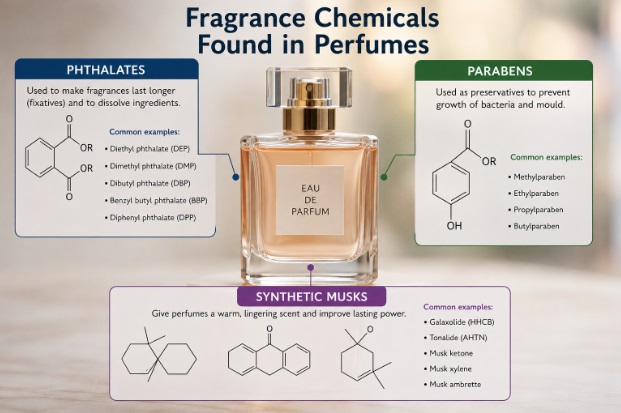
A labelled infographic showing a perfume bottle surrounded by three categories of known endocrine disruptor chemicals (EDC): phthalates, parabens, and synthetic musks. Click on image to enlarge.
Not every ingredient used in perfume has been linked to hormone disruption. Researchers have identified several groups of fragrance chemicals that have raised concerns because of their endocrine disrupting chemical property. The three groups of perfume ingredients which receive the most attention in research on hormone disruption are phthalates, parabens, and synthetic musks.
Phthalates are the most studied. They are used to make perfumes last longer and can also be found in colognes, deodorants, hair sprays, shampoos, body lotions and nail polish.
The most common phthalate added to personal care products is Diethyl phthalate (DEP). Other fragrance-related phthalates include (8, 9):
Parabens are used as preservatives in perfumes to prevent the growth of bacteria and mould. Research has shown that some parabens have been associated with disturbances of the female hormone estrogen responsible for regulating sexual development of the reproductive tissues and secondary sexual characteristics at puberty (10).
Synthetic musks give perfumes that warm lingering base. Examples are:
Others in this family include (8):
Studies have detected synthetic musks in human blood, breast milk, body fat, and even the environment, showing that these compounds can accumulate over time. Laboratory studies suggest that some synthetic musks may interfere with hormone receptors or influence the activity of other endocrine disrupting chemicals.
If you look at the ingredient list of a perfume, you may simply see words like: Fragrance or Parfum. This single word can represent a complex mixture of dozens or even hundreds of individual perfume ingredients, including natural extracts and synthetic chemicals.
Many countries allow manufacturers to list these ingredients collectively because fragrance formulas are considered proprietary or trade secrets. As a result, companies are generally not required to disclose every chemical in the fragrance blend on the product label.
Some manufacturers now voluntarily market products as: “Phthalate free”, “Fragrance free”, “Paraben free”. These labels can help consumers make informed choices but they do not necessarily mean a product is free from every potential endocrine disrupting chemical (9, 10).
Fragrance chemicals can enter the body in several ways and they include;
Perfumes can affect fertility because of the endocrine disrupting chemicals contained in them. They can affect hormonal pathways involved in the development and function of both male and female reproductive systems. Phthalates have been linked to reduced egg quality in women and sperm health in men and long-term exposure to these perfumes has been associated with higher risks of infertility and pregnancy complications (11, 12).
For most healthy adults, occasional use of perfume does not mean they will become infertile but prolonged exposure is associated with higher health risk. Research suggests that endocrine disrupting chemicals can cause transgenerational effects too (13).
Exposure to fragrance chemicals does not affect everyone in the same way. Risk levels may be determined by:
Perfume is just one source of exposure. A person may encounter similar chemicals through lotions, deodorants, hair products, cosmetics, detergents, and other personal care products. Certain groups deserve extra attention when discussing perfume hormone disruption.
A pregnant African woman using a small amount of perfume in a well ventilated room
Pregnancy is a period of major hormonal and fetal development, as well as increased vulnerability to environmental chemicals. Some endocrine disrupting chemicals can cross biological barriers and reach the developing fetus. Research has associated prenatal exposure to certain phthalates with serious side effects such as increased risk of premature birth, and hypertensive disorders (14, 15).
Phthalate exposure to the unborn child was measured by phthalate levels in mothers’ urine, and research has linked it to abnormal development of genitals in males which presents as reduced distance between the penis base and the anus, smaller penis size, undescended testes, as well as poorer cognitive and behavioral outcomes in children (14). It was also observed that the urethral opening may not form at the tip of the glans but on the underside of the penis, resulting in hypospadias.
In females, endocrine disrupting chemicals can alter hormone signaling during fetal or early postnatal life, leading to long-term consequences for reproductive function such as early puberty, polycystic metabolic ovarian syndrome (PMOS), premature ovarian insufficiency (POI), reduced fertility, early menopause and potentially an increased risk of reproductive cancers.
Babies and children are sensitive to fragrance chemicals because their bodies are still developing. They often touch their skin, mouths, clothing, toys, and household surfaces. So there are several routes of chemical exposure. Research has examined possible links between endocrine disrupting chemicals and puberty (16)
People with hormone related conditions involving thyroid hormones, reproductive hormones, puberty, fertility, metabolism are more sensitive to fragrance chemicals because the endocrine disrupting chemicals contained in them can interfere with hormone signalling which may further worsen their condition.
Some people encounter fragrance chemicals far more frequently than the average consumer. These people include:
Their exposure may involve repeated skin contact and inhalation throughout the working day.
A natural perfume can still produce perfume side effects, particularly in someone with sensitive skin or a fragrance allergy.
A perfume labelled “natural,” “plant based,” “organic,” or “made with essential oils” may sound safer but it does not tell you whether a fragrance is less likely to affect your hormones or cause other health problems. They can interact with the body. Some may cause irritation or allergic reactions when applied to the skin.
Certain citrus oils can make skin more sensitive to sunlight. A case series published in the New England Journal of Medicine described three prepubertal boys who developed breast tissue growth (gynecomastia) coinciding with the topical use of products containing lavender oil, tea tree oil, or both. In all three cases, the condition was resolved within months of stopping use (17).
The point isn’t that essential oils are dangerous at every dose, but that “natural” and “hormone-safe” aren’t synonyms.
The safety of a perfume depends on its individual ingredients, concentration, route of exposure, and how frequently you use it (18)
You do not necessarily need to stop wearing perfume because you are concerned about perfume hormone disruption. If you want to reduce your exposure to potentially concerning fragrance chemicals, focus on how often you use scented products, how much you apply, and how many different fragranced products you use each day.
Headache is one of the symptoms people commonly associate with perfume side effects. Some people report headaches or other symptoms after exposure to strong fragrances. This does not establish that the fragrance has disrupted their hormones.
Hormone related problems can affect several body systems. Depending on the underlying condition, possible symptoms may include:
These symptoms have many possible causes. They should not automatically be attributed to fragrance chemicals or perfume ingredients. A healthcare professional can assess symptoms and determine whether hormone testing or other investigations are appropriate.
Fragrances are also recognised cause of contact dermatitis. Symptoms can include: Itching, redness, burning or stinging, swelling, dry or cracked skin, rash
If a symptom repeatedly appears after using a particular product and improves when you stop using it, the product may be contributing to the symptom.
Completely avoiding endocrine disrupting chemicals is difficult because they occur in many everyday products. You do not have to give up perfume to reduce your exposure. Use fewer fragranced products, choose products with greater ingredient transparency, and consider fragrance free or phthalate free options when practical. These measures would help limit unnecessary exposure to endocrine disrupting chemicals.
1. Cleveland Clinic. Hormones. [Internet]. Last updated February 23, 2022. [Cited 2026 Aug 7]. Available from here
2. The Pituitary Foundation. What are Hormones? [Internet. n.d.]. [Cited 2026 Aug 7]. Available from here
3. Hiller-Sturmhöfel S, Bartke A. The Endocrine System. Alcohol Health Res World. 1998;22(3):153–64. Available from here
4. Endocrine Society. Endocrine-Disrupting Chemicals (EDCs) [Internet]. Last updated January 24, 2022. [Cited 2026 Aug 10]. Available from here
5. US Environmental Protection Agency (EPA). Overview of Endocrine Disruption. [Internet]. Last updated on December 2, 2025. [Cited 2026 Aug 8]. Available from here
6. Endocrine Library. Endocrine Disrupting Chemicals. [Internet, n.d.]. [Cited 2026 Aug 8]. Available from here
7. Pagoni A, Arvaniti OS, Kalantzi OI. Exposure to phthalates from personal care products: urinary levels and predictors of exposure. Environ Res. 2022;212:113194. doi:10.1016/j.envres.2022.113194. Available from here
8. ScienceInsights. Is Fragrance an Endocrine Disruptor? What Research Shows. [Internet]. 2026 Mar 24 [Cited 2026 Aug 8]. Available from here.
9. US Food and Drug Administration (FDA) Phthalates in Cosmetics. [Internet]. 2024 Aug 22 [Cited 2026 Aug 8]. Available from here.
10. ScienceInsights. What ‘Fragrance’ Really Means on Ingredient Labels. [Internet]. 2026 Mar 26 [Cited 2026 Aug 8]. Available from here.
11. Engeli RT, Rohrer SR, Vuorinen A, Herdlinger S, Kaserer T, Leugger S, et al. Interference of Paraben Compounds with Estrogen Metabolism by Inhibition of 17β-Hydroxysteroid Dehydrogenases. Int J Mol Sci. 2017 Sep 19;18(9):2007. doi:10.3390/ijms18092007. Available from here.
12. Thukral P. Fragrance & Fertility: Can Perfumes Affect Reproductive Health? | Blog [Internet]. September 9, 2025. [Cited 2026 Aug 8]. Available from here.
13. Hipwell AE, Kahn LG, Factor-Litvak P, Porucznik CA, Siegel EL, Fichorova RN, et al. Exposure to non-persistent chemicals in consumer products and fecundability: a systematic review. Hum Reprod Update. 2019 Jan;25(1):51–71. doi:10.1093/humupd/dmy032. Available from here.
14. Zlatnik MG. Endocrine-Disrupting Chemicals & Reproductive Health. J Midwifery Womens Health. 2016 Jul;61(4):442–55. doi:10.1111/jmwh.12500. Available from here.
15. NIH. National Institute of Environmental Health Sciences. Preterm Birth More Likely With Exposure to Phthalates. [Internet]. Last reviewed: Jan. 6, 2026. [Cited 2026 Aug 9]. Available from here.
16. NIH. National Institute of Environmental Health Sciences. Endocrine Disruptors. [Internet]. Last reviewed: March 6, 2026. [Cited 2026 Aug 9]. Available from here.
17. Henley DV, Lipson N, Korach KS, Bloch CA. Prepubertal gynecomastia linked to lavender and tea tree oils. N Engl J Med. 2007;356(5):479 485. doi:10.1056/NEJMoa064725. Available from here.
18. NIH. National Institute of Environmental Health Sciences. Children’s Environmental Health. [Internet, n.d.]. [Cited 2026 Aug 9]. Available from here.
Related:
Published: September 27, 2026
© 2026. Datelinehealth Africa Inc. All rights reserved.
Permission is given to copy, use, and share content freely for non-commercial purposes without alteration or modification and subject to source attribution.
DATELINEHEALTH AFRICA INC., is a digital publisher for informational and educational purposes and does not offer personal medical care and advice. If you have a medical problem needing routine or emergency attention, call your doctor or local emergency services immediately, or visit the nearest emergency room or the nearest hospital. You should consult your professional healthcare provider before starting any nutrition, diet, exercise, fitness, medical or wellness program mentioned or referenced in the DatelinehealthAfrica website. Click here for more disclaimer notice.