Hernias in Sub-Saharan Africa: Causes, Risk Factors and Treatment
By: Elizabeth Obigwe, B.Sc. Anatomy. Freelance Health Writer. Medically reviewed by: A. Odutola. MBBS, PhD, FRCSEd.
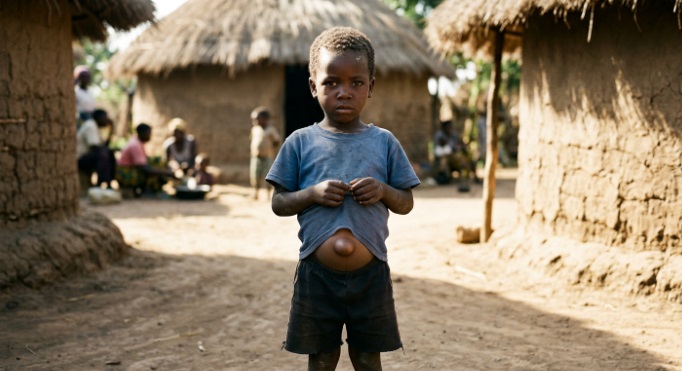
Photo of an African male child with a bulging umbilical hernia, standing in an rustic village courtyard facing the camera. A blurry image of his relatives, including adults and children who are mostly sitting, is seen in the background to the child's right. Click on image to enlarge.
Have you ever noticed a baby or young child whose belly button (navel) seems to stick out more than usual, especially after feeding, crying, or laughing? Many people simply call it a "big navel." Some children outgrow it as they get older, while others do not.
You may even know families where several children have had the same protruding belly button, causing people to believe it "runs in the family."
What many people don't realise is that some of these "big navels" may actually be umbilical hernias, one of the most common types of hernia in children. But hernias are not limited to babies or the belly button. They can affect people of all ages and occur in different parts of the body.
You are probably wondering, "How can I tell whether a lump or bulge is a hernia or something else, and what causes it?"
This article answers these questions and more:
A hernia is defined as the bulging of an organ or tissue through a weak spot or opening in the muscle or connective tissue that normally holds it in place.
Think of the muscles and connective tissues that support and keep your organs in their proper place as a strong protective barrier. If part of this barrier becomes weak or develops an opening, pressure from inside the body can cause an organ or tissue to push through, forming a hernia.
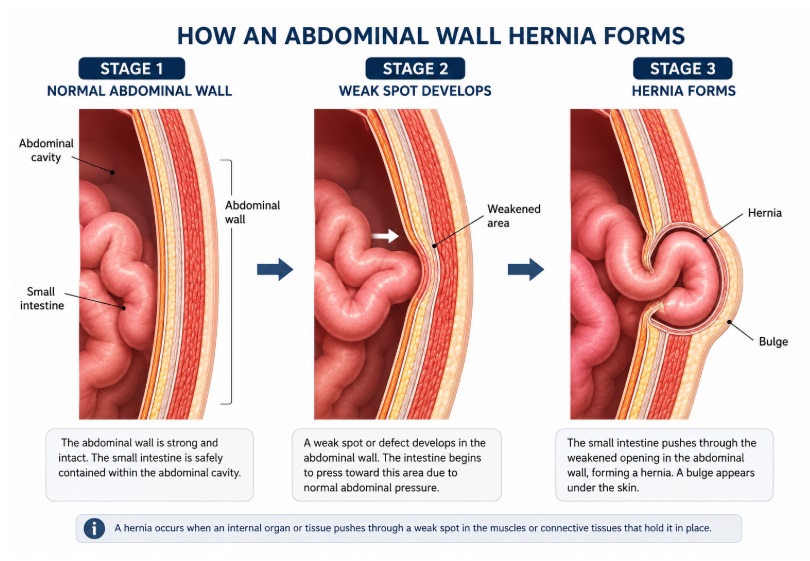
Infographic illustration showing three panels in which a small intestine loop progresses from being contained within the abdominal cavity, to pressing against a weakened abdominal wall, to protruding through the defect and forming an abdominal hernia bulge. Click on image to emlarge.
In the abdomen (belly), where most hernias occur, this barrier is known as the abdominal wall. Here, part of the intestine or abdominal fat can protrude through a weakened area of the abdominal wall, particularly around the groin, navel )or belly button), or a previous surgical scar. This creates a noticeable bulge beneath the skin, which often becomes more noticeable when you strain, cough, lift heavy objects, or stand for a long time.
Hernias can also occur through the diaphragm or, less commonly, inside the abdominal cavity itself, and in both cases, they do not produce any noticeable bulge.
Hernias can occur at birth (congenital) because an opening that should have closed before birth remains open. It can also develop later in life (acquired) after years of repeated strain on the abdominal wall.
Although hernias occur worldwide, they pose a significant health challenge in many African countries. In high-income nations, most hernias are repaired soon after diagnosis. In contrast, poor health-seeking behaviour and limited access to affordable surgical care mean that many people in sub-Saharan Africa live with untreated hernias for years, increasing their risk of pain, disability, and life-threatening complications.
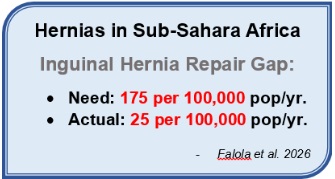
Infographic showing inguinal hernia repair gap in sub-Saharan Africa.
The problem is not just the number of people affected but also the large gap between those who need surgery and those who receive it. In many parts of sub-Saharan Africa, an estimated 175 inguinal hernia repairs are needed per 100,000 people each year, yet only about 25 repairs are performed, leaving a substantial backlog of untreated cases [1].
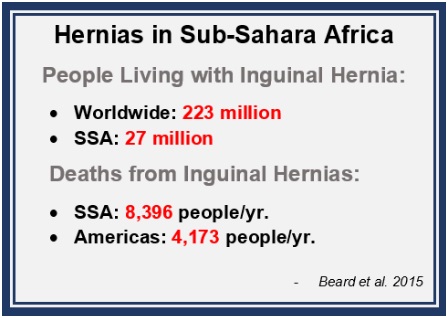
Infographic showing comparative burden of and crude death rates from inguinal hernia in sub-Saharan Africa. Click on image to enlarge.
The burden becomes even more apparent when death rates are considered. According to Beard and colleagues, an estimated 223 million people worldwide live with inguinal hernias, including about 22.7 million in Africa. Although Africa has fewer cases than some regions, such as the Americas, where an estimated 28.2 million people are affected, it records far more deaths from the condition. Each year, approximately 8,396 people die from inguinal hernias in Africa, compared with 4,173 deaths in the Americas [2]. In other words, Africa experiences about twice as many deaths despite having fewer people living with the condition.
So, it is either that Africa is facing challenges with diagnosing and treating inguinal hernia, or more people are living with the condition than the record says.
The burden is also increasing. A Global Burden of Disease study covering 204 countries found that the number of people living with inguinal, femoral, and abdominal hernias rose by 36% between 1990 and 2019. While age-standardised rates declined in most parts of the world, central Sub-Saharan Africa was one of the few regions where both incidence (new cases only) and prevalence (total number of cases—old and new) continued to rise, with the greatest burden seen among men, older adults, and people living in low- and middle-income countries [3].
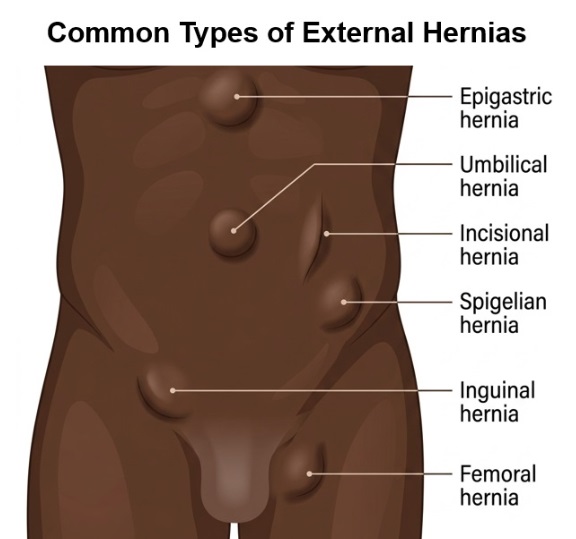
An illustration of a dark-skinned male torso showing the locations of six different external hernias bulging from the abdomen and groin. Click on image to enlarge.
Hernias are primarily classified by their:
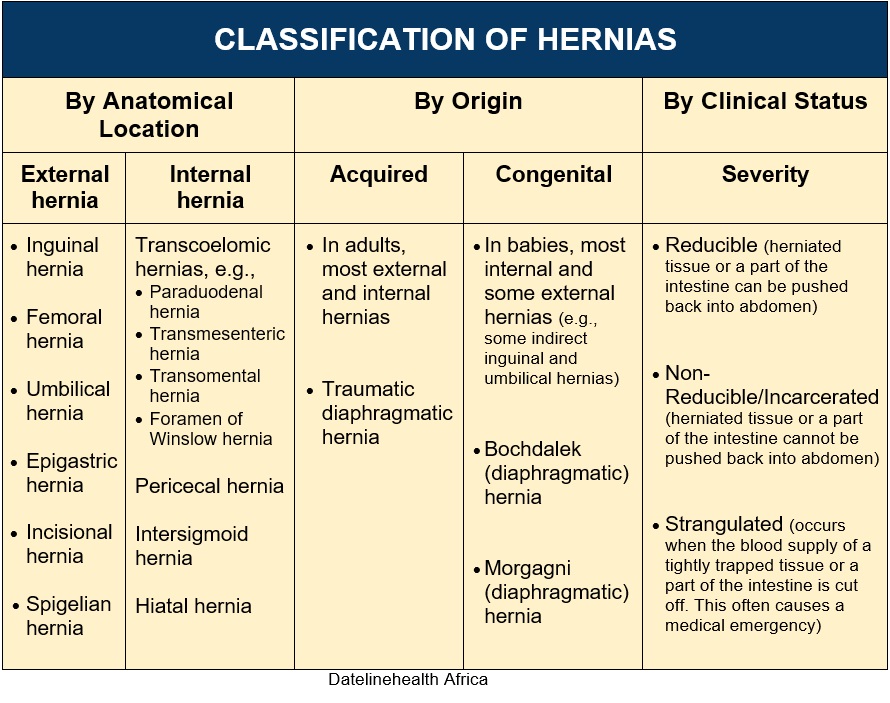
Table showing types of hernia classified (for professionals) by their anatomical location, origin and clinical status. Click on image to enlarge.
An external hernia occurs when an organ or tissue pushes through the abdominal wall, creating a bulge that can usually be seen or felt beneath the skin. These are by far the most common type of hernia.
The common types of external hernias include:
1. Inguinal hernia
An inguinal hernia (or groin hernia) develops in the groin and is the most common type of hernia worldwide, including in Africa. It occurs when part of the intestine or abdominal fat protrudes through a weak area in the inguinal canal.
More than 20 million groin hernia repairs are performed globally every year [4]. Men are far more likely than women to develop this type because of natural differences in the anatomy of the groin [4].
If left untreated, an inguinal hernia may enlarge and extend into the scrotum. This is known as an inguinoscrotal hernia.
There are two subtypes of inguinal hernia:
A femoral hernia occurs just below the groin, where tissue passes through the femoral canal. Although it is much less common than an inguinal hernia, it is more likely to become trapped or strangulated because the opening is narrow. Femoral hernias occur more frequently in women, particularly older women.
3. Umbilical hernia
An umbilical hernia forms near the belly button (navel). It is common in infants because the opening through which the umbilical cord passed may not have fully closed after birth.
Adults can also develop umbilical hernias, especially after pregnancy, obesity, repeated abdominal strain or the accumulation of fluid in the abdomen (ascites).
In children, more than 90% of umbilical hernias close on their own without treatment [5]. As a result, healthcare providers recommend monitoring uncomplicated, symptom-free cases rather than operating immediately, since most close naturally by the age of 4 to 5 years [5].
4. Epigastric hernia
This type develops in the upper middle part of the abdomen, between the breastbone and the belly button. It usually contains fatty tissue rather than intestine and often appears as a small lump that becomes more noticeable when coughing or straining.
An incisional hernia develops through the scar of a previous abdominal operation. Although surgery closes the muscles carefully, the healed area is never quite as strong as the original tissue. Over time, the scar may weaken, allowing abdominal contents to protrude.
The risk is higher in people who develop wound infections after surgery, smoke, are obese, or have conditions that impair wound healing.
Unlike external hernias, internal hernias do not produce a visible lump beneath the skin. Instead, part of the intestine slips through an opening inside the abdominal cavity.
Although relatively uncommon, internal hernias can obstruct the bowel or cut off its blood supply, making them a surgical emergency. Majority often occur after certain abdominal operations, such as gastric bypass surgery, or in people born with uncommon internal defects. One group of internal hernias are collectively called Transcelomic Hernias
A. Transcelomic Hernias include:
Paraduodenal simply means "beside the duodenum." Part of the small intestine pushes through an abnormal opening near the duodenum, a section of the small intestine.
Part of the small intestine pushes through a hole in the mesentery, the tissue that holds the intestines in place.
A loop of the small intestine, and less commonly other abdominal structures pushes through an opening in the omentum. The omentum is a layer of fatty tissue that covers and supports the abdominal organs.
Part of the small intestine pushes into an abnormal opening around the caecum, the first part of the large intestine.
Part of the small intestine pushes into an opening near the sigmoid colon, the lower part of the large intestine.
Other Internal hernias include:
There is a natural opening in the diaphragm through which the food pipe (oesophagus) passes as it extends to the stomach. This opening is called the oesophageal hiatus. When the muscle surrounding the oesophageal hiatus becomes weak, it can cause the upper stomach to bulge upward into the chest, resulting in a hiatal hernia.
A hiatal hernia does not cause a visible bulge. Its common symptoms are heartburn, acid reflux, chest discomfort, and difficulty swallowing.
C. Diaphragmatic hernia
A diaphragmatic hernia occurs when there is an opening or weak spot in the diaphragm (the large muscle separating the chest and abdomen), allowing organs such as the stomach or intestines to move up into the chest cavity. A common example of this is the hiatal hernia, which is often acquired.
Other types of diaphragmatic hernia include:
Part of an abdominal organ pushes into the chest through a weak or incomplete area in the back and side of the diaphragm. It is usually present from birth.
This is also present at birth. Part of an abdominal organ pushes into the chest through a weak area at the front of the diaphragm.
Part of an abdominal organ pushes into the chest through a tear in the diaphragm caused by an injury.
A hernia develops when two things happen together:
Neither factor alone is usually enough. It is the combination that leads to a hernia.
Some people are born with naturally weaker areas in the abdominal wall. In others, muscles weaken gradually with age, previous surgery, injury or certain inherited connective tissue disorders.
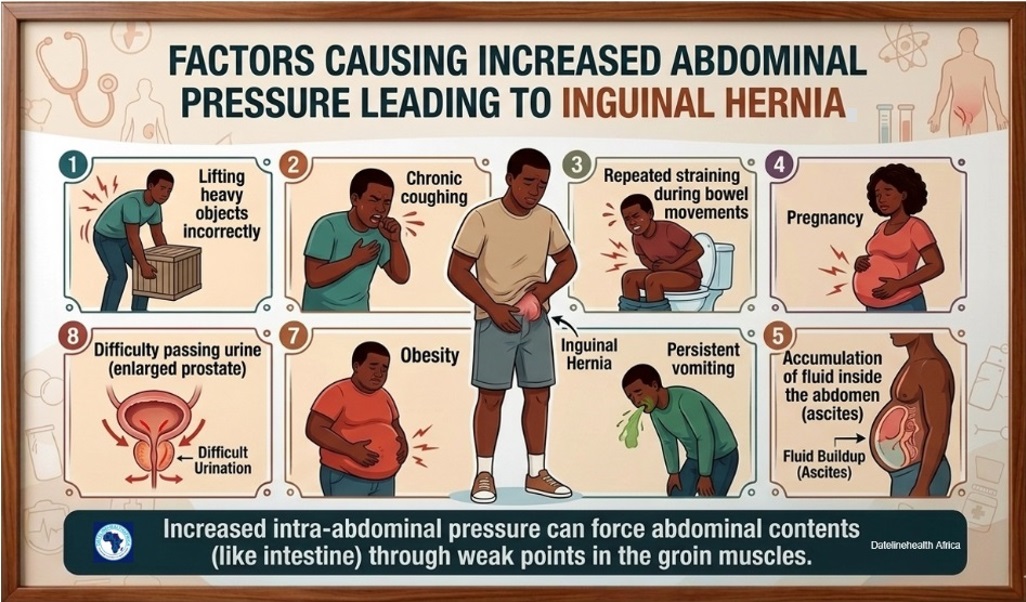
Factors causing increased intra-abdominal pressure leading to inguinal hernia. AI generated from Gemini. Click on image to enlarge.
Anything that repeatedly increases pressure inside the abdomen can contribute to the formation of a hernia. Examples include:

An infographic titled “Risk Factors of Hernia,” showing 11 illustrated risk factors. Image credit: AI-generated from ChatGPT. Click on image to enlarge.
While anyone can develop a hernia, certain factors, including those earlier described as causing an increase in intra-abdominal pressure, make some people more likely than others to develop the condition.
As people grow older, muscles and connective tissues naturally lose strength and elasticity. This partly explains why many adult hernias become more common with increasing age.
Men are several times more likely than women to develop inguinal hernias because the inguinal canal is naturally larger and contains structures that descended before birth. Lifetime risk is estimated to be around 27% in men compared with approximately 3% in women [4].
Research suggests that family history is a significant risk factor for certain hernias, like the inguinal hernia [6]. Having a close relative with this hernia increases your own likelihood of developing one.
Every abdominal operation leaves behind a scar. Although most scars heal well, they remain slightly weaker than the surrounding tissue, increasing the risk of an incisional hernia.
Excess body weight increases pressure inside the abdomen while also making surgery and wound healing more difficult.
Pregnancy stretches the abdominal muscles and temporarily increases pressure inside the abdomen. Women who have had multiple pregnancies are at greater risk of certain types of hernias, especially umbilical hernias.
Persistent coughing from asthma, chronic obstructive pulmonary disease (COPD), smoking or untreated respiratory infections repeatedly increases abdominal pressure.
Frequently straining during bowel movements places repeated stress on the abdominal wall over many years.
Men who strain repeatedly to urinate because of benign enlargement of the prostate may also increase their risk of developing a hernia.
Smoking damages collagen, the protein that gives connective tissue much of its strength. Smokers are therefore more likely to develop hernias and to experience recurrence after surgical repair because smoking also delays wound healing.
Inherited conditions that affect collagen production, such as certain forms of Ehlers-Danlos syndrome, can weaken supporting tissues throughout the body, making hernias more likely.
The symptoms of a hernia vary depending on its size, location and whether complications have developed. Some people notice only a small painless swelling, while others experience significant discomfort.
Some small hernias cause no symptoms and may only be discovered during a routine medical examination.
A hernia becomes an emergency if it becomes incarcerated (trapped) or strangulated (its blood supply is cut off).
Seek urgent medical care if you develop:
Diagnosing a hernia usually involves a thorough medical history and physical examination. Imaging tests may also be necessary when the diagnosis is uncertain, the hernia is small or hidden, or complications are suspected. The choice of imaging test depends on the type of hernia suspected, its location, and the patient's symptoms.
Your healthcare provider will first ask about your symptoms and medical history, which may include, but are not limited to:
This information helps distinguish a hernia from other conditions that can cause lumps in the abdomen or groin.
Your healthcare provider may ask you to:
These actions temporarily increase pressure inside the abdomen, making a hernia easier to detect.
If there is a swelling, the clinician will examine it to determine:
Surgery remains the only definitive cure for a hernia. No medication, exercise, or herbal remedies can permanently close the underlying weak spot, although a truss (hernia belt) can sometimes offer temporary symptom relief while awaiting surgery.
Not every hernia requires immediate surgery. For some adults with small inguinal hernias that cause minimal to no symptoms, careful observation, known as watchful waiting, may be an appropriate option.
During this period, your health care provider will monitor you regularly and advise you to seek medical attention if:
Most people on watchful waiting eventually opt for surgery because symptoms (especially pain) gradually worsen over time [7].
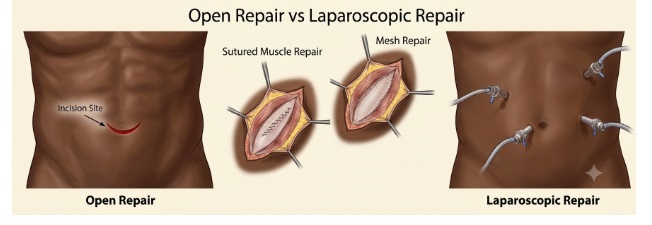
An illustration comparing open umbilical hernia repair, which shows an incision, to laparoscopic repair, which shows multiple instrument port insertion points, and featuring muscle and mesh suturing in between. Image credit: AI-generated from Gemini. Click on image to enlarge.
The goal of surgery is to push the protruding tissue back into the abdominal cavity and repair the weakened muscle or connective tissue. There are two main approaches.
In open surgery, the surgeon makes a single incision directly over the hernia. The protruding tissue is returned to the abdomen before the weakened area is repaired by suturing the edges of the muscle together or by placing a surgical mesh to reinforce the area.
Laparoscopic surgery uses several very small incisions instead of one larger incision. A tiny camera and specialised instruments are inserted into the abdomen, allowing the surgeon to repair the hernia from inside. A mesh can also be used for this procedure.
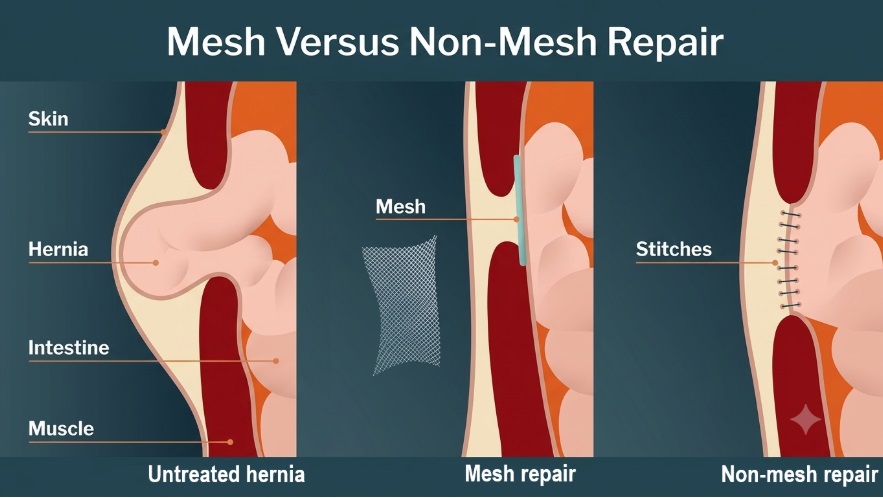
A three-panel illustration comparing a hernia with two types of surgical repairs: a mesh repair showing an internal patch and a non-mesh repair showing stitches, all set against a dark teal background. Image credit: AI=generated from Gemini. Click on iamge to enlarge.
A surgical mesh is a sterile, flexible sheet made from synthetic or biological materials, and is used to strengthen weak or damaged tissue. During hernia surgery, it is placed over or behind the weakened area of the abdominal wall. The body's own tissue then gradually grows into it, creating a stronger and more durable repair.
For most adult inguinal hernias, surgeons usually reinforce the repair with a surgical mesh rather than stitching the weakened tissue together alone.
By reinforcing the weakened area without placing tension on the surrounding tissues, mesh repair significantly reduces the risk of the hernia coming back compared with traditional non-mesh repairs.
The cost of commercial mesh has been a barrier to the mesh technique in resource-limited settings like in sub-Saharan Africa. However, studies have shown that low-cost mesh alternatives, such as sterilised mosquito nets, can be safe and effective, with no significant differences in recurrence or wound complications compared to commercial mesh [8].
Some hernias remain relatively unchanged for months or even years. However, there is no way to predict which hernia will suddenly become dangerous. Leaving a hernia untreated can result in several serious complications.
Most hernias gradually increase in size over time. As they enlarge, they often become more uncomfortable, more noticeable, and more difficult to repair.
Initially, many hernias cause little or no pain. Over time, you may start to experience increased pain, especially during physical activities or after prolonged standing. Pain often becomes more frequent as the hernia enlarges.
An incarcerated hernia occurs when the protruding tissue becomes trapped outside the abdominal wall and cannot be pushed back in. This can cause: persistent pain, nausea, vomiting, bowel obstruction, and increasing swelling. Incarceration requires urgent medical assessment because it can progress to strangulation.
Strangulation is the most serious complication of a hernia. It occurs when the blood supply to the trapped intestine is cut off. It is a medical emergency requiring immediate surgery. Without treatment, the affected bowel or tissue can die within hours, which may lead to infection, sepsis, and potentially death.

An AI generated infographic titled “How to Prevent Hernia” showing six prevention habits. Credit: ChatGPT. Click on image to enlarge.
While not all hernias can be prevented, especially those from congenital weaknesses, you can significantly reduce your risk by modifying lifestyle factors that increase pressure within the abdomen.
Hernias are common but treatable conditions that occur when an organ or tissue pushes through a weak spot in the muscle or connective tissue. It occurs around the world, but the burden is high in Africa, where poor health-seeking behaviour and limited access to timely surgical care often lead to delayed treatment and avoidable complications.
Knowing the different types of hernias, their causes, symptoms, and risk factors can help you recognise the condition early and seek appropriate care. Although healthy lifestyle habits may reduce your risk, surgery remains the only definitive treatment for most hernias.
If you notice a persistent lump in your groin, abdomen, or around your belly button, don't ignore it or rely on home remedies. Getting evaluated early can prevent serious complications and make treatment safer and more effective.
Babies develop umbilical hernias when the opening in the abdominal wall where the umbilical cord passed before birth doesn't close completely after delivery. This leaves a small gap that allows part of the intestine or fatty tissue to bulge through. Most umbilical hernias close on their own by the time a child is 4–5 years old.
Yes. Some hernias can move or bulge in and out of the abdominal wall, particularly in their early stages. The bulge may become more noticeable when you stand, cough, strain or lift something and may disappear when you lie down or gently press it back in. This is called a reducible hernia.
A hernia does not directly cause weight loss. However, a co-occuring or underlying medical condtion, like tubercolosis with chronic cough, or a large or complicated hernia may reduce your appetite or make eating uncomfortable, leading to weight loss.
1. Falola A, Satea M, Guillen PV, Oviedo RJ. Robotic and laparoscopic inguinal hernia repair in Africa: current adoption, challenges, and future horizons. J Abdom Wall Surg. 2026;5:14775. doi:10.3389/jaws.2026.14775. Available from here.
2. Beard JH, Ohene-Yeboah M, deVries CR, Schecter WP. Hernia and hydrocele. In: Debas HT, Donkor P, Gawande A, Jamison DT, Kruk ME, Mock CN, editors. Essential surgery: Disease Control Priorities. 3rd ed. Vol. 1. Washington (DC): The International Bank for Reconstruction and Development/The World Bank; 2015. p. 181-190. doi:10.1596/978-1-4648-0346-8_ch9. Available from here.
3. Ma Q, Jing W, Liu X, Liu J, Liu M, Chen J. The global, regional, and national burden and its trends of inguinal, femoral, and abdominal hernia from 1990 to 2019: findings from the 2019 Global Burden of Disease Study—a cross-sectional study. Int J Surg. 2023;109(3):333-342. doi:10.1097/JS9.0000000000000217. Available from here.
4. HerniaSurge Group. International guidelines for groin hernia management. Hernia. 2018;22(1):1-165. doi:10.1007/s10029-017-1668-x. Available from here.
5. Troullioud Lucas AG, Bamarni S, Panda SK, et al. Pediatric umbilical hernia. [Updated 2023 Nov 18]. In: StatPearls [Internet]. Treasure Island (FL): StatPearls Publishing; 2026 Jan– [cited 2026 July 30]. Available from here.
6. Öberg S, Sæter AH, Rosenberg J. The inheritance of groin hernias: an updated systematic review with meta-analyses. Hernia. 2023;27(6):1339-1350. doi:10.1007/s10029-022-02718-3. Available from here.
7. Gong W, Li J. Operation versus watchful waiting in asymptomatic or minimally symptomatic inguinal hernias: the meta-analysis results of randomized controlled trials. Int J Surg. 2018;52:120-125. doi:10.1016/j.ijsu.2018.02.030. Available from here.
8. Löfgren J, Nordin P, Ibingira C, Matovu A, Galiwango E, Wladis A. A randomized trial of low-cost mesh in groin hernia repair. N Engl J Med. 2016;374(2):146-153. doi:10.1056/NEJMoa1505126. Available from here.
Related:
Intestinal Obstruction in African Adults
What Africans Need To Know About Cough
Published: October 5, 2026
© 2026. Datelinehealth Africa Inc. All rights reserved.
Permission is given to copy, use and share content freely for non-commercial purposes without alteration or modification and subject to source attribution
DATELINEHEALTH AFRICA INC., is a digital publisher for informational and educational purposes and does not offer personal medical care and advice. If you have a medical problem needing routine or emergency attention, call your doctor or local emergency services immediately, or visit the nearest emergency room or the nearest hospital. You should consult your professional healthcare provider before starting any nutrition, diet, exercise, fitness, medical or wellness program mentioned or referenced in the DatelinehealthAfrica website. Click here for more disclaimer notice.