9 Lifesaving Vaccines Every Nigerian Parent Should Know
By Helen Ohunene Otailku, B.Sc., Health Education, Freelance Health Writer. Medically reviewed by KT Craig. MBBS, MScPH
October 6, 2026
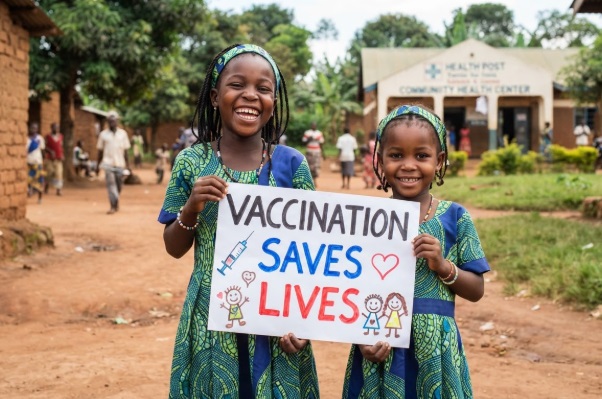
Two young and smiley African girls standing on the grounds of a rural village and holding a poster saying “Vaccination Saves Lives”. In the background is a white building suggestive of the village dispensary and several people of different ages walking around. Photo Credit: Gemini.
Vaccines are one of modern medicine's simplest and most powerful defenses.
A vaccine is a biological preparation that contains a weakened version of a germ, or just a piece of it, which produces active protection against a specific infectious disease.
When a child gets infected with a germ, it takes the body about 7 to 14 days to build a strong immune response against it, during this time the child gets sick. With a vaccine, however, the immune system responds in just hours or days, neutralizing the threat before symptoms even appear.
For Nigerian parents, this means protection against diseases that once killed or disabled thousands of children every year. Effective vaccination can be achieved through a few visits to the nearest public primary health centre (PHC).
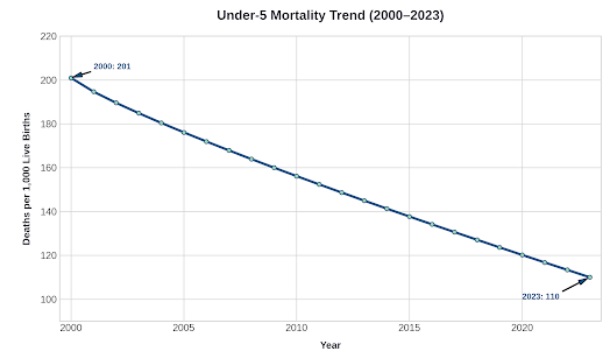
Line chart illustrating the downward trend in under-5 mortality from 2000 to 2023. Click on image to enlarge.
Over the years, the 0-5 years mortality fell from 201 deaths in every 1000 newborns in 2000 to 110 in every 1000 in 2023 [1]. Even so, an estimated 850,000 Nigerian newborns and under-5s still die every year from largely preventable causes [1].
Childhood vaccines are among the simplest tools available for closing the prevention gap.
When enough children in a community are vaccinated, the disease struggles to spread, thereby protecting even babies too young to be vaccinated (herd immunity).
The National Primary Health Care Development Agency (NPHCDA) coordinates Nigeria's Routine Immunization (RI) schedule, delivered free at public health centres from birth through 15 months.
Related: Beyond Hesitancy: Overcoming Barriers to Vaccination in Nigeria
Now, let's look at nine vaccines that are quietly transforming child survival across Nigeria.
.jpg)
Table showing an adapted NPHCDA Routine Immunization Schedule. Click on image to enlarge.
BCG (Bacille Calmette-Guérin) is given at birth to protect against tuberculosis (TB), a bacterial infection that mostly affects the lungs but can also spread to the brain in young children.
It’s especially good at preventing the most severe, life-threatening forms of TB in infants, including TB meningitis.
Its protection is reported to be over 80% against severe disease such as TB meningitis in young children, and BCG is best given at birth, up to 11 months before the child is exposed to the TB bacteria [2].
That’s why it’s one of the very first vaccines on the schedule.
Thousands of Nigerian children were once polio-paralyzed.
In August 2020, the WHO African Regional Certification Commission officially declared Nigeria and the entire WHO African Region free of wild poliovirus, after four years without a single case [3].
Since 1996, 180,000 lives and 1.8 million cases of lifelong paralysis have been prevented across Africa through polio vaccination [3].
The fight is not over.
Rare outbreaks of circulating vaccine-derived poliovirus type 2 (cVDPV2), a virus type that can re-emerge where too many children miss their doses, still occur in parts of Nigeria [4].
That is why Nigerian children still receive oral polio vaccine (OPV) drops at birth, 6, 10 and 14 weeks, plus an injectable inactivated polio vaccine (IPV) dose at 14 weeks [5].
The hepatitis B birth dose is given within the first 24 hours of life to inactivate any virus that may have passed from mother to child during delivery, or from other household members in the first weeks of life.
A timely dose given within 24 hours, followed by the later doses in the routine schedule, offers 100% protection against the virus [6].
This matters because babies infected with hepatitis B at birth have about a 95% chance of developing a lifelong, chronic infection that can lead to liver damage in adulthood so the timing of this dose is just as important as getting it at all [6].
The Pentavalent vaccine is a single injection that protects against 5 major childhood diseases. [3]. It is given in 3 doses at 6, 10, and 14 weeks. These diseases are as follows [7]:
The pentavalent vaccine, supported in Nigeria by Gavi, the Vaccine Alliance, combines five vaccines into a single shot.
This means fewer injections, clinic visits and faster protection against some of the biggest killers of children under five [7].
Pneumonia is Nigeria's single biggest killer of children under 5, claiming around 177,000 young lives every year about 16% of all under-5 deaths [8].
Nigeria introduced the pneumococcal conjugate vaccine (PCV) in December 2014, rolling it out nationwide by 2016 [8].
A study across three teaching hospitals (University College Hospital (UCH), Ibadan; National Hospital (NH), Abuja; and Federal Teaching Hospital (FTH), Gombe) found that both hospitalised pneumonia cases and death rates fell after 3 years of PCV introduction, with the drop in case fatality rate statistically significant in Ibadan [9].
Nationally, deaths from pneumonia and related lung infections fell from about 480 in every 100,000 children in 2014 to 386 in every 100,000 by 2019 [10].
PCV is given in three doses, at 6, 10 and 14 weeks.
According to UNICEF and WHO data, as at 2022, Nigeria achieved 60% coverage with the final dose of the PCV vaccine.
Diarrhoea is the third leading cause of death among Nigerian children under five. Rotavirus is the most common cause of severe diarrhoea in young children worldwide. Responsible for around 50,000 of those deaths every year, giving Nigeria the world's second-highest rotavirus death toll [11].
In August 2022, National Primary Health Care Development Agency (NPHCDA), working with WHO, UNICEF, and Gavi, introduced the rotavirus vaccine into Nigeria's free Routine Immunization schedule, given as oral drops at 6, 10 and 14 weeks alongside other vaccines [12].
Health officials project it could avert over 110,000 child deaths over its first decade in use [11].
Measles spreads extremely fast, and in malnourished children it can trigger severe complications, including pneumonia, dehydration and blindness [12].
Nigeria has struggled with measles coverage for years; in past outbreaks, barely half of eligible children had been reached with the vaccine. A 2016 outbreak in the north-east alone recorded around 25,000 cases and at least 100 child deaths [12].
Globally, measles vaccination prevented an estimated 20.3 million deaths between 2000 and 2015 alone [12].
In Nigeria's schedule, children receive their first measles dose at 9 months, alongside yellow fever and meningitis A vaccines, and a second dose at 15 months.
Given at 9 months, the yellow fever vaccine protects against a mosquito-borne viral disease that can cause severe illness, bleeding and jaundice.
The good news for parents: a single dose is effective and gives lifelong immunity in most people [13].
So, unlike some other vaccines, there’s no booster to keep track of later in childhood.
Meningitis A protects against a bacterial infection of the lining around the brain and spinal cord, one that can kill or cause permanent brain damage within hours if untreated.
Since the vaccine (MenAfriVac) was rolled into routine immunisation, it has brought Africa close to eliminating meningitis A, with cases in the meningitis belt falling from tens of thousands to just a handful a year [14].
All nine vaccines, and the rest of Nigeria's Routine Immunization schedule, are available free of charge at public health centres nationwide.
Every child should have an immunization card recording each dose received; parents should keep this card safe and bring it to every clinic visit.
If your child has missed a dose or fallen behind schedule, do not worry. The Primary health center staff can arrange catch-up vaccination. It is never too late to start protecting your child.
Together, BCG, OPV, hepatitis B, pentavalent, PCV, rotavirus, measles, yellow fever, and meningitis A vaccines have helped prevent hundreds of thousands of child deaths in Nigeria and continue to do so every day.
They are safe, thoroughly tested, and free at government health facilities across the country. If you are unsure whether your child's vaccines are up to date, check their immunization card today or visit your nearest PHC to ask.
Share this article with another parent or caregiver. The more Nigerian children are fully vaccinated, the safer every child is.
1. Ileyemi M. 850,000 Nigerian children die yearly from preventable causes; Health Minister. [Internet] 2025, November 13. Premium Times. [Cited 2026 Sep 25]. Available from here.
2. Puvaci? S, Dizdarevi? J, Santi? Z, Mulaomerovi? M. Protective effect of neonatal BCG vaccines against tuberculous meningitis. Bosnian Journal of Basic Medical Sciences, 2004;4(1), 46–49. Abstract available here.
3. World Health Organization Regional Office for Africa. Polio – We have won a battle, but the war is still on – Professor Tomori [Internet]. 2021 Sep 11. [Cited 2026 Sep 25]. Available from here.
4. Nigeria Health Watch. Maintaining Nigeria's wild poliovirus-free status: a critical step for long life for all [Internet]. 2022 Apr 27. [Cited 2026 Sep 25]. Available from here.
5. Ciapponi A, Bardach A, Rey Ares L, Glujovsky D, Cafferata ML, Cesaroni S, & Bhatti A. Sequential inactivated (IPV) and live oral (OPV) poliovirus vaccines for preventing poliomyelitis. The Cochrane database of systematic reviews, 2019;12(12), CD011260. Available from here.
6. World Health Organization. Hepatitis b. [Internet]. 29 September 2026. [Cited 2026 Sep. 28], Available from here
7. Gavi, the Vaccine Alliance. Pentavalent vaccine support [Internet. n.d.]. [Cited 2026 Sep 25]. Available from here.
8. World Health Organization Regional Office for Africa. Nigeria introduces new vaccine – PCV 10 [Internet]. 2014 Dec. [Cited 2026 Sep 25]. Available from here.
9. Iliya J, Shatima DR, Tagbo BN, Ayede AI, Fagbohun AO, Rasaq A, et al. Pneumonia hospitalizations and mortality in children 3–24-month-old in Nigeria from 2013 to 2020: Impact of pneumococcal conjugate vaccine ten valent (PHiD-CV-10). Hum Vaccin Immunother. 2023;19(1):2162289. Available from here.
10. Gavi, the Vaccine Alliance. The fight against pneumonia in five charts [Internet]. [Cited 2026 Sep 25]. Available from here.
11. World Health Organization Regional Office for Africa. Nigeria to avert 50,000 deaths in children annually, introduces rotavirus vaccine into vaccination schedule [Internet]. 2022 Aug 22. [Cited 2026 Sep 25]. Available from here.
12. World Health Organization. Millions of children to receive measles vaccine in north-eastern Nigeria [Internet]. 2017 Jan 16. [Cited 2026 Sep 25]. Available from here.
13. World Health Organization. Yellow fever vaccines. [Internet, n.d.]. Accessed September 29, 2026. Available from here.
14. Gavi. VaccinesWork. How Africa defeated meningitis A. [Internet]. 5 October. 2023. [Cited 2026 Sep 25]. Available from here.
Related:
Published: October 6, 2026
© 2026. Datelinehealth Africa Inc. All rights reserved.
Permission is given to copy, use, and share content freely for non-commercial purposes without alteration or modification and subject to attribution as to source.
DATELINEHEALTH AFRICA INC., is a digital publisher for informational and educational purposes and does not offer personal medical care and advice. If you have a medical problem needing routine or emergency attention, call your doctor or local emergency services immediately, or visit the nearest emergency room or the nearest hospital. You should consult your professional healthcare provider before starting any nutrition, diet, exercise, fitness, medical or wellness program mentioned or referenced in the DatelinehealthAfrica website. Click here for more disclaimer notice.