The Effect of Alcohol on Male Fertility in Africans: An Overview
By: Kelechi Nwaowu, RN, RM. Freelance Medical Writer. Medically reviewed by: Esther A. Odekina, MB.BS.
May 22, 2026

An African man sitting across from a doctor in a clinic, looking concerned during a consultation. Image credit: Freepik. Click on image to enlarge.
Picture two friends, Emeka and Olaniyi, who are both married and trying to conceive. Emeka, like some men, is the kind you'd call a social drinker. He makes it a point to drink at least 3 bottles of beer at every gathering.
Olaniyi, on the other hand, stopped drinking two years ago out of concern for his health. Within eight months of trying, Olaniyi’s wife got pregnant, while Emeka had been trying for over a year with no success.
Alcohol-related infertility is not exactly the first thing that comes to mind when a couple is trying to conceive, but research indicates that it should be highly considered. Many men across Africa have no idea that what they drink may damage their reproductive health.
The World Health Organization (WHO) identifies excessive alcohol intake as a key lifestyle factor that affects fertility, contributing to a worldwide prevalence where 1 in 6 people are affected by infertility (1). Despite this reality, the connection between alcohol and male fertility remains largely undiscussed in most African communities.
This article will walk you through how alcohol affects male fertility, showcase the facts, and explain what men can do to achieve good reproductive health.
To understand how alcohol damages male fertility, it helps first to understand what healthy male fertility looks like, which includes how sperm is made, and what makes sperm healthy. These two factors form the foundation of everything that follows in this article.
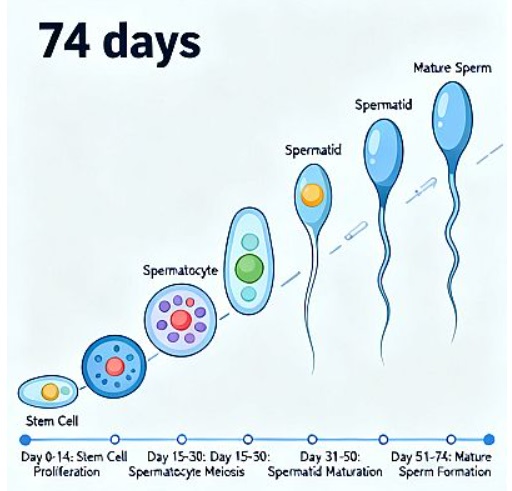
Diagram showing the stages of sperm production from the stem cell to the mature sperm cell over 74 days. Image credit: Freepik. Click on image to enlarge.
Sperm is always being produced inside the testicles (the two oval-shaped organs in the scrotum responsible for producing sperm and testosterone). The process by which the testicles produce new sperm cells is called spermatogenesis. In an average man, it takes approximately 74 days to produce an individual mature sperm cell (2).
This means that the sperm produced today is a reflection of the lifestyle choices that were made about two and a half months ago. Every drink, every cigarette, every good or bad decision in those past 74 days has a direct influence on the quality of his current sperm.
The health of a sperm is assessed using three main criteria (3).
Other factors, such as volume and thickness of sperm, can affect fertility.
When any of these criteria fall below the healthy baseline, infertility may occur.

A group of African men socialising with drinks at an outdoor gathering. Image credit: Gemini AI. Click on image to enlarge.
“The most common drinking pattern in sub-Saharan Africa is heavy episodic use; that is, consuming 60 or more grams of pure alcohol on at least one occasion per month”
Across Africa, alcohol is part of everyday social life. For instance, in Nigeria, drinks flow freely at naming ceremonies, weddings, and community celebrations. Palm wine is shared as a gesture of hospitality in many communities. Locally brewed spirits like Ogogoro (a potent spirit distilled from raffia palm sap, commonly consumed in southern Nigeria) and Burukutu (a fermented drink brewed from sorghum or millet, popular in northern Nigeria and parts of West Africa) are widely available and affordable.
According to a review published in the International Journal of Environmental Research and Public Health, the most common drinking pattern in sub-Saharan Africa is heavy episodic use, which is consuming 60 or more grams of pure alcohol on at least one occasion per month (4). This pattern carries a particularly high risk for reproductive and general health harm in men.
Beyond social drinking, a growing number of young African men are developing alcohol use disorder (a medical condition in which a person is unable to control how much they drink, even when it causes harm to their health, relationships, or daily life).
A 2024 massive review of 141 studies from across sub-Saharan Africa found that nearly 1 in 10 adults (9.5%) struggled with alcohol use disorders over the past year (5). The study also noted that being male was one of the biggest risk factors for developing this disorder.
For men in this group, the impact of alcohol on fertility is not just occasional; it is continuous and accumulates over time.
Alcohol harms male fertility through several biological pathways, such that it doesn't simply cause a single problem, but affects the following:
This section explains these pathways in detail.
1. Reduced Sperm Count and Quality
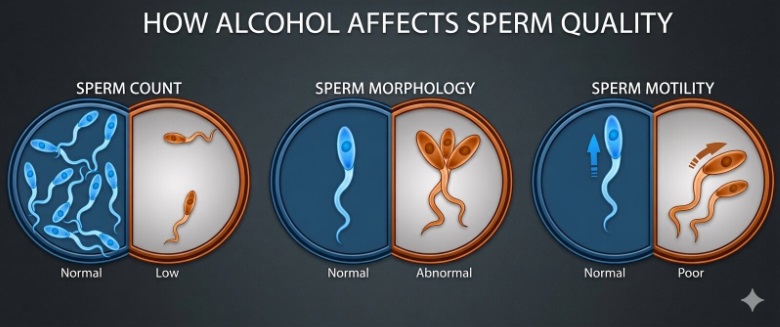
Side-by-side comparison infographic showing healthy sperm versus alcohol-damaged sperm. Image credit: Gemini AI. Click on image to enlarge.
Alcohol is broken down in the body into a substance called acetaldehyde (a toxic chemical produced during the breakdown of alcohol in the liver) (6). Acetaldehyde is harmful to the cells inside the testicles, particularly the cells responsible for making sperm.
A 2017 study of studies, which covered over 16,000 men, found that drinking alcohol damages sperm quality, specifically the amount of semen and the shape of the sperm (7). These issues were even worse for daily drinkers, who showed much more damage than those who only drink occasionally.
Alcohol interferes with testosterone (the primary male sex hormone, responsible for sperm production, sex drive, and several other male reproductive functions) through multiple pathways operating at the same time.
A combined analysis of research from 2024 found that long-term drinking lowers both total and free testosterone levels in men (8). At the same time, it causes a clear rise in estrogen. While men naturally have small amounts of estrogen, high levels of this hormone can block testosterone production and upset the chemical balance required for healthy reproduction in men.
Alcohol also acts on the pituitary gland (a small gland at the base of the brain that sends hormonal signals to the testicles). This gland normally releases two hormones, namely luteinising hormone (LH) and follicle-stimulating hormone (FSH) that instruct the testicles to produce sperm and testosterone. Chronic alcohol exposure suppresses this signalling pathway, thereby affecting male fertility (6).
It is also worth noting that as a man gets older, hormonal and reproductive changes become more complex. This, too, can have significant effects on fertility.
One of the most serious effects of alcohol on fertility is its impact on the genetic material inside sperm cells. Alcohol increases oxidative stress, which is a process that produces harmful molecules called free radicals that damage cells throughout the body, including sperm cells (6).
This oxidative damage affects the genetic material that carries inherited information from father to child inside sperm, called deoxyribonucleic acid (DNA). Sperm with fragmented or damaged DNA may still fertilise an egg, but the resulting pregnancy carries a higher risk of implantation failure (the fertilised egg may not attach to the womb), miscarriage, or developmental complications in the child.
Alcohol is a central nervous system depressant, meaning that it slows down brain and nerve activity (6). While small amounts may temporarily cause excitation, regular heavy drinking impairs the nerve signals and blood flow needed for an erection.
A 2020 study comparing men with alcohol dependence to a control group of non-drinkers identified a significant gap in sexual health outcomes. More than half of the men (58.6%) who were dependent on alcohol experienced sexual issues, compared to only about one-fifth (18.5%) of the non-drinkers (9).
The most common problems were the ability to sustain and maintain an erection (affecting 7 in 10 men or 70%) and low arousal (affecting 6 in 10 men or 62.8%) (9). When combined with the drop in testosterone mentioned earlier, these issues create a double burden that makes it much harder for a couple to conceive.
5. Other Ways Alcohol Harms Male Reproductive Health
Beyond the direct effects on sperm and hormones, alcohol damages male reproductive health through several additional mechanisms that are less commonly discussed. Understanding these broader effects helps explain why heavy and long-term drinking can cause more severe and more difficult-to-reverse fertility problems.
The liver plays a central role in regulating hormone levels throughout the body. It processes and removes excess hormones, including oestrogen, from the bloodstream. When long-term alcohol consumption damages the liver, this clearance process is impaired, leading to the accumulation of oestrogen (a female hormone) in the affected man (6, 8).
High oestrogen levels in men reduce the male hormone in charge of reproduction (testosterone) and disrupt the hormonal environment needed for sperm production.
Long-term heavy drinking can lead to testicular atrophy, which is a clinical condition where the testes decrease in size due to the progressive loss of sperm-producing and testosterone-producing cells. Research indicates that testicular atrophy is a recognized complication of chronic alcoholism, resulting from sustained oxidative damage to the Leydig and Sertoli cells within the testicular tissue (6).
This reduction in testicular volume directly leads to lower sperm counts and decreased testosterone production. In severe cases, especially where significant structural damage has occurred, these changes may not be fully reversible even after quitting alcohol use.
Drinking alcohol affects much more than just one part of your body; it affects your overall health, which is the foundation for healthy sperm.
(i) Nutrition and weight
Alcohol is high in "empty" calories (foods or drinks that give you a lot of energy but very little nutrients) that can lead to weight gain, and it also prevents your body from absorbing the vitamins and minerals it needs from food. This leaves your body and your reproductive system without the fuel they need to function properly (6).
(ii) Cancer
Alcohol is also classified as a Group 1 carcinogen by the International Agency for Research on Cancer (10). Group 1 is the highest risk category, reserved for substances with the strongest evidence of causing cancer in humans. Regular alcohol consumption has been linked to cancers of the liver, mouth, throat, oesophagus, colon, and breast (10). Cancer, and the aggressive treatments used to fight it, can cause lasting damage to the reproductive system, including reduced sperm production and permanent hormonal disruption. This means that beyond its immediate effects on nutrition and hormone balance, alcohol carries a long-term threat to your fertility and your life.
(iii) Gateway drug
Alcohol is also known as a gateway to other habits that hurt fertility. In many communities, heavy drinking goes hand-in-hand with smoking. This creates a double attack on your health, where the damage from tobacco combines with the harm from alcohol to lower your chances of having a child (4).
(iv) Sleep
Alcohol ruins your sleep and increases stress. Even if it helps you fall asleep faster, it prevents the deep, and “recharging" sleep your body needs. This chronic tiredness and stress can throw your hormones out of balance, making it much harder for your body to produce healthy sperm (8)
(v) Environmental connection
Many men in Africa face environmental risks, such as exposure to pesticides and industrial chemicals in their workplaces. Because alcohol already weakens the body’s natural defenses and disrupts hormonal balance (8), it makes the reproductive system even more vulnerable to these external toxins.
The best results for improving fertility come from addressing all these risks – alcohol, smoking, and environment, at the same time
To understand more about the environmental risk, read: Harmful Chemicals Harming Male Fertility in Africa
Several studies on the effects of alcohol on male fertility have been conducted for decades across multiple continents.
1. Alcohol Damages Sperm Quality and Male Hormone Levels
A 2017 review of 15 studies involving over 16,000 men confirmed that daily drinking clearly damages sperm quality – specifically the amount of semen produced and the shape of the sperm ( 7). Additionally, the 2024 combined data roundup showed that long-term alcohol use leads to a significant drop in both total and free testosterone levels in men (8).
In a 2015 study, male rats exposed to alcohol showed a steady decline in testosterone and sperm health with each additional month of testing (11). This suggests that the longer and more heavily a person drinks, the greater the physical damage. While we cannot always apply animal studies directly to humans, they offer a clear view of how this damage unfolds over time.
Although data specific to Africa is still growing, the biological impact on the body is the same everywhere. However, the type of alcohol often matters; locally brewed spirits in African communities frequently have a much higher alcohol content than commercial drinks. These higher concentrations can potentially speed up and intensify the damage to a man's fertility
There is no officially established "safe" level of alcohol use for men trying to have children. Most fertility specialists advise men not just to avoid heavy drinking, but to cut out alcohol altogether or limit it as much as possible while trying to conceive.
According to the CDC, heavy drinking for men is defined as consuming 15 or more standard drinks per week. One standard drink usually contains 0.6 ounces of pure alcohol, which is typically found in:
?The 2017 review mentioned earlier showed that the most serious damage to fertility happened in daily drinkers (7). While men who only drank occasionally showed very few differences from non-drinkers, researchers found that alcohol reduced the total amount of semen produced, even at lower levels of consumption.
A commonly asked question is whether beer affects fertility differently from spirits and wine. The available evidence suggests that the total quantity of alcohol consumed matters most, not the form in which it is consumed (7).
For instance, spirits and locally brewed drinks like Ogogoro typically contain significantly higher alcohol concentrations per serving. A man consuming two cups of Ogogoro may be ingesting the alcohol equivalent of five or six standard bottles of beer. The form of the drink, therefore, shapes how much alcohol actually enters the body, which ultimately determines the magnitude of reproductive damage.
One of the most important and encouraging aspects of this topic is reversibility. Unlike some health consequences of alcohol, many of its effects on male fertility can be meaningfully reduced and, in some cases, fully corrected with early action. This section explains the recovery timeline and the steps men can take to achieve it.
The good news is that your body has a remarkable ability to heal. Because it takes approximately 74 days for the body to produce an entirely new batch of sperm, a man who stops drinking can see significant improvements in as little as three months.
Medical reports show that even in severe cases where sperm production had completely stopped due to heavy drinking, the situation can turn around. A 2010 case study highlights this: a patient who had stopped producing sperm entirely after years of heavy drinking saw his levels return to completely normal within three months of quitting (12). The researchers noted that this rapid reversal proves how quickly the body can benefit from stopping alcohol, even after long-term use.
However, the extent of recovery depends on the individual's history. Men who have practiced heavy drinking for many years may experience a slower or incomplete recovery if there is lasting hormone disruption or physical damage to the testes. Taking action early offers the best chance for a full recovery of fertility
Beyond quitting alcohol entirely, men can take the following practical steps to support the body’s recovery (13).
Alcohol causes "oxidative stress," which acts like rust on your cells. You can fight this by eating foods rich in antioxidants. These substances act as a shield for your sperm. Tomatoes, dark-green leafy vegetables, citrus fruits, and groundnuts are affordable sources of antioxidants.
Research shows that being overweight can worsen the hormone problems already caused by alcohol. Regular, moderate exercise helps your body maintain a healthy weight and keeps your testosterone levels in balance. However, avoid over-exercising, as extreme physical stress can sometimes have the opposite effect.
Getting enough sleep and staying hydrated are essential for good hormonal health. Your body does most of its repair work while you sleep, and water is needed for keeping every part of the reproductive system functioning properly.
A couple is said to be experiencing infertility when there is failure to achieve pregnancy after 12 months of regular unprotected sexual intercourse (1). At this point, both partners should seek medical evaluation.
For men, the evaluation typically begins with a comprehensive clinical review that includes a history, physical examination, and then semen analysis;
Semen analysis is a laboratory test that measures sperm count, motility, morphology, and other semen characteristics. This is a straightforward, non-invasive test that can identify fertility problems early.
While alcohol is a factor, male infertility has many causes, such as infections, hormonal issues, heat exposure, toxins, genetic disorders, and underlying conditions like diabetes.
The influence of alcohol on male fertility has two parts: the biological and the cultural. The biological issues have already been discussed. But in Africa, both alcohol use and male infertility carry significant social weight, and navigating both requires sensitivity. This section addresses conversations around alcohol and male fertility and how to support men who want to make changes.
In many African communities, infertility is still treated as a woman's burden. When a couple cannot conceive, the woman is typically blamed, but science tells a different story.
Millions of couples across sub-Saharan Africa struggle with infertility, and men are a major part of that equation. A study in southeastern Nigeria revealed that in over 42% of cases, the man was the only reason the couple couldn't conceive – a rate significantly higher than cases where only the woman had fertility issues (25.8%) (14).
Despite this, cultural stigma often stops men from getting tested, leaving the burden on women even when the issue lies with the man. Breaking the silence means acknowledging that infertility is a shared journey. Seeking a medical evaluation is not a sign of weakness, but a responsible act for a man’s health and his family's future.
Related: How to Have Open Conversation on Infertility: Tips for African Couples
Reducing alcohol intake is not always easy, particularly in social environments where drinking is the norm. Men who want to cut down alcohol use can benefit from: choosing non-alcoholic alternatives at social events, being honest with close friends about their goals, and identifying the specific situations in which they drink most heavily.
For men who find it difficult to reduce drinking without support, speaking to a doctor is a good first step. Alcohol use disorder is a medical condition, and it responds well to treatment when approached early.
Alcohol harms male fertility through several well-established biological pathways, such as reducing sperm count and quality, disrupting reproductive hormones, damaging sperm DNA, and impairing sexual function. These effects are dose-dependent and time-dependent, meaning that the more a man drinks, and the longer that pattern continues, the greater the growing damage to his reproductive health.
For African men who live within a culture that normalises heavy drinking, this article is not intended to shame or alarm, but to inform. The body has a remarkable capacity to repair itself when alcohol is reduced or removed, and a man who acts today may see meaningful improvements in sperm quality within three months.
If you have been trying to conceive or if you simply want to maintain good reproductive health, know that it is never too late to make a change, and speaking to a doctor about your alcohol intake is a powerful place to start.
1. World Health Organization. Infertility. Geneva: World Health Organization; Updated 2023 Apr 4; [Cited 2026 Apr 24]. Available from here
2. Kaltsas A, Kyrgiafini MA, Markou E, Koumenis A, Mamuris Z, Dimitriadis F, Zachariou A, Chrisofos M, Sofikitis N. Artificial gametogenesis and in vitro spermatogenesis: emerging strategies for the treatment of male infertility. International Journal of Molecular Sciences. 2025 Jul 30;26(15):7383. Available from here
3. Krausz C, Farnetani G. Clinical interpretation of semen analysis. In Practical Clinical Andrology 2022 Oct 15 (pp. 173-184). Cham: Springer International Publishing. Available from here.
4. Ferreira-Borges C, Parry CD, Babor TF. Harmful use of alcohol: a shadow over sub-Saharan Africa in need of workable solutions. International journal of environmental research and public health. 2017 Apr;14(4):346. Available from here.
5. Belete H, Yimer TM, Dawson D, Espinosa DC, Ambaw F, Connor JP, Chan G, Hides L, Leung J. Alcohol use and alcohol use disorders in sub?Saharan Africa: a systematic review and meta?analysis. Addiction. 2024 Sep;119(9):1527-40. Available from here.
6. Finelli R, Mottola F, Agarwal A. Impact of alcohol consumption on male fertility potential: a narrative review. International journal of environmental research and public health. 2021 Dec 29;19(1):328. Available from here.
7. Ricci E, Al Beitawi S, Cipriani S, Candiani M, Chiaffarino F, Viganò P, Noli S, Parazzini F. Semen quality and alcohol intake: a systematic review and meta-analysis. Reproductive biomedicine online. 2017 Jan 1;34(1):38-47. Available from here.
8. Santi D, Cignarelli A, Baldi M, Sansone A, Spaggiari G, Simoni M, Corona G. The chronic alcohol consumption influences the gonadal axis in men: Results from a meta?analysis. Andrology. 2024 May;12(4):768-80. Available from here.
9. Rohilla J, Dhanda G, Meena PS, Jilowa CS, Tak P, Jain M. Sexual dysfunction in alcohol-dependent men and its correlation with marital satisfaction in spouses: A hospital-based cross-sectional study. Industrial psychiatry journal. 2020 Jan 1;29(1):82-7. Available from here.
10. World Health Organization Regional Office for Europe. No level of alcohol consumption is safe for our health [Internet]. Copenhagen: WHO/Europe; 2023 Jan 4 [cited 2026 May 21]. Available from here.
11. Oremosu AA, Akang EN. Impact of alcohol on male reproductive hormones, oxidative stress, and semen parameters in Sprague–Dawley rats. Middle East Fertility Society Journal. 2015 Jun 1;20(2):114-8. Available from here.
12. Sermondade N, Elloumi H, Berthaut I, Mathieu E, Delarouzière V, Ravel C, Mandelbaum J. Progressive alcohol-induced sperm alterations leading to spermatogenic arrest, which was reversed after alcohol withdrawal. Reproductive biomedicine online. 2010 Mar 1;20(3):324-7. Available from here.
13. Moustakli E, Zikopoulos A, Katopodis P, Dafopoulos S, Paraschos VS, Zachariou A, Dafopoulos K. Dietary and lifestyle interventions to mitigate oxidative stress in male and female fertility: practical insights for infertility management—a narrative review. Metabolites. 2025 Jun 8;15(6):379. Available from here.
14. Ikechebelu JI, Adinma JI, Orie EF, Ikegwuonu SO. High prevalence of male infertility in southeastern Nigeria. Journal of Obstetrics and Gynaecology. 2003 Nov 1;23(6):657-9. Available from here.
Related:
Published: May 22, 2026
© 2026. Datelinehealth Africa Inc. All rights reserved.
Permission is given to copy, use and share content freely for non-commercial purposes without alteration or modification and subject to attribution as to source.
DATELINEHEALTH AFRICA INC., is a digital publisher for informational and educational purposes and does not offer personal medical care and advice. If you have a medical problem needing routine or emergency attention, call your doctor or local emergency services immediately, or visit the nearest emergency room or the nearest hospital. You should consult your professional healthcare provider before starting any nutrition, diet, exercise, fitness, medical or wellness program mentioned or referenced in the DatelinehealthAfrica website. Click here for more disclaimer notice.