PMOS in Africa: Early Signs, Root Causes, and How It’s Diagnosed
By Kelechi Nwaowu – RN, RM, Freelance Medical & Health Writer. Medically reviewed by: Azuka Ezeike, MBBS, FWACS (Obstetrics and Gynaecology), FMCOG, MSc. (Public Health).
July 22, 2026

An African woman studying a wall calendar titled "Menstrual Tracker" while sitting on her bed in a tidy, warm room. Magnific
Amaka was 26 years old when she began wondering why her body seemed different from those of her friends. Her menstrual periods came months apart. She had facial acne that lingered long after her teenage years, and facial hair she had been shaving in secret since she was 20. When she finally visited a hospital, she left with a diagnosis she had never heard before: Polyendocrine Metabolic Ovarian Syndrome (PMOS).
For many African women, Amaka's experience is all too familiar. Symptoms such as irregular periods, weight changes, acne, excess facial hair, or difficulty becoming pregnant are often dismissed as "normal," blamed on stress, or misunderstood altogether. Many women spend years searching for answers before receiving the right diagnosis. Others never receive one at all.
PMOS, previously known as Polycystic Ovary Syndrome (PCOS), is one of the most common hormonal disorders affecting women of reproductive age worldwide. It affects hormone balance, ovulation, fertility, and how the body uses insulin to regulate blood sugar. Without proper diagnosis and management, PMOS can also increase the risk of type 2 diabetes, heart disease, and other long-term health problems (1, 2).
Early diagnosis can make a significant difference, yet many women across Africa continue to face barriers such as limited awareness, inadequate specialist care, and misinformation. Understanding PMOS is the first step toward recognising the symptoms, seeking appropriate medical care, and protecting long-term health.
This article explains:
Polyendocrine Metabolic Ovarian Syndrome (PMOS), formerly known as Polycystic Ovary Syndrome (PCOS), is a long-term hormonal condition that affects women during their reproductive years (1). Although the name has changed, it refers to the same medical condition. The new name better reflects how the condition affects not only the ovaries but also hormone balance and metabolism.
PMOS is called a syndrome because it is not a single disease with one defining symptom. Instead, it is a group of related signs and symptoms that often occur together. These symptoms may include irregular menstrual periods, acne, excess facial or body hair, difficulty conceiving, and weight changes. However, PMOS affects every woman differently (1). Some women experience only a few mild symptoms, while others develop more severe symptoms.
The condition can begin soon after puberty, although many women are not diagnosed until years later, often when they seek medical care for irregular periods, fertility problems, or persistent symptoms that do not improve (1).
PMOS is now recognised as one of the most common hormonal disorders affecting women worldwide. Beyond its effects on reproductive health, it can also increase the risk of long-term conditions such as type 2 diabetes, heart disease, and complications during pregnancy if left untreated (1, 2).
Although PMOS is common, researchers do not yet know the exact cause (1). Current evidence suggests that several biological and genetic factors work together to increase a woman's risk of developing the condition.
Globally, PMOS affects an estimated 10 to 13% of women of childbearing age. The World Health Organisation (WHO) notes that up to 70% of cases worldwide go undiagnosed (1). This means that out of every ten women with PMOS, approximately seven do not know they have it.
Research shows a varying prevalence of PMOS among African women. Generally, in everyday communities, about 1 in 12 women (8.6%) have the condition (3). However, among women seeking infertility care in specialist clinics, that number jumps significantly to between 16% and 32% of women, depending on the medical check-up rules doctors use (4, 5).
These findings suggest that PMOS affects women in different parts of Africa, yet African women remain underdiagnosed due to socio-economic and cultural factors.
The exact cause of Polyendocrine Metabolic Ovarian Syndrome (PMOS) is still not fully understood. Rather than having a single cause, researchers believe the condition develops through a combination of genetic, hormonal, and metabolic factors that interact with one another (1, 2).
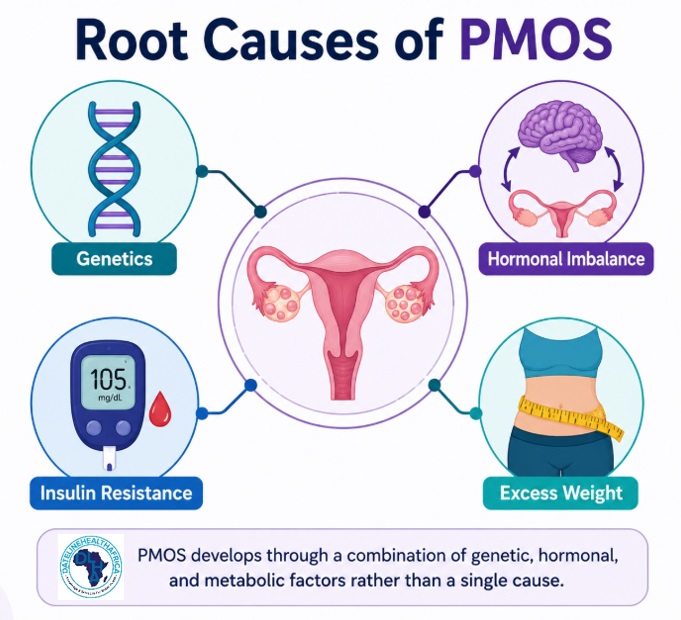
An info-poster illustrating the root causes of PMOS. Fact checked for medical accuracy. Image credit: ChatGPT. Click on image to enlarge.
PMOS often runs in families. Women who have a mother, sister, or close female relative with the condition are more likely to develop it themselves, suggesting that inherited genes play an important role (1, 2).
Research suggests that several genes may increase the risk of PMOS, but no single gene has been found to cause the condition. Instead, multiple genes appear to work together, making some women more susceptible than others (2).
Hormones are chemical messengers that regulate many body functions, including the menstrual cycle and ovulation. In women with PMOS, the hormonal signals between the brain and the ovaries become disrupted, so the ovaries do not release an egg as regularly as they should (1, 2). This condition, known as anovulation, causes immature follicles to remain in the ovaries, which can give them a "polycystic" appearance on ultrasound (1, 2).
At the same time, the ovaries produce higher-than-normal levels of androgens. Androgens are hormones usually associated with males but are also produced naturally in small amounts in women. When the ovaries produce excess androgen (a condition called hyperandrogenism), it contributes to the common PMOS symptoms such as acne, excessive facial or body hair growth, and thinning hair on the scalp (1, 2).
Many women with PMOS also have insulin resistance, a condition in which the body's cells do not respond properly to insulin. Insulin is the hormone that helps move glucose (sugar) from the blood into the body's cells for energy (1).
To compensate for this, the body produces more insulin. High insulin levels stimulate the ovaries to produce even more androgens, worsening hormone imbalance and making ovulation less regular. Over time, insulin resistance can also increase the risk of developing type 2 diabetes (1, 2).
Being overweight does not cause PMOS, and many women with the condition have a healthy body weight. However, carrying excess body fat (especially around the waist) can worsen insulin resistance and make symptoms more severe (1, 2).
Regular physical activity, balanced nutrition, and maintaining a healthy weight can help improve symptoms in many women. Even so, lifestyle changes alone do not cure PMOS because the condition is driven by underlying hormonal and genetic factors (1, 2).
Together, these factors explain why PMOS affects women differently. Some women experience only mild symptoms, while others develop more noticeable hormonal, reproductive, and metabolic problems. Understanding these underlying changes also makes it easier to see how PMOS affects different parts of the body.
PMOS does not affect only the ovaries. Because hormones help regulate many different body systems, the condition can affect reproductive health, the skin, metabolism, and long-term health. The effects vary from one woman to another, and not everyone experiences the same symptoms or complications (1, 2).
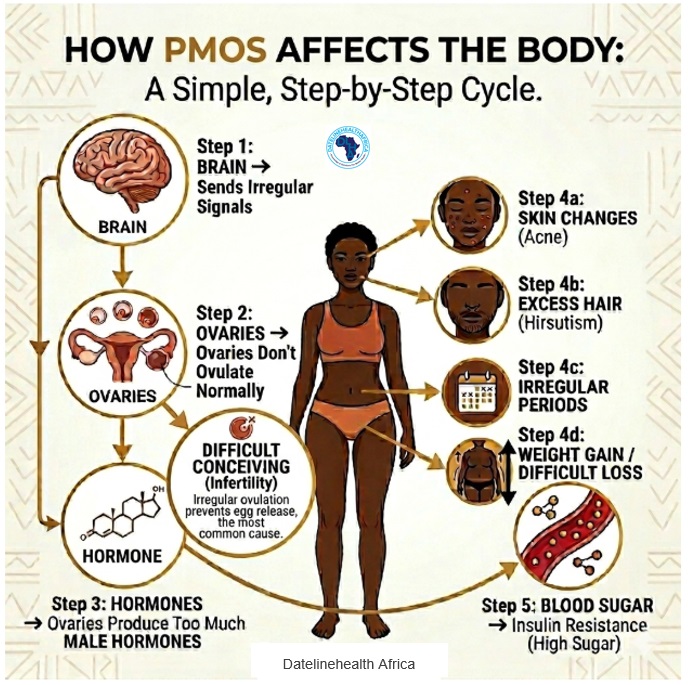
An info-poster outlining a step-by-step cycle of how PMOS affects a woman's body, from irregular brain and hormone signals to ovulation issues, physical symptoms, and insulin resistance. Image credit: Gemini Click on image to enlarge.
One of the main ways PMOS affects the body is by disrupting the normal menstrual cycle. When ovulation does not occur regularly, menstrual periods may become irregular, infrequent, or stop altogether. This can make it more difficult for some women to become pregnant because an egg is not released every month (1, 2).
Over time, long gaps between menstrual periods can also cause the lining of the womb (endometrium) to build up more than usual. If left untreated for many years, this may increase the risk of endometrial hyperplasia and, in some cases, endometrial cancer (1, 2).
Changes in hormone levels can affect the skin and hair. Some women develop persistent acne, increased hair growth on the face, chest, or abdomen, while others notice thinning hair on the scalp (1, 2). These changes can affect self-esteem and emotional well-being, especially when symptoms begin during adolescence or early adulthood.
PMOS can also affect how the body processes sugar and stores fat. Women living with PMOS have an increased risk of developing type 2 diabetes, abnormal cholesterol levels, and weight gain, particularly around the waist (1). These metabolic changes can occur in women of any body size, including those who have a healthy weight (2).
Without appropriate management, PMOS may increase the risk of several long-term health problems, including high blood pressure, heart disease, pregnancy complications, and mental health conditions such as anxiety and depression (1, 2).
Although these complications may sound concerning, they can often be prevented or managed. Early diagnosis, healthy lifestyle habits, and appropriate medical treatment can help many women manage their symptoms and reduce their risk of long-term health problems.
Understanding how PMOS affects the body also makes it easier to recognise its early signs and know when to seek medical advice.
Related: 10 Common Hormone-Linked Disorders in African Women
The signs and symptoms of PMOS vary from one woman to another. Some women develop symptoms soon after their first menstrual period, while others notice changes only years later, often when trying to conceive (1).
Also, note that not every woman with PMOS experiences the same symptoms. Some may have only one or two, while others have several. Common early signs of PMOS include:
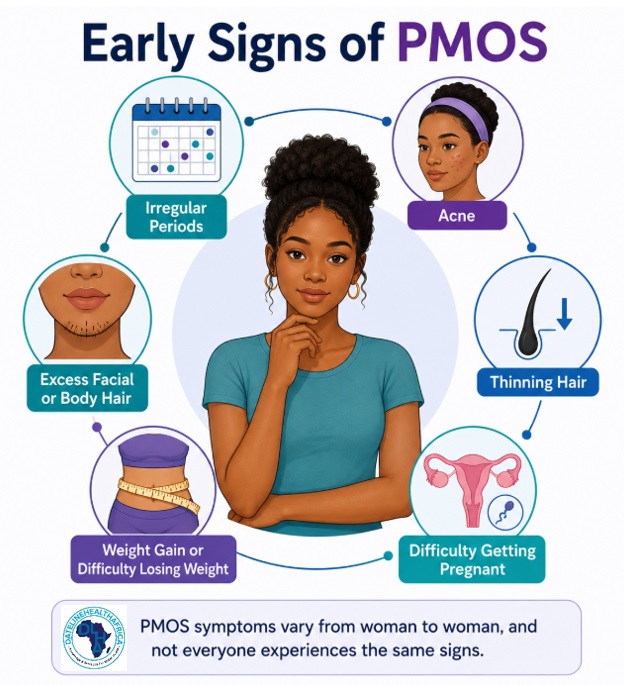
An illustration showing the early signs of PMOS. Fact checked for medical accuracy. Image credit: ChatGPT. Click on image to enlarge,
Irregular or missed periods are one of the most common signs of PMOS. Some women have fewer than eight menstrual periods a year, while others may go several months without menstruating. In some cases, periods may stop completely (2).
Higher-than-normal androgen levels can cause coarse, dark hair to grow on areas such as the face, chin, chest, abdomen, or back. This condition, known as hirsutism, affects many women with PMOS and can be emotionally distressing (1, 2).
Acne that continues beyond the teenage years or does not respond to usual treatments may be a sign of PMOS. It commonly affects the face, chest, and upper back and is linked to increased androgen levels (1, 2).
While some women notice increased hair growth on the face or body, others experience thinning hair on the scalp or gradual hair loss, particularly around the crown of the head (1, 2).
Many women with PMOS find it easier to gain weight, especially around the waist, and more difficult to lose it. However, PMOS also occurs in women who have a healthy body weight, so weight alone does not determine whether someone has the condition (1, 2).
Because PMOS can interfere with regular ovulation, some women only discover they have the condition after experiencing difficulty becoming pregnant (1). However, having PMOS does not mean pregnancy is impossible. Many women conceive successfully with appropriate treatment and support.
There is no single test that can confirm PMOS. Instead, healthcare professionals make the diagnosis by combining a woman’s medical history, symptoms, physical examination, blood tests, and, when appropriate, an ultrasound scan (2).
The most widely used international guideline is the Rotterdam criteria, which state that a woman must have at least two of the following three features, after other possible causes have been ruled out (2):
Because several other medical conditions can cause symptoms similar to PMOS, doctors may also request additional blood tests to check for thyroid disorders, high prolactin levels, congenital adrenal hyperplasia, or other hormonal conditions before confirming the diagnosis (2).
It is important to note that not every woman with PMOS has polycystic ovaries, and not every woman with polycystic-looking ovaries has PMOS. This is why the diagnosis cannot be made using an ultrasound scan alone (1, 2).
Many African women live with PMOS symptoms for years without knowing. Several factors contribute to this problem, and they include the following:
Together, these barriers leave many African women undiagnosed and untreated. They also allow misinformation to spread through family conversations, social media posts, and well-meaning advice.
Related: PMOS in Africa: 5 Common Misinformation Debunked
PMOS is a common but often misunderstood hormonal condition that affects millions of women worldwide, including many across Africa. While it can affect menstrual cycles, fertility, metabolism, and long-term health, it is also a condition that can be effectively managed with early diagnosis and appropriate care.
Unfortunately, many African women continue to face delayed diagnosis because of limited awareness, cultural misconceptions, and barriers to accessing healthcare. As a result, they may live with symptoms for years before receiving the support they need.
Improving awareness of PMOS, recognising its early signs, and making diagnosis more accessible are essential steps towards better health outcomes. The earlier PMOS is identified, the sooner women can receive treatment, manage their symptoms, and reduce their risk of long-term complications.
No woman should have to live with unanswered questions or suffer in silence. Accurate information and timely medical care can make a meaningful difference to both reproductive health and overall well-being.
1. World Health Organisation. Polycystic ovary syndrome [Internet]. Geneva: World Health Organisation; 2026 Jan 22 [cited 2026 Jun 10]. Available from here.
2. Shukla A, Rasquin LI, Anastasopoulou C. Polycystic ovarian syndrome. InStatPearls [Internet] 2025 Jul 7. StatPearls Publishing. Available from here.
3. Makwe CC, Olamijulo JA, Balogun MR, Akinkugbe AO, Samuel A, Udenze K, Bril F, Buyalos RP, Laven JS, Azziz R. SAT363 the prevalence and phenotype of polycystic ovary syndrome (PCOS) in A Community-Based population in Sub-Saharan Africa: the Nigeria-PEP study. Journal of the Endocrine Society. 2023 Oct;7(Supplement_1):bvad114-1668. Available from here.
4. Akpata CB, Uadia PO, Okonofua FE. Prevalence of polycystic ovary syndrome in Nigerian women with infertility: A prospective study of the three assessment criteria. Open J Obstet Gynecol. 2018;8(12):1109-20. Available from here.
5. Pembe AB, Abeid MS. Polycystic ovaries and associated clinical and biochemical features among women with infertility in a tertiary hospital in Tanzania. Tanzania journal of health research. 2009;11(4). Available from here
Published: July 22, 2026
© 2026. Datelinehealth Africa Inc. All rights reserved.
Permission is given to copy, use, and share content freely for non-commercial purposes without alteration or modification, and subject to attribution as to source.
DATELINEHEALTH AFRICA INC., is a digital publisher for informational and educational purposes and does not offer personal medical care and advice. If you have a medical problem needing routine or emergency attention, call your doctor or local emergency services immediately, or visit the nearest emergency room or the nearest hospital. You should consult your professional healthcare provider before starting any nutrition, diet, exercise, fitness, medical or wellness program mentioned or referenced in the DatelinehealthAfrica website. Click here for more disclaimer notice.