Why Millions of Nigerian Women Can’t Access Contraceptives
By Kelechi Nwaowu, RN, RM, BNSc, Freelance Medical and Health Writer. Medically reviewed by: Onyinyechi Kalu, MBBS.
September 7, 2026
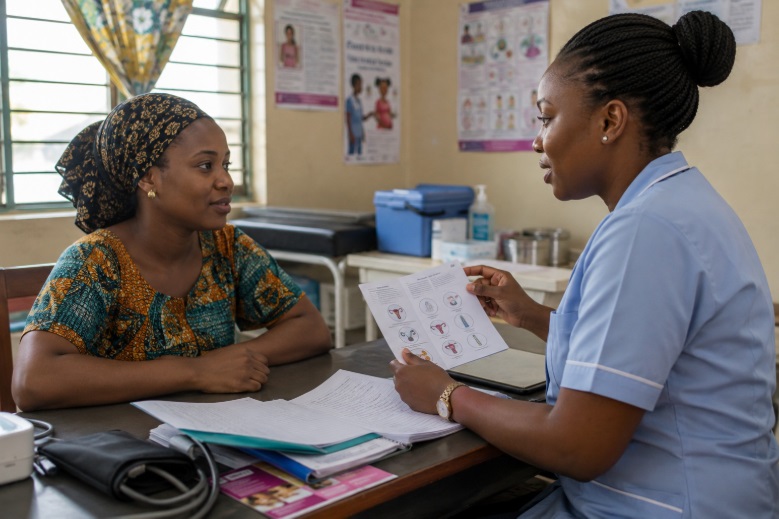
A young Nigerian woman discussing family planning with a female healthcare worker inside a primary healthcare clinic. Image credit: ChatGPT. Click on image to enlarge.
Imagine Fatima, a 27-year-old Nigerian woman who runs a small fabric stall in Kaduna.
She has three children, all under five. She is exhausted from running her business and caring for her children, and knows she cannot cope with another pregnancy right now. She knows about family planning because she has seen the posters at the primary health centre, but the centre is far away. When she finally gets there, she is told that no contraceptives are available.
She tries to obtain pills from the pharmacy in her street, but the pharmacist looks at her strangely when she asks about them. When she discusses contraception with her husband, he tells her that family planning goes against their religious beliefs. Even her mother-in-law cautions her that a woman who spaces her children does not love them.
Fatima is fictional, but her situation reflects barriers that many Nigerian women face when seeking contraception.
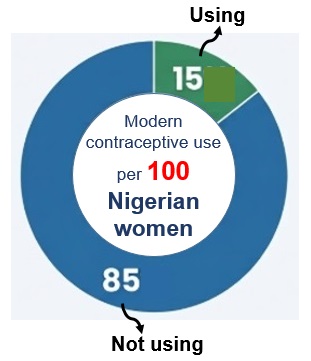 Across Nigeria, millions of women have an unmet need for family planning. The 2018 and 2024 Nigeria Demographic and Health Surveys (NDHS) found that modern contraceptive use among married women increased from 12% in 2018 to 15% in 2024 (1, 2). That means that, as of 2024, 85 out of 100 married Nigerian women are not using modern contraception. The survey also found that only 37% of demand for family planning is satisfied (2).
These figures do not simply reflect a lack of knowledge. Fatima knows what contraception is. What she does not have is reliable access, which can be blocked by distance, contraceptive shortages, provider attitudes, partner opposition, cultural and religious beliefs, stigma, and cost.
This article examines the barriers that prevent Nigerian women from accessing contraception, the additional challenges faced by adolescents, and what can be done to improve access.
Contraceptives, also called birth control, are an important part of family planning used to prevent pregnancy. They work in different ways, and the most suitable option depends on a woman's health, reproductive goals, lifestyle, and personal preferences.
Access to contraception is not only about preventing pregnancy. It reduces death from pregnancy and childbirth, and it allows women to decide whether, when, and how many children they want to have.
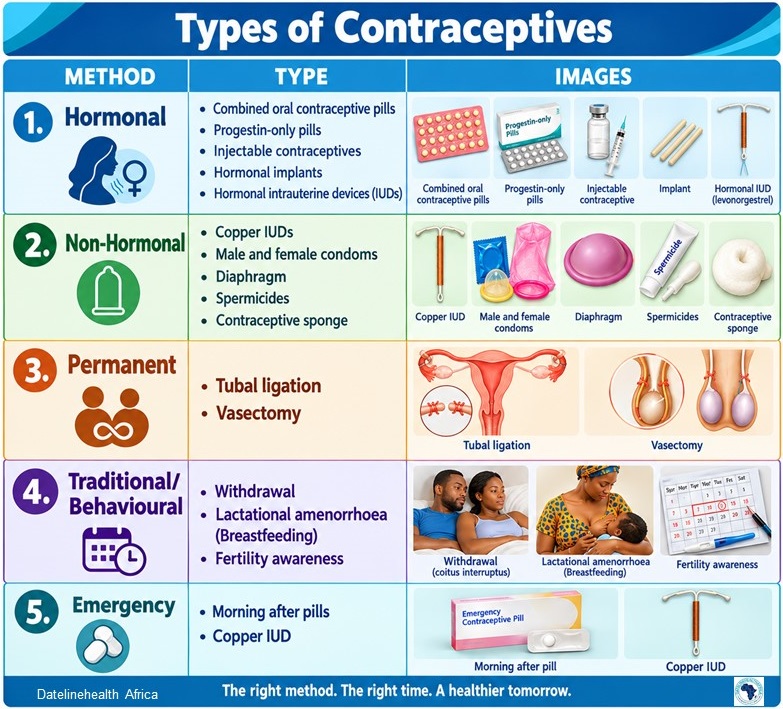
Table showing different types of contraveptives methods and products with images, AI geberated: ChatGPT. Click on image to enlarge
The various types of modern contraceptives include (3):
These use synthetic hormones to prevent pregnancy. They include:
A. Long Acting Reversible Contraceptives (LARC)
B. Short Acting Reversible Contraceptives
These prevent pregnancy without using hormones. They include:
Condoms also help protect against sexually transmitted infections (STIs).
These are intended for people who have decided they do not want future pregnancies. They include:
These generally have higher failure rates than modern contraceptive methods when not used correctly. They include:
Emergency Contraception include:
Related: Why Family Planning Is Essential To Nigerian Women of Reproductive Age
Access to contraception is one of the most effective public health investments a country can make. When women can plan their pregnancies, they are more likely to seek antenatal care, deliver safely, and recover fully between births.
Poor access to contraceptives is associated with unintended pregnancy, unsafe abortion, and maternal death. Nigeria has one of the highest maternal death rates in the world, at 993 deaths per 100,000 live births as of 2023 (3). A significant proportion of these deaths could be prevented through access to contraception.
Beyond health, access to contraceptives can also support women's educational attainment, economic participation, and overall well-being.
Related: A Framework for Reducing Maternal Mortality in Nigeria
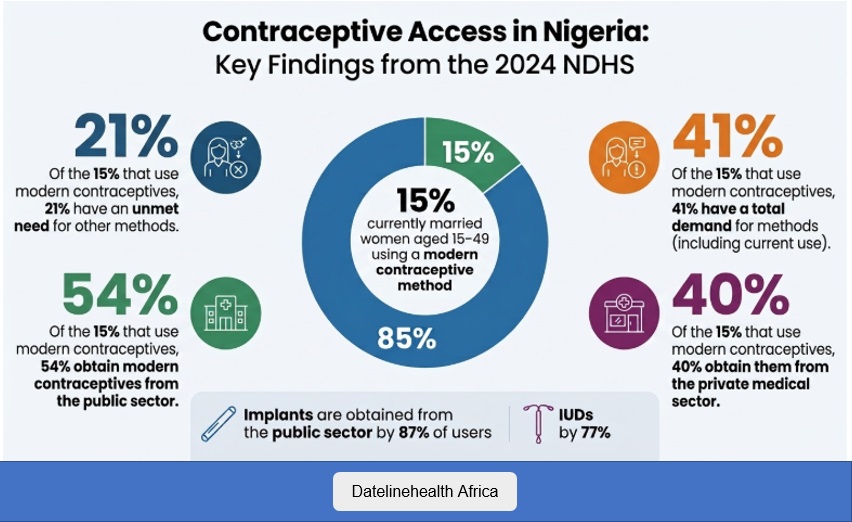
An infographic showing selected findings from the 2024 Nigeria Demographic and Health Survey (NDHS), including modern contraceptive use, unmet need for family planning, and where women obtain contraceptive methods. Adapted from the 2024 NDHS and redesigned with Gemini for readability. Click on image to enlarge.
Unmet need for family planning refers to women who want to delay or stop having children but are not using contraception (1). In simple terms, it shows how many women want to avoid pregnancy but are not using a contraceptive method.
According to the 2018 and 2024 Nigeria Demographic and Health Surveys (NDHS) and related studies (1, 2, 5):
When women cannot access contraception despite wanting to prevent or delay pregnancy, they are more likely to:
These risks are especially higher when women lack the resources or support needed to continue these activities alongside pregnancy and childcare.
Access to contraception is not equal across Nigeria. Rural, poorer, and less educated women often face greater barriers to using modern contraceptives (2).
These inequalities help explain why simply making contraceptive methods available is not enough. Women must also be able to reach services, afford them, obtain their preferred method, and make decisions about their use without facing barriers.
The barriers discussed below often overlap. For example, a woman in rural area may live far from a health facility, face contraceptive stock-outs when she gets there, and still need her husband's approval before she can use a method. Addressing only one of these barriers may not be enough to improve access.
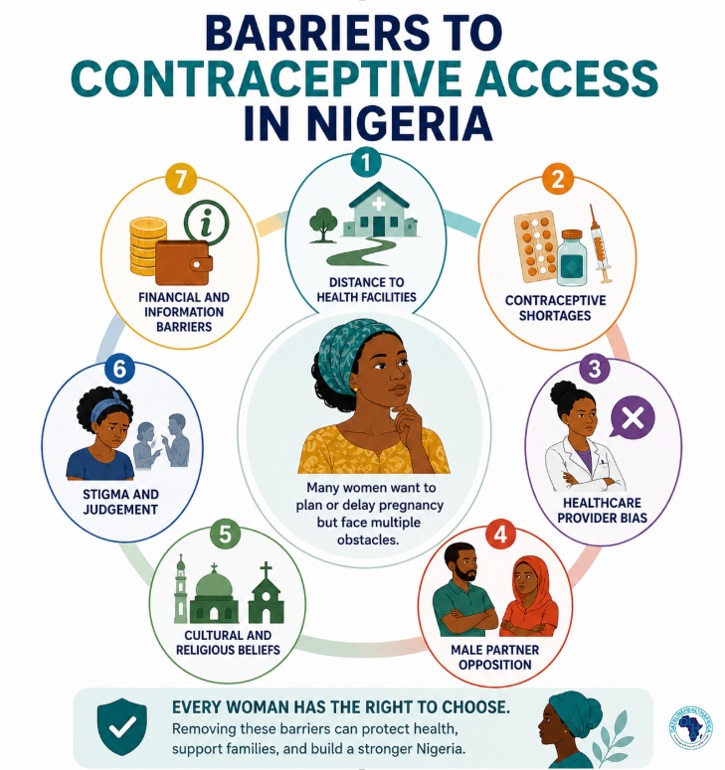
Info-poster showing major barriers to contraceptive access among Nigerian women. Credit:ChatGPT. Click on image to enlarge.
For some women in rural and semi-urban Nigeria, contraceptive access begins with distance. Primary health centres, which often provide free or subsidised contraceptive services, are unevenly distributed across the country. In some communities, the nearest facility may be a long walk or journey away.
That journey costs money for transport. It also takes time away from domestic responsibilities, trading, and childcare. For some women, these costs and demands may be enough to discourage them from seeking family planning services.
A woman may overcome the distance to a health facility and still leave without contraception because the method she needs is unavailable.
Shortages of contraceptives at public health facilities are a documented problem in Nigeria. A 2023 study of 32 primary health care facilities in Delta State revealed that 11 of the surveyed facilities failed to provide five or more modern contraceptive methods (6). And for the ones that provided services:
These shortages can result from underfunding, poor logistics management, weak facility reporting systems, and dependence on external donor funding.
Sometimes, women reach a health facility but still do not receive the contraceptive care they seek because of provider bias. Provider bias occurs when healthcare workers make judgements about who is an appropriate candidate for contraception based on factors such as age, marital status, or number of children.
A 2017 study of healthcare workers, pharmacists, and medicine vendors in six Nigerian cities (Abuja, Benin City, Ibadan, Ilorin, Kaduna, and Zaria) found provider bias to be a barrier to family planning. The study found that providers' decisions about which contraceptive methods to offer were influenced by factors such as:
Such gatekeeping can prevent women from obtaining the contraceptive method they want, even when services are available.
In some Nigerian households, contraceptive decisions are strongly influenced by husbands or male partners. When a partner opposes contraception, a woman may find it difficult to access or continue using a method.
Research has identified male partner support as an important determinant of contraceptive use in sub-Saharan Africa (8). A 2025 study conducted in Ogun State, Nigeria found that male partner support or opposition influenced women's access to and continued use of family planning services (9).
For some women, using contraception without their partner's knowledge may also create fear of conflict or other consequences. This can make the perceived social cost of using contraception seem greater than the risk of an unintended pregnancy.
Cultural and religious beliefs can shape how contraception is viewed within families and communities. In some Nigerian communities, large families are highly valued, while some religious or cultural interpretations discourage the use of contraception.
A 2024 study carried out among men and women in Ekiti State, Nigeria, found that religious beliefs and cultural expectations significantly influenced contraceptive use among couples (10).
Although not all religious and community leaders oppose family planning, where opposition to contraception is strong, women may face pressure not to use family planning even when services are available.
Stigma around contraception is closely related to cultural beliefs but creates a different barrier. In stigma, a woman who visits a family planning clinic may be judged as sexually promiscuous, while an unmarried woman seeking contraception may face particularly strong social disapproval.
Such fear of judgement can discourage women from seeking services or discussing their contraceptive needs openly. Reducing this stigma requires accurate information and community conversations that treat family planning as a normal part of reproductive healthcare rather than a source of shame.
Even when contraceptives are free or subsidised at some public facilities, women may still face indirect costs such as transport, time away from income-generating activities, and fees at facilities where supplies are more reliable.
A 2024 market survey by the Development Research and Projects Centre (dRPC), the Association for the Advancement of Family Planning (AAFP), and the Nigerian Health Watch found that rising contraceptive prices were a significant barrier to uptake (11).
For a woman living on a low income, even a modest cost can be difficult to afford when weighed against other household needs.
Limited access to reliable reproductive health information can also affect contraceptive use. Women may have questions about side effects, effectiveness, or how different methods work but lack access to clear information from trusted sources.
Women with lower educational attainment have also been found to have lower contraceptive uptake than women with higher levels of education (2). This may reflect differences in access to health information as well as the economic independence needed to seek healthcare and make reproductive decisions.
Addressing this barrier requires community-based health education that provides accurate information in clear, accessible language and reaches women beyond health facilities.
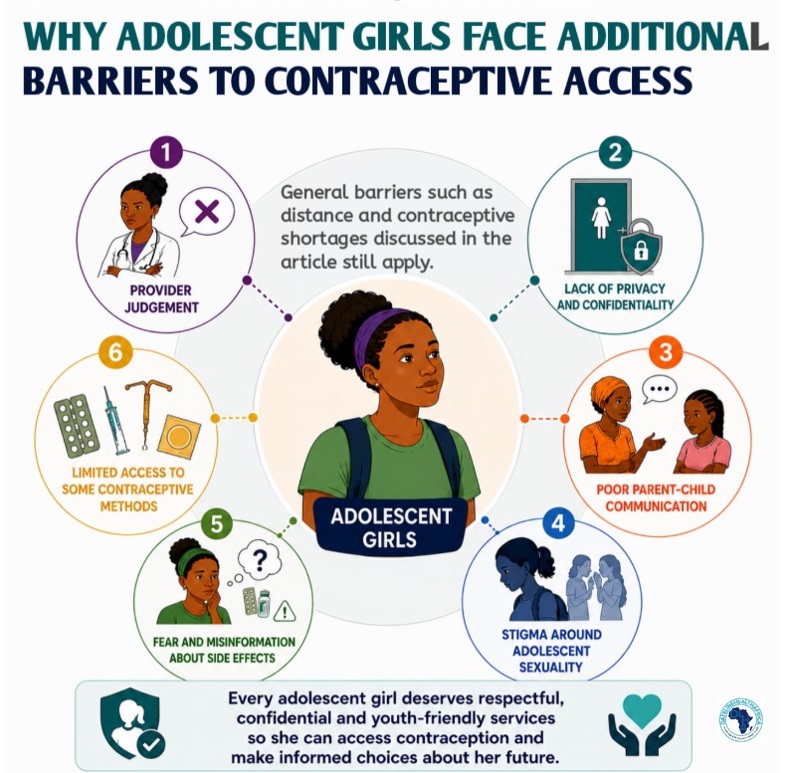
Info-poster showing additional barriers to contraceptive access faced by Nigerian adolescent girls. Image credit: ChatGPT. Click on image to enlarge.
Adolescent girls face many of the same barriers to contraception as adult women, but their age and social status can create additional challenges.
A 2026 multilevel analysis found that barriers to contraceptive use among adolescent girls and young women in Nigeria operate at individual, household, community, and health-system levels (12). The study also suggested that addressing only one of these levels may have limited impact (12).
At the individual level, girls may have limited knowledge of contraceptive methods, concerns about side effects, or lack the confidence to seek services.
At home, limited parent-child communication about sexual and reproductive health can leave girls without reliable information or support.
At the community level, stigma around adolescent sexuality can discourage girls from seeking contraception.
Within the health system, provider bias may create an additional barrier for unmarried adolescents seeking contraceptive services.
When adolescent girls cannot access contraception, they face a greater risk of unintended pregnancy. Adolescent pregnancy can disrupt education, increase maternal deaths, and limit future economic opportunities, particularly when girls are unable to return to school or continue their education.
According to the 2024 NDHS reports, about 15% of Nigerian girls aged 15 to 19 have experienced pregnancy (2). Adolescent pregnancy is also more common among girls facing socioeconomic disadvantage and limited access to reproductive health services (12).
Improving adolescent contraceptive access is therefore an important part of preventing unintended adolescent pregnancies and protecting girls' health, education, and future opportunities.
The barriers to contraceptive access in Nigeria are interconnected, so addressing them requires action at several levels.
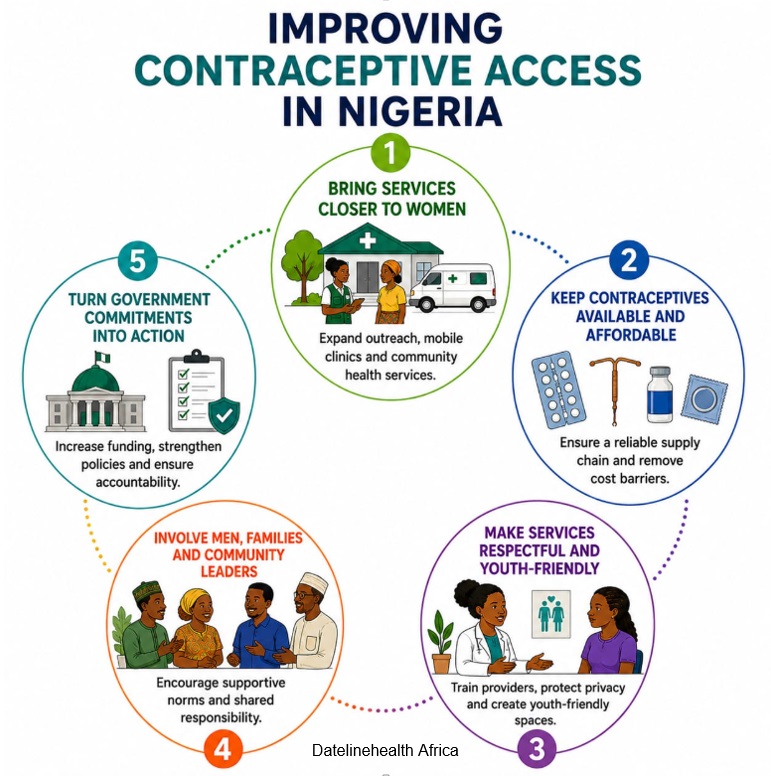
An info-poster showing ways to improve contraceptive access in Nigeria. Image credit ChatGPT, Click on image to enlarge.
Distance remains a major barrier, especially for women living in rural communities. Expanding community-based family planning services can reduce the need for women to travel long distances to health facilities. Trained community health workers can also provide family planning information, counselling, selected contraceptive methods, and referrals within communities.
Family planning can also be integrated into services women already use, including antenatal care, postnatal care, immunisation, and other primary healthcare services. This can make contraception easier to access without requiring women to make a separate trip to a health facility.
Reaching a health facility is not enough if the contraceptive a woman needs is unavailable. Health facilities need reliable supply chains, accurate forecasting, adequate funding, and systems for identifying and responding to stock-outs before they leave women without options.
Public facilities should also maintain access to free or affordable contraceptive methods, particularly for women with limited incomes. When women have to rely on private facilities or pharmacies because public facilities are out of stock, the resulting costs can become another barrier.
Healthcare workers play an important role in determining whether women feel able to use family planning services. Regular training and supervision can help reduce provider bias and ensure that women are counselled according to their health needs and reproductive goals rather than their age, marital status, or number of children.
Adolescents, on the other hand, should have access to youth-friendly services including privacy, confidentiality, accurate information, and non-judgemental counselling. Young people should be able to ask questions and discuss contraception without being shamed or automatically turned away.
Because reproductive decisions are often influenced by partners, families, and wider community expectations, improving access cannot be treated as a women's issue alone.
Family planning programmes should engage men and couples in discussions about pregnancy spacing, contraceptive options, and the health benefits of planned pregnancies.
Religious and traditional leaders can also help address misconceptions and reduce stigma when they are engaged appropriately. These trusted community voices can make it easier for women to seek family planning without being labelled irresponsible, promiscuous, or disrespectful of cultural or religious values.
Nigeria is already committed to improving family planning access, including the goal of increasing the modern contraceptive prevalence rate among women to 27% by 2030.
Achieving this goal requires sustained domestic funding for contraceptive commodities, stronger primary healthcare facilities, better supply-chain monitoring, trained healthcare workers, and regular measurement of whether services are actually reaching the women who need them most.
Improving contraceptive access is therefore not simply about increasing awareness. Women need to be able to find a service, obtain a method, afford it, and receive care without judgement or barriers.
Addressing these obstacles would move Nigeria closer to ensuring that wanting to plan or space a pregnancy does not depend on where a woman lives, how much she earns, or whether someone else approves of her decision.
Fatima, the woman in Kaduna at the beginning of this article, is not waiting for information. She already knows what contraception is. What she needs is reliable access, but distance, shortages, cost, provider attitudes, partner opposition, and social expectations can stand between her and the care she needs.
Nigeria's contraceptive access crisis will not be resolved by one intervention or campaign. It requires sustained investment in primary healthcare and contraceptive supply chains, respectful and youth-friendly services, community engagement, and policies that support women's ability to make informed reproductive decisions.
Therefore, the question is not just whether Nigerian women want family planning. It is whether Nigeria's health systems, institutions, and communities will remove the barriers that prevent women from accessing it.
1. National Population Commission (NPC) [Nigeria], ICF. Nigeria Demographic and Health Survey 2018. Abuja, Nigeria, and Rockville, Maryland: NPC and ICF; 2019 Oct. Report No.: FR359. [Cited 2026 Aug 25]. Available from here.
2. Federal Ministry of Health and Social Welfare (FMoHSW) [Nigeria], National Population Commission (NPC) [Nigeria], ICF. Nigeria Demographic and Health Survey 2024. Abuja, Nigeria, and Rockville, Maryland: FMoHSW, NPC, and ICF; 2025 Oct. Report No.: FR395. [Cited 2026 Aug 25]. Available from here.
3. Eunice Kennedy Shriver National Institute of Child Health and Human Development. What are the different types of contraception? [Internet]. Bethesda (MD): National Institutes of Health; 2017 Jan 31 [Cited 2026 Aug 25]. Available from here.
4. World Bank Group. Nigeria country profile [Internet]. Washington (DC): World Bank Gender Data Portal; 2026 [Cited 2026 Aug 26]. Available from here.
5. Family Planning 2030. Nigeria galvanizes support to meet its FP2030 commitments [Internet]. Washington (DC): FP2030; 2022 Mar 11 [Cited 2026 Aug 26]. Available from here.
6. Obong DT, Oyibo P. Family planning service availability and readiness assessment of primary health care facilities in Delta State, Nigeria: a mixed methods survey. Reproductive Health. 2023 Oct 24;20(1):158. Available from here.
7. Schwandt HM, Speizer IS, Corroon M. Contraceptive service provider imposed restrictions to contraceptive access in urban Nigeria. BMC Health Serv Res. 2017 Apr 12;17(1):268. Available from here.
8. Hernandez JH, Babazadeh S, Anglewicz PA, Akilimali PZ. As long as (I think) my husband agrees...: role of perceived partner approval in contraceptive use among couples living in military camps in Kinshasa, DRC. Reprod Health. 2022 Jan 12;19(1):6. Available from here.
9. Ojo OY, Ayowole DJ, Ojo AI, Alabi GJ, Dauda SO, Adeniran A, Akingbade TP, Ogunsola DO. Influence of partner’s support and communication on family planning method preferences among women in a Nigerian healthcare facility. Discover Public Health. 2025 Nov 24;22(1):740. Available from here.
10. Ibikunle OO, Ipinnimo TM, Bakare CA, Ibirongbe DO, Akinwumi AF, Ibikunle AI, Ajidagba EB, Olowoselu OO, Abioye OO, Alabi AK, Seluwa GA. Community perceptions, beliefs and factors determining family planning uptake among men and women in Ekiti State, Nigeria: findings from a descriptive exploratory study. BMJ Open. 2024 Apr;14(4):e077932. Available from here.
11. Development Research and Projects Centre. The 2024 NDHS Summary – A Wake-Up Call for Nigeria's Maternal Health Community [Internet]. Abuja: dRPC; 2024 [Cited 2026 Aug 26]. Available from here.
12. Muhammad A, Okunlola MA, Morhason-Bello IO. Barriers and enablers of modern contraceptive use among adolescent girls and young women in Nigeria: evidence from a multilevel mixed effect analysis. Int J Community Med Public Health. 2026 Jul;13(7):3359-70. Available from here.
Published: September 7, 2026
© 2026. Datelinehealth Africa Inc. All rights reserved.
Permission is given to copy, use, and share content freely for non-commercial purposes without alteration or modification and subject to attribution as to source.
DATELINEHEALTH AFRICA INC., is a digital publisher for informational and educational purposes and does not offer personal medical care and advice. If you have a medical problem needing routine or emergency attention, call your doctor or local emergency services immediately, or visit the nearest emergency room or the nearest hospital. You should consult your professional healthcare provider before starting any nutrition, diet, exercise, fitness, medical or wellness program mentioned or referenced in the DatelinehealthAfrica website. Click here for more disclaimer notice.