PMOS in Africa: 5 Common Misinformation Debunked
By Kelechi Nwaowu – BNSc, RN, RM, Freelance Medical & Health Writer. Medically reviewed by the DLHA Editorial Team.
.jpg)
An AI-generated illustration captioned: PMOS Misinformation and showing a young African woman holding a small sign saying "Know the Facts" In the background is a list of common PMOS misconceptions on one side and evidence-based medical facts on the other. Image credit: ChatGPT. Click on mage to enlarge,
Picture Amara, a 26-year-old Nigerian woman, who had just been diagnosed with Polyendocrine Metabolic Ovarian Syndrome (PMOS). Those four words finally explained years of irregular periods, unexpected weight gain, and the chin hair she had been privately shaving since she was 20. Her doctor gave her a clear explanation, a treatment plan, and a follow-up date.
Relieved to finally understand what had been happening to her body, Amara sent a voice note to her family group chat while still sitting in the hospital car park. Before she got home, the responses had already started coming in.
In the space of a single evening, a diagnosis that had brought Amara clarity became a source of confusion, fear, and doubt.
Unfortunately, Amara’s story is not rare. Across Africa, misinformation about PMOS spreads through social media, family conversations, and well-meaning advice. These misconceptions can delay diagnosis, discourage women from seeking medical care, and leave many feeling anxious about their future.
This article separates fact from fiction by examining the five common misinformation Amara heard that evening and explaining what current medical evidence says about each one.
Many false beliefs about PMOS are passed from one person to another without scientific evidence. Understanding the misinformation and the facts that debunk them can help women recognize symptoms earlier, seek appropriate care, and avoid unnecessary fear.
Here are 5 Common Misinformation and Facts that you need to know about:
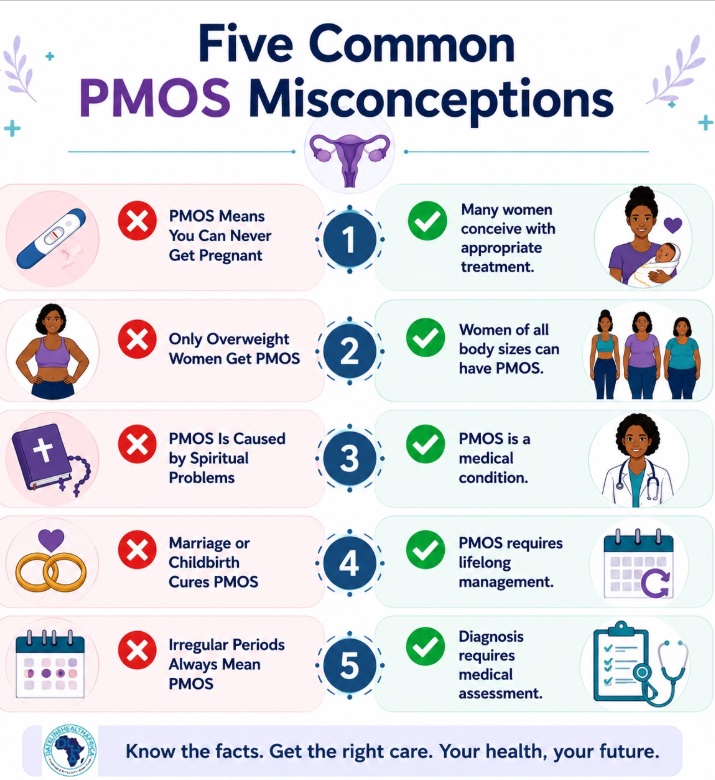
AI-generated Info-poster comparing five common misconceptions about PMOS with evidence-based medical facts. Image credit: ChatGPT. Click on image to enlarge.
Many women believe that a PMOS diagnosis means pregnancy is impossible and that PMOS is a permanent cause of infertility.
The Fact: This is not true. PMOS is one of the most common and most treatable causes of infertility (difficulty in conceiving) (1). Having difficulty getting pregnant does not mean pregnancy is impossible. It means that pregnancy may take longer to happen or may require medical support.
The main reason PMOS can make it harder to conceive is that many women with PMOS do not release an egg regularly during their menstrual cycle (a condition called anovulation (2). Without the release of an egg, pregnancy cannot occur. However, the good news is that this problem can often be treated.
The Fact: PMOS affects women of all body sizes. Research shows that about 20% of women with PMOS are of normal weight, a form often called lean PMOS (3).
Women with lean PMOS experience the same hormone imbalances, the same ovulation problems, and the same long-term health risks as women with PMOS who are overweight. However, they are diagnosed less often because their appearance does not fit the common misinformation of PMOS.
Weight is not part of the factors doctors use to diagnose PMOS (2). Both normal weight and obese women can have PMOS.
This misinformation is harmful because it can delay diagnosis and treatment, as many women assume they cannot have PMOS simply because they are not overweight.
The Fact: PMOS is a medical condition linked to biological and genetic factors. Spiritual attacks, curses, promiscuity, or moral failings do not cause it.
Although the exact cause of PMOS is not fully understood, research shows that genetics and hormone imbalances play significant roles. PMOS also often runs in families, meaning a woman whose mother or sister has PMOS is more likely to develop the condition herself (2).
A woman with PMOS did not cause her condition. She deserves medical care, support, and accurate information, not spiritual or moral blame.
Related: PMOS in Africa: Early Signs, Root Causes, and How It’s Diagnosed
4. Marriage or Childbirth Cures PMOS
The Fact: PMOS is a long-term hormonal condition. Marriage or childbirth does not cure PMOS.
Some women may notice that certain symptoms of PMOS improve during pregnancy, but this does not mean the condition has gone away. After pregnancy, the underlying hormonal imbalance remains.
Women who had PMOS before pregnancy still have PMOS afterwards. This means that pregnancy or childbirth does not cure PMOS, nor does it reduce the associated risks of:
These risks remain throughout a woman’s life unless it is properly managed (4).
The Fact: Irregular periods are a common symptom of PMOS, but they are not enough on their own to confirm a diagnosis.
Doctors diagnose PMOS using internationally accepted guidelines that require at least two of the three key features mentioned earlier (2). A woman who only has irregular periods, without other signs such as excess androgen levels or polycystic ovaries on ultrasound, does not meet the guidelines for PMOS diagnosis.
In fact, some women with PMOS have regular periods (1). This alone shows that irregular periods are not enough to diagnose PMOS. Irregular periods can happen for many other reasons, such as the following:
This is why every woman with irregular periods deserves a proper medical assessment rather than an automatic assumption of PMOS.
.jpg)
An AI-generated illustration of an African healthcare professional counselling a young woman about PMOS using evidence-based medical information instead of misinformation. Image credit ChatGPT. Click on image to enlarge.
Misinformation can make living with PMOS more confusing than it needs to be. Learning the facts is the first step, but understanding the condition more fully can help you recognise symptoms early, seek appropriate care, and make informed decisions about your health.
Misinformation about PMOS can be just as harmful as the condition itself. Believing common myths may prevent women from recognising symptoms, seeking medical advice, or receiving timely treatment.
The evidence shows that PMOS is a medical condition, not a spiritual problem or a moral punishment. It is not a permanent cause of infertility, it is not cured by pregnancy or childbirth, and it does not only affect women who are overweight or have irregular periods. While PMOS cannot currently be cured, it can be effectively managed with the right medical care and lifestyle support.
If you recognise symptoms such as irregular periods, excess facial or body hair, persistent acne, unexpected weight changes, or difficulty becoming pregnant, speak with a qualified healthcare professional rather than relying on advice from social media or word of mouth.
Getting accurate information is the first step towards taking control of your health.
Want to learn more about PMOS, including its early signs, root causes, and diagnosis? Read our comprehensive guide: PMOS in Africa: Early Signs, Root Causes, and How It's Diagnosed
1. World Health Organisation. Polycystic ovary syndrome [Internet]. Geneva: World Health Organisation; 2026 Jan 22 [cited 2026 Jun 10]. Available from here.
2. Shukla A, Rasquin LI, Anastasopoulou C. Polycystic ovarian syndrome. InStatPearls [Internet] 2025 Jul 7. StatPearls Publishing. Available from here.
3. Toosy S, Sodi R, Pappachan JM. Lean polycystic ovary syndrome (PCOS): an evidence-based practical approach. Journal of Diabetes & Metabolic Disorders. 2018 Dec 31;17(2):277-85. Available from here.
4. Waghmare SV, Shanoo A, Shanoo IV AB. Polycystic ovary syndrome: a literature review with a focus on diagnosis, pathophysiology, and management. Cureus. 2023 Oct 20;15(10). Available from here.
5. Attia GM, Alharbi OA, Aljohani RM. The impact of irregular menstruation on health: a review of the literature. Cureus. 2023 Nov 20;15(11). Available from here.
Published: July, 22, 2026
© 2026. Datelinehealth Africa Inc. All rights reserved.
Permission is given to copy, use, and share content freely for non-commercial purposes without alteration or modification, and subject to attribution as to source.
DATELINEHEALTH AFRICA INC., is a digital publisher for informational and educational purposes and does not offer personal medical care and advice. If you have a medical problem needing routine or emergency attention, call your doctor or local emergency services immediately, or visit the nearest emergency room or the nearest hospital. You should consult your professional healthcare provider before starting any nutrition, diet, exercise, fitness, medical or wellness program mentioned or referenced in the DatelinehealthAfrica website. Click here for more disclaimer notice.