Beyond Hesitancy: Overcoming Barriers to Vaccination in Nigeria
By Helen Ohunene Otailku, B.Sc. Ed, Health Education, Freelance Health Writer. Medically reviewed by: KT Craig. MBBS, MScPH.
September 7, 2026
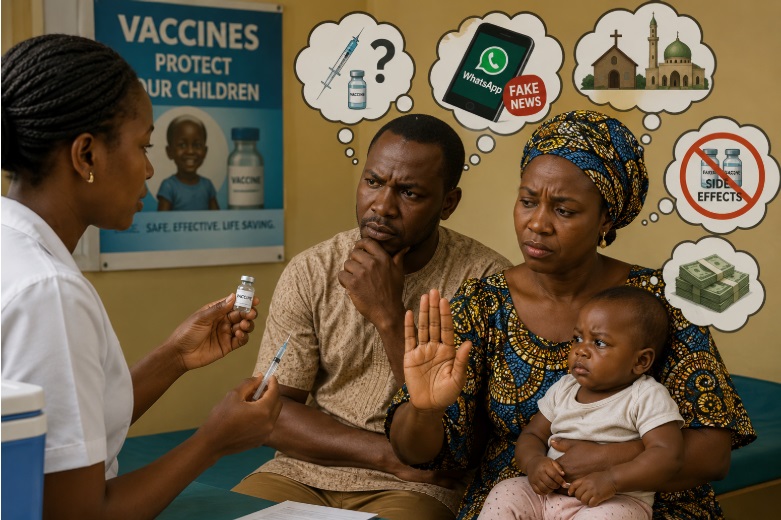
A Nigerian mother and father hesitate to vaccinate their child and are discussing their concerns about childhood vaccination with a female health worker. Thought bubbles represent concerns about vaccine side effects, misinformation, religion and cost barriers. Photo Credit: ChatGPT. Click on image to enlarge.
Did you know that Nigeria has more children who have never received a single vaccine than any other country in Africa? These are called “zero-dose children” [1].
Data from the 2021 Multiple Indicator Cluster Survey (MICS) shows that at least 6.2 million children have never received or missed all their vaccines in the past five years [2].
Similarly, 2012 WHO and UNICEF estimates show that Nigeria accounts for 2.2 million zero-dose children and is one of six countries that account for half of all zero-dose children globally [3].
The zero-dose matters because if a child missed all routine vaccines like DPT, polio, measles, BCG, etc., they become prone to diseases as evident in the Diphtheria outbreak which is currently affecting the country, with thousands of confirmed cases across multiple states. Kano State remains the hardest-hit area, accounting for the vast majority of cases.
It is tempting to file this situation under one heading, “vaccine hesitancy”, and leave it there. This flattens a problem that is actually made up of several segments of problems, often sitting inside the same household.
Some parents are afraid. Some carry years of mistrust. Some have never heard a clear explanation of why immunisation is important. Some simply cannot get their child to a clinic. Questioning these reasons matters, because the fix for one is not the fix for another in the bid to understand why some Nigerian parents say ‘no’ to vaccines.
The purpose of this blog is to identify the barriers to vaccine uptake and how they can be overcome.
The most immediate worry for many caregivers is simple: will this injection hurt my child, and is it actually safe? A fever or a bout of crying after a jab can look, to an anxious parent, like proof that something has gone wrong, especially when no one has warned them to expect it. Where a health worker takes a minute to explain what a mild reaction looks like, that fear tends to ease. Where they don’t, it can be enough to keep a family from returning for the next dose.
Some of this fear has real history behind it. In 1996, during a meningitis outbreak in Kano, Pfizer tested an unapproved drug, Trovan, on children without what families say was proper informed consent. Several children died or were left disabled, and the case, which was eventually settled out of court, became a lasting symbol of Nigerian children being used as test subjects [4]. That memory resurfaced in 2003, when political and religious leaders in Kano, Zamfara, and Kaduna states halted the polio vaccine campaign over rumours that it was contaminated with anti-fertility agents and HIV as part of a Western plot to control the country’s population [5]. The boycott lasted roughly a year, and polio cases climbed before it was resolved through sustained dialogue with religious and traditional leaders.
For families who lived through either episode, distrust of vaccines isn’t abstract, it is a lasting memory.
Trust is also built or broken in small, everyday moments. A rushed consultation, an unexplained stock-out, a health worker who seems dismissive, or caregivers who have had one bad experience often extend that distrust to immunisation services generally. A recent study across high zero-dose communities in Kano and Lagos found past negative experiences with health services were among the strongest predictors of a missed vaccination, while respectful, well-trained health workers were among the strongest reasons families kept coming back [5].
Vaccination coverage is measurably lower in some Muslim-majority communities in the north, shaped by a mix of religious interpretation, cultural norms about who decides for a child, and the role religious leaders played in both fuelling and later resolving the 2003 boycott [4]. In many households, that decision rests with fathers or elders rather than the mother. So even for a willing mother, taking the child to the clinic can be overruled [6].
Where imams and traditional rulers speak up in support of immunisation, uptake tends to rise; where they stay quiet or suspicious, it tends to fall.
Not every zero-dose child is a case of refusal. Some caregivers have never heard that a vaccination schedule exists, don’t know where the nearest outreach post is, or wrongly believe that a child who looks healthy doesn’t need vaccinating at all. That distinction matters because a family that has never heard of routine immunisation needs information and an accessible entry point. A family that has actively refused needs reassurance and relationship-building instead. Treating both the same way wastes effort, and can deepen suspicion in the second group.
Even a convinced caregiver can end up with a zero-dose child if the system doesn’t meet her halfway. Long distances, transport costs, unpredictable clinic hours, and vaccine stock-outs all push immunisation down a very long list of daily demands, especially for nomadic families and those in fast-growing urban slums who fall outside routine outreach schedules [5]. For a mother juggling work and childcare with no one to cover for her, a vaccination visit costs a morning she may not be able to spare.
There is real progress here. Leadership at the national and state level have agreed that a paradigm shift is needed in the way vaccines reach children.
In Lagos, weekly outreach through the Routine Immunisation Intensification Programme takes vaccination teams into underserved neighbourhoods instead of waiting for families to come in [6].
In Bauchi State, a data-driven, community-led push deployed nearly 1,300 health workers across hundreds of wards, reaching caregivers who had previously stayed away [7].
Nigeria’s Immunisation Recovery Plan aims to cut the number of zero-dose children by 15% by 2024 and 80% by 2028, starting with the worst-affected local government areas [8].
It’s not a fix for every barrier above, but it shows that sustained, local engagement works.
Vaccine hesitancy in Nigeria is rooted in fear, history, everyday experience, culture, low awareness, and access challenges. These all interact and no single fact sheet resolves them at once. What consistently moves the needle is trust: respectful health workers, community leaders willing to speak up, and services that show up reliably where families already are.
If you’re unsure about your child’s vaccination schedule, or have heard something worrying about a vaccine, don’t believe the rumours. Talk to a qualified health worker at your nearest primary health centre, they can check your child’s actual vaccine card and answer your specific questions.
1. UNICEF. Every child counts: The Republic of Korea and UNICEF partner with Nigeria to reach unvaccinated children [Press release]. [Internet]. 2026 Apr 17. [Cited 2026 Sep 5]. Available from here.
2. UNICEF. The National Bureau of Statistics in collaboration with UNICEF launches the 2021 Multiple Indicator Cluster Survey/ National Immunization Coverage Survey Report. [Internet]. 2022 August 16. [Cited 2026 Sep 5]. Available from here.
3. World Health Organization Regional Office for Africa. WHO partners government for Big-Catch-up campaign to close immunization coverage gaps. [Internet]. 2023 May 5. [Cited 2026 Sep 5]. Available from here.
4. Garba M, and Abidakun MG. Vaccine hesitancy – the Pfizer Kano case. [Internet] Unbias The News. 2021 Jul 6. [Cited 2026 Sep 5]. Available from here.
5. Jegede AS. What led to the Nigerian boycott of the polio vaccination campaign? PLoS Med. 2007;4(3):e73. doi:10.1371/journal.pmed.0040073. Available from here.
6. Bolarinwa OA, Salaudeen GA, Lar L, Alhaffar M, Abdelmagid N, McGowan CR, et al. Barriers and enablers to childhood immunization in high zero-dose burden communities in Kano and Lagos states, Nigeria. Vaccine. 2025;64:127754. doi:10.1016/j.vaccine.2025.127754. Available from here.
7. Antai D. Rural-urban inequities in childhood immunisation in Nigeria: the role of community contexts. Afr J Prim Health Care Fam Med. 2011;3(1):8. Available from here.
8. Ejiofor B. In Lagos, healthcare workers bring vaccines to children where they are. [Internet]. UNICEF Nigeria. 2026 Mar 2. [Cited 2026 Sep 5]. Available from here.
Related Links:
Published: September 7, 2026
© 2026. Datelinehealth Africa Inc. All rights reserved.
Permission is given to copy, use, and share content freely for non-commercial purposes without alteration or modification and subject to source attribution.
DATELINEHEALTH AFRICA INC., is a digital publisher for informational and educational purposes and does not offer personal medical care and advice. If you have a medical problem needing routine or emergency attention, call your doctor or local emergency services immediately, or visit the nearest emergency room or the nearest hospital. You should consult your professional healthcare provider before starting any nutrition, diet, exercise, fitness, medical or wellness program mentioned or referenced in the DatelinehealthAfrica website. Click here for more disclaimer notice.