Ted Turner, CNN Founder: Lewy Body Dementia Diagnosis, Death and Key Lessons
By Oluwasola Samuel, Freelance health writer. With medical review by the DLHA Editorial Team.
June 8, 2026.
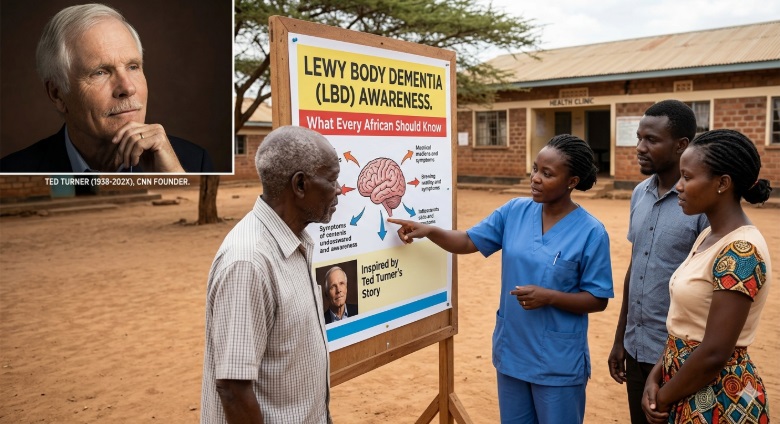
An AI-generated image depicts a healthcare worker explaining Lewy Body Dementia (LBD) to an elderly man and two others outside a rural clinic, accompanied by visual diagrams of the brain and symptoms, alongside a featured portrait of Ted Turner to emphasise awareness and the real-life impact. Click on image to enlarge.
On 6 May 2026, Ted Turner, Founder of television cable news network CNN, died at the age of 87. In September 2018, Turner sat down for a rare and deeply personal interview on CBS News and revealed that he had been diagnosed with Lewy Body Dementia (LBD). This progressive brain disease slowly disrupts a person's ability to think, move, remember, and eventually function at all.
From that diagnosis to his death, he lived approximately seven to eight years with the disease, a timeline that falls almost exactly within the average life expectancy of LBD, which is estimated at five to eight years following diagnosis, though some people live fewer than two years and others considerably longer depending on the quality of care they receive.
This blog is not just about Ted Turner's life and death. It is about what his Lewy Body Dementia diagnosis and what his death can teach everyone, and most especially African families who may be watching an elderly parent or grandparent change in ways they cannot explain.
Lewy Body Dementia is a progressive brain disease that most people have genuinely never heard of, and that unfamiliarity is part of the problem.
Here is what you need to know:
LBD is a progressive brain disease that gradually destroys a person's ability to think clearly, move normally, sleep properly, and perceive reality as it is, making it one of the most complex and wide-ranging forms of dementia that exists.
The exact cause of LBD remains unknown. What researchers do know is that the disease is strongly associated with the misfolding of a protein called alpha-synuclein inside brain cells (1). When this protein misfolds, it clumps together to form abnormal deposits known as Lewy bodies, and these deposits accumulate in areas of the brain responsible for thinking, movement, behaviour, and sleep, gradually causing those areas to break down and stop working properly.
According to the National Institute on Aging (NIH), LBD is the second most common form of progressive dementia after Alzheimer's disease, which tells you just how significant and widespread this condition truly is, even if most people have never heard its name (2, 3).
The distinction is worth understanding clearly. While Alzheimer's disease primarily affects memory in its early stages and follows a predictable pattern of decline, LBD affects a much broader range of brain functions from very early on, including movement, sleep, perception, and alertness, often alongside memory difficulties. It is this wide-ranging impact that makes LBD so frequently misdiagnosed and so deeply misunderstood.
Learn more about Lewy Body Dementia from here.
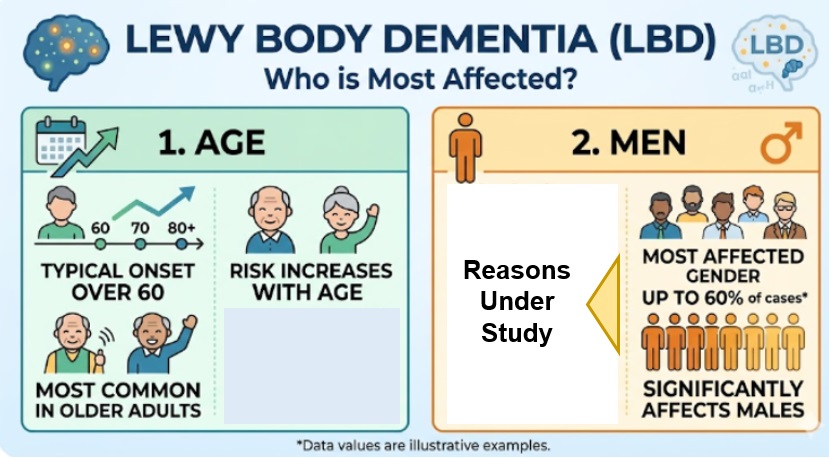
Infographics showing who is most affected by Lewy Body Dementia. Clicjk on image to enlarge.
Lewy Body Dementia does not affect everyone the same way, and knowing who has the highest risk could help you and your family spot the warning signs before it is too late.
It's important to understand how age and gender puts you at risk of this condition.
LBD most commonly develops in people over the age of 50, with the majority of diagnoses occurring between the ages of 60 and 80. (2) While it is possible for the disease to develop in younger people, such cases are considered rare and are not the norm.
Ted Turner himself was 79 years old when he made his diagnosis public in 2018, placing him squarely within the most common age range for this disease and serving as a very real reminder that LBD is not a distant or abstract condition but one that can affect someone you know, someone you admire, and someone you love.
Research consistently shows that LBD is significantly more common in men than in women, with men being diagnosed at a notably higher rate across different countries and populations. (4) The difference is believed to be linked to how the misfolded alpha-synuclein protein behaves differently in male biology, though the exact biological reasons are still being studied.
For African families, this means that if you have an elderly father, grandfather, uncle, or older brother who is beginning to show signs of cognitive or behavioural change, the possibility of LBD should not be dismissed simply because the family has never heard of the condition before.
Africans living in cities, where traffic fumes, generator exhaust, bush burning, and smoke from cooking with biomass fuel are part of daily life, need to understand that long-term exposure to these pollution sources can increase the risk of developing Lewy Body Dementia (LBD).
The symptoms of Lewy Body Dementia are the clues that families notice first, long before any doctor makes a diagnosis. What makes LBD particularly difficult to recognise is that its symptoms are wide-ranging and can look like several other conditions at the same time.
The following are the most common symptoms to watch out for:
If any combination of these symptoms sounds familiar in relation to someone you love, please do not wait and hope it resolves on its own, because early medical evaluation makes a genuine difference.
Lewy Body Dementia is one of the most difficult conditions to diagnose correctly, and misdiagnosis is far more common than most people realise. LBD is frequently mistaken for Alzheimer's disease, Parkinson's disease, or even a psychiatric condition, sometimes for years before the correct diagnosis is finally made (5).
For families across Africa where access to specialist care can already be a significant challenge, this makes it even more important to advocate persistently for a proper evaluation.
Here is what you need to know about how it's diagnosed:
There is currently no single test that can definitively confirm LBD during a person's lifetime, and a conclusive diagnosis can only be made after death when the brain is examined in a laboratory.
Doctors (neurologists) rely on a combination of detailed clinical history, neurological and cognitive assessments, blood tests to rule out other conditions, and brain imaging such as MRI or CT scans. In some specialist centres, a DaTscan, which examines dopamine activity in the brain, can provide additional supporting evidence.
If you or a loved one is experiencing frequent unexplained falls, persistent sleep disturbances, movement difficulties, or unusual behavioural and personality changes, do not dismiss these as simply old age. These are recognised warning signs that deserve a proper evaluation from a neurologist, a specialist in brain and nerve diseases, or a geriatric specialist who has experience managing complex conditions in older adults.
Because LBD shares symptoms with several other conditions, many patients spend years receiving the wrong diagnosis and consequently the wrong treatment, which can sometimes cause serious harm.
There is currently no cure for Lewy Body Dementia, and no medication can stop or reverse the disease once it has begun. However, that does not mean that nothing can be done. With the right combination of medications and supportive care, it is possible to manage symptoms meaningfully and preserve a reasonable quality of life for both the patient and the family caring for them.
Below are details you need to understand about treatment of LBD:
LBD is a terminal, progressive disease and there is currently no medication or procedure that can stop or reverse its course.
Cholinesterase inhibitors such as rivastigmine or donepezil may help improve memory, alertness, and reduce hallucinations in some patients.
Certain Parkinson's medications like levodopa may be used cautiously, though the response in LBD patients is not always straightforward and requires careful medical supervision.
Melatonin or low-dose clonazepam can help reduce the frequency and severity of REM Sleep Behaviour Disorder episodes, making sleep safer for the patient and those around them.
Antidepressants may be prescribed to manage depression or anxiety, both of which are common in people living with LBD.
Many conventional antipsychotic medications can cause severe and life-threatening reactions in people with LBD, a condition known as neuroleptic sensitivity. (6) What this means is that before any new medication is introduced, the treating doctor must be fully informed of the LBD diagnosis.
Physical therapy, occupational therapy, speech therapy, and consistent emotional support for caregivers all play an essential role in managing the disease and preserving the patient's dignity and quality of life.
Having an honest and clear picture of what lies ahead is one of the most important things you or your family can have as they prepare to support a loved one while living with LBD.
Ted Turner built CNN and gave the world a new way to see itself, bringing breaking news and global events into the living rooms, offices, hotels and television screens across the world, including Africa for decades. But perhaps one of the most important things he did in his final years was to speak openly about his diagnosis, because his willingness to sit in front of a camera on CBS News in 2018 and tell the world he had Lewy Body Dementia put a name, a face, and a story to a disease that most people had never heard of.
For African families, when an elderly parent begins seeing things that are not there, starts acting out their dreams violently in the night, or a loved one shifts between clarity and confusion from one hour to the next, these experiences are too often linked to spiritual attacks or simply the natural consequence of old age. However, medical reality points to the fact that these can be symptoms of a diagnosable and manageable condition that every family deserves to know.
1. Lewy Body Dementia | National Institute of Neurological Disorders and Stroke [Internet, n.d.]. [Cited 2026 May 26]. Available from here.
2. National Institute on Aging. Lewy Body Dementia: Causes, Symptoms, and Diagnosis. [Internet]. Last reviewed: Jan. 27, 2025. [Cited 2026 May 26]. Available from here.
3. Lewy Body Dementia Association (LBDA). Men are at greater risk for Lewy Body Dementia than women, but why? New study seeks answers. [Internet]. December 12, 2024. [Cited 2026 May 26]. Available from here.
4. Huff G. Air pollution tied to higher risk of dementia due to Lewy body diseases - UF Health [Internet]. May 14, 2026. [Cited 2026 May 26]. Available from here.
5. Lewy Body Dementia Association (LBDA). About LBD: The LBD Spectrum | [Internet, n.d.]. [Cited 2026 May 26]. Available from here.
Related:
Published: June 8, 2026
© 2026. Datelinehealth Africa Inc. All rights reserved.
Permission is given to copy, use, and share content freely for non-commercial purposes without alteration or modification and subject to source attribution.
DATELINEHEALTH AFRICA INC., is a digital publisher for informational and educational purposes and does not offer personal medical care and advice. If you have a medical problem needing routine or emergency attention, call your doctor or local emergency services immediately, or visit the nearest emergency room or the nearest hospital. You should consult your professional healthcare provider before starting any nutrition, diet, exercise, fitness, medical or wellness program mentioned or referenced in the DatelinehealthAfrica website. Click here for more disclaimer notice.