The Realities of Universal Health Coverage in East and West Africa
By Kelechi Nwaowu, RN, RM, BNSc, Freelance Medical and Health Writer. Medically reviewed by: K. Craig. MBBS, MPH.
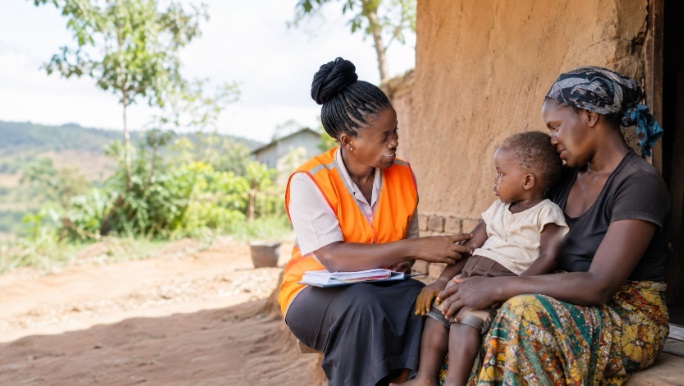
A community health worker in a bright orange vest visiting a rural household in East Africa, speaking to a mother with a young child. Created with ChatGPT. Click on image to enlarge.
Across East and West Africa, a certain situation plays out in different homes every day. For instance, a mother in Tamale, Ghana, notices her seven-year-old has had a fever for two days. She knows the child needs medical attention. But she also knows that visiting the clinic means paying out of pocket, money that is currently set aside for food. Similarly, a farmer in rural Oromia, Ethiopia, might have been experiencing chest pain for two weeks. He has not gone to the hospital because the nearest one is a one-hour journey, and the consultation fee alone would consume a week's income. Another market trader in Kano, Nigeria, has been living with untreated hypertension because she had no health insurance.
These cases and many more are the everyday realities in Africa. Despite decades of policy commitments and international investment, access to healthcare without financial hardship remains out of reach for millions of people in East and West Africa.
In 2016, the African Union adopted the Africa Health Strategy (2016–2030), which commits African governments to ensuring equitable access to healthcare for all citizens by 2030 (1). The strategy aligns with the 2030 Sustainable Development Goals (SDGs), which include universal health coverage (UHC) as a global health commitment.
Universal Health Coverage (UHC) is the global commitment that every person should be able to access the health services they need, when and where they need them, without being pushed into poverty by the cost. Across Sub-Saharan Africa, UHC was adopted as a target under the 2030 Sustainable Development Goals (SDGs). The 2030 deadline is now close, but how much progress have East and West Africa made? And what is still standing in the way?
This article answers both questions clearly, using the most current available data and evidence.
Universal Health Coverage does not mean free healthcare for everyone. It means every person, regardless of where they live, how much they earn, or what condition they have, can access quality health services without the cost pushing them into financial hardship (2).
According to this definition, a system where services exist but are unaffordable does not meet the UHC standard. Neither does a system where services are free but unavailable, or are of poor quality and provide no real health benefit. UHC requires all of these three elements simultaneously:
UHC does not just stop at disease treatment. It also covers the full continuum of health services, from health promotion and disease prevention to treatment, rehabilitation, and end-of-life care, across a person’s entire lifespan (2).
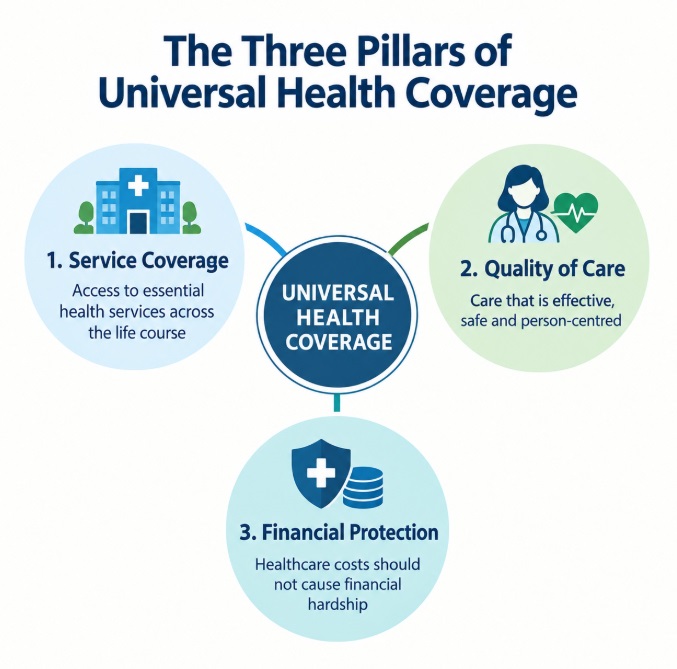
Infographic showing the three pillars of universal health coverage: service coverage, quality of care, and financial protection. Source ChatGPT Click on image to enlarge.
Tracking progress toward UHC requires measuring three interconnected dimensions, which are:
This is a combination of 14 health service indicators (including reproductive health, child health, infectious disease management, and non-communicable disease care) tracked globally using the UHC Service Coverage Index (SCI (3). It measures how well people in a country can access essential, quality health services on a scale from 0 to 100.
This examines whether the services people receive are effective, safe, and person-centred. Service coverage without quality is not meaningful coverage. A patient who reaches a clinic but receives an incorrect diagnosis or treatment has not truly been covered.
This assesses whether the cost of accessing health services causes financial hardship. The two most important measures are:
All three pillars outlined above must improve together. Progress on one without the others does not constitute genuine UHC progress.
Although UHC is presented in abstract policy language sometimes, its value becomes clearer when it is absent.
When people cannot access healthcare without financial hardship, it affects other aspects of living beyond health. Financial hardship is defined as a household spending more than 40% of its discretionary budget (the money available after essential household expenses) on out-of-pocket (OOP) health expenses (4).
Without UHC, for instance, households that pay heavy health costs are pushed into debt, forced to sell assets, and diverted from spending on education and food.
In East and West Africa, where a large proportion of the population lives on low and irregular incomes, and where the majority work in the informal sector without employer-linked health insurance, out-of-pocket (OOP) spending is the primary means of covering healthcare costs. This is both inefficient and inequitable because it means that in relative terms, the sickest and poorest people pay the most for their care.
According to the WHO Africa Region, OOP health spending continues to push over 150 million Africans into or deeper into poverty every year (5). That figure represents not just a health crisis, but a poverty trap. One in which illness becomes a cause of destitution rather than something a functioning health system protects against.
Countries that have made substantial UHC progress, including Rwanda, have recorded improvements in maternal death, child death, infectious disease control, management of non-communicable diseases (high blood pressure, diabetes, etc.), alongside reductions in poverty (6, 7).
A 2025 review by Langat and colleagues confirmed that although UHC implementation in Africa remains uneven, it is associated with financial protection, improved access to healthcare, and stronger health systems (8). The study highlighted that these benefits are substantially present where UHC approaches are accompanied by adequate financing, strong primary healthcare systems, and strong political commitment (8).
Another 2022 study of 34 African countries found that higher primary healthcare (PHC) spending is associated with a higher UHC index, higher life expectancy at birth, and lower infant mortality (9). The study revealed that countries that prioritize local clinics, frontline healthcare workers, and community-level insurance achieve better health outcomes than those who focus on the hospital level alone.
According to the 2025 UHC Global Monitoring Report, the UHC Service Coverage Index rose from 54 to 71 between 2000 and 2023 (2). The Africa region also improved and is notably among the three WHO regions that reduced financial hardship alongside improving service coverage over this period (4).
However, the report noted that progress has slowed significantly since 2015, and only one-third of countries globally are improving in both service coverage and financial protection simultaneously. Without acceleration, the global SCI is projected to reach only 74 by 2030, still leaving 1 in 4 people worldwide facing financial hardship when the SDG era ends (4).
The table below shows UHC Service Coverage Index scores for selected East and West African countries alongside regional and global benchmarks.
UHC Service Coverage Index of Selected East and West African Countries (2023)
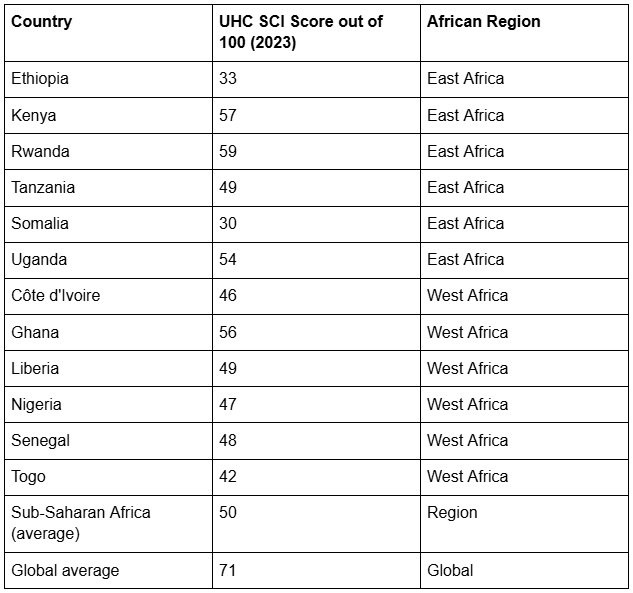
Table showing the UHC Service Coverage Index of Selected East and West African Countries, alongside Sub-Saharan Africa and world averages. Click on image to enlarge.
Source: World Bank UHC Service Coverage Index – Africa
From the table, most countries in East and West Africa remain significantly below the global average. Although Rwanda looks promising, Somalia, Ethiopia, and Togo have low numbers. The gap between where these countries are and where they need to be by 2030 is wide, and the time remaining is short.
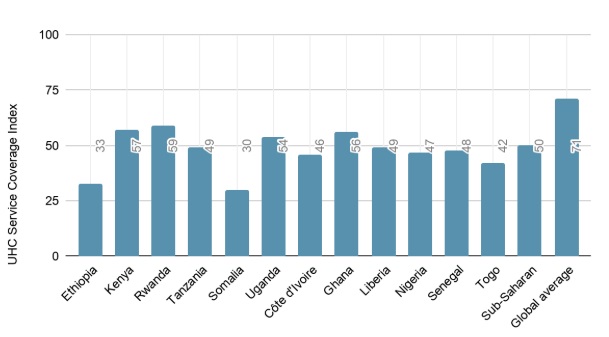
Bar chart showing the UHC Service Coverage Index of Selected East and West African Countries, alongside Sub-Saharan Africa and world averages. Data adapted from the World Bank UHC Service Coverage Index – Africa. Chart created by the author using Google Docs. Click on image to enlarge.
Despite the numbers reflected in the table, several countries across East and West Africa have made genuine, measurable progress toward UHC. This progress resulted in many benefits, including a decrease in the number of people pushed into (or deeper into) poverty because of out-of-pocket payments (4).
This section examines three country case studies and the role of community health workers in achieving UHC.
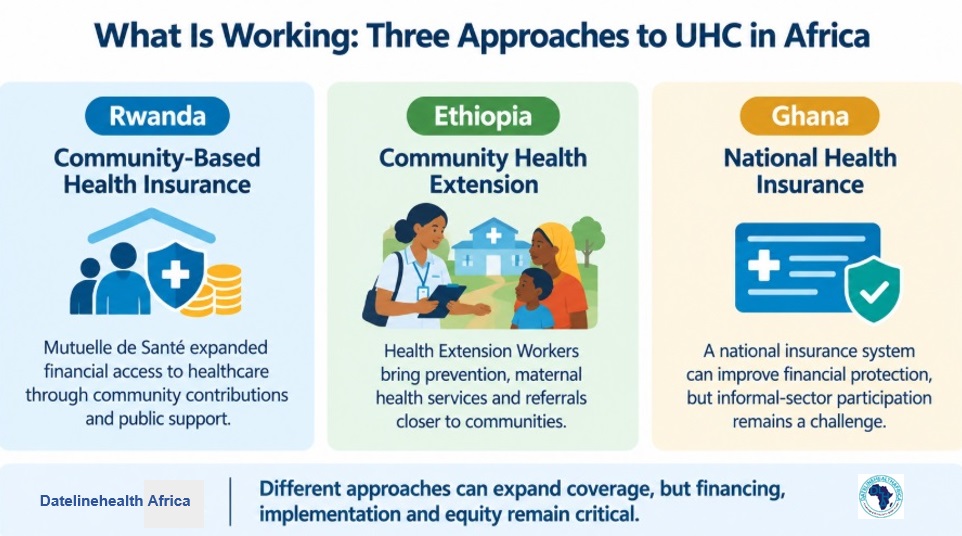
Infographic showing three approaches to universal health coverage in Africa: community-based health insurance in Rwanda, community health extension in Ethiopia, and national health insurance in Ghana. Image Credit: ChatGPT. Click on image to enlarge.
Rwanda’s progress is one of the most cited UHC success stories in Africa. Rwanda has a community-based health insurance programme, known as Mutuelle de Santé. It was established around 1999 after the 1994 genocide, when the country's healthcare infrastructure had been almost destroyed (10).
Under the Mutuelle de Santé scheme, community members pool contributions, as little as 2 USD for each family member per year (10). The government and charity organisations expand these contributions and use them to provide affordable healthcare for all citizens (10).
The Mutuelle de Santé scheme has produced remarkable results. For example, health Insurance coverage in Rwanda increased from 27% in 2004 to over 85% by 2025 (6). Out-of-pocket health spending also fell from 26.6% in 2000 to 10.4% in 2020, and use of healthcare increased from 0.25 yearly visits per capita in 2000 to 1.57 visits per capita in 2023 (5).
These numbers translated into health outcomes such as:
Rwanda is not a perfect model, and questions remain about sustainability and equity in utilisation (10). But it demonstrates what is possible with deliberate policy, consistent investment, and community participation.
Ethiopia introduced its Community-based Health Insurance (CBHI) in 2011 as a trial in 13 districts, then increased it gradually to over 500 districts over the following decade (11).
Alongside insurance expansion, Ethiopia invested heavily in its Health Extension Programme (HEP). Ethiopia’s HEP is a large-scale community health worker scheme that places trained health extension workers in communities across the country, providing primary prevention, maternal health services, and referrals to higher-level care (12).
Since 2004, this programme has hired and deployed over 30 000 Health Extension Workers (HEWs). In addition to that, over 2500 health centres and 15 000 village-level health posts have been built (12).
This combination of community insurance plus community health worker deployment has driven meaningful improvements in health access metrics such as antenatal care coverage, health facility delivery rates, and childhood immunisation rates (13).
Despite this success, a 2024 study of CBHI implementation in Ethiopia's Sidama Region highlights persistent challenges to UHC such as (14):
These findings suggest that the successful launch of UHC schemes and sustainable operation are two different challenges. As a result, many countries that have established schemes are now struggling with retention and quality issues that the initial launch phase did not fully address.
Ghana was the first sub-Saharan African country to introduce the National Health Insurance Scheme (NHIS) in 2003. The scheme replaced the previous "cash and carry" system, in which patients paid for every service and every medicine at the point of care (15).
Ghana’s NHIS has delivered real gains, including improved healthcare utilisation and reduced financial barriers to accessing basic services. As of late 2025, approximately 20 million Ghanaians held active NHIS cards (16).
However, the scheme faces persistent challenges that prevent it from delivering universal coverage. For example, informal workers make up the majority of the working population in Ghana, and because informal workers cannot have contributions deducted from salaries, they must pay premiums directly to the National Health Insurance Authority (NHIA) (17).
Premium payment is usually perceived as more costly and complex, and as a result, many do not pay it. The outcome is a scheme that is universal in name, but in practice leaves a substantial proportion of the population, including the poorest and most economically in need, without effective coverage.
A 2026 Ghana Statistical Service report stated that health insurance deprivation alone contributed 26.5% to poverty outcomes in the third quarter of 2025, and called for expanded enrollment, simplified renewal processes for informal sector workers, and digital renewal systems to improve continuity of coverage (16).
Ghana's NHIS demonstrates both the value and the limits of national health insurance in a highly informal economy. The programme is sound, and the benefits are significant, but the scheme has not yet solved the equity problem it was designed to address.
Across East and West Africa, the most cost-effective and widely proven mechanism for extending health coverage to underserved populations is the community health worker (CHW). CHWs are trained community members who provide basic health services, education, and referral within their own communities, in local languages, at lower cost than clinic-based care.
Ethiopia's Health Extension Programme, Rwanda's community health agent network, Ghana's Community-Based Health Planning and Services initiative, and similar programmes in Kenya, Nigeria, and Tanzania have all demonstrated that CHW-delivered services (covering maternal health, childhood immunisation, malaria prevention, tuberculosis case finding, and family planning) significantly improve health outcomes in communities with limited access to health facilities (7, 8, 9, 12).
The available evidence confirms that where CHW programmes are well-trained, adequately supervised, and appropriately rewarded, they function as the essential bridge between underserved populations and the health system. In contrast, where they are under-resourced, poorly supported, or used as a substitute for, rather than a complement to, facility-based care, their impact is limited.
Despite overall improvement in service coverage scores, the Africa region still has the widest gap between service coverage and financial protection. This means that even where services are technically available, the cost of accessing them continues to cause hardship.
According to the World Bank, Africa’s SCI average is about 50. When compared to the global average of 71, it reflects a coverage shortfall that cannot be closed by 2030 if the current rate of progress continues.
The Four Persistent Challenges to UHC in Africa
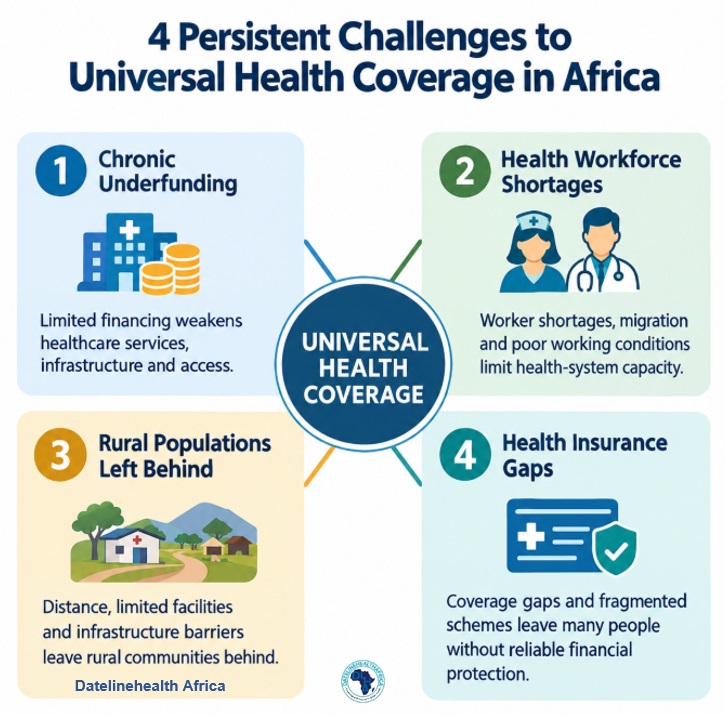
Infographic showing four key UHC challenges in sub-Saharan Africa: chronic underfunding, healthcare workforce shortages, rural exclusion and health insurance gaps. Image Credit: ChatGPT. Click on image to enlarge.
In the 2001 Abuja Declaration, African governments committed to allocating at least 15% of their national budgets to health. More than twenty years later, only about 33% of African countries have allocated roughly 10% of their national budget to health, still falling short of the 15% (18). This chronic underfunding leaves African healthcare systems with few resources and heavily dependent on donor support that is unpredictable and unreliable.
When domestic health financing is insufficient, the consequences progress through the entire system, leading to understaffed facilities, non-procured medicines, failing supply chains, and health workers who remain underpaid and overwhelmed. No insurance scheme, however well-designed, can compensate for a health system that lacks the resources to function.
Sub-Saharan Africa, including East and West Africa, faces a severe and growing shortage of trained health workers (8).
This workforce shortage could be attributed to:
The result is a workforce that is too small, geographically concentrated in urban centres, and unable to provide the coverage that UHC requires.
Across East and West Africa, healthcare services are often more limited or unavailable in rural communities than in urban areas. This pattern of poor health coverage in rural areas is often attributed to low access to health facilities, as many of them are concentrated in cities.
Although Community health workers exist in some rural communities, not all are covered. This means that the poorest and most remote communities, which tend to have the highest burden of preventable disease, remain the least served.
In most countries across Africa, health insurance schemes (whether community-based, social health insurance, or national schemes) share a common structural limitation: they struggle to enrol and retain the informal sector workers who make up the majority of the population.
Informal workers have irregular incomes, no formal employer relationship, and no automatic payroll deduction mechanism. For them, maintaining insurance requires making a regular, voluntary payment that competes with other immediate household needs, especially during periods of economic difficulty. When they cannot pay, the insurance lapses and, as a result, they are no longer covered.
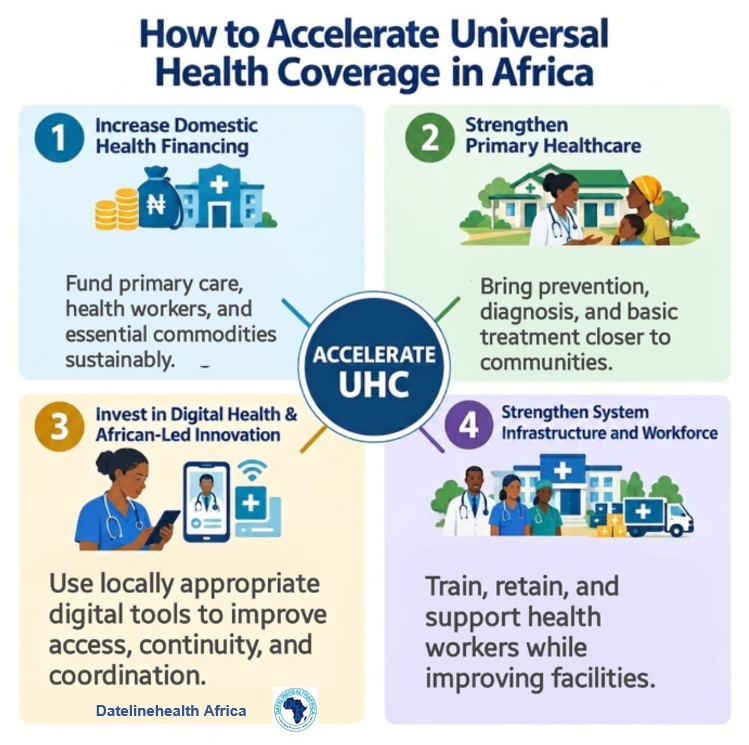
Infographic showing four actions to accelerate universal health coverage in Africa. Created with ChatGPT. Click on image to enlarge.
Adequate, sustained domestic health financing is an essential requirement for UHC; there are no shortcuts. It requires a political commitment to allocating a greater share of national budgets to health, and spending those resources on the primary care infrastructure, workforce, and commodities that reach the majority of the population. External funding alone will not deliver this.
Countries across East and West Africa must move beyond the Abuja Declaration as an aspirational statement and implement it as a working framework. This requires domestic political will, financial capacity evaluation, and transparent tracking of health budget execution to ensure that what is allocated is actually spent, and spent equitably.
Well-resourced, distributed, and competently staffed primary healthcare facilities are the most cost-effective route to UHC. It provides prevention, early diagnosis, basic treatment, and refer ill community members to higher-level care when needed.
Strengthening primary healthcare requires building and equipping facilities, training and retaining primary care workers, ensuring reliable medicine supplies, and creating functioning referral systems that link communities to higher-level care. None of this is achievable without sustained domestic financing.
Digital health technologies, including mobile health applications, electronic health records, telemedicine platforms, and digital payment systems for insurance premiums, offer practical solutions to some of the UHC challenges described in this article by:
These solutions work best when they are designed by and for African communities, incorporating local language, local context, and the infrastructure realities of the settings in which they are deployed.
No UHC reform will succeed without addressing the fundamental capacity constraints of:
Investing in healthcare worker training, salaries, and working conditions, with a specific focus on rural deployment and retention, is essential to achieving UHC. Addressing the migration of skilled workers requires competitive domestic salaries, career development pathways, and working environments that make it possible for health workers to practice with dignity and effectiveness.
Supply chain strengthening, which ensures that medicines, diagnostics, and equipment are reliably available at the facility level, is equally important. A community health insurance scheme that entitles members to services is meaningless if the facility they visit has no medicines to dispense.
Finally, implementation and accountability systems must be strengthened to ensure that health resources reach the patients and communities they are intended to serve, and that the progress of UHC is monitored at the facility and community level, not only at the national policy level.
Countries like Rwanda have shown that transformative progress in Universal Health Coverage is possible when political will, community engagement, and sustained financing are aligned. Ghana has shown that a national insurance architecture can meaningfully reduce financial hardship, and also shown the limits of insurance reform in an economy where most workers are informal. Ethiopia has shown that phased, community-anchored approaches can extend coverage at scale, and shown that sustainability and quality require just as much attention as initial expansion.
The 2030 deadline is near. At current rates of progress, Africa is unlikely to reach the UHC targets that its governments have committed to. Reaching them will require investing in primary healthcare, domestic financing, community health workers, and choosing equity as the measure of progress rather than national averages that mask the persistent exclusion of those who are furthest from care.
The people who need UHC most – the mother in Tamale, the farmer in Oromia, the market trader in Kano – are not waiting for policy documents. They are waiting for a health system that actually shows up when they need it, without requiring them to choose between their health and survival.
1. African Union. Africa Health Strategy 2016–2030 [Internet]. Addis Ababa: African Union Commission; 2016 [Cited 2026 Sep 22]. Available from here.
2. World Health Organization. Universal health coverage (UHC) [Internet]. Geneva: World Health Organization; 2023 Oct 5 [Cited 2026 Sep 2]. Available from here.
3. World Health Organization, World Bank. Tracking universal health coverage: 2025 global monitoring report [Internet]. Geneva: World Health Organization; 2025 [Cited 2026 Sep 2]. Available from here.
4. World Health Organization. Universal health coverage (UHC) [Internet]. Geneva: World Health Organization; 2023 Oct 5 [Cited 2026 Sep .2]. Available from here.
5. World Health Organization Regional Office for Africa. UHC Day: High health-care costs in Africa continue to push over 150 million into poverty: new WHO report [Internet]. Brazzaville: WHO AFRO; 2024 Dec 12 [Cited 2026 Sep 3]. Available from here.
6. Julius N, John M, Emmanuel N. Public Health Achievements in Rwanda: A 21st Century Transformation. Public Health Challenges. 2026 Jun;5(2):e70225. Available from here.
7. Murangwa D. New AHOP policy brief explores community-based health insurance in Rwanda [Internet]. Kigali: University of Rwanda; 2025 Oct 27 [Cited 2026 Sep 4]. Available from here.
8. Langat EC, Ward P, Gesesew H, Mwanri L. Challenges and opportunities of universal health coverage in Africa: a scoping review. International Journal of Environmental Research and Public Health. 2025 Jan 10;22(1):86. Available from here.
9. Arhin K, Frimpong AO, Acheampong K. Effect of primary health care expenditure on universal health coverage: evidence from sub-Saharan Africa. ClinicoEconomics and Outcomes Research. 2022 Dec 31:643-52. Available from here.
10. Lu C, Chin B, Lewandowski JL, Basinga P, Hirschhorn LR, Hill K, et al. Towards universal health coverage: an evaluation of Rwanda Mutuelles in its first eight years [Internet]. PLoS One. 2012 Jun;7(6):e39282. Available from here.
11. Deresse T, Eshete A, Mulatu H, Dessalegn M. Community-based health insurance utilization and its determinants among informal workers: cross-sectional study. Ethiopian Journal of Health Sciences. 2023 Sep;33(5):781. Available from here.
12. Croke K. The origins of Ethiopia's primary health care expansion: the politics of state building and health system strengthening. Health Policy and Planning. 2020 Dec 1;35(10):1318-27. Available from here.
13. The Commonwealth Fund. International health care system profiles: Ethiopia [Internet]. New York: The Commonwealth Fund; [cited 2026 Sep 4]. Available from here.
14. Debessa KC, Negeri KG, Dangisso MH. Barriers and enablers of community-based health insurance enrollment in the Sidama national regional state, Southern Ethiopia, 2024: A qualitative study. PLOS Global Public Health. 2025 Sep 11;5(9):e0004310. Available from here.
15. Alhassan RK, Nketiah-Amponsah E, Arhinful DK. A review of the National Health Insurance Scheme in Ghana: what are the sustainability threats and prospects?. PloS one. 2016 Nov 10;11(11):e0165151. Available from here.
16. News Ghana. Ghana Statistical Service urges expanded health coverage to accelerate poverty reduction [Internet]. News Ghana; 2026 Feb 5 [Cited 2026 Sep 4]. Available from here.
17. National Health Insurance Authority. About NHIS [Internet, n.d.]. Accra: NHIA; [Cited 2026 Sep 4]. Available from here.
18. Dereje N, Fall MP, Tessema R, Tsague MM, Ngongo N, Ndembi N, et al. More than two decades since Abuja declaration: A way forward for ending AIDS as a public health threat by 2030. J Public Health Afr. 2025;16(1), a1272. Doi: org/10.4102/jphia. v16i1.1272 Available from here.
Published: September 27, 2026
© 2026. Datelinehealth Africa Inc. All rights reserved.
Permission is given to copy, use, and share content freely for non-commercial purposes without alteration or modification and subject to attribution as to source.
DATELINEHEALTH AFRICA INC., is a digital publisher for informational and educational purposes and does not offer personal medical care and advice. If you have a medical problem needing routine or emergency attention, call your doctor or local emergency services immediately, or visit the nearest emergency room or the nearest hospital. You should consult your professional healthcare provider before starting any nutrition, diet, exercise, fitness, medical or wellness program mentioned or referenced in the DatelinehealthAfrica website. Click here for more disclaimer notice.