By Mosope Ososanya. Freelance Health Writer. Reviewed by the DLHA Editorial Team
September 24, 2025.
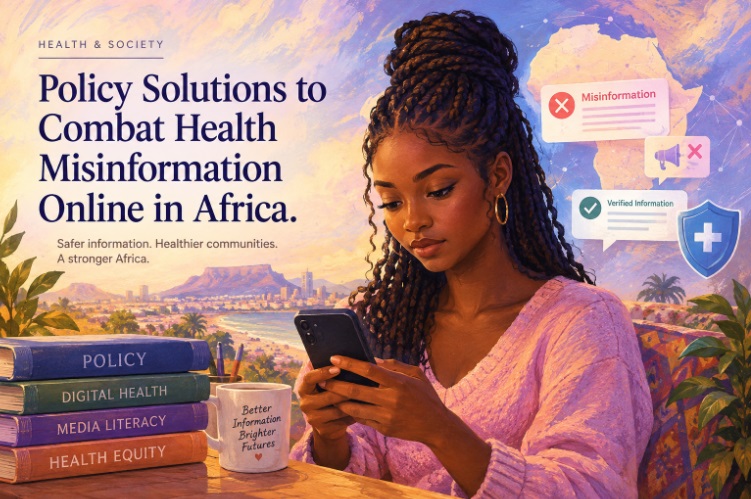
Description: Black woman using a smartphone with symbols for health misinformation, verified information, digital health, and policy against an African cityscape. Photo Credit: ChatGPT-4. Click on image to enlarge.
In Africa, digital platforms, AI tools, and messaging apps are developing faster than regulations can keep up. A review of national eHealth strategies found that only 16 of 34 African countries had updated their policies to include strategies for 2023 or beyond [1]. This shows that much of Africa’s digital health landscape is growing without enough policy to regulate it.
A previous article explained the effects of technology on the spread of health misinformation. Social media, messaging apps, AI-generated content, and recommendation algorithms have made it easier for health misinformation to spread quickly, often reaching millions before corrections can be made.
The technology is not going away, and neither will misinformation disappear without deliberate action. This article explores how tackling the problem requires better policies that are regularly updated, stronger systems for holding governments and platforms accountable, and collaboration between technology companies, public health institutions, and communities.
Across Africa, policies on online health misinformation are still limited and inconsistent. Indeed there are no specific laws for dealing with it. Most African countries rely on general cybercrime or internet laws to deal with online misinformation. These laws mainly focus on cybercrime, fraud, and data protection, not health misinformation.
South Africa has the Cybercrimes Act 2020, while Nigeria has the Cybercrimes Act 2015. Kenya passed the Digital Health Act in 2023, although its implementation was temporarily suspended by the Constitutional Court [2]. Other countries have similar laws, but they do not specifically deal with how false health claims are created and spread online [3].
A review of cybercrime laws in Africa found that having these laws does not always mean they are properly enforced [4]. This creates a gap between what the law says and what governments can actually do.
Removing content may seem like an easy way to fight misinformation. However, Africa has many different cultures and languages, and content regulation can sometimes remove useful health information or silence certain groups when the local context is not understood [5].
In South Africa, an attempt to give the Films and Publications Board power to remove online misinformation was challenged and withdrawn in 2024. Critics warned that this could give the government too much control over online content [6].
This is a serious concern in Africa, where press freedom is already under pressure. The share of African countries with the lowest journalism conditions rose from 33% to 40% between 2022 and 2023 [7]. Policies meant to fight misinformation should not be used to silence legitimate health criticism or public debate.
Censorship also does not address why people believe misinformation in the first place. It does not address distrust, poor digital literacy, or limited access to healthcare.
Social media platforms have a responsibility to protect the users they serve. African governments should require platforms to be more open about how their algorithms recommend and promote health content. The EU’s Digital Services Act provides a useful example, requiring platforms to assess risks, improve transparency, and act on harmful content [8].
Platforms should also be required to clearly label misleading health information instead of simply removing it. Research shows that warning labels can reduce the spread of misleading content, especially when corrections come from trusted sources [9].
A recent example from the United States shows how legal pressure can force technology platforms to change. In August 2026, Meta agreed to pay up to $18 billion to settle claims that Facebook and Instagram were designed in ways that harmed young users. The agreement also requires Meta to introduce measures such as daily time limits, night-time restrictions, and limits on notifications during school hours [10].
The lesson for Africa is simple: legal pressure can make technology platforms change their behaviour. African governments, individually and through the African Union, can use laws and regulations to hold platforms accountable for the harm they cause.
Health misinformation is both a health problem and a technology problem, yet these areas are often handled by separate government bodies. Health ministries manage public health, while communications regulators manage digital platforms. They need to work together.
One practical solution is to create national teams made up of health ministries, communications regulators, public health agencies, and civil society groups. These teams could monitor online health misinformation and coordinate quick responses during disease outbreaks.
The WHO’s Africa Infodemic Response Alliance (AIRA) showed that this kind of cooperation was possible during COVID-19 by monitoring false health claims and responding with reliable information [11]. This approach should become a permanent system rather than something used only during emergencies.
Health misinformation crosses national borders, so countries cannot effectively tackle it alone. For example, a false claim about an Ebola treatment shared on social media in the Democratic Republic of the Congo could spread into neighbouring Uganda and South Sudan through WhatsApp and Facebook groups. This makes it difficult for one government to respond effectively on its own.
The African Union and Africa CDC should develop common standards for dealing with health misinformation. These standards could define what counts as health misinformation, establish ways to monitor harmful claims, and create systems for countries to respond quickly to cross-border misinformation. The AU and Africa CDC already have experience developing continent-wide policies on digital technology and health information [12]. Building on these existing frameworks would make it easier for African countries to coordinate their response to health misinformation [13].
4. Invest in Digital and Health Literacy
Fighting misinformation cannot depend only on punishment for offenders. People also need the skills to recognise unreliable health information.
Schools should teach students how to check health claims, identify reliable sources, and look for evidence. Africa Check has already developed educational resources and trained teachers in South Africa, Nigeria, and Kenya [14].
Community health workers should also receive digital literacy training and reliable health information they can share with their communities. A review of digital literacy among health professionals in Ethiopia found that overall digital literacy levels were low, with an urgent need for training [15]. Hence, governments should include healthcare professionals in digital and health literacy programmes, not just the general public.
The Africa Infodemic Response Alliance (AIRA), created by WHO’s Regional Office for Africa, brings together fact-checkers, media organisations, technology groups, and other partners to monitor and respond to health misinformation [16]. Its content has reached more than 100 million views across 70 social media channels in five African countries [11].
AIRA shows that coordinated action against health misinformation can work in Africa [17]. However, it has no authority to make platforms take action or follow specific rules. Governments therefore need to build on this model with proper funding, legal support, and long-term institutional backing.
Nigeria has a strong fact-checking community, with organisations such as Dubawa and Africa Check Nigeria playing an important role. During the 2023 elections, FactCheckHub verified 127 claims, with health misinformation being the most common type found on Facebook [18].
However, Nigeria still lacks a national policy specifically addressing health misinformation. Fact-checking organisations remain largely dependent on donors and civil society support, making the system vulnerable when funding or platform support changes [19]. Nigeria shows that fact-checking efforts need government support and clear policies.
The EU’s Digital Services Act (DSA) is one of the strongest examples of platform regulation. It requires major platforms to assess risks, improve transparency, and take action on harmful content, with penalties for non-compliance [8]. The EU model has already influenced digital policies in Africa. However, many African regulators lack the funding and technical capacity needed to enforce similar rules [20].
These examples show that the problem is not a lack of ideas. Africa already has useful models to build on. What is missing is strong institutional support, sustainable funding, effective regulation, and the will to hold platforms accountable. Without these, policies may exist on paper without making a real difference to public health.
Across Africa, laws meant to control online misinformation have sometimes been used to silence journalists, activists, and critics.
For example, Nigeria’s Cybercrimes Act 2015 is often used to address false information online. However, it has also been used against journalists and activists. In the first quarter of 2024, 39 freedom of expression violations were recorded in West Africa, including 13 in Nigeria, most linked to the Cybercrimes Act [21].
This shows why misinformation laws must be carefully designed. In Africa, where press freedom is already under pressure, laws with unclear definitions can be used beyond their original purpose. A law meant to stop a false health claim could also be used to silence legitimate health reporting or criticism of government health programmes.
The goal should be to stop false information, not silence people. Policies should clearly explain what counts as misinformation and how it should be handled. They should also protect journalists and people who share legitimate health concerns or criticism. Laws should be reviewed regularly to make sure they are not being abused.
Policy is an important part of the fight against health misinformation, but it cannot solve the problem alone. Laws can create accountability, but they cannot fact-check every WhatsApp message, rebuild trust in vaccines, or teach people how to identify false information.
Africa needs to tackle health misinformation from different angles. This means having clear laws, making technology platforms more responsible, improving collaboration between regulators, and helping people develop the skills to identify false health information.
African governments should also not simply copy and paste policies from other regions. These policies must take Africa’s languages, infrastructure, and healthcare challenges into consideration. Existing efforts such as AIRA, Africa CDC, and the Africa Facts Network are already good starting points that can be built on.
Health misinformation is already affecting public trust and health outcomes across the continent. Policy is not the whole solution, but without it, other efforts have no strong foundation.
References
1. Olufadewa, I. I., Iyiola, O. P., Nnatus, J., Fatola, K., Oladele, R., Olufadewa, T., Adesina, M., & Udofia, J. National eHealth strategy frameworks in Africa: a comprehensive assessment using the WHO-ITU eHealth strategy toolkit and FAIR guidelines. Oxford Open Digital Health. 2024. 2, oqae047. Available from here.
2. PolicyVault.Africa. Digital Health Act, 2023 — Kenya. [Internet] 2023. Accessed 11th September 2026. Available from here.
3. ComplianceHub. Africa Cybersecurity Guide: Regional Threats and Compliance Trends. [Internet] February 19, 2025. Accessed 11th September 2026. Available from here.
4. Frimpong, S., Udechukwu, C., Adeoba, M., Mensah, T. K., & Mensah, D. Assessing the effectiveness of cybercrime laws in Africa: a systematic review of enforcement barriers and policy reform options. Current Research in Interdisciplinary Studies. 2026. 5(1). Available from here.
5. CIPESA. What Does Meta's About-Turn on Content Moderation Bode for Africa? [Internet] January 13 2025. Accessed 11th September 2026. Available from here.
6. Digital Policy Alert. DPA Digital Digest: South Africa 2024. [Internet] December 18 2024. Accessed 11th September 2026. Available from here.
7. Better World Campaign. The Damaging Deluge of Disinformation: What Researchers are Learning from Africa's Digital Boom. [Internet] 2024. Accessed 11th September 2026. Available from here.
8. DIG Watch. Content Policy Trends in 2025. [Internet n.d] Accessed 11th September 2026. Available from here.
9. UK Parliament Written Evidence. Response to Social Media, Misinformation and Harmful Algorithms. [Internet n.d] Accessed 11th September 2026. Available from here.
10. Wall Street Journal. Meta Reaches $18 Billion Settlement With 48 States Over Child-Safety Claims. [Internet] August 26 2026. Accessed 11th September 2026. Available from here.
11. WHO Regional Office for Africa. Countering COVID-19 Misinformation in Africa. [Internet] 23 July 2021. Accessed 11th September 2026. Available from here.
12. Africa CDC. Africa Sets Course to Strengthen and Harmonise Health Data Governance. [Internet] 30 July 2025. Accessed 11th September 2026. Available from here.
13. Tamirat, B., Mazuguni, F., Bamutura, M., Mercy, K., Nyarko, K. M., Tilahun, B., Alinon, K. N., & Tebeje, Y. K. Africa CDC spearheading the strengthening of health information exchange in Africa. The Lancet Digital Health. 2024. 6(6), e382–e384. Available from here.
14. Africa Check. Raising Informed Media Consumers Starts at School. [Internet] 2023. Accessed 11th September 2026. Available from here.
15. Chereka, A. A., Walle, A. D., Kassie, S. Y., Shibabaw, A. A., Butta, F. W., Demsash, A. W., Hunde, M. K., Dubale, A. T., Bekana, T., Kitil, G. W., Emanu, M. D., & Tadesse, M. N. Evaluating digital literacy of health professionals in Ethiopian health sectors: a systematic review and meta-analysis. PLoS ONE. 2024. 19(5), e0300344. Available from here.
16. WHO Regional Office for Africa. Africa Infodemic Response Alliance. [Internet n.d] Accessed 11th September 2026. Available from here.
17. Anoko, J. N., Kobie, A. G., Ho, E., Rahman, M. M., Nyawade, S., Sowo, L., Abdulrahman, D. I., Cordero, J. P., Kirigia, D., Bailo, D. A., Nanyunja, M., Braka, F., Chamla, D., Gueye, A. S., & Moeti, M. Managing infodemics in Africa: the role of the Africa Infodemic Response Alliance (AIRA) in advancing theory and practice during the COVID-19 pandemic. Health Communication. 2026. 41(3), 455–461. Available from here.
18. Africa at LSE. African Social Media Is Likely to See a Rise in Viral Propaganda. [Internet] 2025. Accessed 11th September 2026. Available from here.
19. Nieman Reports. Fact-Checking in Africa: Combating Disinformation Amid Political Strife and Ethnic Conflict. [Internet] 2025. Accessed 11th September 2026. Available from here.
20. TechHive Advisory Africa. Roundup on Data Protection in Africa 2024: Projections for 2025. [Internet] 2024. Accessed 11th September 2026. Available from here.
21. AllAfrica. West Africa: First Quarter 2024 — Senegal's Political Troubles, Nigeria's Cybercrime Law Trigger Massive Repression. [Internet] 2024. Accessed 11th September 2026. Available from here.
Related:
Healthy Scrolling: How to Spot and Filter Social Media Misinformation
Tech Age Woes: How Digital Health Misinformation Cost African Lives
Misinformation and disinformation in the era of Covid-19 are no exception
Published: September 24, 2026
© 2026. Datelinehealth Africa Inc. All rights reserved.
Permission is given to copy, use and share content for non-commercial purposes without alteration or modification and subject to source attribution.
DATELINEHEALTH AFRICA INC., is a digital publisher for informational and educational purposes and does not offer personal medical care and advice. If you have a medical problem needing routine or emergency attention, call your doctor or local emergency services immediately, or visit the nearest emergency room or the nearest hospital. You should consult your professional healthcare provider before starting any nutrition, diet, exercise, fitness, medical or wellness program mentioned or referenced in the DatelinehealthAfrica website. Click here for more disclaimer notice.