By Oluwasola Samuel, Freelance health writer. Medically reviewed by: A. Odutola, MB.BS, PhD, FRCSEd.
June 8, 2026
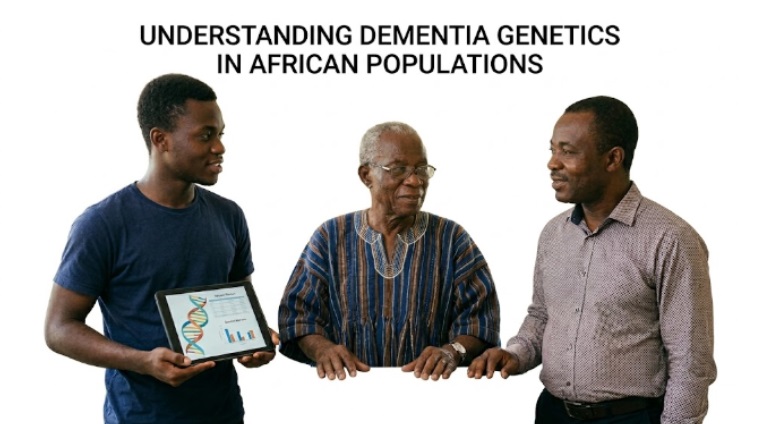
An AI generated image captioned "Understanding Dementia Genetics in Africxan Populations" and showing three African men standing side-by-side representing different generations of a family. A young adult holds a tablet displaying a DNA double helix chart probably to explain the basis of heredity to others. Click on image to enlarge.
Introduction
You watched your father forget your name. You sat with your grandmother as she wandered through the house she had lived in for decades, confused about where she was. And now, a fear has settled in you that you cannot quite shake off, as you ask yourself, "Will this happen to me too?”
That question keeps many people up at night, especially in African families where dementia is often suffered in silence and rarely talked about openly.
Some families call it "old age symptoms." Others relate it to their ancestral curse. But what is actually happening in the brain is real, it is medical, and more importantly, it is something you can understand.
In this blog, we will discuss dementia heredity from the following viewpoints:
But first let's take a look at what dementia and hereditary mean.
Dementia is not a single disease. It is an umbrella term used to describe a group of symptoms that affect memory, thinking, behaviour, and the ability to carry out everyday tasks. Dementia is a general term for loss of memory, language, problem-solving and other thinking abilities that are severe enough to interfere with daily life.
The most common type is Alzheimer's disease, which accounts for between 60 and 80 per cent of all dementia cases globally. Other types include Vascular dementia, Lewy body dementia, and Frontotemporal dementia. Each type affects the brain differently, but they all get worse over time.
In Africa, dementia is commonly dismissed as a normal part of ageing, and the lack of awareness means many patients are suffering undiagnosed. This is a serious problem, because early diagnosis can make a meaningful difference to the quality of life of both the person affected and their family.
When a condition is hereditary, it means it can be passed down from a parent to a child through genes (1). Genes are the biological instructions that our bodies inherit from both parents. They help determine things like our blood group, our height, our eye colour, and in some cases, our risk of developing certain diseases.
But hereditary does not always mean absolute certainty. There is a big difference between inheriting a gene that makes you more likely to develop a condition and inheriting a gene that will definitely cause it. That difference is important in this matter.
Some genes are like a loaded gun. If you inherit them, the disease is almost certain to follow. These are called deterministic genes (2). They are rare genes that make dementia almost certain to develop regardless of how healthy your lifestyle is.
The other genes are more like a nudge in a particular direction. They raise your chances, but they do not seal your fate. These are called risk genes, and they are far more common. Most people who carry dementia risk genes never actually develop the disease.
99 out of 100 cases of dementia are not directly caused by genes inherited from parents (3). That is a reassuring number, and it is worth sitting with for a moment. This means that if your parent or grandparent had dementia, it does not mean you are destined to have it too.
However, having a close blood relative, that is a parent, brother or sister, with dementia does increase your risk compared to someone with no family history.
Research shows that those who have a parent or sibling living with Alzheimer's are more likely to develop the disease than those who do not have a first-degree relative with Alzheimer's (2).
Family history becomes more significant in two situations. The first is when multiple close relatives have been affected across different generations. The second is when the person developed dementia at a young age, before the age of 65. This is known as early-onset dementia, and it carries a stronger hereditary link than dementia that develops in old age (4).
The two types of genes related to dementia are:
The most well-known dementia risk gene is called APOE-e4, which is like a flag in your DNA that can slightly raise your chances of developing Alzheimer's disease (5). Everyone inherits one copy of the APOE gene from each parent, and there are three versions: e2, e3, and e4.
Inheriting the e4 version raises your risk of developing Alzheimer's disease. Inheriting two copies, one from each parent, raises it further. But carrying this gene does not mean you will definitely get Alzheimer's. Many people with the APOE-e4 gene live long without ever developing dementia.
More than 100 risk genes are suspected to influence the likelihood of developing late-onset Alzheimer's, the most common form of the disease (2).
A very small number of people with dementia inherit deterministic gene mutations. These are rare genetic faults that will almost certainly cause early-onset dementia that develop before age 65. These genes include APP, PSEN1, and PSEN2, and among them the PSEN-1 gene is the most common cause of mutation in genes. Around one in 100 cases of Alzheimer’s dementia are caused by faulty deterministic genes.
People who carry them usually develop dementia at a younger age, before they are 65 (2). If people with these faulty genes have children, there is a one-in-two chance of passing the faulty gene to their child.
These mutations are linked mainly to early-onset Alzheimer's disease and a type of dementia called frontotemporal dementia.
Research has shown that the APOE-e4 gene, the most studied dementia risk gene, does not behave the same way in all populations (6). Carriers of APOE-e4 in African ancestry populations have a lower risk of developing Alzheimer's disease than carriers of European ancestry. Scientists believe this is connected to differences in how the gene expresses itself depending on the surrounding genetic ancestry.
A 2024 study found that the link between APOE-e4 and dementia was strongest among white participants and was significantly lower among blacks (7). This does not mean Africans are immune to the APOE-e4 risk gene. It means the gene carries a weaker effect in people of African ancestry compared to those of European ancestry.
However, this must be balanced against an important reality on the ground. Alzheimer's disease, vascular dementia, and HIV/AIDS-associated conditions that affect how you think, remember and process information are the most common dementia subtypes across Africa (8). Also, many of the risk factors for dementia that you can actually do something about, including high blood pressure, diabetes, low educational access, and limited healthcare, are highly prevalent across the continent.
In other words, while genetics may be slightly less of a direct concern for Africans with the APOE-e4 gene, lifestyle and environment remain critically important.
If someone close to you has dementia, here is a practical way to think about your own risk.
Regardless of what your family history looks like, there are ways you can protect your brain health.
The 2024 Lancet Commission on dementia found that nearly 1 in 2 (45 percent) of all dementia cases worldwide are potentially preventable by addressing 15 modifiable risk factors across different stages of life (9).
Here are partly what that look like in practice, especially for Africans:
You do not need to hit the gym before you can do this. You can walk to the market, dance at a celebration, work on a farm, and play with your children or grandchildren. All of these count as physical activity. Experts recommend at least 150 minutes of physical activity each week. That is just over 20 minutes a day.
High blood pressure in middle age is one of the strongest risk factors for dementia that you can actually do something about, and it is extremely common across Africa. If you have not checked your blood pressure recently, please do. The same goes for your blood sugar. Uncontrolled diabetes damages blood vessels in your brain over time. These are conditions that can be managed, but only if you know about them.
Smoking increases the risk of developing dementia, including Alzheimer's disease. And over time, excessive drinking can lead to high blood pressure and brain injuries, both of which raise your risk of having dementia. Cutting back on either is one of the most direct things you can do for your long-term brain health.
Social isolation is a genuine risk factor for cognitive decline. The good news is that African culture already understands this deeply. Staying close to family, showing up for community events, sitting with neighbours and elders, these things are not just culturally meaningful, they are medically protective.
Education in early life builds cognitive reserves. This is a protective cushion that the brain builds up over time through learning and staying mentally active. But learning does not stop at school. Reading, picking up a new skill, joining a discussion group at your church or mosque, all of this keeps the brain active and resilient as you age.
Many Africans ignore gradual hearing or vision loss because they assume it is just part of getting older. But research now confirms that untreated hearing loss and poor eyesight are both linked to a higher risk of dementia. If you have noticed changes in either, see a healthcare professional.
Traditional African diets, rich in vegetables, legumes, whole grains, fish, and local herbs, are genuinely good for the brain. The shift happening in many African cities towards processed foods, fried snacks, and sugary drinks is a growing concern for brain health as populations age. It's important to include local meals that are rich in essential nutrients that help your brain function optimally.
You need small and consistent steps taken over years and decades to add up. And if dementia runs in your family, the steps mentioned above become even more important.
You should see a doctor as soon as possible if a close family member, particularly a parent or sibling, has developed dementia before the age of 65.
Also, seek medical advice if multiple relatives across different generations have been affected. If you are noticing changes in your own memory or thinking that are beginning to affect your daily life, or if you are considering genetic testing and want proper guidance before you proceed.
A general practitioner can assess your symptoms, review your family history, and refer you to a neurologist or genetics counsellor if needed. In many African cities, specialist care is available at some private specialist hospitals, teaching hospitals and tertiary health centres. Do not wait until symptoms are severe. The earlier you seek help, the more options you have.
Dementia is something that touches many families across Africa, and if someone you love has been affected, it is completely normal to wonder whether the same thing could happen to you.
The good news is that dementia is not something that is simply passed down from parent to child like eye colour or blood group. Having a family member with dementia raises your risk, but it does not make it your destiny. Your chances of developing dementia depend on many things working together, the genes you inherited, your age, the way you live day to day, and the environment around you.
For Africans, there is an extra reason to feel encouraged. Research has shown that the most common dementia risk gene, known as APOE-e4, actually has a weaker effect in people of African ancestry compared to people of European ancestry. What this means is that for most Africans, the things you can control matter more than the genes you were born with. Keeping your blood pressure and blood sugar in check, moving your body regularly, eating well, staying close to the people you love, and continuing to learn at every stage of life, these are not small things. They are the most powerful tools you have to protect your brain for the long term.
No, you will not definitely get dementia. Having two parents with dementia does raise your risk, but it does not make it certain. In the vast majority of cases, dementia results from a combination of age, lifestyle, and multiple genes working together, not a single inherited gene passed directly from parent to child.
The only exception is a very rare group of gene faults linked to early-onset dementia, and these account for less than 1 in 100 dementia cases overall (10). If both your parents were affected, the most important step you can take is to speak with a doctor who can properly assess your personal risk and guide you on how to protect your brain health going forward.
No. Dementia does not work like some conditions that appear to skip a generation. If a close relative carries a rare gene fault that directly causes dementia, there is roughly a one in two chance of passing it to their child, not their grandchild.
However, because most dementia is not caused by a single faulty gene in the first place, the idea of it skipping generations does not really apply.
Yes, you can get tested for dementia genes. Genetic testing for dementia is available in some African countries, mainly through teaching hospitals and specialist neurology or genetics units in major cities. However, it is not yet widely accessible across the continent.
It is also important to understand that testing has its limits. A positive result does not tell you exactly if or when you will develop dementia, and a negative result does not mean your risk is zero. Before pursuing any test, speak first with a doctor or genetic counsellor who can help you understand what the results would actually mean for you and your family.
You can lower your risk, even if it runs in your family. Start by taking care of your brain and your body every day.
Focus on controlling conditions like high blood pressure, diabetes, and high cholesterol, because they increase your risk of dementia. Stay physically active, eat balanced meals, and avoid smoking and excessive alcohol.
Also, keep your brain active by reading, learning new skills, and staying socially connected. Good sleep and managing stress are just as important.
If you are concerned, speak with a doctor early. They can guide you based on your personal risk and help you make the right lifestyle choices.
1. CDC. Genomics and Your Health. Genetics Basics. [Internet]. 2024 May 15. [Cited 2026 May 3]. Available from here.
2. Alzheimer’s Association. Is Alzheimer’s Hereditary? [Internet, n.d.]. [Cited 2026 May 3]. Available from here.
3. Alzheimer’s Society. Is dementia hereditary? [Internet, n.d.]. [Cited 2026 May 3]. Available from here.
4. Alzheimer’s Society. Young-onset dementia. [Internet, n.d.]. [Cited 2026 May 3]. Available from here.
5. National Library of Medicine. MedlinePlus Genetics. APOE gene. [Internet]. Last updated 2021 March 29. [Cited 2026 May 3]. Available from here.
6. Alzheimers.gov . Study finds differences in APOE ?4 expression based on genetic ancestry. [Internet, n.d.]. [Cited 2026 May 3]. Available from here.
7. Gilmore MJ, Varga AM, Schaefer C, Banda Y, Hoffmann TJ, Glymour MM, et al. The relationship between APOE genotype and dementia varies by genetic ancestry and race/ethnicity. Alzheimer's Dement., 2024;20: e093068. Doi: 10.1002/alz.093068. Available from here.
8. Akinyemi RO, Yaria J, Ojagbemi A, Guerchet M, Okubadejo N, Njamnshi AK, et al. Dementia in Africa: Current evidence, knowledge gaps and future directions. Alzheimers Dement. 2022 Apr;18(4):790–809. doi:10.1002/alz.12432. Available from here.
9. Mostert CM, Udeh-Momoh C, Winkler AS, McLaughlin C, Eyre H, Salama M, et al. Broadening dementia risk models: building on the 2024 Lancet Commission report for a more inclusive global framework. eBioMedicine. 2025 Sep 25;120:105950. doi:10.1016/j.ebiom.2025.105950. Available from here.
10. Alzheimer’s Society. Rare types of dementia caused by genetic changes. [Internet, n.d.]. [Cited 2026 May 3]. Available from here.
Related:
Dementia: What Africans should know
15 Modifiable Risk Factors of Dementia Africans Need to Know
10 things Africans should be doing to lower dementia risk
African foods that promote brain health
Anti-Inflammatory Foods Can Lower Dementia Risk, Study
Published: June 8, 2026.
© 2026. Datelinehealth Africa Inc. All rights reserved.
Permission is given to copy, use and share content for non-commercial purposes without alterations or modifications and subject to source attribution.
DATELINEHEALTH AFRICA INC., is a digital publisher for informational and educational purposes and does not offer personal medical care and advice. If you have a medical problem needing routine or emergency attention, call your doctor or local emergency services immediately, or visit the nearest emergency room or the nearest hospital. You should consult your professional healthcare provider before starting any nutrition, diet, exercise, fitness, medical or wellness program mentioned or referenced in the DatelinehealthAfrica website. Click here for more disclaimer notice.